A Test of Questions: Types, Examples, and Practice Tools

A Test of Questions: Types, Examples, and Practice Tools
This guide breaks down every major question format, when to use it, and where to practice. You’ll find:
- A taxonomy of nine common question types with real examples
- A framework for matching question types to learning goals
- Practice tools and delivery features that actually improve results
Start here: pick your objective, choose two matching item types, then try a timed mock to see how they perform under pressure.
Key Takeaways
Matching question format to learning objective, then practicing with randomized, timed mocks that mirror real exam conditions, is what separates effective test prep from guesswork.
| Point | Details |
|---|---|
| Match format to purpose | Formative questions check learning in progress; summative questions certify mastery at the end. |
| Nine core question types | MCQ, short answer, true/false, matching, fill-in-the-blank, numeric, situational, diagram, and practical each measure something different. |
| Use backward design | Define the outcome first, then pick the item type that provides evidence for it. |
| Prioritize delivery features | Auto-grading, randomized banks, and detailed feedback separate real study tools from static quizzes. |
| Practice under real conditions | Prepadmit’s timed mocks and official past papers report noticeable score improvements among users. |
Table of Contents
- What Makes a Good Test Question?
- What Are the Main Types of Test Questions?
- How Do You Choose the Right Question Type for a Learning Objective?
- What Delivery Features Matter When Building or Choosing a Test?
- How Should You Practice With Mock Tests and Question Banks?
- Does Realistic Practice Actually Improve Test Scores?
- A Note on Building Better Question Banks
- Where to Find Realistic Practice for the Bocconi Test
- Sources
What Makes a Good Test Question?
A test question is a measurement tool. Its job is to produce evidence about what someone knows or can do, nothing more. That sounds simple, but most weak assessments fail at exactly this step: they measure recall when they meant to measure judgment, or they test writing ability when they meant to test math.
The purpose behind a question determines almost everything about its design. Formative questions check understanding while learning is still happening. They’re low-stakes, quick to answer, and meant to surface gaps before they calcify. Summative questions come at the end. They certify mastery, rank candidates, or decide admission, and they need to hold up under scrutiny.
Educators are increasingly told to ask a basic question before building any assessment: what is the purpose of this assessment, and how will it support learning or a decision? Skip that step and you get a questionnaire test that measures the wrong thing entirely.
- Formative use: daily quizzes, practice drills, self-checks with immediate feedback
- Practice tip: if you’re prepping for an exam, treat every practice session as formative until the final week, then shift to summative-style timed mocks
What Are the Main Types of Test Questions?
Nine formats cover almost everything you’ll encounter on a real exam or need to build one yourself. Each measures something different, and picking the wrong one for the job is the single most common assessment mistake.
Multiple choice (MCQ). Tests recall, application, or misconception-spotting, depending on how the distractors are written. Sample item: “Which of these best explains why ice floats on water? A) Ice is less dense than liquid water B) Ice contains trapped air C) Water molecules shrink when frozen D) Gravity affects solids less.” The correct answer is A. Strength: fast to grade, scales to thousands of test-takers. Limit: guessing inflates scores unless distractors are genuinely plausible.
Short answer / essay. Tests explanation and synthesis. Sample item: “Explain why the Federal Reserve raises interest rates during inflation.” A strong response covers the reduced-borrowing mechanism and its effect on demand. Providing a scoring rubric and a suggested word count before the exam helps students calibrate their responses instead of guessing at expected depth.
True/false. Tests quick fact recognition. Sample item: “The mitochondria is the site of protein synthesis.”
Matching. Tests associative recall across a set. Sample item: match five countries to their capital cities. Efficient for vocabulary or terminology, but clumsy for testing reasoning.
Fill-in-the-blank. Tests unambiguous, precise recall. Sample item: “The powerhouse of the cell is the ______.” Works well when there’s exactly one correct term, poorly when multiple phrasings could be right.
Numeric response. Tests calculation accuracy without multiple-choice guessing. What is the new price?" ($50.) No distractors to lean on, so partial credit rubrics matter.
Situational judgment. Tests applied decision-making. Sample item: “A coworker takes credit for your idea in a meeting. What is the most appropriate response?” These items work best with ranked or best/worst response formats rather than a single correct answer.
Diagram / labeling. Tests spatial or structural understanding. Sample item: label the four chambers of the heart on a blank diagram. Strong for anatomy, engineering, and geography; weak for anything abstract.
Practical / performance. Tests execution under real conditions, like a coding exercise or a lab procedure. The most realistic format and the hardest to grade at scale.
| Question Type | Best For | Main Limit |
|---|---|---|
| Multiple choice | Recall and application at scale | Guessing inflates scores with weak distractors |
| Short answer/essay | Explanation and synthesis | Slow to grade, needs a rubric |
| True/false | Fast fact checks | High guess rate |
| Matching | Terminology and associations | Poor fit for reasoning |
| Fill-in-the-blank | Precise recall | Ambiguous phrasing causes false negatives |
| Numeric response | Calculation accuracy | No partial-credit structure without a rubric |
| Situational judgment | Applied decision-making | Subjective scoring |
| Diagram/labeling | Spatial or structural knowledge | Narrow subject fit |
| Practical/performance | Real-world execution | Expensive and slow to administer |
Pro Tip: Run every multiple-choice item through the cover-up test: hide the answer options and see if a knowledgeable reader can answer from the stem alone. If they can’t, the stem is unfocused and needs a rewrite. When you can’t come up with four plausible distractors, use three strong ones instead of a throwaway fourth option.
How Do You Choose the Right Question Type for a Learning Objective?
Identify the exact outcome you need evidence for before you write a single question. Choosing a format first, then bending the content to fit it, is how you end up with a fill-in-the-blank item that was supposed to test reasoning.
- Define the outcome. What should the learner be able to do, specifically?
- Pick the cognitive level. Recall, application, or synthesis each demand different formats.
- Choose the item type. Match the level to a format from the taxonomy above.
- Set the scoring rubric. Decide what a full-credit answer looks like before you administer the test.
This mirrors backward design: outcomes first, assessment second, instruction last.
A quick mapping example: if the objective is “identify logical fallacies in an argument,” multiple choice with well-built distractors and short-answer explanation both work, since one checks recognition and the other checks reasoning. If the objective is “perform under timed pressure,” a full-length numeric or situational judgment mock beats either.
What Delivery Features Matter When Building or Choosing a Test?
Question banks and randomization protect test integrity while giving learners fresh material every session. A bank of 200 items pulling a randomized 40-question subset means no two attempts look identical, which cuts down on memorized answers rather than real understanding.

The USCIS civics practice pool is a useful real-world model: 128 official questions feed a randomized subset for the live interview, with a clear pass threshold of 12 correct answers out of 20. That structure, a fixed bank plus randomized delivery plus a defined passing score, is what separates a serious assessment quiz from a casual questionnaire test.
When evaluating a test builder or LMS, prioritize:
- Auto-grading for objective formats (MCQ, true/false, matching, fill-in-the-blank)
- Detailed feedback and explanations attached to every answer, not just a score
- Timed simulation mode that mirrors real exam conditions
- Item analysis reports showing which questions were missed most often
These features show up across quiz platforms, learning management systems, and dedicated test-bank tools, and standardized admission tests increasingly rely on the same architecture.
Pro Tip: If a platform doesn’t show you which specific questions you missed and why, it’s a scorekeeper, not a study tool. Corrections matter more than the score itself.
How Should You Practice With Mock Tests and Question Banks?
Spaced practice beats cramming for almost every subject, and mixing question types in a single session forces the kind of flexible recall a real exam demands. Three tactics do most of the work:
- Targeted drills on your weakest question type, not your strongest
- Mixed-practice sessions that combine formats instead of repeating one
- Full-length timed mocks at least once a week as the exam approaches
For review, keep an error log instead of just re-taking the same sample test questions. Read the worked solution for every miss, not just the correct letter, and grade essay or short-answer responses against a rubric rather than a gut feeling.
A simple four-week rhythm: weeks one and two focus on spaced review of weak areas, week three adds one timed mock, and week four alternates mocks with error-log review until test day.
Does Realistic Practice Actually Improve Test Scores?
Practice that mirrors real exam timing and format produces more reliable preparation than untimed, piecemeal review. Randomized banks and full-length simulations remove the surprise factor, which is often what costs points on the actual day rather than a lack of knowledge.
Interfaces that accept alternative answer phrasing and give immediate feedback help learners reach passing thresholds faster, a pattern seen clearly in citizenship practice tools that use randomized official question pools instead of static lists.
Prepadmit reports that many students experience noticeable score improvements among those who use its full-length mock exams built on official past papers. Results vary by student and study consistency, but the underlying principle holds across formats: the closer practice mirrors the real test, the less that test feels unfamiliar.
A Note on Building Better Question Banks
Backward design sounds obvious until you sit down to write items. Most people default to whatever format is easiest to write, not whatever format actually proves the skill. The fix isn’t more questions, it’s fewer, better-targeted ones.
If you’re prepping for an exam, spend fifteen minutes before your next session identifying exactly which cognitive level you’re weak on before you touch a single practice question.
Where to Find Realistic Practice for the Bocconi Test
Reading about question types only gets you so far. At some point you need a full-length mock under real time pressure, with official material and answers that explain themselves.
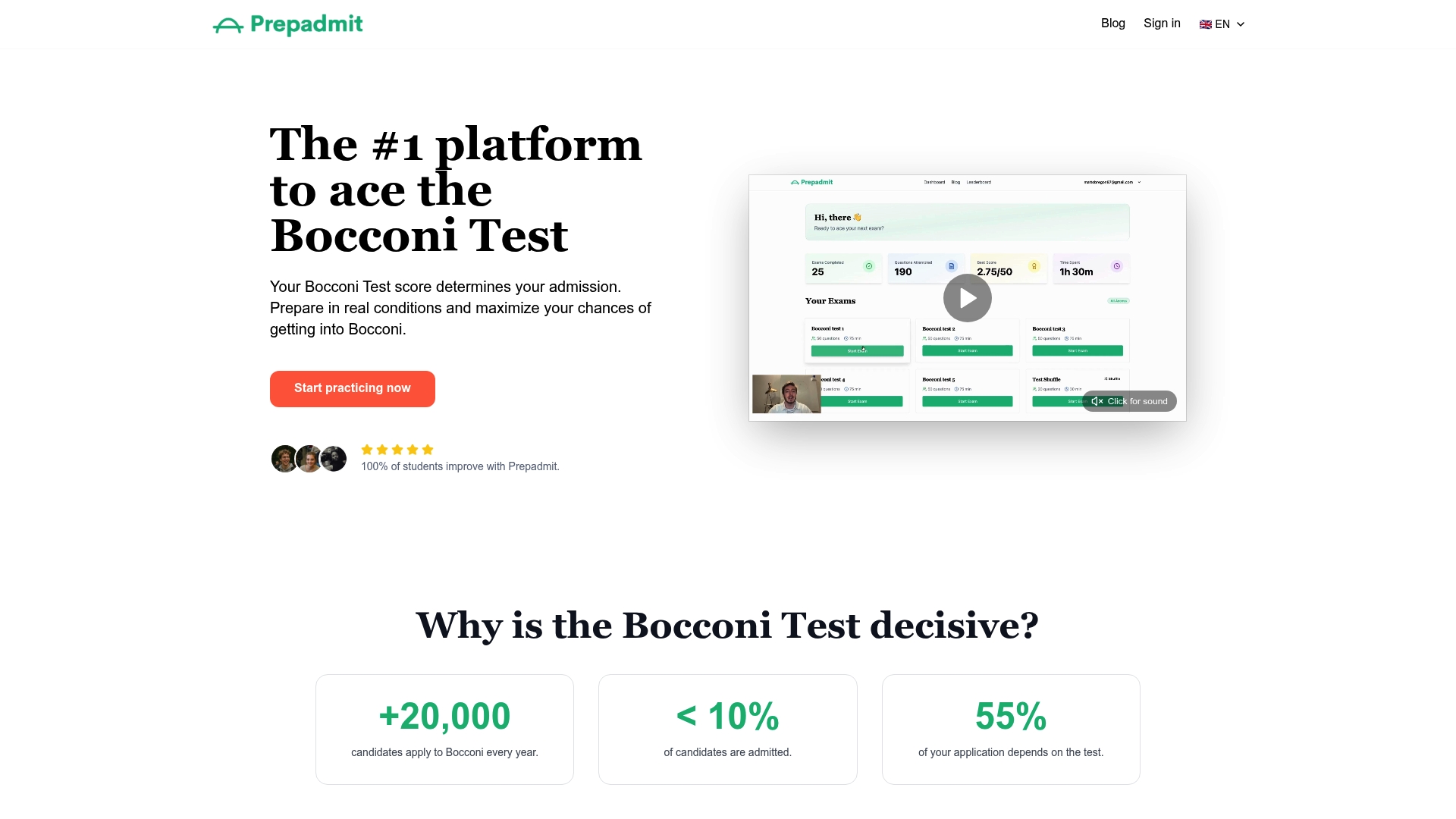
Prepadmit builds its practice platform around exactly that gap. Instead of generic quiz banks, it runs timed simulations using official past papers from the actual Bocconi Test, at a fraction of what private coaching costs.
- Full-length mock exams that mirror real exam timing and structure
- Detailed answer corrections for every missed question, not just a score
- Progress tracking and peer ranking so you know exactly where you stand
- Skill-specific drill modes for targeted weak-point practice
Start with a sample mock at Prepadmit to see how your current prep holds up against real exam conditions, or check the leaderboard to see how you rank against other candidates before test day.
Sources
- Designing Assessment Questions | Poorvu Center for Teaching and Learning
- 8 questions teachers should ask when giving assessments
- Full U.S. Citizenship Practice Quiz 2026 | All 128 USCIS Questions
Recommended
Related articles
Ready to ace your admission test?
Discover PrepAdmit, the platform that helps you succeed at top university admission tests.
Discover PrepAdmit