Free Sample Test Questions: Where to Find and Use Them

Free Sample Test Questions: Where to Find and Use Them
Official test makers and state practice portals are the best place to get free sample test questions. Start with a short training set to learn the interface, move to a half-length practice test to spot weak areas, then run a full-length timed simulation close to your test date.
The most trusted sources in the US are:
- ACT — free section practice and full-length tests at act.org
- College Board — SAT and PSAT sample items and full practice at collegeboard.org
- ETS — GRE and TOEFL practice questions and official prep at ets.org
- USMLE / NBME — clinical block samples and self-assessments at nbme.org and usmle.org
- LSAC — LSAT sample questions and free prep tools at lsac.org
Start with one official source for your exam. Take the shortest available set first. Record your score before you close the tab.
Key Takeaways
Free sample test questions are most effective when you use them in sequence: short diagnostic first, targeted drills next, and full-length timed simulation in the final weeks before your exam.
| Point | Details |
|---|---|
| Start with official sources | ACT, College Board, ETS, LSAC, and NBME publish free, format-accurate practice items. |
| Match format to study stage | Training tests for interface practice; practice tests (~30 items) for diagnostics; full-length simulations for endurance. |
| Save results manually | Many free platforms, including ACT’s, do not autosave; record your raw score immediately after finishing. |
| Prioritize rationales over bare keys | Paid practice tests like HiSET’s include full answer rationales; free versions often provide only a basic key. |
| Prepadmit for Bocconi prep | Prepadmit offers official-paper simulations, detailed corrections, and progress tracking for Bocconi Test candidates. |
Table of Contents
- Where can you find free sample test questions?
- What types of practice materials will you encounter?
- What format options and accessibility supports should you look for?
- What do official practice tests typically include?
- How should you use sample questions to actually improve?
- How do you evaluate answer explanations and scoring guides?
- Run this checklist before every practice test
- Why the diagnose-then-simulate workflow is the one that works
- Prepadmit offers structured Bocconi Test simulations with detailed feedback
- Sources
Where can you find free sample test questions?
Official test-maker websites are the most reliable place to start. Each major exam publisher maintains a dedicated practice hub with at least some free material.
ACT publishes free section practice and full-length tests organized by subject. One practical note: answers on the free ACT pages are not saved if you refresh or close the browser, so write down your raw score immediately after finishing.
College Board (SAT/PSAT) offers released full-length tests with answer keys and scoring guides through its official prep resources. ETS provides free GRE sample questions by section and TOEFL practice sets. LSAC hosts free LSAT sample items and a free prep platform called LSAT Prep Plus. For medical licensing, NBME and the USMLE program publish free sample clinical block questions that mirror the real exam’s format and timing.
State education portals are an underused resource. Ohio’s Department of Education, for example, publishes sample items, practice tests, and scoring guides with step-by-step guest access instructions so you can practice without creating an account. SmarterBalanced, which serves multiple states, offers training tests and full practice tests with scoring guides and supplemental resources.
Third-party aggregator sites can be useful for volume practice, but treat them as secondary. Official sources control item quality, format accuracy, and scoring alignment. A third-party site may use outdated question formats or incorrect answer keys.
When to prefer official over third-party: always choose official sources for format familiarization, for scoring calibration, and whenever your exam has recently changed its structure.
Pro Tip: Before using any third-party site, check the publication date of its questions. If the exam was redesigned in the last two years and the site hasn’t updated its content, the format may not match what you’ll see on test day.
What types of practice materials will you encounter?
Practice materials come in four distinct formats, and each one serves a different study purpose.
- Training tests are the shortest format, typically 5–10 minutes and around six items. Their job is software familiarization, not content review. Use them on day one to learn the interface, navigation, and timer before you touch any real content.
- Topic drills and item banks let you target a single subject area or question type. Use these after your diagnostic to work on specific weak spots.
- Half-length practice tests cover roughly 30 items or half of an official subtest. They’re the right tool for a mid-study content check when you don’t have time for a full simulation.
- Full-length timed simulations match the real exam’s length and pacing. Use these in the final weeks of your prep to build endurance and test your timing strategy under realistic conditions.
According to SmarterBalanced’s practice resources, training tests often contain about six questions while practice tests typically include around 30 items, with full-length simulations designed to match official test length. That progression from short to long isn’t arbitrary. Each format builds on the last.
Pro Tip: Don’t skip the training test even if you feel tech-savvy. The first time you encounter a drag-and-drop item or an embedded calculator under timed conditions should not be during the real exam.

For a broader look at how standardized university admission tests are structured across different programs, the format differences between exams matter as much as the content differences.
What format options and accessibility supports should you look for?
Not all practice platforms offer the same technical features, and the gap matters more than most test-takers expect.
- Timed vs. untimed modes: Use untimed mode when you’re learning new material or reviewing rationales. Switch to timed mode as soon as you’re doing any simulation work. Practicing untimed exclusively is one of the most common prep mistakes.
- Screen reader and text-to-speech support: Official platforms from College Board, ETS, and ACT support screen readers and, in some cases, text-to-speech. If you use these accommodations on the real exam, practice with them active so the experience is familiar.
- Built-in tools: Many official practice tests include digital calculators, formula sheets, and annotation tools. Confirm which tools are permitted for your specific exam and use only those during practice.
- PDF and printable formats: Some state portals and official sources offer downloadable PDFs of released items. These are useful for offline review or for working through problems on paper, but they won’t replicate the digital interface. Use them for content review, not simulation.
Practice tests reduce test anxiety by normalizing the interface, timing constraints, and accessibility features. They’re as valuable for procedural readiness as for content review. If you’re preparing for a high-stakes exam, the benefits of timed exam simulation extend well beyond content mastery.
What do official practice tests typically include?
Official practice materials vary by exam, but most share a common structure.
Section names and composition follow the real exam’s format. ACT practice covers English, Math, Reading, and Science. HiSET practice tests mirror the five HiSET subtests. USMLE/NBME sample materials use clinical blocks identical in structure to the real Step exams. The NextGen UBE from NCBE introduces a more complex format: standalone multiple-choice questions, integrated question sets, and performance tasks including writing and research components, each with distinct time allocations.
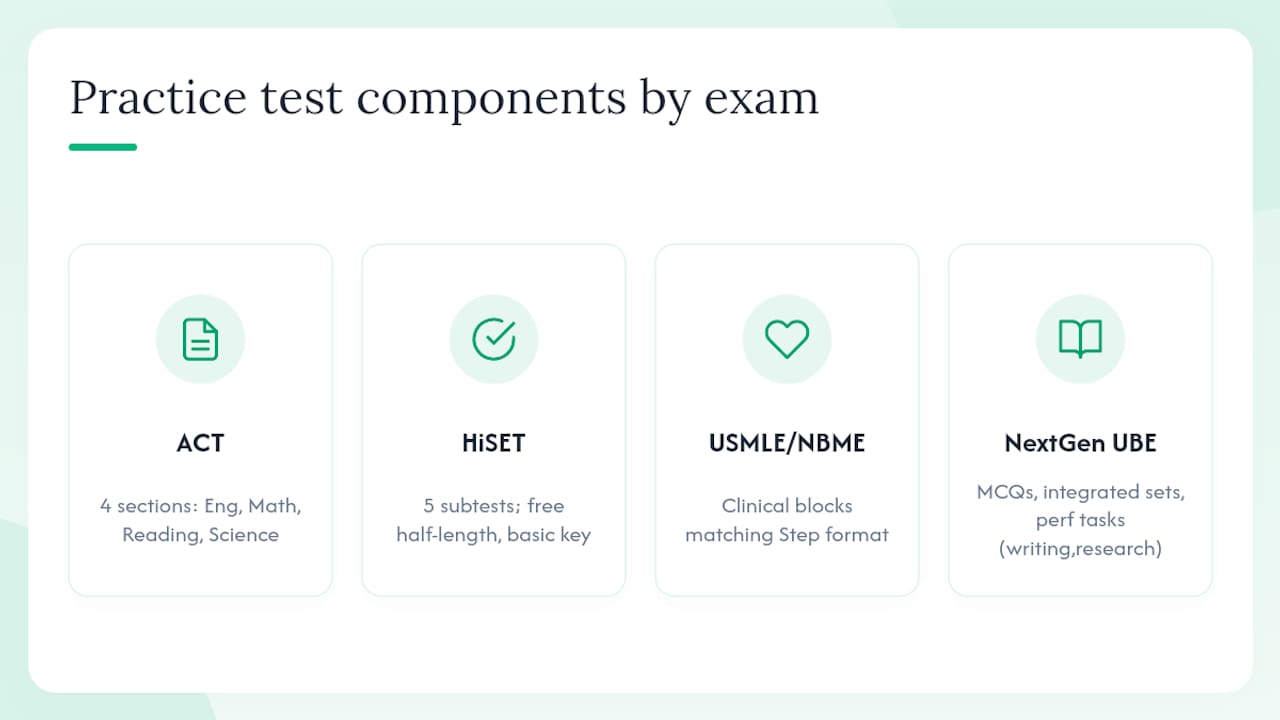
Typical question counts follow the pattern established by SmarterBalanced: training tests at roughly six items, practice tests at around 30 items, and full-length simulations matching real exam length.
Scoring guides and answer rationales are where free and paid materials diverge most sharply. HiSET’s free practice tests are half the length of an official subtest and come with a basic answer key. Paid HiSET practice tests include detailed rationales explaining why each answer is correct or incorrect. Ohio’s state portal includes scoring guides and item release resources alongside its practice tests, accessible to guest users. SmarterBalanced similarly provides scoring guides and supplemental resources including calculator policies.
Some programs treat official practice tests as more than optional prep. Under certain state and program policies, passing an Official Practice Test is required before you can register for the real exam.
How should you use sample questions to actually improve?
The most effective workflow moves through four stages: diagnose, drill, simulate, review.
- Diagnose first. Take a short set of exam practice questions with no preparation. Don’t study beforehand. The goal is a baseline, not a good score. Note which sections and question types gave you the most trouble.
- Drill weak areas. Use topic-specific item banks to work on the sections where your diagnostic showed gaps. Keep sessions focused and short, 20–30 minutes per topic.
- Run half-length timed checks. After two to three weeks of drilling, take a half-length timed practice test. Compare results to your diagnostic. If a section hasn’t improved, adjust your drill focus.
- Simulate under real conditions. In the final two to four weeks before your exam, run at least one full-length timed simulation. Treat it exactly like the real test: same time of day, same device, no interruptions.
Track every session. Log which question types you missed, not just your total score. Patterns in your errors tell you more than a single number. If you keep missing inference questions in Reading, that’s a drill target, not a general “study more” signal.
Timed practice tests are particularly effective for building the endurance and pacing judgment that content review alone can’t develop. For a structured approach to mock exam scheduling, spacing full-length simulations across your prep timeline produces better results than clustering them at the end.

After every session, use the answer rationales. Don’t just check whether you got the answer right. Read the explanation for every question you missed and for any you guessed correctly. Correct answers reached by wrong reasoning will cost you on test day.
Pro Tip: Schedule your first full-length simulation at least three weeks before your exam date. That gives you time to act on what it reveals.
How do you evaluate answer explanations and scoring guides?
A bare answer key tells you what you got wrong. A good rationale tells you why, and that difference is what drives actual score improvement.
- Full rationales walk through the reasoning step by step, explain why the correct answer is right, and explain why each distractor is wrong. These are the most useful explanations available.
- Scoring rubrics for constructed responses show you exactly what scorers look for. Ohio’s state portal includes rubric guidance for open-response items alongside its released practice tests.
- Red flags to watch for: an answer key with no explanation, conflicting explanations across different prep sources for the same question, or a scoring guide that uses vague language like “student demonstrates understanding” without specifying what that looks like.
Free practice materials often include only basic keys. Paid versions, like HiSET’s paid practice tests, typically add the full rationale layer. When you’re working with a free source that only gives you the answer, use the rationale from an official scoring guide if one is published separately.
Pro Tip: For subjective sections like essays or performance tasks, find a peer, teacher, or mentor to score your response against the official rubric. Self-scoring written work is notoriously unreliable.
The quality of expert-designed prep materials shows up most clearly in the explanation layer. Weak explanations are the fastest way to identify a low-quality practice source.
Run this checklist before every practice test
A realistic practice run requires more than opening a browser tab.
- Check your device and browser. Use the same device you plan to test on. Confirm the browser is compatible with the practice platform. Official sites often list supported browsers on their help pages.
- Confirm permitted tools. Check the calculator policy for your exam. Know whether scratch paper is allowed and whether the platform provides a digital notepad. Use only what the real exam permits.
- Set up your environment. Disable all notifications. Close every other tab. Tell anyone nearby that you’re unavailable for the duration of the test.
- Log in or access as a guest before the clock starts. State portals like Ohio’s require a few steps to access practice as a guest. Complete those steps before your scheduled start time.
- Save your results immediately. ACT’s free practice pages do not autosave. If you refresh or close the tab, your results are gone. Write down your raw score and any section breakdowns the moment you finish.
Pro Tip: Take a screenshot of your results screen before closing the tab. It takes two seconds and prevents the frustration of losing data you can’t recover.
Why the diagnose-then-simulate workflow is the one that works
Most test-takers do the same thing: they find a set of mock exam questions, work through them casually, check the answers, and move on. That approach feels productive but rarely moves the needle.
The workflow that actually works treats sample questions as data. Your first short set is a measurement tool. Your drills are targeted corrections. Your full-length simulation is a stress test of everything you’ve built. Each stage has a job, and skipping any one of them leaves a gap.
The part most people skip is the review. Finishing a practice test and not reading the rationales is like going to the gym and skipping the workout. The questions themselves aren’t the training. The analysis afterward is.
If you’re unsure where to start, pick the official practice hub for your exam, take the shortest available set, and write down three question types you missed. That list is your first week’s study plan.
Prepadmit offers structured Bocconi Test simulations with detailed feedback
Free sample questions from official sources are the right starting point for any exam. For students preparing specifically for the Bocconi Test, the gap between free samples and structured preparation is significant.
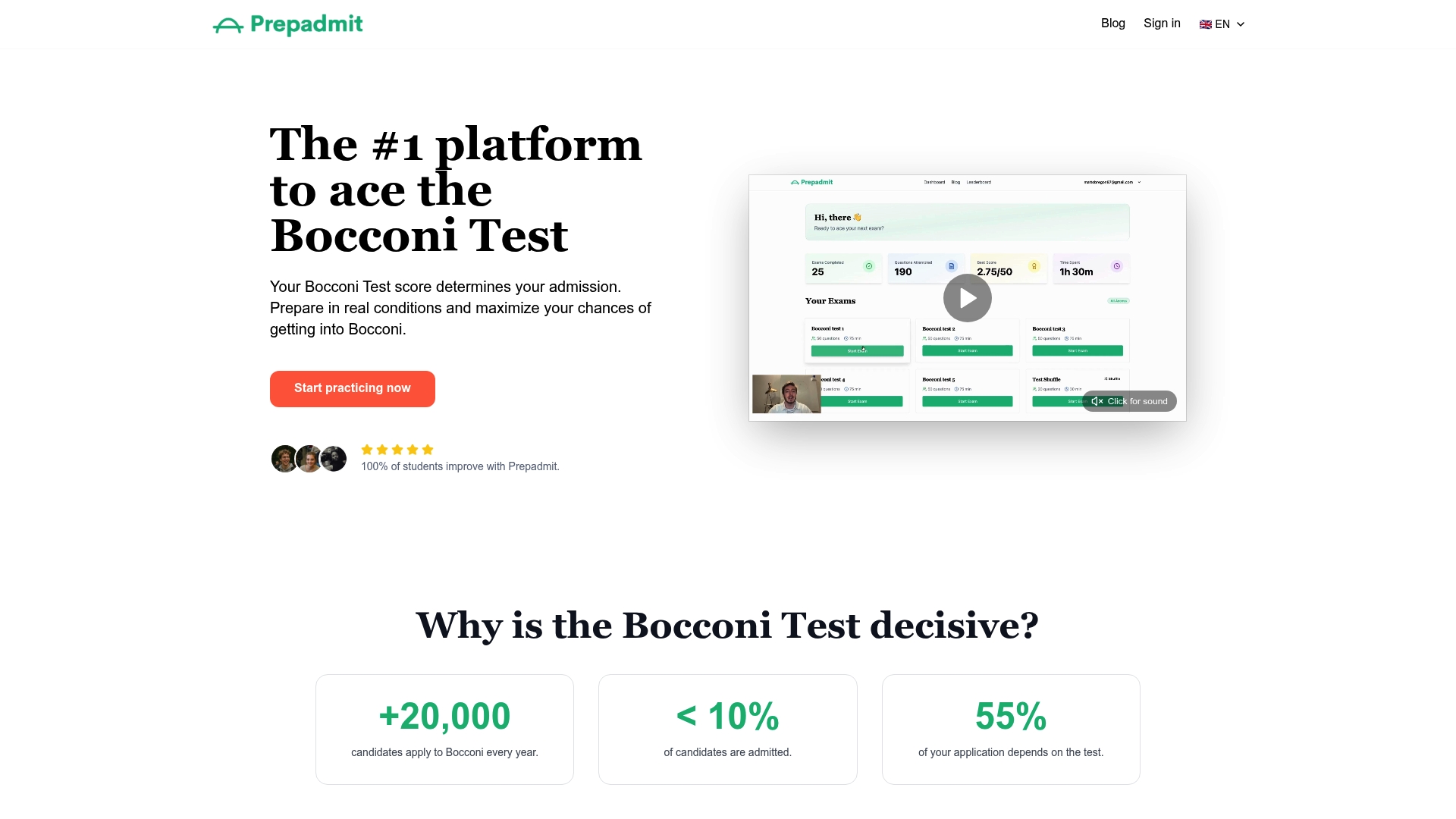
Prepadmit was built for exactly this situation. The platform offers full exam simulations using official past papers, on-demand adaptive practice tests, and detailed answer corrections that explain not just what you got wrong but why. Progress tracking and peer ranking show you where you stand relative to other applicants.
If you’ve worked through free samples and want a structured path to Bocconi admission, check your standing on the Prepadmit leaderboard and see where your current score puts you against the field.
Sources
- Practice Tests and Sample Questions - SmarterBalanced
- Online ACT Practice Tests | Sample Questions | ACT
- HiSET Practice Tests | Free, Paid & Official Test Prep Resources
- Sample test items and practice tests | Ohio Department of Education and Workforce
Recommended
Related articles
Ready to ace your admission test?
Discover PrepAdmit, the platform that helps you succeed at top university admission tests.
Discover PrepAdmit