How to Pass the Bocconi Test With a Focused Study Plan

How to Pass the Bocconi Test With a Focused Study Plan
Passing the Bocconi Test comes down to three things: targeted practice, simulations that match the real exam, and a technical setup that won’t cost you a valid score. Students who treat this like a content problem alone tend to underperform students who also drill the format and the proctoring rules. If you have an hour right now, spend it on three moves.
- Read the official scoring rules so you know exactly when guessing helps and when it hurts you.
- Run one full 50-question mock, timed at 75 minutes, under real exam conditions, no pausing, no notes.
- Test your room, camera, and device with a dry run so a technical glitch never invalidates a score you earned.
Prepadmit gives you the official-format simulations to do all three, and this guide walks through the rest of the plan.
Key Takeaways
Passing the Bocconi Test depends on pairing exam-accurate simulations with strict technical preparation, since either gap alone can undo months of content study.
| Point | Details |
|---|---|
| Know the scoring math | A wrong answer costs 0.2 points typically, or 0.33 on some critical-thinking items, so guess only above your break-even odds. |
| Protect the 17-point threshold | A total score below 17 is invalid, so pacing and guess discipline matter as much as raw knowledge. |
| Match your plan to your timeline | Use daily drills and two mocks for a one-month plan, or weekly mock cycles for three to six months of runway. |
| Never skip the technical dry run | Test your camera, mic, lighting, and room 48 to 72 hours before the real exam to avoid invalidation. |
| Practice with Prepadmit | Run official-format timed mocks, correct every error, and track progress on the leaderboard to build toward a reported 34% average score gain. |
Table of Contents
- What does the Bocconi Test actually measure?
- How does Bocconi Test scoring actually work?
- What is the best study plan for the time you have left?
- Why does the technical setup matter as much as content knowledge?
- Which drills and pacing tactics raise your raw score fastest?
- How do you use Prepadmit to simulate the real Bocconi Test?
- How should you approach each section of the test?
- What mistakes cost students the most points?
- What resources actually help you prepare?
- What do typical Bocconi Test questions look like?
- How should you prepare on test day itself?
- How can Prepadmit help you prepare for the Bocconi Test?
- Sources
What does the Bocconi Test actually measure?
The Test Online Bocconi is 50 multiple-choice questions in 75 minutes, split across four areas: math, text comprehension, numerical reasoning, and critical thinking. That’s roughly 90 seconds per question if you want to leave a buffer for review, though some questions demand far more time than others.
The format that trips students up isn’t the content. It’s the navigation. Once you submit an answer and move forward, you cannot go back to fix it. That single rule changes your entire strategy, because a wasted 90 seconds on a question you’ll never revisit is gone for good.
- Sequential navigation means no backtracking, so pacing decisions are final the moment you make them.
- Math and numerical reasoning tend to reward speed drills more than memorization.
- Text comprehension and critical thinking reward reading stamina over raw formula recall.
- Bocconi publishes an official simulation, and running it at least once before your test date should be non-negotiable.
Law-track applicants sit a broadly similar structure, though weighting can shift slightly toward reasoning-heavy items. Confirm the current-year specifics on the university’s own admissions page before you finalize your prep priorities.
How does Bocconi Test scoring actually work?
Every correct answer earns 1 point. A blank earns 0. A wrong answer typically costs you 0.2 points, though some critical-thinking questions carry a steeper 0.33 penalty. That asymmetry is the whole game.
Score threshold: a total below 17 points is not valid for admission, regardless of how the rest of your application looks. That number should live in your head the entire time you practice, not just on test day.
Here’s the guessing math in plain terms. With a standard -0.2 penalty, you break even on a guess once you can eliminate one of five answer choices, because your odds of being right exceed the point where the penalty outweighs the reward. With a -0.33 penalty, you need better odds, closer to eliminating two of five choices, before a guess is worth the risk.
- Never leave a question blank if you can eliminate even one wrong choice under standard penalty rules.
- Be more conservative on critical-thinking items carrying the steeper penalty.
- Track your real accuracy rate during practice mocks so your guessing threshold is based on your actual performance, not a guess about your performance.
What is the best study plan for the time you have left?
Your plan should match your calendar, not a generic template. TestBuddy’s preparation guidance breaks this into three realistic windows, and each one demands a different rhythm.
- One month. Cover every official area at least once in the first two weeks. Run daily 20 to 30 minute drills targeting your weakest area. Take one full timed mock in week one to set a baseline, then a second full mock in your final week as dress rehearsal. Skip anything that isn’t directly tested.
- Three months. Spend the first three to four weeks on foundational review, math fundamentals, reading speed, logic patterns, then shift into a weekly cycle: one full mock every seven to ten days, paired with focused error analysis and drills on whatever the mock exposed as weak. This rhythm lines up with what Prepadmit’s step-by-step guide recommends for students who aren’t cramming.
- Six months. Build the habit early. Rotate through content areas with progressively harder question sets, and add simulated stress tests every two to three weeks, full mocks under real timing and real proctoring conditions, not casual practice. The extra runway lets you fix conceptual gaps instead of just pattern-matching question types.
Across all three timelines, one habit matters more than the calendar: repetition under realistic conditions. A practical routine worth adopting is one diagnostic mock to set your baseline, two weekly drills on your weakest area, one full timed mock every seven to ten days, and a technical dry run 48 to 72 hours before your actual test.
Pro Tip: Log every mock score in a simple spreadsheet with date, area breakdown, and time spent per question. After three or four mocks, patterns in your mistakes become obvious in a way they never are after just one attempt.
Why does the technical setup matter as much as content knowledge?
A perfect score means nothing if your test gets invalidated over a webcam angle. The official Bocconi instructions lay out specific proctoring requirements covering your room, your camera framing, your microphone, and what materials you’re allowed to have nearby.
Invalidation often has nothing to do with your knowledge of math or logic. Background noise, a camera angle that doesn’t show your hands or face clearly, or an unauthorized device on your desk can disqualify a test regardless of the score you actually earned.
Common causes worth mitigating in advance:
- A phone visible on the desk, even if you never touch it.
- A second monitor or device the system flags as unauthorized.
- Household noise, a doorbell, a sibling, a dog, that the microphone picks up mid-test.
- Poor lighting that obscures your face from the camera’s view.
Run this dry run at the exact time of day your real test is scheduled:
- Check your device meets the technical requirements and your internet connection is stable.
- Position your camera so your face and hands are visible and well lit.
- Clear your desk of every item not explicitly permitted.
- Test your microphone in a silent room, then confirm no one will interrupt you during the real window.
- Log into your test account ahead of time to confirm your session and credentials are ready.
Pro Tip: Do this dry run 48 to 72 hours before test day, not the night before. That buffer gives you time to fix a lighting problem or a shaky connection without any pressure.
Which drills and pacing tactics raise your raw score fastest?
Generic studying wastes time. Targeted drills matched to each test area move your score faster than reviewing everything evenly.
- Math: timed problem sets on functions, geometry, and probability, 15 to 20 minutes, no calculator unless the real test allows one.
- Text comprehension: active reading practice where you predict the next paragraph before reading it, then check your inference against the actual text.
- Numerical reasoning: pattern-recognition drills using data tables and graphs, since these questions reward speed more than depth. A dedicated numerical reasoning practice tool can sharpen this specific skill outside your regular mock sessions.
- Critical thinking: argument-structure exercises, identifying assumptions and flaws, borrowed techniques from logical reasoning strategies used in other high-stakes reasoning exams translate well here.
For pacing, use a first-pass, flag-and-move, final-review approach adapted to sequential navigation. Since you cannot return to earlier questions, “flagging” really means deciding fast, answering with your best guess, and moving on rather than dwelling.
Pro Tip: After every mock, write down the exact question types you missed, not just the topic. “Missed a probability question” is vague. “Missed conditional probability with three variables” tells you exactly what to drill next.
How do you use Prepadmit to simulate the real Bocconi Test?
Everything above works better when your practice mirrors the actual exam, question format, timing, and pressure included. That’s the specific gap Prepadmit was built to close.
- Start with a full timed mock using Prepadmit’s official past papers as your diagnostic. This tells you your real baseline before you plan anything else.
- Repeat weekly mocks on demand, then use the detailed answer corrections to run the error-analysis routine described earlier, question by question, pattern by pattern.
- Track your progress and compare your standing against other students through the leaderboard and dashboard, which turns abstract improvement into a visible number.
The platform was built by a team with backgrounds at HEC and Bocconi, and Prepadmit reports an average score improvement of 34% among students who use it consistently, backed by a money-back guarantee.
| Point | Details |
|---|---|
| Diagnostic mock first | Run one full timed mock before building your study plan to know your real starting point. |
| Weekly repetition | Repeat mocks on a schedule matched to your timeline, then correct errors immediately after each one. |
| Prepadmit for realistic practice | Use Prepadmit’s official-format mocks and corrections to simulate the exam and track a reported 34% average score gain. |
How should you approach each section of the test?
Math and logic questions reward speed over elegance. You won’t have time to solve every problem the long way, so learn to recognize shortcuts, factoring patterns, quick geometry checks, elimination by estimation, before test day.
Reading comprehension passages are dense and time-boxed. Read the question before the passage when possible, so you know what to hunt for instead of absorbing every detail. Practice summarizing a paragraph in one sentence as you read; that habit speeds up inference questions dramatically.

Verbal reasoning items test how well you spot relationships between words and ideas, analogies, categorization, logical consistency. These questions often have a trick answer that sounds right but breaks a subtle rule. Slow down by five seconds on any answer that feels “too easy.”
General knowledge sections vary in weight but reward broad reading habits over cramming. Following quality news coverage of economics, current events, and business for a few months does more than memorizing facts the week before.
Across every section, the same discipline applies: practice under time pressure, not just for accuracy. A student who answers 90% of practice questions correctly with unlimited time but only finishes 60% of a timed section has a pacing problem, not a knowledge problem, and no amount of extra studying fixes that without timed repetition.
What mistakes cost students the most points?
The single most expensive mistake is treating the test like a knowledge exam instead of a timed-performance exam. Students who study content exhaustively but never simulate the clock consistently underperform their practice scores on the real day.
Second is ignoring the sequential navigation rule until test day. If you’ve never practiced under a format where you can’t go back, you’ll freeze the first time you realize a question is gone for good. Practice this constraint specifically, not just the content.
Third is guessing inconsistently. Some students leave every uncertain question blank out of fear of the penalty, others guess on everything. Neither is optimal. Apply the elimination threshold from the scoring section consistently, every time, not based on how confident you feel that day.
Fourth is skipping the technical dry run entirely. Students who ace every practice mock sometimes lose their valid score to a framing issue or background noise that a five-minute check would have caught.
Fifth is misjudging session timing. The test allows multiple attempts across sessions, with your best score counted, but that only helps if you plan your retake window before deadlines close, not after a disappointing first attempt.
What resources actually help you prepare?
There’s no single official manual for the Bocconi Test, so your preparation needs to follow the areas Bocconi itself declares and lean on official-format practice wherever it exists.
Start with the official simulation Bocconi provides; it’s the closest thing to ground truth on question style and difficulty. From there, general high school math and reading comprehension textbooks cover the foundational content, while step-by-step preparation guides and targeted math drill routines help translate that foundation into exam-specific skill.
Student forums can surface useful anecdotal detail, what the interface feels like, common last-minute worries, but treat them as supplementary color, not a substitute for structured practice. Forum advice varies wildly in quality and sometimes repeats outdated information about test format.
The resource that matters most isn’t any single book. It’s consistent access to full-length, official-format mock tests with detailed corrections, since that’s what actually builds the pacing instinct and error-recognition skill the real test demands.
What do typical Bocconi Test questions look like?
A numerical reasoning question might present a data table showing company revenue across five years and ask you to calculate a percentage change or identify a trend, testing speed of calculation as much as accuracy.
A critical-thinking question typically presents a short argument, then asks which statement, if true, would most weaken or strengthen the conclusion. The trap answer usually restates a premise rather than actually engaging with the logical gap.
A text comprehension question might ask you to identify the author’s tone or the primary purpose of a paragraph, not just its literal content. These questions punish literal-minded reading and reward inference.
A math question could ask you to solve for a variable in a function under time pressure, where the fastest path is recognizing a shortcut, like factoring or substitution, rather than working through the algebra from scratch. Practicing these patterns repeatedly under timed mock conditions is what turns recognition into speed.
How should you prepare on test day itself?
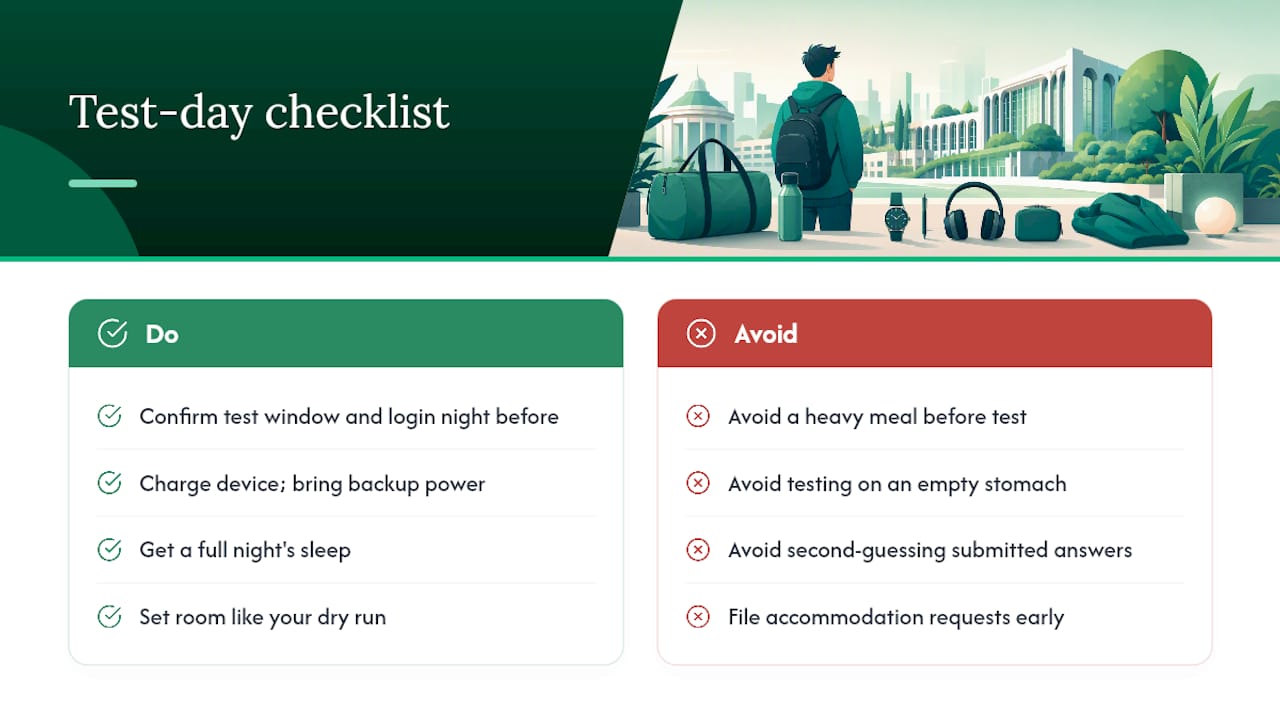
Confirm your test window, device, and login credentials the night before, not the morning of. Charge your device fully and have a backup power source ready in case your session runs long.
Eat something light beforehand; a heavy meal or an empty stomach both work against sustained focus for 75 minutes. Get a full night of sleep rather than cramming until 2 a.m., since fatigue directly hurts pacing and reading accuracy far more than one extra hour of review helps.
Set up your room exactly the way your dry run confirmed works: same lighting, same camera angle, same silence. Familiarity here reduces anxiety, because nothing about your physical environment is a surprise.
Mentally, treat the first few questions as a chance to settle into rhythm rather than a test of your entire preparation. A slow start on question two doesn’t predict your final score. Keep a steady pace, trust the guessing threshold you practiced, and don’t second-guess an answer you’ve already submitted, since the sequential format means that decision is already behind you.
If you require accommodations, submit that documentation early. Bocconi’s own guidance indicates requests typically need to be filed several days before your scheduled test, so this isn’t something to handle the week of.
Author perspective: realistic expectations and the value of repetition
Cramming feels productive right up until test day, when it usually isn’t. Spaced, repeated mock exams under real conditions build steady, compounding gains that last-minute review can’t match. What surprises most students is that the technical dry run, checking a camera angle, testing a microphone, matters just as much as another hour of math drills. It’s the boring part of preparation, so it gets skipped, and skipping it is exactly what causes avoidable invalidations. Log every mock. Correct every mistake before moving to the next one. That discipline, more than any single study trick, is what separates a passing score from a wasted attempt.
— quentin
How can Prepadmit help you prepare for the Bocconi Test?
Private coaching for the Bocconi Test can run into real money, and it still can’t give you unlimited timed mocks on demand. Prepadmit is built specifically to close that gap: official past papers, on-demand simulations you can run whenever your schedule allows, and detailed corrections that turn every mistake into a targeted fix, all at a fraction of what one-on-one tutoring costs.
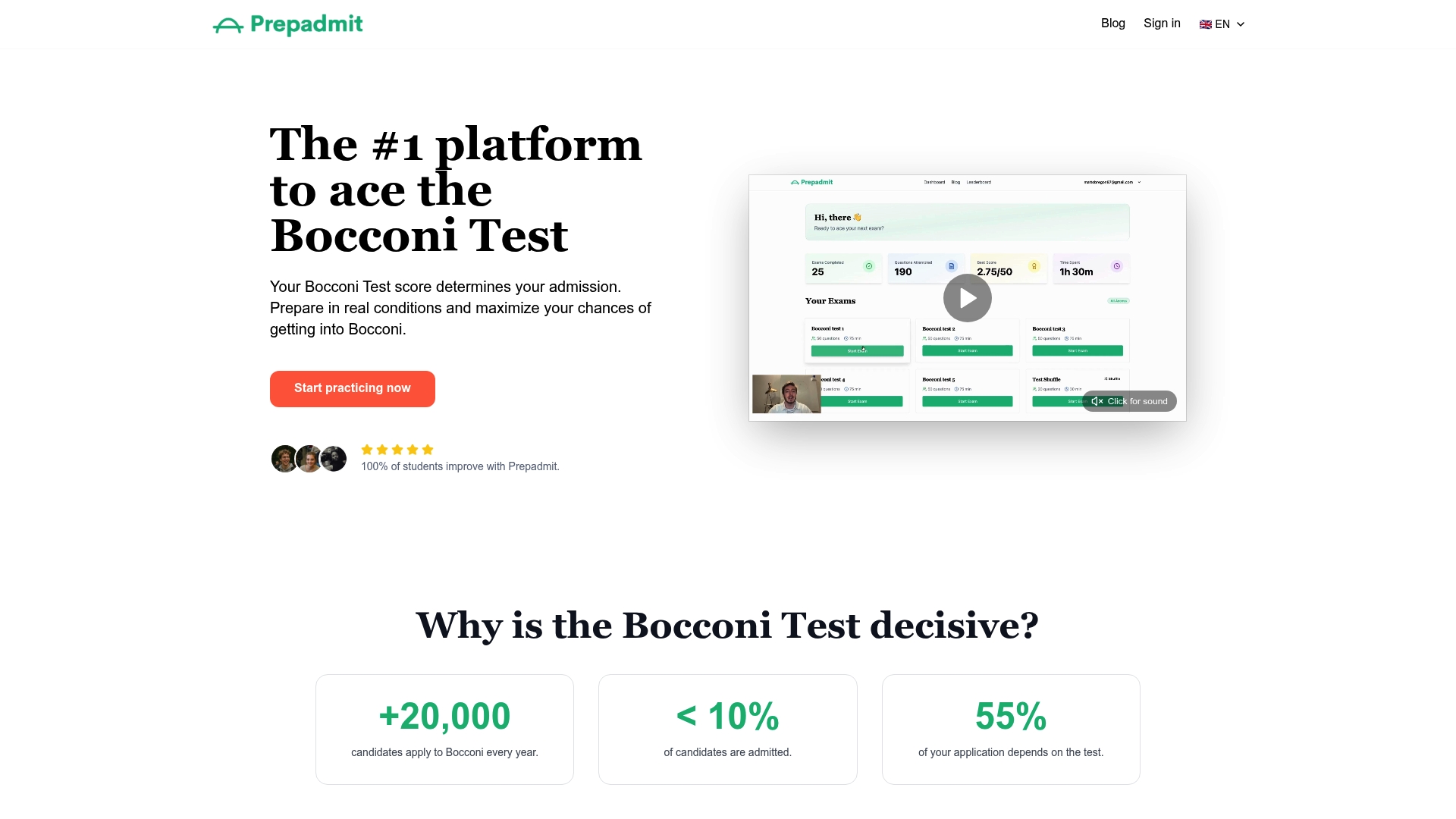
The platform suits students at any stage of prep, whether you’re running your first diagnostic mock a week before test day or building a six-month cycle of progressively harder drills. Because the questions follow the official format and timing, the skills you build transfer directly, no adjustment period on test day itself. The 34% average score improvement Prepadmit reports comes from that same discipline this article has walked through: repetition, correction, and honest measurement of where you stand against other applicants.
Start with a diagnostic mock on Prepadmit today, see your baseline score, and build your study plan around exactly what it reveals.
Sources
Recommended
Related articles
Ready to ace your admission test?
Discover PrepAdmit, the platform that helps you succeed at top university admission tests.
Discover PrepAdmit