Allenamento Logica Bocconi: A 4-Week Practice Plan

Allenamento Logica Bocconi: A 4-Week Practice Plan
The fastest way to raise your Bocconi logic score is a four-week routine built on three fixed habits: run the official Bocconi simulation early for a real baseline, drill weak question types for 20 to 30 minutes daily, and sit a full timed mock every week. Students who train this way close gaps faster than students who just read theory, because logic performance comes from repetition under real time pressure, not memorization.
Here is your starting checklist for today:
- Take one official Bocconi simulation to establish your baseline score.
- Identify which question types cost you the most time or points.
- Start 20 to 30 minute daily drills on your two weakest types.
- Schedule one full timed mock every week, same day, same conditions.
- Track errors by category, not just by total score.
- Review every wrong answer before moving to new questions.
- Use a platform like Prepadmit’s practice modes to isolate logic-only sets and get worked corrections. Prepadmit reports that students who follow a structured routine like this one often see significant score improvements.
Key Takeaways
A structured four-week routine combining the official Bocconi simulation, daily targeted drills, and weekly timed mocks produces measurable score gains for the logic section.
| Point | Details |
|---|---|
| Start with a baseline | Take the official Bocconi simulation cold before building any study plan. |
| Drill by question type | Spend 20 to 30 minutes daily on your two weakest logic subtypes. |
| Use the two-pass method | Answer easy questions first, then return to marked items with remaining time. |
| Log errors by category | Track accuracy and time per question type weekly to redirect focus. |
| Practice with Prepadmit | Use skill-specific drills and worked corrections to close weak spots faster. |
Table of Contents
- What the Bocconi Logic Section Actually Tests
- How to Solve Each Logic Question Type Faster
- Where to Practice: Official Simulation and Question Banks
- The Four-Week Bocconi Logic Training Plan
- Two Worked Examples: How to Reason Through Real Questions
- Tracking Progress and Fixing Recurring Mistakes
- A Quick Note From Someone Who Has Watched Thousands of Mocks
- How Prepadmit Fits Into Your Logic Training Plan
- Sources
What the Bocconi Logic Section Actually Tests
The Online Bocconi Test runs 50 multiple-choice questions across several skill areas, and the official pages recommend the simulation specifically because it reproduces the real timer and interface. For master-level applicants, the test breaks into verbal reasoning, data and statements, data insight, and quantitative reasoning.
Each type trains a different skill:
- Verbal reasoning (passage based, true/false/not deducible) tests whether you can separate what a text states from what it merely implies.
- Data and statements questions ask you to judge whether given statements are sufficient to answer a question, a skill closer to formal logic than reading comprehension.
- Numerical sequences test pattern recognition under time pressure.
- Syllogisms and deductions test whether you can formalize an argument and spot invalid conclusions.
| Question type | Core skill tested |
|---|---|
| Verbal reasoning | Deduction from text, distinguishing stated vs. implied |
| Data/statements | Judging sufficiency and truth from given data |
| Numerical sequences | Pattern recognition, speed |
| Syllogisms | Formal deduction, spotting fallacies |
How to Solve Each Logic Question Type Faster
Speed comes from technique, not talent. Each question type rewards a specific approach.
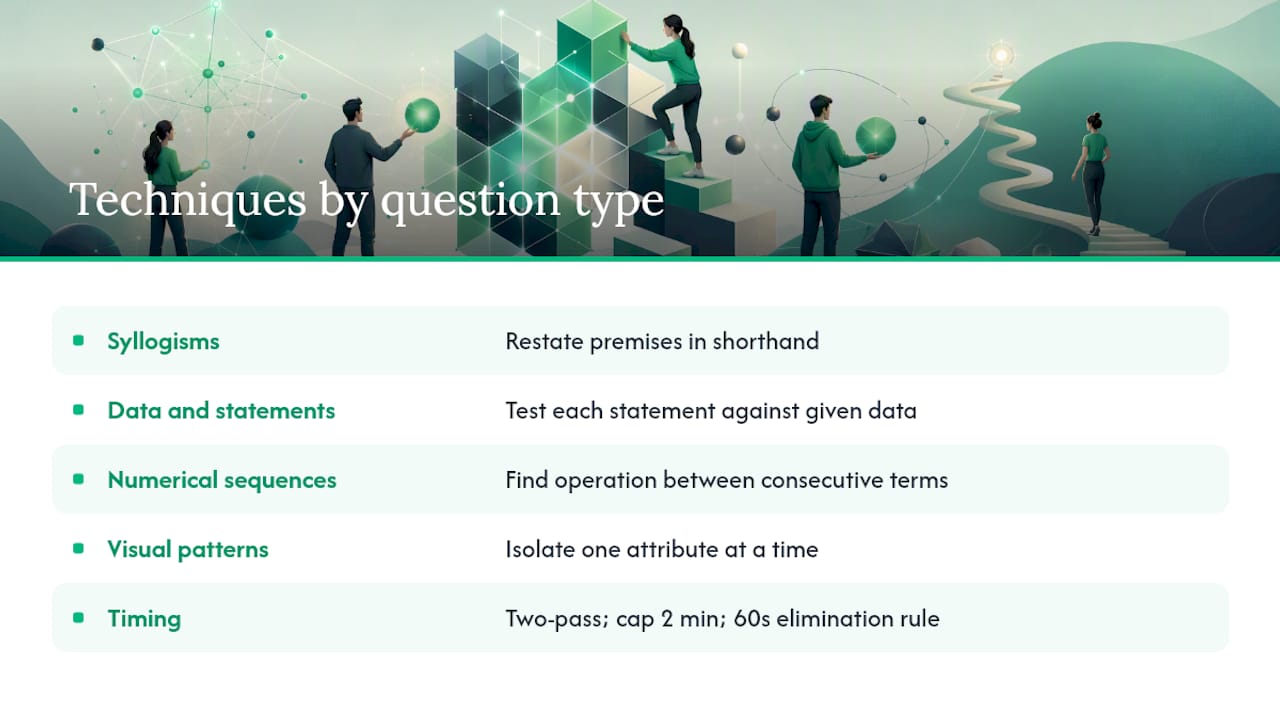
For syllogisms, restate each premise in your own shorthand before touching the answer choices. Most wrong answers come from students reasoning from what sounds plausible rather than what the premises actually allow.
For data and statements, test each statement strictly against the data given, never against outside knowledge. If a statement could be true or false depending on missing information, the answer is usually “not deducible,” not “false.”
For numerical sequences, look for the operation between consecutive terms first (addition, multiplication, alternating patterns) before trying anything more complex.
For visual and pattern items, isolate one attribute at a time (shape, then color, then rotation) instead of scanning the whole figure at once.
On timing, use the two-pass method: answer everything you find straightforward in your first pass, mark the rest, then return in a second pass with remaining time. Cap any single question at around two minutes on your first pass.
Pro Tip: If you cannot eliminate at least two answer choices within 60 seconds, mark the question and move on. Coming back with fresh eyes after easier items almost always beats grinding on one hard question.
Build micro-drills around each technique: 10 syllogisms in eight minutes, or 45 seconds per sequence item, timed and reviewed immediately after.
Where to Practice: Official Simulation and Question Banks
Start with the official Bocconi simulation. It is the only resource that reproduces the actual interface, timer, and question distribution, which makes it indispensable for your baseline test and your final mock before exam day.
After that baseline, layer in other resources:
- Free single-topic drill sets for isolating one weak question type at a time.
- Mixed timed tests that mimic the real 50-question structure once you have built basic accuracy.
- A platform with worked corrections and skill-specific practice modes, which lets you drill logic questions in isolation, see exactly why an answer was wrong, and track your progress against other students over time.
Rotate between these: single-topic drills early in the week, full mixed simulations on weekends.
The Four-Week Bocconi Logic Training Plan
This plan assumes 45 to 60 minutes of daily study, structured around focused drills and progressively longer simulations.
- Week 1: Take the official simulation cold to set your baseline. Spend the rest of the week on daily 20 to 30 minute drills covering all logic subtypes, so you know exactly where you’re weakest.
- Week 2: Shift to targeted drills on your two weakest question types, five days a week. Run one half-length timed mock covering only the logic section.
- Week 3: Reintroduce mixed-section practice to simulate real test pacing, alongside continued targeted drills. Run one full-length timed simulation.
- Week 4: Taper drill volume, focus review time on error logs from weeks 1 through 3, and run two full timed simulations, including one within 48 hours of test day.
Log every wrong answer by question type in a simple spreadsheet.
Pro Tip: Set one measurable target per week, like “cut average time per sequence item from 90 seconds to 60 seconds,” rather than a vague goal like “get better at logic.”
Two Worked Examples: How to Reason Through Real Questions
Verbal reasoning example: A passage states that “most successful startups in the sample raised funding within their first year.” A question asks whether “all successful startups need first-year funding” is true, false, or not deducible.
- Mark the qualifier in the passage: “most,” not “all.”
- Compare it to the claim in the question: the claim uses “all,” which the passage does not support.
- Conclude: not deducible, since the passage never rules out successful startups without first-year funding.
Data-insight example: You’re told Statement A gives a company’s total revenue, and Statement B gives its total costs. The question asks whether you can determine profit.
- Test Statement A alone: revenue without costs, insufficient.
- Test Statement B alone: costs without revenue, insufficient.
- Test both together: revenue minus costs gives profit directly, so both statements together are sufficient.
Common mistakes to watch: rushing past qualifiers like “most” or “some,” and assuming outside knowledge fills data gaps. Drill ten data-insight items in a row, checking each statement in isolation before combining them.
Tracking Progress and Fixing Recurring Mistakes

Track four numbers weekly: baseline score, accuracy per question type, average time per question, and week-over-week improvement.
Watch for these recurring error patterns:
- Rushing: skipping the setup step and jumping straight to answer choices.
- Misreading qualifiers: treating “most” as “all” or “some” as “none.”
- Over-assuming: filling data gaps with outside knowledge instead of sticking to what’s given.
If accuracy on a question type stalls for two straight weeks despite drilling, switch your approach rather than repeating the same drills. If it’s improving steadily, stay the course.
A Quick Note From Someone Who Has Watched Thousands of Mocks
The biggest surprise students hit isn’t the questions. It’s the clock. Consistency beats intensity: 25 focused minutes daily outperforms one long weekend cram, every time.
How Prepadmit Fits Into Your Logic Training Plan
Every phase of the four-week plan maps to a specific Prepadmit feature. Your baseline test runs through Prepadmit’s official-simulation mode, built to mirror the real Bocconi interface and timer down to the second.
Your weekly topic drills use skill-specific logic modes that isolate syllogisms, data/statements, or sequences on their own, so you’re not wasting time re-answering question types you’ve already mastered. Worked corrections show you exactly where your reasoning broke down on each missed item, and the progress dashboard tracks your accuracy and speed by category week over week, which is the same error-logging habit the four-week plan asks you to build manually. The peer leaderboard adds one more data point: how your pace and accuracy compare to other students preparing for the same test.
Prepadmit users report an average score improvement of 34% when they follow a structured practice routine like this one, at a fraction of what private coaching costs. If you’re starting week 1 today, create a free account and run your first official-style simulation to see where your baseline actually stands.
Sources
- Online Bocconi test | Bocconi University
- Bocconi Logic Test: Exercises & Methods | Your Dream School
Recommended
Related articles
Ready to ace your admission test?
Discover PrepAdmit, the platform that helps you succeed at top university admission tests.
Discover PrepAdmit