One Page Bocconi Guessing Checklist: When a Guess Pays Off

One Page Bocconi Guessing Checklist: When a Guess Pays Off
No, blind guessing is not a smart move on the Bocconi Test. Because wrong answers cost you points while blank answers cost you nothing, random guessing usually drags your score down over 50 questions. Educated guessing is a different story. When you can rule out even one wrong option, the math flips in your favor. The sections below break down the scoring rules and the exact point where a guess stops being a gamble and starts being a calculated move.
TL;DR:
- Elimination of at least one wrong answer in a four-option question can make guessing statistically worthwhile with the typical penalties.
- Guessing on questions with no possible elimination is almost always worse than skipping, as the negative scoring penalty often outweighs the chance of a correct guess.
- Practicing quick elimination and estimation strategies under timed, no-return conditions improves decision-making and score consistency across mock tests.
- The test’s sequential format makes confident, rule-based guessing more valuable than random guessing or excessive skipping.
- Focused preparation with simulation and targeted drills increases the likelihood of earning a positive expected value and reducing score volatility on exam day.
Table of Contents
- Rispondere a Caso alla Bocconi: Format and Scoring Rules That Matter
- How Do You Calculate Expected Value for a Guess?
- What Are the Best On-Test Guessing Tactics?
- How Do You Train the Guessing Decision Before Test Day?
- What Does the Data Say About Guessing and Final Scores?
- Does Guessing Strategy Affect Stress and Focus During the Test?
- How Does This Compare to Guessing on Other Standardized Tests?
- Why Disciplined Practice Beats Luck on Test Day
- How Prepadmit Helps You Practice Educated Guessing
- Sources
- FAQ
Rispondere a Caso alla Bocconi: Format and Scoring Rules That Matter
Before you decide whether to guess, you need to know exactly what you’re working with. The Bocconi Online Test runs 50 multiple-choice questions in 75 minutes, covering four areas: quantitative reasoning, reading comprehension, numerical reasoning or data insights, and critical thinking. That’s roughly 90 seconds per question, though smart test takers never split time evenly across a section that mixes easy arithmetic with dense reading passages.
The bigger constraint is navigation. The test moves in one direction only. Once you submit an answer, or the platform advances you, there’s no going back to fix it. Sequential presentation is often delivered in small groups, and the interface locks you out of previous groups the moment you move forward. That single design choice is why “rispondere a caso Bocconi” (answering the Bocconi test at random) is a genuinely different decision than skipping a question on a paper exam you can revisit later.
Scoring follows a straightforward structure, though the exact penalty has varied across sources:
- Correct answer: +1 point
- Omitted answer: 0 points
- Wrong answer: a negative penalty, reported in preparation guides as anywhere from −0.20 to −0.33 depending on the specific test version
Always confirm the current penalty on your official test instructions before exam day, since the figure has changed between test cycles. One more thing worth knowing: the official rules of conduct allow for test invalidation over technical or behavioral violations, so your prep needs to include a dry run of your setup, not just content review.
How Do You Calculate Expected Value for a Guess?
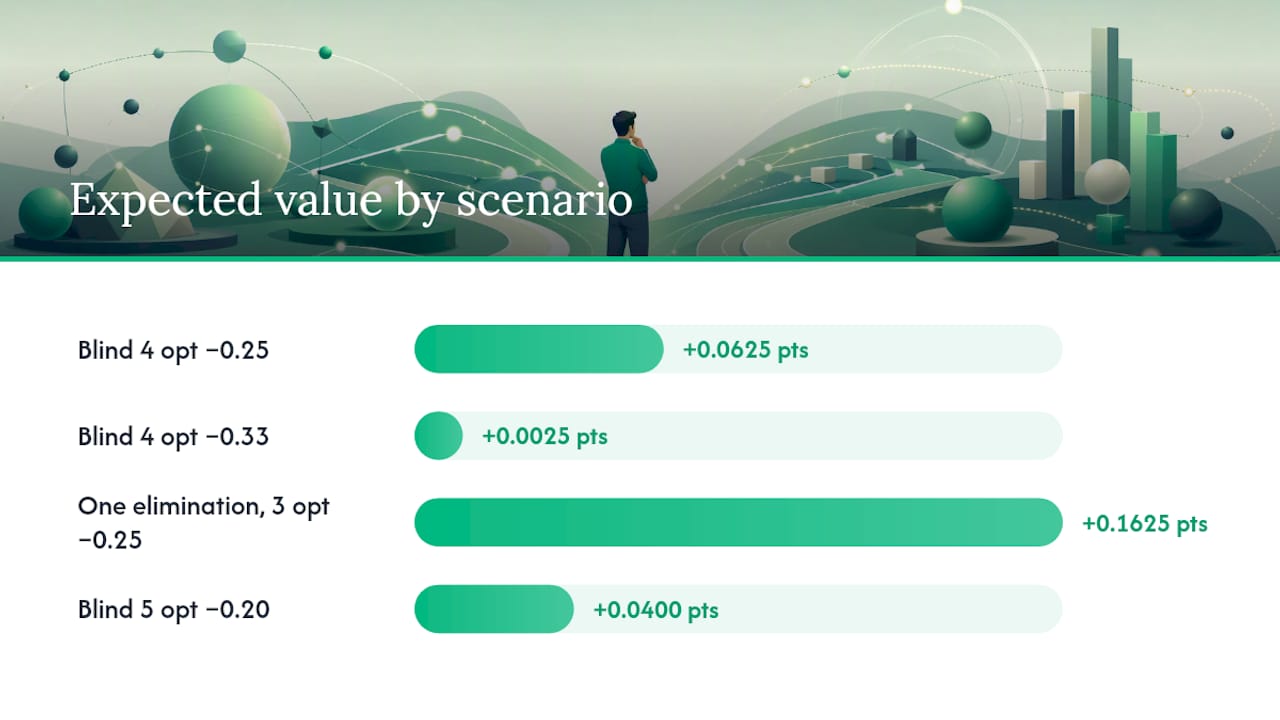
Expected value, or EV, is just the average outcome you’d get if you made the same guess hundreds of times. The formula is simple: multiply your chance of being right by the points you gain, then add your chance of being wrong multiplied by the points you lose. If the result is positive, guessing helps you on average. If it’s negative, leaving the question blank is the better bet.
Here’s how that plays out with the penalty values reported for the Bocconi test:
- Blind guess, four options, −0.25 penalty: EV = (0.25 × 1) + (0.75 × −0.25) = 0.25 − 0.1875 = +0.0625. Technically positive, but razor-thin.
- Blind guess, four options, −0.33 penalty: EV = (0.25 × 1) + (0.75 × −0.33) = 0.25 − 0.2475 = +0.0025. Almost break even, not worth the mental energy.
- One elimination, three options left, −0.25 penalty: EV = (0.33 × 1) + (0.67 × −0.25) = 0.33 − 0.1675 = +0.1625. A meaningfully better bet.
- Blind guess, five options, −0.20 penalty: EV = (0.20 × 1) + (0.80 × −0.20) = 0.20 − 0.16 = +0.04. Positive, but weak.
Pro Tip: If you can confidently eliminate even one wrong option in a four-choice question, guessing usually becomes worth it under the commonly reported penalty ranges. That single rule of thumb matters more than memorizing every EV calculation, because on test day you won’t have time to run the numbers. Always double-check the specific penalty listed on your version of the test, since a swing from −0.20 to −0.33 changes how aggressive you should be.
What Are the Best On-Test Guessing Tactics?
Knowing the math is one thing. Applying it in 90 seconds per question, with no way to go back, is another. Here’s how to convert the EV logic into behavior you can actually execute under pressure.

Because the test moves forward only, your “mark and return” instincts from other exams won’t work here. Every question becomes a binary choice the moment it appears: answer now, or skip it forever. Practice treating each one that way rather than assuming you’ll circle back.
Concrete tactics that hold up under time pressure:
- Set a hard cap per question band. Give quantitative and numerical reasoning items around 75 to 90 seconds, and reading comprehension passages a bit more since they front load your time.
- Eliminate before you guess. Cross out any option with the wrong units, an impossible magnitude, or a contradiction with the passage. Even ruling out one choice moves your EV from marginal to solidly positive.
- Estimate before you calculate. For numerical reasoning, round the numbers and check whether an answer choice is even in the right ballpark before doing exact math.
- Watch for contradictions in critical thinking items. Test writers often bury one answer that directly contradicts a stated premise. Spotting it takes seconds and removes an option instantly.
- Leave it blank only when you have zero traction. If you can’t eliminate a single option and time is tight, skipping protects your score more than a coin flip does.
Pro Tip: In the last ten questions, if you’re running short on time, prioritize items you can solve fast over ones you’d need to guess on. A rushed educated guess still beats a blind one.
How Do You Train the Guessing Decision Before Test Day?
Guessing well under pressure is a skill, and like any skill, it needs repetition under realistic constraints. Here’s a training sequence that builds the judgment you’ll need.
- Run full timed mocks with no return allowed. Replicate the sequential navigation exactly, including the small-group presentation, so you’re not learning a habit you’ll have to unlearn.
- Drill elimination speed separately. Give yourself 20 seconds per question to eliminate at least one wrong option, then track how often you succeed. This isolates the skill the EV math depends on.
- Compare two mock runs, one conservative and one aggressive. Skip every ambiguous question in one run, and apply educated guessing wherever you can eliminate an option in the other. Your own score report will show which strategy nets you more points.
- Match your timeline to your prep window. A structured prep plan built around one month focuses on full topic coverage plus at least one realistic simulation; three months alternates study blocks with mocks; six months rotates study, simulate, and analyze in a repeating cycle.
Testing the same guessing strategy across multiple worked practice sessions is the only reliable way to know it actually works for you, since elimination speed varies a lot from one candidate to the next.
What Does the Data Say About Guessing and Final Scores?
The EV math tells you what should happen in theory. In practice, the effect compounds across 50 questions in ways that surprise a lot of students. A blind guess with an EV of +0.06 sounds harmless, but multiply small margins like that by dozens of uncertain questions and the outcome swings hard in either direction depending on the exact penalty applied that year.
Students who guess blindly on every uncertain item tend to see their score bounce more from one mock to the next, even when their actual content knowledge hasn’t changed. That volatility is the real cost of relying on chance instead of elimination. A candidate who leaves ambiguous questions blank and answers only what they can partially reason through tends to land in a tighter, more predictable score band across repeated mocks.
The Bocconi test also enforces a minimum score threshold for a result to count toward your application at all. A strategy that inflates your score on a lucky day but tanks it on an unlucky one is riskier than a steadier approach, even if the average EV looks similar on paper. Consistency, not a single high score, is what gets you across that threshold reliably.
Does Guessing Strategy Affect Stress and Focus During the Test?
Uncertainty is exhausting, and the Bocconi test’s sequential format makes every hesitation costly since you can’t come back to reconsider. Students who walk in without a clear guessing rule tend to burn mental energy re-litigating the same decision on question after question: guess, skip, second-guess, move on. That hesitation eats into the 75-minute clock and often bleeds into later questions where focus has already started slipping.
Having a fixed decision rule, like the elimination heuristic covered earlier, removes that friction. You’re not deciding whether to guess anymore. You’re just checking whether you cleared the bar you already set for yourself, which is a much faster mental operation under time pressure.
There’s also a confidence effect worth naming honestly. Students who practiced blind guessing heavily in mocks and saw their scores swing unpredictably often report more anxiety heading into the real test, because they never built trust in a repeatable process. Students who trained elimination and estimation skills instead tend to describe the test as more manageable, not because the questions got easier, but because they had a plan for the moments when they didn’t know the answer outright. That difference shows up less in raw content knowledge and more in how steady someone stays through the last ten questions, when fatigue and time pressure peak together.
How Does This Compare to Guessing on Other Standardized Tests?
Bocconi’s scoring model sits in a specific category of standardized tests: those that penalize wrong answers to discourage careless guessing. That puts it in the same family as some international admissions and aptitude exams, though the exact penalty and format differ enough that strategies don’t transfer cleanly.
Tests with no penalty for wrong answers, where you simply get points for correct responses and zero for incorrect ones, reward blind guessing on every single item, since there’s no downside. That’s not the environment Bocconi creates. Its negative penalty means the calculation is closer to exams that also subtract points for errors, where the standard advice has always been the same: guess only when you can eliminate at least one option, and skip when you’re working from pure chance.
The other major difference is navigation. Many standardized tests let you flag a question and return to it before time runs out, which turns guessing into a lower-stakes fallback you can revisit if time allows. Bocconi’s sequential, no-return format removes that safety net entirely. Every guess is final the moment you commit to it, which is exactly why building a fast, reliable decision rule matters more here than it does on exams where a second look is always an option.
Why Disciplined Practice Beats Luck on Test Day
The Bocconi Test doesn’t punish uncertainty. It punishes uncertainty answered carelessly. That distinction gets lost every year by students who treat guessing as an all-or-nothing coin flip instead of a skill they can sharpen. Elimination, estimation, and pattern recognition in critical thinking questions are trainable, and they’re what separate a positive EV guess from a genuine gamble.
Simulation matters more than most students expect going in. The sequential, no-return format means your first mock run should already look like the real thing, not a warmup you’ll fix later. Prepadmit exists as an environment where you can build that judgment before it counts. Rispondere a caso alla Bocconi should never be the plan. Testing your own elimination speed against realistic conditions should be.
— quentin
How Prepadmit Helps You Practice Educated Guessing
Prepadmit is the practical alternative to guessing your way through test day: a preparation platform built to turn the EV math in this article into a habit you can execute under real time pressure. The platform runs official past-paper simulations with the same sequential, no-return navigation Bocconi uses, so your first encounter with that constraint doesn’t happen on the actual exam.
You get skill-specific drills for elimination and numerical estimation, detailed answer corrections that show exactly where a guess would have paid off or cost you, and progress tracking that compares your conservative and educated-guess strategies side by side. Prepadmit reports an average score improvement of 34% among users who train this way. Run a timed mock this week, apply the elimination heuristic from this article, and check your own score report to see which strategy actually raises your net score. Access the full preparation and find out before test day, not during it.
Sources
FAQ
Is the Bocconi Test Genuinely Hard?
The test is demanding because of its time pressure and no-return navigation more than any single question’s difficulty. Most students find the content itself manageable with preparation; what trips people up is the 75-minute clock combined with the inability to revisit earlier questions.
What Percentage of Bocconi Students Graduate With Top Honors?
Specific figures on the share of students graduating with the highest distinction aren’t publicly listed here. What’s clear from the test’s structure is that consistent, low-volatility performance, built through practice rather than guesswork, is what gets students through the admission threshold in the first place.
How Many Students Drop Out of Bocconi?
Dropout figures aren’t publicly listed here. Admission itself depends first on clearing the minimum score threshold on the entrance test, which is the stage this article focuses on.
How Much Does Three Years at Bocconi Cost?
Tuition costs vary by program and household income bracket and aren’t detailed in this article. Check Bocconi’s official admissions pages directly for the current fee structure tied to your specific program.
Should I Ever Guess Blindly on the Bocconi Test?
Blind guessing carries a thin or near-zero expected value under the penalty ranges reported for this test, so it’s rarely worth the risk. Educated guessing, where you eliminate at least one option first, consistently produces a stronger expected value and is the approach worth training for.
What Does Prepadmit Cost?
Pricing for full access to Prepadmit’s preparation platform isn’t listed with a fixed rate here. Visit Prepadmit directly for current access details.
Recommended
Related articles
Ready to ace your admission test?
Discover PrepAdmit, the platform that helps you succeed at top university admission tests.
Discover PrepAdmit