One Official Bocconi Simulation? Plan for 6–10 Full Mocks

One Official Bocconi Simulation? Plan for 6–10 Full Mocks
Bocconi offers exactly one official practice simulation on its webtesting platform: 50 questions in 75 minutes, with review of correct, wrong, and blank answers afterward. Official attempt limits allow four bookings per test type per academic year, but that governs the real test, not practice. Most candidates need more repetition than the single official mock provides, which is why platforms like Prepadmit exist to provide extra, realistic full mocks.
TL;DR:
- Bocconi provides only one official practice simulation designed to mirror the real exam’s format, with no proctoring during practice, which limits its predictive accuracy.
- The university caps attempts at four per test type per academic year, requiring strategic scheduling and extensive pre-practice since attempts cannot be made on consecutive days.
- Paid platforms like Prepadmit offer multiple full mocks with detailed explanations, progress tracking, and skill-focused drills to supplement limited Bocconi practice tests.
- Consistent improvement across several full mocks, rather than a single high score, indicates better readiness because it reflects stable pacing and understanding.
- For effective preparation, candidates should analyze errors thoroughly after each mock, focus on weak areas, and space out practice to avoid fatigue and maximize skill development.
Table of Contents
- How many simulations Bocconi actually provides
- How many attempts you get and how booking works
- Free vs. paid simulations: what actually differs
- How many mocks to schedule and how to use each one
- Where Prepadmit fits into your practice plan
- What a good score on a Bocconi simulation looks like
- What subjects and question types show up in practice mocks
- Where students get tripped up on Bocconi mocks
- Turning a score into a study plan
- How many attempts is enough without burning out
- How Bocconi mocks compare to other Italian university entrance tests
- Why review quality beats simulation quantity
- Get more realistic full mocks with Prepadmit
- Official pages and Prepadmit resources worth bookmarking
- Sources
- FAQ
How many simulations Bocconi actually provides
Bocconi’s own practice tool is narrower than most students expect. It is one simulation, built to mirror the real exam’s shape rather than to give you dozens of practice rounds.
The official Bocconi practice test runs on the university’s webtesting platform and follows a fixed structure:
- 50 multiple-choice questions covering the same subject areas as the real test
- A 75-minute timer, matching the actual exam’s pacing
- Immediate access to a breakdown of correct, wrong, and blank answers once you finish
You access it through Bocconi’s admissions pages, where instructions and login details are published alongside the booking system. International candidates get the same access path, with instructions also available in a downloadable candidate rules document that covers language options and eligibility notes.
Here is the part students often miss: this practice mode does not run the same proctoring system active during the real, scored test. You get the same questions and the same clock, but not the same supervision. That is useful for learning the interface and pacing, but it means a strong score on the official simulation does not fully predict how you will perform under actual test-day conditions.
How many attempts you get and how booking works
The official test itself, not the practice simulation, is where Bocconi caps your attempts. Understanding this limit matters because it shapes how much pressure each real booking carries.
According to Bocconi’s webtesting platform rules, the booking system enforces:
- Four attempts per test type, per academic year
- No attempts allowed on the same day or on consecutive days
- Booking windows set by the university each year, with slots opening on published dates
That gap between attempts is deliberate. Bocconi wants each attempt to reflect genuine preparation, not repeated guessing within a short window. Fees and exact scheduling dates change from year to year, so check the university’s own admissions page before you book rather than relying on last year’s figures. Because attempts are limited and spaced out, the practical lesson is simple: treat every real attempt as a checkpoint, and do your heavy repetition beforehand, using practice material that does not count against your four bookings.
Free vs. paid simulations: what actually differs
Once you understand the official limits, the real question becomes where to get more practice without touching your four attempts. Options fall into a few clear categories.
- The single official simulation: free, one mock, basic correct/wrong/blank feedback
- Subscription-style platforms: multiple full mocks, often with detailed answer corrections and progress tracking
- One-off paid packs: a fixed number of mocks, useful for a short, focused practice sprint
- Short topic drills: narrow sets of questions targeting one skill, like logical reasoning or reading comprehension
The differences that matter most are depth of feedback and volume. A free simulation tells you whether an answer was right. A stronger paid platform tells you why it was wrong, how you compare to peers, and where your time management broke down. Industry coverage of learning-technology platforms points to this exact trend: tools that go beyond a single static test toward adaptive practice and analytics tend to produce more useful preparation data.
Pro Tip: Before paying for any simulator, check whether it offers detailed corrections and not just a score. A number without an explanation teaches you nothing about what to fix.
How many mocks to schedule and how to use each one
The honest answer to “how many simulations do I need” is not a single number. It depends on your timeline and how disciplined your review process is. A reasonable cadence looks like this:
- Start with the official simulation once, purely to learn the interface, timing, and question style.
- In your early prep phase, schedule roughly one full mock per week, paired with shorter topic drills between mocks.
- In your final two weeks, take two full mocks under strict timed conditions, spaced a few days apart, with a full review after each.
- After every mock, log every missed or guessed question in a simple tracker, grouped by topic.
- Drill the weak topics specifically, then retest only after that targeted practice, not immediately after the mock itself.
The review step is where most of the score gain actually happens. Taking mock after mock without analyzing errors just trains you to repeat the same mistakes faster. Pay attention to time per question too; if you are consistently slow on one section, that is a pacing problem, not just a knowledge gap.
Watch for diminishing returns. If you retake the exact same mock a third time and your score barely moves, you are memorizing that specific test, not building the underlying skill. At that point, switch to a new set of questions or increase the difficulty rather than repeating what you have already solved.
Pro Tip: Time-box your review sessions. Thirty focused minutes analyzing three wrong answers beats two rushed hours skimming an entire answer key.
Where Prepadmit fits into your practice plan
Once you have used the single official simulation and hit your comfort ceiling with it, you need a source of additional full mocks that still feel realistic. That is the specific gap Prepadmit is built to fill.
Prepadmit provides on-demand full mocks built from official past papers, paired with detailed answer corrections, skill-specific practice modes, progress tracking, and peer ranking dashboards. The platform was developed by a team with backgrounds from HEC and Bocconi, and it reports an average score improvement of 34% among users, backed by a money-back guarantee. That combination is meant to give you the extra repetition your four official attempts cannot provide, without sacrificing the realism of timing and question style.
- On-demand full mocks modeled on official past exam papers
- Detailed corrections that explain why an answer is wrong, not just that it is
- Skill-specific drill modes for targeted weak-area practice
- Progress tracking and peer ranking to benchmark your improvement over time
If you follow the weekly-mock cadence described above, Prepadmit’s blog also breaks down a final week study plan and a structured error-analysis workflow that maps directly onto the review step.
What a good score on a Bocconi simulation looks like
Bocconi does not publish a universal passing threshold for its practice simulation, and that is intentional. Admission depends on how your score ranks against other applicants for the specific program and intake you are applying to, not on hitting a fixed number.
That said, patterns show up across candidates who use simulations seriously. Students who score consistently in the top range on multiple full mocks, not just one lucky attempt, tend to feel more confident and perform more predictably on the real test. A single high score on your first simulation attempt is often a fluke of easier questions or fresh material rather than a reliable signal.
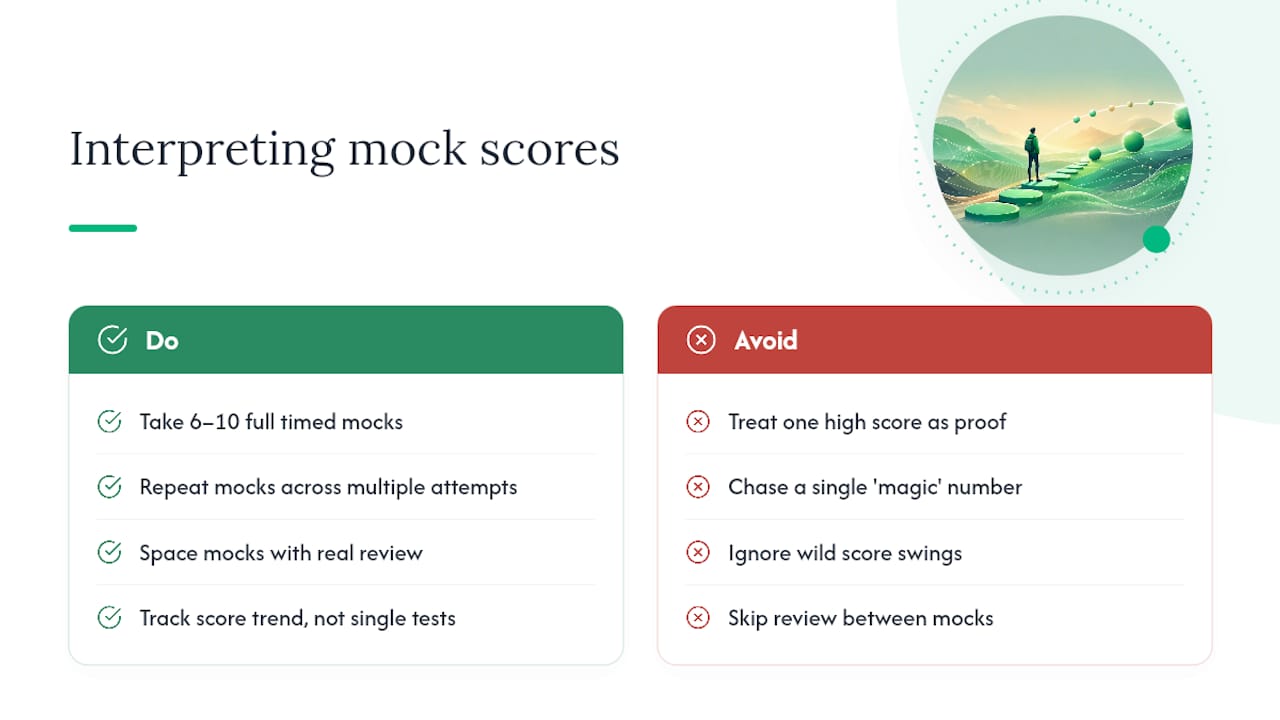
What matters more than the raw number is consistency across attempts and improvement trend over time. If your score climbs steadily across three or four full mocks, spaced with real review in between, that trajectory tells you more about readiness than any single benchmark score. If your score swings wildly between attempts, that usually points to inconsistent pacing or gaps in specific topic areas rather than an accurate reflection of your overall level.
Treat every mock score as one data point in a trend line, not a verdict. The goal is not to chase a magic number on a practice test. It is to build a reliable, repeatable performance under timed conditions that transfers to the real, proctored exam.
What subjects and question types show up in practice mocks
Bocconi’s simulation questions cluster around a handful of consistent categories, and knowing them helps you target your drills instead of practicing everything equally.
Expect a mix of logical reasoning questions that test how quickly you can spot patterns and draw valid conclusions from limited information. Reading comprehension sections ask you to extract precise meaning from dense passages under time pressure, which trips up students who read carefully but too slowly. Quantitative and numerical reasoning questions cover basic math applied to word problems and data interpretation, rewarding speed and accuracy over advanced formulas.
Verbal and language-based questions test vocabulary, sentence logic, and sometimes English proficiency depending on the test track you are sitting for. General knowledge or critical thinking items occasionally appear, designed less to test memorized facts and more to see how you reason through unfamiliar scenarios.
It comes from identifying which one or two categories are dragging your overall score down and drilling those specifically. A student who is strong in quantitative reasoning but slow in reading comprehension needs a completely different practice plan than one with the opposite profile, even if their total scores look identical on paper.
Where students get tripped up on Bocconi mocks
Certain question types cause disproportionate trouble, and recognizing them in advance saves real points on test day.
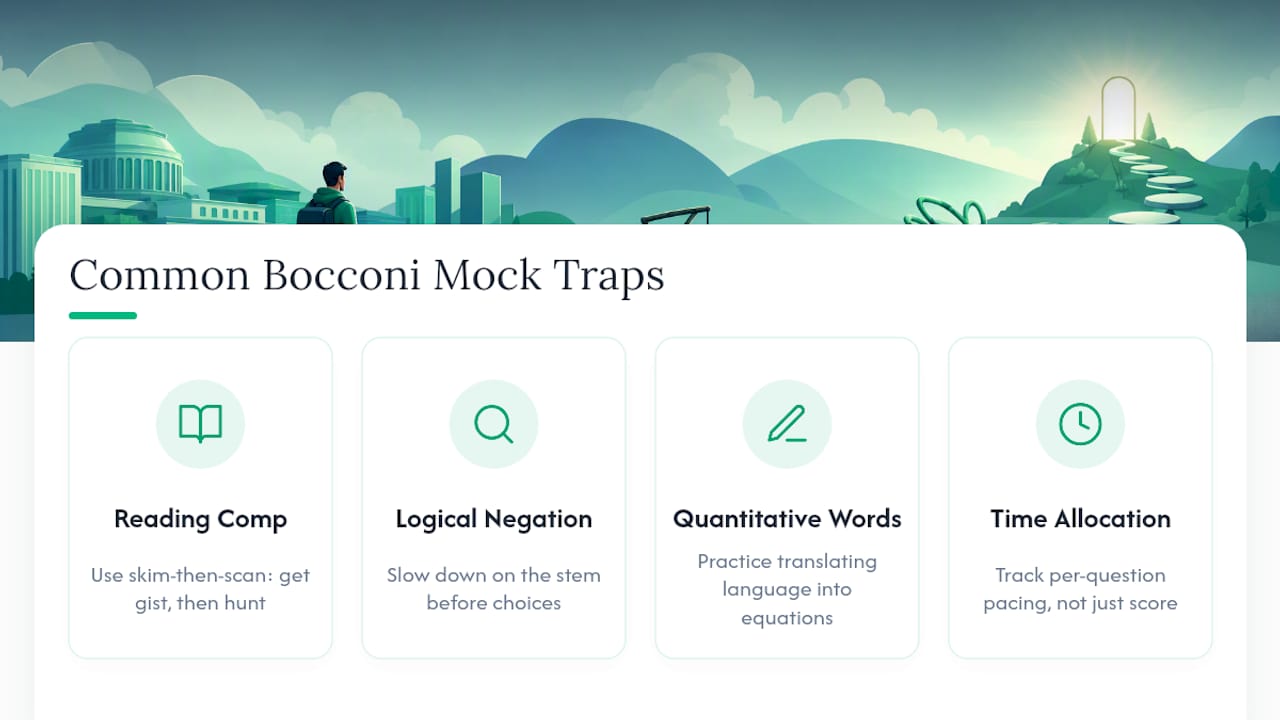
Reading comprehension passages with dense, technical language often trip up students who understand the content but run out of time before finishing all the questions tied to one passage. The fix is not reading faster in a panic. It is practicing a skim-then-scan technique: get the gist first, then hunt for specific answers.
Logical reasoning questions with negation or double conditions (“which of the following is NOT true unless…”) cause a specific kind of misread error. Students understand the logic but misparse the sentence structure, answering the opposite of what was actually asked. Slowing down on the question stem itself, before touching the answer choices, cuts this error dramatically.
Quantitative questions disguised as word problems trip up otherwise strong math students because the difficulty is in translating language into an equation, not solving the equation itself. Practicing the translation step specifically, separate from the arithmetic, addresses this directly.
Finally, students consistently misjudge time allocation. They spend too long perfecting early questions and then rush the final stretch, where careless errors spike. Since the 75-minute timer never pauses, a mock that tracks your per-question pacing, not just your final score, is far more useful for catching this pattern than a mock that only reports right or wrong.
Turning a score into a study plan
A simulation result is only useful if you read past the total number. The real value sits in the breakdown.
Start by separating your errors into three buckets: questions you got wrong because you did not know the material, questions you got wrong because you misread them under time pressure, and questions you left blank because you ran out of time. Each bucket points to a different fix. Knowledge gaps need content review. Misreads need slower, more deliberate question analysis. Blanks need pacing work, not more content study.
Next, look at your accuracy by section rather than your overall percentage. That second number is where your study hours belong for the next two weeks, not spread evenly across everything.
Finally, track your trend across multiple mocks, not just your latest result. One official Bocconi practice test tells you where you stand today. A history of three or four scored mocks, reviewed properly between each one, tells you whether your studying is actually working. If a weak section refuses to improve after two rounds of targeted drilling, that is the moment to consider a different practice resource with more detailed explanations, rather than repeating the same drills and expecting a different outcome.
How many attempts is enough without burning out
There is no single magic number, but a useful range for most students lands between six and ten full mock attempts total, spread across a preparation window of six to eight weeks. Fewer than that rarely builds enough consistency under timed pressure. Significantly more, without structured review between attempts, tends to produce fatigue rather than improvement.
The warning signs of overdoing it are fairly specific. Scores plateau or dip slightly across consecutive mocks. Review sessions get shorter and more rushed because motivation is fading. You start recognizing specific questions from repeated mocks rather than reasoning through them fresh, which inflates your score without reflecting real skill.
When you notice those signs, the fix is not stopping entirely. It is switching the format: fewer full-length mocks, more short, focused drills on your two or three weakest topics, then one final full mock about a week before test day to confirm the improvement held. Spacing matters as much as volume. A mock taken every single day, with no time to review or drill weaknesses in between, wastes most of its value. A mock taken once a week, followed by two or three focused review sessions, extracts far more improvement from the same total number of questions attempted.
How Bocconi mocks compare to other Italian university entrance tests
Bocconi’s practice format sits closer to a structured, timed reasoning test than to the broader, syllabus-heavy entrance exams used by many Italian public universities for programs like medicine or law. Those tests often rely on multiple-choice questions tied directly to a fixed academic syllabus, with practice materials built around memorizing specific content areas.
Bocconi’s test leans more heavily on reasoning speed, reading comprehension under pressure, and quantitative problem-solving that does not require specialized prior coursework. That distinction changes how you should practice. Content-heavy entrance exams reward flashcards and syllabus review. Bocconi’s format rewards repeated exposure to the question style itself and disciplined pacing practice, since the actual knowledge tested is closer to general aptitude than memorized coursework.
This is also why the practice-volume question matters more for Bocconi than for some other entrance tests. A syllabus-based exam has a finite amount of content to master, and once you know it, additional practice tests offer limited new value. A reasoning-based test like Bocconi’s rewards continued exposure to new question variations, because the skill being tested is pattern recognition and speed under pressure, which keeps improving with fresh material longer than pure content recall does.
Why review quality beats simulation quantity
Students ask “how many simulations” as if the number itself is the strategy. It is not. The number matters far less than what happens in the fifteen minutes after each mock ends.
I have seen the same pattern across test prep generally, not just at Bocconi: candidates who take eight mocks with disciplined error analysis after each one consistently outperform candidates who grind through twenty mocks with no structured review. The second group gets faster at guessing. The first group actually gets better at the underlying skill. If you take away one thing from this article, take that. Book your official attempts deliberately, use extra full mocks to build real repetition, and never move to the next mock without understanding exactly why you missed the last one.
— quentin
Get more realistic full mocks with Prepadmit
Bocconi gives you one free simulation and four real attempts a year. Neither is enough repetition to walk into test day fully calibrated, which is exactly why Prepadmit exists as a next step. It gives you on-demand full mocks built from official past papers, detailed answer corrections that explain the reasoning behind every question, skill-specific drill modes, and progress tracking that shows whether your weak sections are actually improving.
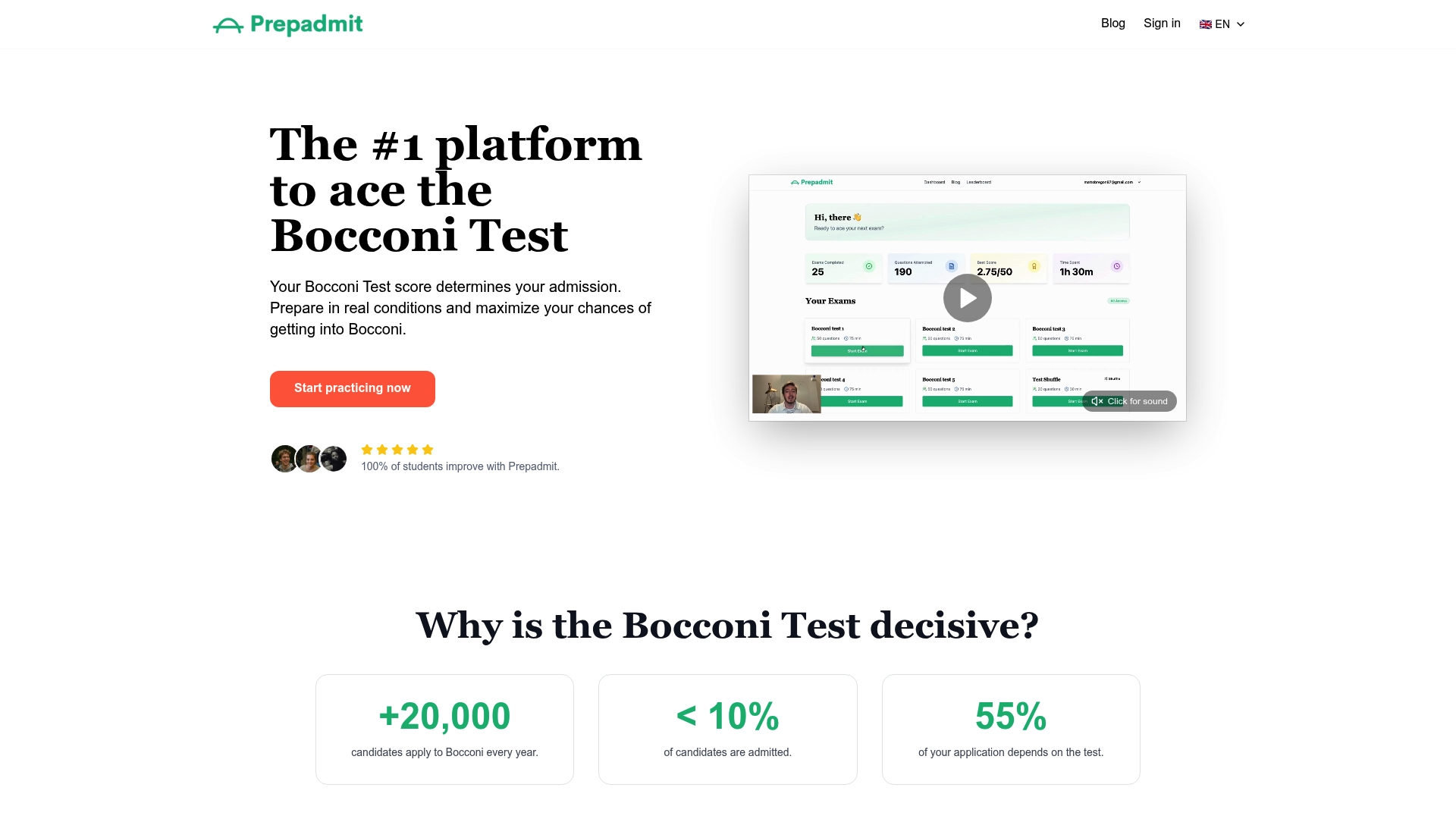
That maps directly onto the weekly-mock cadence recommended earlier: use Prepadmit’s mocks for your regular practice rounds, then lean on the error-analysis workflow and structured mock breakdown to turn each result into a focused study plan. The platform is backed by a money-back guarantee, so testing it against your current prep routine carries little downside. You can access the full preparation directly and start your next mock before your review momentum fades.
Official pages and Prepadmit resources worth bookmarking
Bookmark Bocconi’s official test page for the simulation itself and its booking rules page for attempt limits.
- Prepadmit’s step-by-step preparation guide for a full study roadmap
- Prepadmit’s final week plan for last-minute mock scheduling
Sources
FAQ
How many official Bocconi simulations are there?
Bocconi offers one official practice simulation on its webtesting platform, with 50 questions and a 75-minute timer. Additional practice mocks come from third-party resources like Prepadmit, not from Bocconi itself.
How many questions does the Bocconi test have?
The official simulation and the real test both use 50 multiple-choice questions, completed within a 75-minute time limit. Question topics cover logical reasoning, reading comprehension, and quantitative problem-solving.
What is a good score on the Bocconi test?
Bocconi does not publish a fixed passing score, since admission depends on how your result ranks against other applicants for your chosen program. A consistent, improving trend across several practice mocks is a stronger readiness signal than any single score.
Where can I find a Bocconi test simulation?
The free official simulation is available directly through Bocconi’s admissions pages. For additional full mocks with detailed corrections and analytics, Prepadmit offers on-demand practice tests built from official past papers.
How many attempts can I take at the real Bocconi test?
Bocconi’s booking rules allow four attempts per test type per academic year, with no attempts permitted on the same day or on consecutive days. This limit applies to the real scored test, not to practice simulations.
Recommended
Related articles
Ready to ace your admission test?
Discover PrepAdmit, the platform that helps you succeed at top university admission tests.
Discover PrepAdmit