How to Prepare for an Exam: Your Five-Day Plan

How to Prepare for an Exam: Your Five-Day Plan
Start a spaced, retrieval-first five-day plan today and add at least one timed practice session before your exam. That combination, retrieval practice plus distributed study plus realistic simulation, is what the research consistently points to as the most effective short-window strategy for exam preparation.
Here is what you can do in the next 60–90 minutes to build momentum:
- List every topic on your syllabus and mark each one as strong, shaky, or unknown.
- Block out your available study hours for the next five days on a calendar or phone.
- Pull one past paper or practice test and skim the question types so you know what format you are facing.
- Make 10–15 flashcards or blank-page prompts on your weakest topic right now.
- Set a timer for 25 minutes and do your first retrieval session before you read another word of your notes.
Key Takeaways
Retrieval practice and distributed study, applied through a structured five-day plan with at least one timed simulation, are the most reliable methods for improving exam scores.
| Point | Details |
|---|---|
| Start with a diagnostic | Run a timed quiz on Day 0 to rank your topics by weakness before scheduling anything. |
| Use retrieval, not rereading | Blank-page recall and self-quizzing produce stronger retention than passive review every time. |
| Simulate exam conditions | At least one timed, closed-book practice session before the real exam reduces blanking and avoidable errors. |
| Protect sleep the night before | Seven to nine hours of sleep consolidates memory better than late-night cramming. |
| Prepadmit for Bocconi prep | Prepadmit provides official past papers, adaptive timed simulations, and error-correction tools for the Bocconi Test. |
Table of Contents
- What does a practical five-day exam preparation plan look like?
- Which study techniques actually improve your recall?
- How do you simulate the exam to improve your actual score?
- How should you organize your study space and materials?
- Why do sleep, nutrition, and stress management matter for exam performance?
- What should you do before, during, and after the exam?
- How do you prepare differently for essays, math, and multiple-choice exams?
- Which apps and tools help you study, and when should you turn them off?
- What are the most common exam prep mistakes, and how do you fix them?
- Why do retrieval practice and spacing work better than other methods?
- What the research taught me about studying smarter, not longer
- Prepadmit gives Bocconi Test candidates a structured path to a higher score
- Sources
What does a practical five-day exam preparation plan look like?
The Cornell Learning Strategies Center’s five-day plan structures study around two distinct modes: preparation (organizing and encoding new material) and review (actively retrieving it). The key is alternating between them daily rather than spending all five days passively rereading.
How to chunk your syllabus
Divide your material by chapter, lecture, or topic unit. Aim for chunks you can cover meaningfully in 45–60 minutes. If a topic is broad, split it into two chunks. If it is narrow, pair it with a related one. Write the chunk names on paper before Day 1 so you are not making decisions under pressure mid-session.
Five-day schedule example
| Day | Focus | Session 1 (60 min) | Session 2 (45 min) | Session 3 (30 min) |
|---|---|---|---|---|
| Day 1 | Chunks 1–2 | Prepare: read, annotate, summarize | Review: blank-page recall on Chunk 1 | Make flashcards for Chunk 2 |
| Day 2 | Chunks 3–4 | Prepare: read, annotate, summarize | Review: self-quiz Chunks 1–2 | Interleave Chunks 1–4 flashcards |
| Day 3 | Chunks 5–7 | Prepare: read, annotate, summarize | Review: self-quiz Chunks 3–4 | Timed mixed quiz: Chunks 1–4 |
| Day 4 | Full review | Timed practice test (full or partial) | Error log: fix every wrong answer | Re-test weak spots only |
| Day 4 | Light retrieval | Low-stakes self-quiz on weakest areas | Logistics and materials check | Rest by 9 PM |
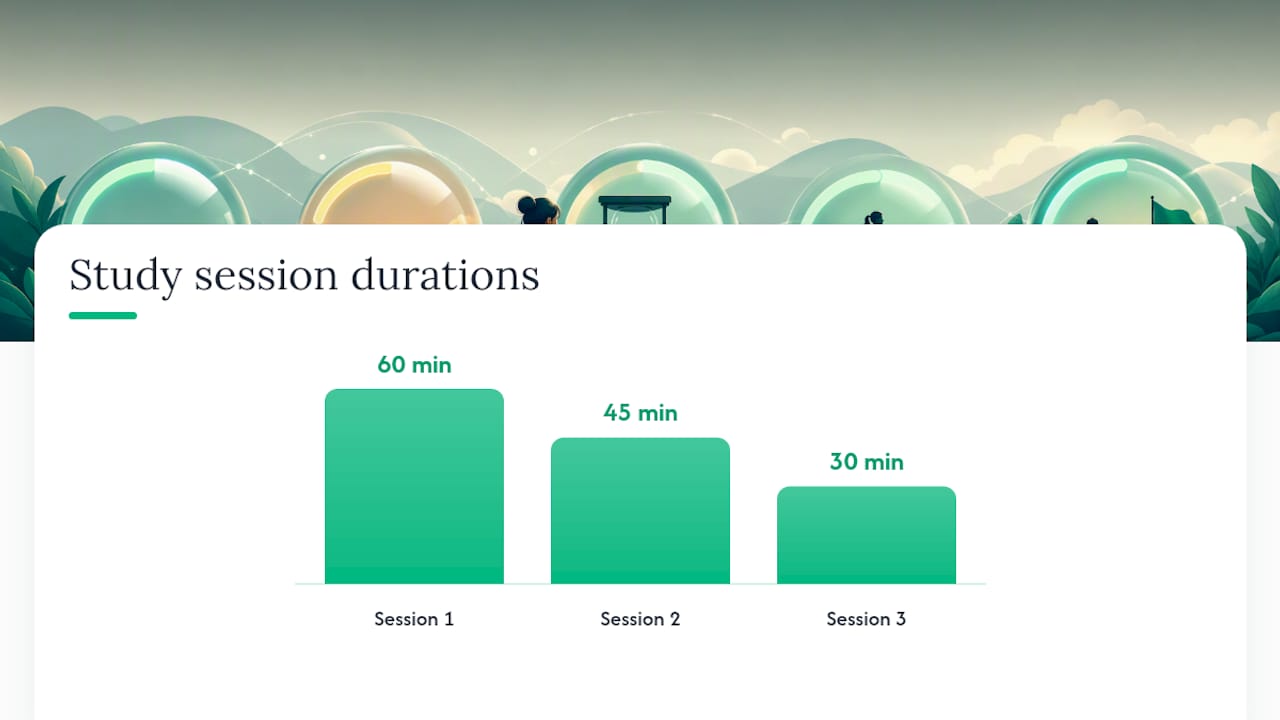
Adapting the plan to your timeline
If you have seven or more days, add a Day 0 diagnostic: take a timed practice test cold, log your errors, and use the results to rank your chunks by weakness before Day 1. The University of Pittsburgh’s seven-day template uses exactly this approach, giving you an extra buffer to revisit the hardest material twice.
With only three days, compress Days 1–3 into two preparation days and protect Day 3 entirely for timed practice and error review. Do not cut the timed practice to add more reading. With one night left, skip new material entirely and do a single 30-minute retrieval session on your weakest three topics, then sleep.
Pro Tip: Weight your chunks by exam points and your own proficiency. Write the point weight next to each chunk name before you schedule anything.
Which study techniques actually improve your recall?
Passive rereading feels productive but produces weak retention. The techniques below force your brain to work harder in the short term, and that difficulty is exactly what makes the learning stick. The APA describes this as “desirable difficulty”: strategies that feel harder but create deeper, more durable learning.
Retrieval practice (blank-page testing)
Close your notes. Write down everything you can recall about a topic on a blank page. Then open your notes and check. The act of retrieving, not the act of reading, is what strengthens the memory. Do this after every preparation session, not just before the exam.
Spaced repetition
Review material at increasing intervals: same day, next day, three days later, one week later. Apps like Anki automate this schedule. The spaced repetition guide on the Prepadmit blog walks through practical spacing schedules you can apply directly to the five-day plan above.
Interleaving
Mix different topics or problem types within a single session instead of blocking all of one subject together. Interleaving forces discrimination between similar concepts and produces better transfer to exam problems, even though it feels harder in the moment.
Self-explanation (the Feynman method)
Explain a concept out loud as if teaching it to someone who has never seen it. When you hit a gap or a vague phrase, that gap is exactly what you need to study next. This works for both conceptual subjects and quantitative ones.
Practice testing
Take a timed quiz, past paper question, or problem set under realistic conditions. Self-quizzing is not just assessment. It is a learning activity that strengthens neural pathways more than any amount of rereading.
Techniques ranked by time efficiency under pressure:
- Retrieval practice (blank-page recall): highest return per minute
- Timed practice testing with error review: close second, especially within 48 hours of the exam
- Spaced flashcard review (Anki or handwritten): strong for vocabulary-heavy or formula-heavy subjects
- Interleaved problem sets: best for quantitative and science exams
- Self-explanation: best when you are stuck on a concept you cannot articulate
How do you simulate the exam to improve your actual score?
Timed, realistic practice is one of the most reliable ways to reduce blanking under pressure. Colorado State University’s TILT resource describes this as a “scrimmage”: practice in a quiet, timed environment, use only the aids the real exam allows, and treat the session as if it counts. Students who do this consistently make fewer avoidable errors on test day because the conditions are no longer unfamiliar.
Diagnostic error log
After every timed practice session, fill in a log like this:
| Question | What I answered | Correct answer | Why I got it wrong | Fix (what to review) |
|---|---|---|---|---|
| Q4 | B | C | Confused two similar formulas | Re-derive both formulas, then re-test |
| Q11 | Skipped | Full answer | Ran out of time | Practice time allocation drills |
| Q15 | D | A | Misread the question stem | Slow down on first read; underline key words |
Keep this log in a single document. Before each new practice session, re-read the previous session’s log. Patterns across multiple sessions tell you where your real weak spots are.
Checklist for a timed practice session
- Find a quiet space with no phone notifications.
- Set a timer that matches the real exam duration.
- Use only the materials the actual exam allows (no extra notes if the exam is closed-book).
- Do not pause the timer for any reason.
- After the session, score it immediately and fill in the error log before doing anything else.
Pro Tip: After logging an error, do not just re-read the correct answer. Re-test yourself on that exact concept within 10 minutes using a fresh blank-page prompt. This “fix and immediate test” cycle converts a mistake into a memory far faster than passive review.
How should you organize your study space and materials?
A cluttered or poorly set-up space costs you focus before you even open a book. The goal is to remove every decision and distraction that is not studying.
Study space setup
- Use consistent lighting (natural light or a warm desk lamp at eye level to reduce strain).
- Keep your desk clear of everything except what you need for the current session.
- Use noise-canceling headphones or a white-noise app if your environment is loud.
- Sit at a desk or table, not a bed or couch, to keep your brain in work mode.
- Keep water on the desk. Dehydration reduces concentration noticeably.
Must-have materials checklist
- Printed or digital notes organized by topic chunk
- Past papers and practice tests (at least two full sets)
- Allowed calculator, ruler, or reference sheet (check your exam rules)
- Stationery: pens, pencils, highlighters, sticky notes
- Charger for laptop or tablet
- Timer (phone timer works, but a dedicated timer removes the temptation to check messages)
Night-before packing checklist
- Photo ID and exam admission ticket printed or saved to phone
- Pencils, pens, and any allowed calculator
- Water bottle and a light snack
- Earplugs if allowed and useful
- Alarm set for at least 90 minutes before you need to leave
Organizing digital materials
Create one folder per subject with subfolders for notes, past papers, and error logs. Name files with a date prefix (e.g., 2026-05-12_Chunk3_Notes.pdf) so you can sort by recency. Back up to a cloud service like Google Drive or iCloud the night before the exam. A corrupted file at 7 AM is a solvable problem only if you have a backup.
Why do sleep, nutrition, and stress management matter for exam performance?
Your brain consolidates what you studied during sleep, particularly during the deep and REM stages that dominate the second half of the night. Cutting sleep to study more is a trade that almost always costs more than it gains: the material you reviewed at 2 AM is far less likely to be retrievable the next morning than material reviewed at 9 PM before a full night’s rest.
Aim for 7–9 hours the night before your exam. If you need a nap during the study window, keep it to 20 minutes (a “power nap”) to avoid sleep inertia. A longer nap can leave you groggy for an hour afterward, which is time you cannot afford.
On the nutrition side, eat a balanced meal with protein and complex carbohydrates before a study session or exam. Avoid high-sugar foods that spike and crash your energy. Caffeine in moderate amounts (one to two cups of coffee) can support alertness, but avoid it within six hours of sleep. Hydration matters more than most students realize: even mild dehydration reduces working memory and attention.
For stress, two practices work quickly and require no equipment. The first is box breathing: inhale for four counts, hold for four, exhale for four, hold for four. Repeat four times. This activates the parasympathetic nervous system and reduces the physical symptoms of anxiety within minutes. The second is a brief body scan: sit quietly for two minutes, notice where you are holding tension (jaw, shoulders, hands), and consciously release it. Neither takes more than five minutes and both can be done right before you walk into the exam room.

Pro Tip: The night before your exam, do a short 20-minute retrieval session on your three weakest topics, then stop. Studying past 10 PM the night before trades sleep quality for marginal review time, and sleep wins that trade every time. Build exam confidence through preparation earlier in the week, not through last-minute cramming.
What should you do before, during, and after the exam?
Before the exam
- Wake up with enough time to eat, review your packing checklist, and arrive early.
- Do a light 10-minute retrieval session on key formulas or concepts, not a full study session.
- Avoid comparing notes with classmates outside the exam room. It raises anxiety without improving recall.
- Arrive at least 15 minutes early to settle in and find your seat without rushing.
During the exam
- Start with a two-minute brain dump: write every formula, date, or key term you remember on scratch paper or the margin of your test booklet. This clears working memory and gives you a reference sheet.
- Allocate time per section before you start. If the exam is 90 minutes with three sections, decide on 30 minutes each and stick to it.
- If you blank on a question, mark it, move on, and return. Coming back with fresh context often unlocks the answer.
- On multiple-choice questions, eliminate obviously wrong answers first. Two remaining options are much easier to reason through than four.
- Read every question stem carefully. Many errors come from misreading, not from not knowing the answer.
After the exam
- Write down two or three questions you found difficult while they are fresh. If you have another exam in the same subject or a retake, this is your next study list.
- Avoid a detailed post-mortem with classmates immediately after. It rarely changes your score and often increases anxiety.
- Give yourself a deliberate cooldown: a walk, a meal, or something unrelated to studying. Recovery is part of performance.
How do you prepare differently for essays, math, and multiple-choice exams?
Essay exams
Practice writing timed outlines before you practice writing full essays. A clear thesis and three supporting points, written in five minutes, is more useful than a half-finished essay written in 45. Use a simple template: claim, evidence, explanation, link back to the question. Drill this structure until it is automatic, then add speed.
Checklist for essay prep:
- Write one timed thesis statement per major topic per day.
- Practice outlining three to five essay questions from past papers.
- Time yourself writing one full essay under exam conditions at least once before the real exam.
Quantitative and problem-solving exams
Interleaved practice on mixed problem sets is more effective than working through one chapter at a time. Show your work on every practice problem, even when you know the answer. This habit makes errors visible and easier to catch during the real exam. After each practice session, check every step, not just the final answer.
Checklist for quantitative prep:
- Mix problem types from different chapters in every session.
- Re-derive key formulas from scratch at least once rather than memorizing them passively.
- Time yourself on five to ten problems to build pacing awareness.
Multiple-choice exams
The goal is converting recognition into recall. If you can only recognize the right answer when you see it, you are vulnerable to well-written distractors. Practice by covering the answer choices and generating your own answer first, then checking. This forces recall rather than recognition.
Checklist for MCQ prep:
- Cover answer choices and answer from memory before reading options.
- Track which distractor types fool you most often (similar-sounding answers, “all of the above,” extreme language).
- Aim for a consistent pace: flag any question that takes more than 90 seconds and return to it.
Which apps and tools help you study, and when should you turn them off?
The right digital tools reduce friction and add structure. The wrong ones replace studying with the feeling of studying.
Tools that genuinely help
- Anki: spaced repetition flashcard app that schedules reviews automatically based on your performance. Best for vocabulary, formulas, and factual recall.
- Forest or Freedom: site and app blockers that lock distracting apps during timed sessions. Set them before you start, not after you have already checked social media.
- Notion or Google Docs: note-syncing tools that keep your error logs, chunk lists, and schedules accessible on any device.
- Khan Academy or subject-specific practice platforms: structured practice questions with explanations, useful for quantitative subjects.
Digital setup checklist for a timed session
- Phone on Do Not Disturb or in another room.
- Site blocker active for the session duration.
- One browser tab open (your notes or practice platform), all others closed.
- Notifications turned off on laptop.
When to turn technology off
If you have watched a video and cannot immediately write down the three main points from memory, you have not learned it yet. The same applies to highlighting PDFs: it is a low-effort activity that creates the illusion of engagement.
Pro Tip: *Most practice platforms show you your accuracy by topic. Check that dashboard after every session and use it to update your chunk priority list.
What are the most common exam prep mistakes, and how do you fix them?
Cramming the night before. Massed practice produces short-term familiarity, not durable memory. Fix it: redistribute the same hours across three to five days. Even two days of spaced review beats one long night.
Passive rereading. Reading your notes again feels safe but produces little retention. Fix it: after every page or section, close the notes and write down what you just read. If you cannot, that is your signal to re-read that section only.
Skipping practice tests. Students often avoid practice tests because they feel discouraging. That discomfort is the point. Practice testing and distributed practice consistently outperform every other study method in long-term retention research. Fix it: schedule at least one timed practice test per subject, treat it as non-negotiable, and log every error.
Studying everything equally. Spending equal time on topics you already know and topics you do not is a slow way to improve. Fix it: run a 20-minute diagnostic quiz at the start of your study window, rank your topics by score, and weight your schedule toward the bottom of that list.
Ignoring red flags. If your practice scores have not improved after three sessions on the same material, or if anxiety is blocking retrieval during practice (you know the material but blank completely), your plan needs adjustment. Fix it: switch techniques (try self-explanation instead of flashcards), reduce session length, or add a short breathing exercise before each session to lower baseline anxiety.
Why do retrieval practice and spacing work better than other methods?
Dunlosky et al.'s landmark review rated ten common study techniques across five criteria: learning conditions, student characteristics, materials, and criterion tasks. Practice testing and distributed practice received the highest utility ratings. Every other commonly used method, including highlighting, rereading, and summarizing, received low or moderate ratings.
Scientific American’s accessible summary of this research identifies the same two techniques as the clear practical winners and explains the spacing guideline in plain terms: short, frequent tests produce better short-term retention, while longer gaps between sessions produce better long-term retention.
| Technique | Evidence strength | Best use case |
|---|---|---|
| Practice testing | High | All subjects; especially strong for factual and conceptual recall |
| Distributed practice | High | Any multi-day study window; pairs with practice testing |
| Interleaving | Moderate-High | Quantitative and science subjects with multiple problem types |
| Self-explanation | Moderate | Conceptual understanding; identifying gaps in reasoning |
| Highlighting / rereading | Low | Not recommended as a primary strategy |
The practical implication is direct: build your study routine around retrieval and spacing first, then add interleaving for quantitative subjects and self-explanation when you hit a concept you cannot articulate. Everything else is supplementary.
What the research taught me about studying smarter, not longer
Most students spend the majority of their study time doing things that feel productive but produce weak results. Rereading, highlighting, and watching lecture replays are comfortable because they require little cognitive effort. The techniques that actually work, retrieval, spacing, timed practice, feel harder precisely because they are harder. That difficulty is the mechanism, not a side effect.
The research on this is not new or contested. What is missing for most students is a concrete plan that translates the science into a daily schedule they can actually follow. That is what the five-day plan above is designed to do: give you a structure that applies the right techniques in the right order, so you are not making decisions about what to study when you are already tired and stressed.
Start small. One blank-page recall session today is worth more than a three-hour passive review marathon. Build from there.
Prepadmit gives Bocconi Test candidates a structured path to a higher score
If you are preparing for the Bocconi Test specifically, the general principles in this guide apply directly, but the materials matter. Prepadmit is built around official past papers and on-demand adaptive tests that replicate the exact format, timing, and difficulty of the real exam.
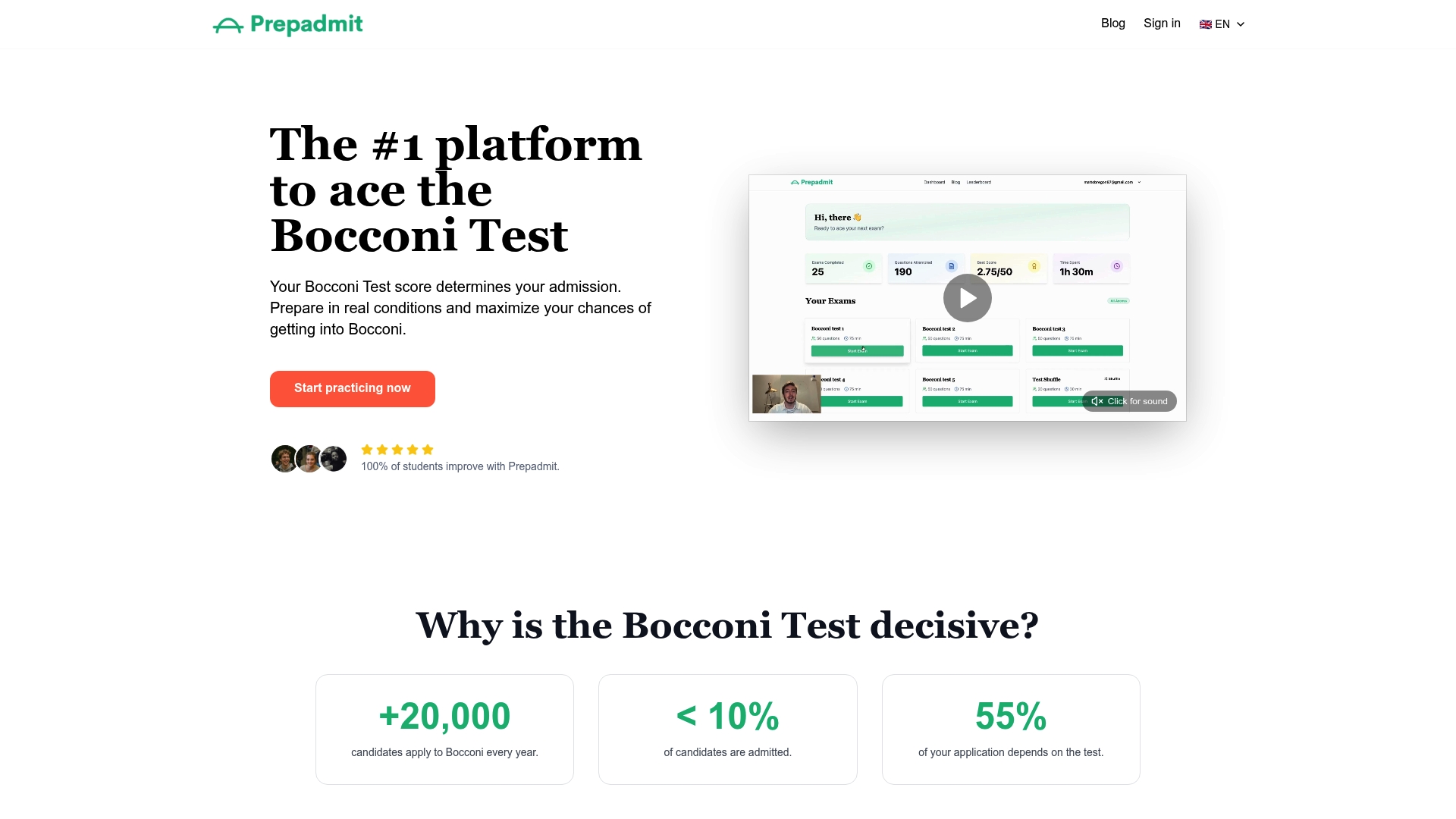
Where this guide gives you the framework, Prepadmit gives you the practice material: timed simulations, detailed answer corrections, skill-specific drill modes, and a peer ranking dashboard so you know exactly where you stand. The error-log approach described in this article is built into the platform’s correction system, so you are not tracking mistakes manually in a spreadsheet.
If you are serious about Bocconi admission, the next step is straightforward: start your preparation on Prepadmit and run your first timed simulation today.
Sources
- Improving Students’ Learning With Effective Learning Techniques: Promising Directions From Cognitive and Educational Psychology
- Study smart
- Five-Day Study Plan – Learning Strategies Center
- Psychologists identify the best ways to study | Scientific American
- Exam study strategies (Tilt, Colorado State University)
Recommended
Related articles
Ready to ace your admission test?
Discover PrepAdmit, the platform that helps you succeed at top university admission tests.
Discover PrepAdmit