On-Demand Practice Testing: What Students Need to Know

On-Demand Practice Testing: What Students Need to Know
On-demand practice testing is defined as asynchronous, web-based exam simulation that lets you take full-length tests anytime, receive instant scoring, and adjust your study plan based on immediate feedback. Unlike scheduled assessments, on-demand models require no proctor, no fixed time slot, and no administrative overhead. The cognitive science behind this method is well established. The testing effect, a principle from educational psychology, confirms that retrieving information from memory builds stronger, more durable knowledge than passive review. Platforms like Prepadmit apply this principle directly, giving students realistic exam simulations with detailed analytics and performance tracking.
What is on-demand practice testing and why does it work?
The testing effect is the single most important concept behind on-demand practice testing. It refers to the cognitive phenomenon where actively retrieving information from memory strengthens that memory trace far more than simply rereading notes or watching a lecture. Students who use retrieval practice retain knowledge longer and transfer it more effectively to new contexts. That is not a minor advantage. It is the difference between recognizing an answer on test day and actually producing it under pressure.

Immediate feedback is the second pillar. When you finish a practice test and see your score within seconds, you get an accurate picture of what you actually know versus what you think you know. Immediate results allow you to assess readiness accurately and focus on weak areas before they become costly mistakes on the real exam. Passive study methods like rereading or highlighting create an illusion of competence. Practice testing destroys that illusion quickly and productively.
There is also a concept called desirable difficulty that explains why practice testing feels harder than other study methods. Retrieval effort is uncomfortable precisely because it is working. Desirable difficulty and failure-driven learning enhance long-term retention, even when you get the answer wrong on the first attempt. Failing to retrieve an answer, then seeing the correct explanation, primes your brain to encode that information more deeply than if you had read it passively.
“Discomfort during retrieval indicates effective memory strengthening, not a sign that you are unprepared.” This reframe matters because most students abandon practice testing when it feels hard, which is exactly the moment it is doing the most work.
The benefits of practice testing extend beyond memory. Regular retrieval practice improves metacognitive monitoring, which is your ability to accurately judge what you know and what you do not. Students who rely on passive review consistently overestimate their readiness. Students who test themselves regularly do not make that mistake.
How does on-demand testing work in practical terms?
On-demand practice testing follows a clear three-step cycle: attempt, diagnose, and remediate. Each step builds on the last, and skipping any one of them reduces the method’s effectiveness significantly.
-
Attempt a full-length simulated exam. The test should mirror the real exam in format, timing, and content distribution. Web-based practice exams simulate real test environments with instant scoring and interactive formats, accessible anytime on multiple devices. Format fidelity matters because your brain needs to practice operating under the same conditions it will face on test day.
-
Diagnose your errors immediately. After the test, review every wrong answer with its full rationale. Do not just note that you got something wrong. Identify why you got it wrong. Was it a knowledge gap, a misread question, or a time pressure mistake? Each cause requires a different fix.
-
Remediate with targeted study. Use your error analysis to build a focused study session. If you missed three questions on a specific topic, that topic gets priority before your next test. Using rationales and error tagging improves targeted study and overall preparedness. Generic review sessions waste time. Targeted remediation does not.
Pro Tip: Tag each wrong answer with a cause code: “knowledge gap,” “misread,” or “time pressure.” After five practice tests, your error log will show clear patterns that tell you exactly where to focus.
The table below shows how on-demand testing compares across key operational dimensions.
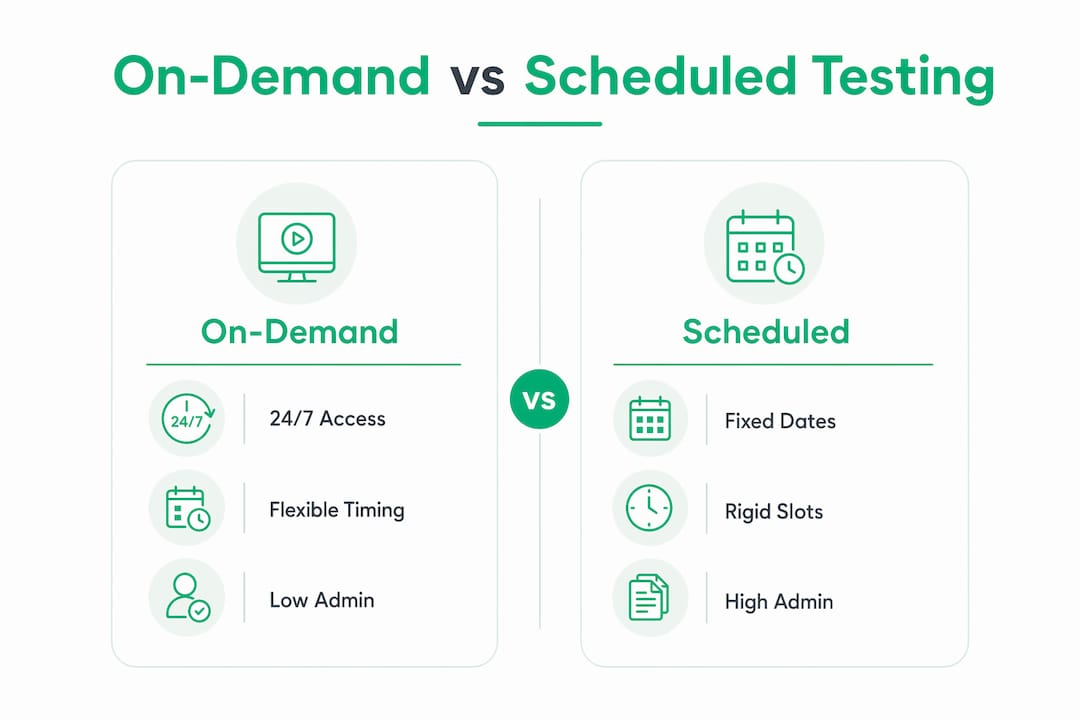
| Feature | On-demand testing | Scheduled assessment |
|---|---|---|
| Availability | 24/7, any device | Fixed date and time |
| Feedback speed | Instant | Delayed, sometimes days |
| Admin overhead | None | Requires scheduling and proctoring |
| Repetition flexibility | Unlimited retakes | Limited by exam calendar |
| Error analysis | Detailed, immediate | Often unavailable or generic |
Candidate flexibility and low administrative effort distinguish on-demand formats from every traditional alternative. For students preparing for competitive exams like the Bocconi Test, that flexibility is not a convenience. It is a strategic advantage.
How does on-demand testing compare to traditional study methods?
The most common misconception is that quizzes and full practice tests are interchangeable. They are not. Quizzes test narrow knowledge. Full practice tests simulate complete exam conditions, including timing and content distribution, to build exam endurance and application skills. Relying solely on short quizzes can create a false sense of preparedness because they never force you to sustain concentration across an entire exam.
Passive review methods, including rereading textbooks, rewatching lectures, and copying notes, feel productive but produce weak memory encoding. The effort feels low because it is low. Your brain is not retrieving anything. It is simply recognizing familiar material, which is a much weaker cognitive process than recall.
Last-minute cramming compounds the problem. Massed practice, where you study the same material intensively in one session, produces short-term familiarity that evaporates within days. Spaced practice, where you return to material across multiple sessions, builds retention that lasts. On-demand testing supports spaced practice naturally because you can schedule tests across weeks rather than cramming them into one night.
There is also a psychological barrier worth naming. Many students avoid practice testing because failing feels discouraging. This avoidance is counterproductive. Practice testing is a fundamental learning method, not just a study shortcut. The discomfort of retrieval is the mechanism, not a side effect. A structured revision plan that builds practice testing into weekly routines removes the psychological friction by making testing feel routine rather than high-stakes.
Fixed testing windows add another layer of difficulty for students with irregular schedules, time zone differences, or work commitments. On-demand formats remove that barrier entirely. You test when you are ready, not when the calendar says you must.
What are common pitfalls and how do you avoid them?
The most damaging mistake is repeating the same practice test immediately after finishing it. Spacing retests 48–72 hours apart maximizes retrieval strength and prevents rote memorization. When you retake a test the same day, you are not testing knowledge. You are testing short-term memory of the questions you just saw. The score looks better, but the learning is weaker.
Other common pitfalls include:
- Skipping the review phase. Finishing a test and moving on without analyzing errors wastes the most valuable part of the exercise. The review is where learning happens.
- Treating every wrong answer the same. A knowledge gap requires content study. A misread question requires attention training. Lumping them together produces unfocused remediation.
- Testing without a schedule. Random, infrequent tests produce inconsistent results. A regular testing cadence, such as one full test every five to seven days, builds momentum and makes progress measurable.
- Ignoring performance trends. Single test scores are noisy. Your score trend across five or ten tests is the real signal. If your score in a specific skill area is flat across three tests, that area needs a different approach.
Pro Tip: After each test, spend at least as much time reviewing wrong answers as you spent taking the test. A 90-minute exam deserves 90 minutes of diagnostic review.
Timed practice tests also train a skill that content review never touches: time management under pressure. Students who practice under real timing conditions arrive at the actual exam knowing exactly how to pace themselves. Students who study without timing often run out of time on questions they actually know.
Key Takeaways
On-demand practice testing works because retrieval effort builds durable memory, and immediate feedback corrects misconceptions before they become exam-day errors.
| Point | Details |
|---|---|
| Retrieval practice beats passive review | The testing effect confirms active recall builds stronger, longer-lasting memory than rereading. |
| Immediate feedback prevents false confidence | Instant scoring shows you what you actually know, not what you think you know. |
| Full tests outperform quizzes | Only full-length simulations build exam stamina, time management, and comprehensive readiness. |
| Space your retests | Wait 48–72 hours between attempts to maximize retrieval strength and avoid pattern memorization. |
| Diagnose errors by cause | Tagging mistakes as knowledge gaps, misreads, or time errors produces targeted, efficient remediation. |
Why I think most students use practice tests wrong
Most students treat practice tests as a measuring tool. They take a test, check the score, feel good or bad about it, and move on. That approach wastes the most powerful study method available.
The score is almost irrelevant. What matters is the error analysis that follows. Every wrong answer is a specific, actionable data point. It tells you exactly where your preparation has a gap. Students who treat each wrong answer as a diagnostic signal, rather than a judgment, improve faster and more consistently than those who focus on the score.
The psychological shift required here is real. Failing questions feels bad. Reviewing your mistakes in detail feels worse. But exam simulation under realistic conditions is the closest thing to a guaranteed improvement method that exists in exam preparation. The discomfort is not a sign that you are doing it wrong. It is confirmation that you are doing it right.
Technology has made this easier than it has ever been. On-demand platforms give you instant data, detailed rationales, and the ability to test at any hour. The only thing standing between most students and a significantly better score is the willingness to sit with the discomfort of retrieval practice and use the feedback honestly.
— quentin
Prepadmit’s on-demand practice tests for the Bocconi Test
Prepadmit is built specifically for students preparing for the Bocconi Test, the entrance exam for Bocconi University in Italy. The platform offers web-based, self-paced simulated exams that replicate real test conditions using official past papers.
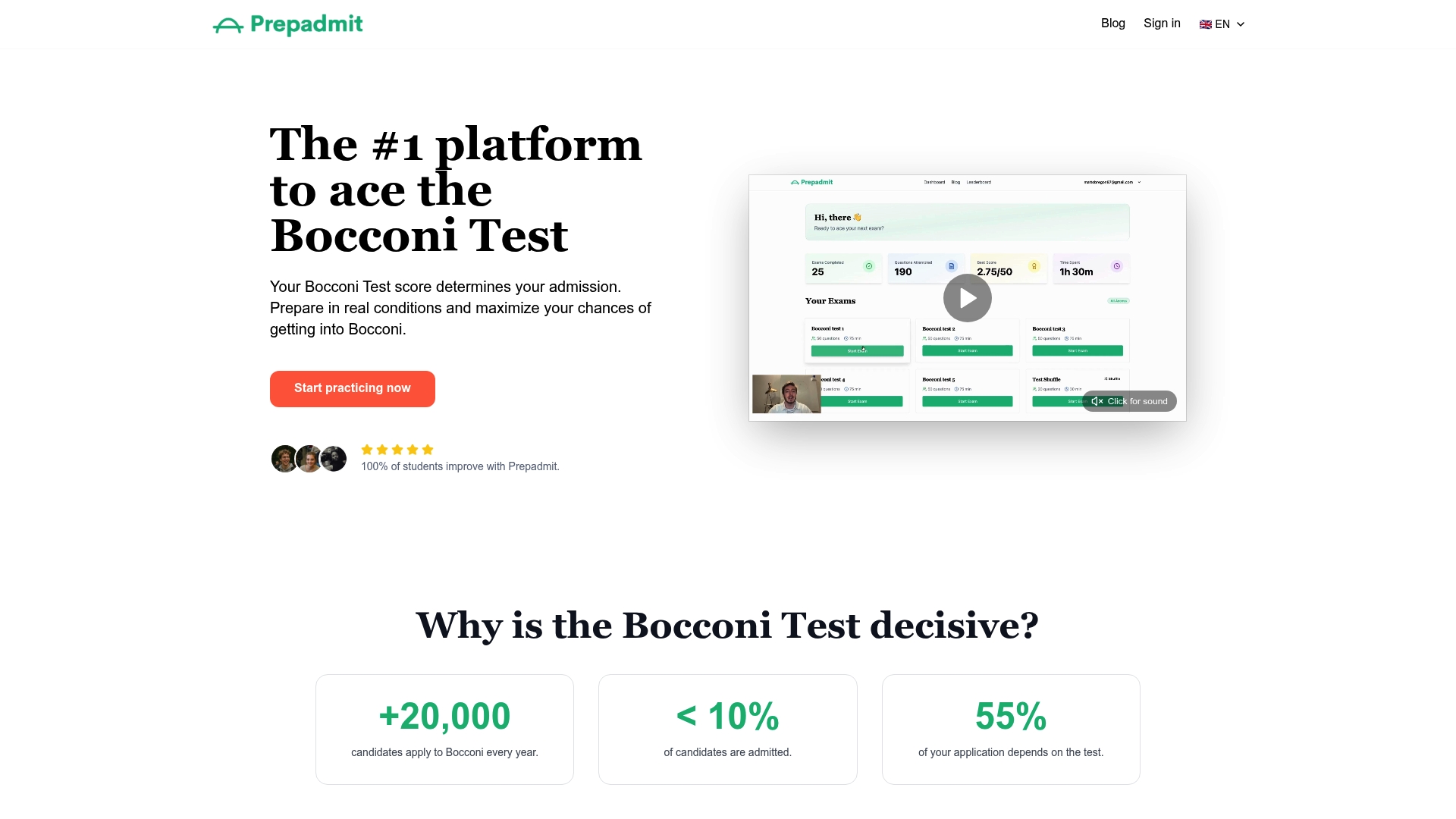
Every test on Prepadmit delivers instant scoring, detailed answer corrections, and skill-specific performance analytics. You can track your progress over time, see where you rank against other students, and identify exactly which areas need more work. Prepadmit reports an average score improvement of 34% for students who use the platform consistently. Start your preparation and see where you stand today.
FAQ
What is on-demand practice testing?
On-demand practice testing is asynchronous, web-based exam simulation that lets you take full-length tests at any time, with instant scoring and detailed performance feedback. No scheduling or proctor is required.
How is a practice test different from a quiz?
A quiz tests a narrow slice of content. A full practice test simulates complete exam conditions, including timing and content distribution, to build stamina and comprehensive readiness.
How often should I take practice tests?
One full-length practice test every five to seven days is a reliable cadence for most students. Space retests at least 48–72 hours apart to maximize retrieval strength.
Does getting answers wrong on practice tests hurt my preparation?
Getting answers wrong is productive. Failure during retrieval primes better memory encoding when you review the correct answer, a principle known as desirable difficulty.
What makes on-demand testing better than fixed-schedule exams?
On-demand testing removes scheduling conflicts, time zone barriers, and administrative delays. You test when you are ready, get results instantly, and start your diagnostic review the same day.
Recommended
Related articles
Ready to ace your admission test?
Discover PrepAdmit, the platform that helps you succeed at top university admission tests.
Discover PrepAdmit