What the Bocconi Online Test Actually Involves

What the Bocconi Online Test Actually Involves
The Bocconi Online Test is a 50-question, proctored admission exam you take from home, and a separate version exists for Bocconi’s Law program. If “piano studio test Bocconi” brought you here, note that the university’s Music Room piano is a campus facility, not part of admissions. Your next moves: confirm your eligibility window, register on the official webtesting platform, book a date, and start timed practice with Prepadmit or similar tools right away.
TL;DR:
- Candidates should focus on practicing under timed conditions using official past papers to develop pacing and pattern recognition skills for the sample exam structure.
- It is crucial to complete the online registration and booking process at least 48 hours before the test, while considering different booking windows for Italian and international candidates.
- Preparing for the test requires targeting specific areas: algebra and word problems, reading comprehension, data interpretation, and logical reasoning, with emphasis on speed.
- Candidates must ensure their testing environment is quiet, clutter-free, and contains only the necessary equipment, as proctoring monitors for irregularities during the exam.
- Multiple attempts are allowed but spread across the year, so using the first try as a diagnostic helps avoid unnecessary fatigue and maximizes chances for improvement.
Table of Contents
- Piano studio test Bocconi: clearing up the confusion first
- What does the Bocconi Online Test actually measure?
- How do you register, book a slot, and what does it cost?
- What should you actually study for each section?
- How should you plan a 4 to 8 week study schedule?
- What technical setup and proctoring rules should you expect?
- How do you read your score report and set a target?
- Why Prepadmit fits directly into this study plan
- How much do test results actually affect your admission chances?
- How should you set up your environment on test day?
- What mistakes do candidates make most often during the test?
- What support exists if something goes wrong during the test?
- A realistic playbook beats theoretical advice
- Ready to turn this study plan into practice?
- Sources
Piano studio test Bocconi: clearing up the confusion first
Search “piano studio test Bocconi” and you land in one of two very different places. One is the admission exam that decides whether you get into Bocconi University. The other is the Music Room on Via Sarfatti, a soundproofed practice space with a Yamaha upright piano that current Bocconi students book for roughly €30.50 a year, limited to two one-hour sessions a day.
If you are still applying, the Music Room is irrelevant to you right now. It reopens for enrolled students each September and requires a payment confirmation and order ID before you can reserve a slot. The university even profiled the students who use that piano, which is likely how the phrase “piano studio” started crossing into search results for the admission test.
What you actually need to prepare for is the Bocconi Online Test, sometimes written informally as the Bocconi entrance exam piano by studio, syllabus, or format. It has nothing to do with music. It is a timed, multiple-choice assessment of math, reading, and reasoning skills, delivered under strict remote proctoring. Everything from here forward covers that exam.
What does the Bocconi Online Test actually measure?
Bocconi runs two versions of this exam, and which one applies to you depends entirely on your intended program. Both share a similar structure. Neither shares anything with a music assessment.
The standard Bocconi Online Test covers four areas across 50 multiple-choice questions, based on the official area breakdown:
- Mathematics: 24 questions
- Reading comprehension: 11 questions
- Numerical reasoning: 6 questions
- Critical thinking: 9 questions
Bocconi Online Test - Law restructures that split across five areas, adding weight to verbal and logical reasoning suited to legal study, since Law applicants are evaluated on argument structure and precise language interpretation rather than heavy quantitative work. If you are applying to Bocconi’s Law program, do not study the standard test’s math-heavy syllabus and assume it transfers directly.
Every question is SAT-style multiple-choice: one correct answer, no partial credit, no open response. That format rewards speed and pattern recognition over creative problem-solving, and the entire exam runs on a strict, unbroken clock. There is no separating “the math part” from “the rest” once the timer starts. You move through sections in the order the platform gives you, and once you submit an answer, you generally cannot revisit earlier questions. Practicing under that exact constraint matters more than reviewing content in isolation.
How do you register, book a slot, and what does it cost?
You register and book every attempt through bocconiwebtesting.giuntipsy.com, the external platform Bocconi uses to administer the exam. This is the only official channel. There is no walk-in version, no paper equivalent, and no way to sit the test through a third party.
Attempt limits: You get up to four attempts per test type per academic year, but not on the same day or on consecutive days. Bocconi enforces spacing so you cannot brute-force your way to a good score through repetition.
Booking windows differ depending on whether you are an Italian or international candidate. In a recent cycle, Italian candidates could book from mid July through late April of the following year, while international candidates faced an earlier cutoff, closing in mid January. That gap exists because international applications typically move through earlier admission rounds, so check your specific category before assuming you have months of runway.
Key logistics to lock in before you do anything else:
- Cost: €60 per attempt, charged each time you book, regardless of test type.
- Booking must happen at least 48 hours before your chosen slot.
- Sessions cluster around named windows, often labeled Early, Winter, and Spring, each with its own final booking date tied to application deadlines.
- You cannot switch test types mid-booking. Confirm you are registering for the right one.
Book earlier than you think you need to. High demand sessions fill fast near deadline cutoffs, and a late booking can force you into a slot at an inconvenient time of day, which matters more than it sounds like when you are trying to stay sharp for 50 timed questions.
What should you actually study for each section?
Bocconi does not publish an official prep manual. Its own pages point candidates toward the test’s structure and encourage practicing with realistic simulations rather than memorizing a textbook. That is a deliberate signal: this test rewards applied skill and speed, not rote recall of formulas you crammed the night before.
Here is where to actually put your hours, area by area:
- Mathematics (heaviest weight on the standard test). Focus on algebra, percentages, ratios, basic geometry, and word problems that hide a two-step calculation inside a paragraph. Bocconi’s math questions rarely test advanced content. They test whether you can extract the right operation from a wordy setup, fast.
- Reading comprehension. Expect dense academic or argumentative passages, often 300 to 500 words, followed by questions on main idea, inference, and tone. Practice reading actively: underline the argument’s turn, not every sentence.
- Numerical reasoning. This section blends data interpretation with quick arithmetic, often through tables or short data sets. Build shortcuts for estimating percentages and ratios without a calculator, since speed matters more than precision to the third decimal.
- Critical thinking. These questions test whether you can spot a flawed assumption or a logical gap in an argument. Drills built for legal reasoning, like those in LSAT-style logical reasoning practice, transfer surprisingly well here even if you are not applying to Law.
- Verbal reasoning (Law test only). Expect heavier emphasis on precise language interpretation, argument structure, and multi-step logical inference specific to legal-style reasoning.
Pro Tip: Time yourself on individual question types before you ever attempt a full mock. If you consistently take 90 seconds on a numerical reasoning question that should take 45, that gap will compound across the real exam and cost you entire unanswered questions later.
How should you plan a 4 to 8 week study schedule?
A six-week plan built around escalating intensity works for most applicants who are not starting from zero. Adjust the timeline down to four weeks if you are already comfortable with standardized testing, or stretch to eight if math is genuinely rusty.
- Week 1: Diagnostic and baseline. Take one full timed mock under real conditions, no notes, no pauses. Log every missed question by topic, not just by section.
- Week 2: Targeted math and numerical reasoning. Since math carries the heaviest weight on the standard test, spend the bulk of your hours here, roughly 6 to 8 hours across the week, drilling the specific error patterns your diagnostic revealed.
- Week 3: Reading comprehension and critical thinking. Shift focus to passage analysis and argument evaluation, aiming for 5 to 6 hours, with daily timed passage drills.
- Week 4: Second full mock, then error triage. Compare your subscore movement against week one. Any area that did not improve gets doubled attention going into week five.
- Week 5: Mixed timed drills across all areas. Simulate the exam’s actual pacing pressure by practicing sections back to back, not in isolation, since that is how the real test will feel.
- Week 6: Final full mock, light review, rest. Take your last complete simulation at least three days before your booked date, then taper down. Cramming the night before rarely fixes a weak area and often just adds fatigue.
This structure mirrors step-by-step preparation approaches built specifically around Bocconi’s test format, and it works because each mock generates the data that directs the next week’s drills. Studying blind, without that feedback loop, is the single biggest time-waster candidates fall into.
What technical setup and proctoring rules should you expect?
The exam runs through a lockdown browser with active audio and video recording throughout your attempt, so your setup needs to work correctly before you ever click “begin.” Bocconi’s own instructions and rules of behavior document lays out the required checklist:
- A computer with administrator access, since the lockdown browser needs to install and run without restriction.
- A second device, typically a smartphone or tablet, positioned for lateral monitoring of your hands, desk, and immediate surroundings.
- A working webcam and microphone on your primary device.
- Stable, wired internet if at all possible. Wi-Fi drops mid-question are a real and preventable risk.
The proctoring flow itself follows a fixed sequence: identity verification against a photo ID, a full room scan with your secondary device, then a locked browser session for the duration of the test. Skipping or rushing the room scan is one of the most common causes of flagged or invalidated attempts.
Pro Tip: Run the official system check and a complete mock test on the exact same hardware setup you plan to use on test day, at least 48 hours in advance. Discovering a webcam angle problem five minutes before your real attempt is far worse than discovering it during a practice run.
How do you read your score report and set a target?
After you finish an attempt, your score report becomes available through the same webtesting platform you booked on, typically showing a total score alongside subscores broken out by area. Reviewing the subscore breakdown matters more than staring at the total, since it tells you exactly where the next study block should go.
- A strong total score generally comes from consistency across areas, not one standout section covering for a weak one, since admissions weighting rewards balanced performance.
- Compare your subscores against your own diagnostic baseline first. Improvement trend matters more than chasing an arbitrary number you saw mentioned somewhere online.
- If your application deadline allows it, use your four available attempts strategically: one diagnostic, one or two practice-informed retakes, and a final attempt with real buffer time before submission.
With up to four attempts per test type per academic year, spaced so you cannot sit them on the same or consecutive days, retaking is built into the system. That structure only helps you if you leave enough calendar room to actually act on what a score report tells you.
Why Prepadmit fits directly into this study plan
Prepadmit was built around one specific problem: generic SAT prep does not replicate Bocconi’s exact format, timing, and pressure. The platform runs on official past papers and on-demand practice tests that mirror the real exam’s structure question count for question count, so the mocks you take actually resemble what you will face under lockdown-browser conditions.
Here’s how the features map onto the study plan above:
- Diagnostic phase: Use an on-demand test in week one to establish your real baseline, not a guessed one.
- Targeted drills: Skill-specific practice modes let you isolate math, reading, or reasoning weaknesses instead of retaking full mocks every time.
- Timed mocks: Simulated timing conditions in weeks four and six train your pacing instincts under the same pressure as test day.
- Final review: Detailed answer corrections turn missed questions into specific, fixable error patterns rather than vague regret.
| Study plan phase | Prepadmit feature | What it fixes |
|---|---|---|
| Diagnostic (week 1) | On-demand full test | Establishes real baseline, not a guess |
| Targeted drills (weeks 2 to 3) | Skill-specific practice modes | Isolates weak topics fast |
| Progress check (week 4) | Progress tracking, peer ranking | Shows if you’re improving relative to others |
| Timed mocks (weeks 5 to 6) | Simulated timing, official past papers | Builds real exam pacing |
Prepadmit claims that training on the platform can lead to notable score improvements among many students and offers money-back guarantees to support its effectiveness.
How much do test results actually affect your admission chances?
Your Bocconi Online Test score is not the entire application, but it functions as a hard filter early in the process. Bocconi uses it alongside your academic record and, depending on the program, other application components, to shortlist candidates for further stages.
A weak score does not automatically disqualify you, but it puts more pressure on every other part of your file to compensate, and there is no guarantee that compensation happens. A strong score, conversely, does not guarantee admission on its own, since Bocconi evaluates the complete applicant, not a single number in isolation.
Where the test carries outsized weight is in comparative terms. Bocconi receives applications from a large, ambitious pool, and standardized test performance gives the admissions committee one of the few directly comparable data points across every candidate, regardless of which high school or country they come from. Grade scales vary wildly between school systems. A 50-question, identically timed exam does not.
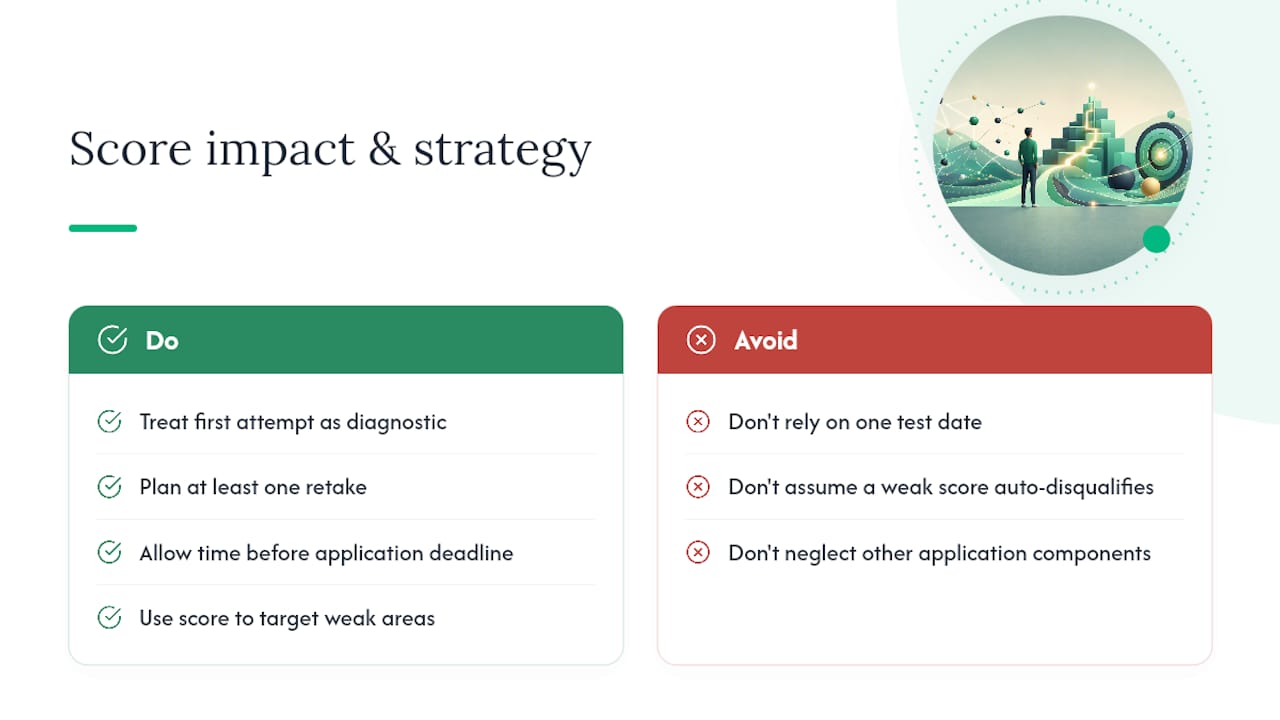
That is exactly why retake strategy matters so much. If your first attempt lands below where you wanted, treat it as diagnostic information, not a final verdict. You have up to four attempts per test type in an academic year specifically because Bocconi expects a meaningful share of applicants to improve with practice and familiarity, not because everyone gets the score right on attempt one.
The practical takeaway: do not submit your application banking on a single test date going well. Build in enough time to retake at least once if week one’s mock reveals gaps you have not closed yet.
How should you set up your environment on test day?
Your physical environment matters as much as your academic preparation, because the proctoring system is actively watching for anything that looks like an irregularity, and a messy setup can trigger unnecessary flags even when you are doing nothing wrong.

Choose a room with a plain, uncluttered background and a door you can close. The room scan at the start of your session requires you to show your surroundings clearly, and a shared living space with people walking through frame is a recipe for interruption, not just distraction.
Clear your desk down to your ID, a glass of water, and nothing else. No notes, no second monitor, no phone within reach beyond the one device positioned for lateral monitoring. Bocconi’s proctoring rules treat unauthorized materials strictly, and “I forgot it was there” is not a defense that helps you once a session is flagged.
Silence every notification source in the room. Phone on airplane mode except for its monitoring function, smart speakers unplugged, other devices closed. A single buzzing notification during a 50-question timed exam can cost you focus you will not get back in the remaining time.
Tell whoever else lives in your space exactly when your test window is and ask for genuine quiet, not just an attempt at it. A knock on the door mid-test is one of the most common, entirely preventable disruptions candidates report. Treat the hour before your test the same way you would treat the hour before a real, in-person exam: no last-minute cramming, just a calm runthrough of your setup checklist.
What mistakes do candidates make most often during the test?
The most common and costly mistake is poor time management within sections, not lack of knowledge. Because you generally cannot go back to revisit earlier questions once you move forward, spending four minutes wrestling with one hard math problem can quietly eat into the time you needed for three easier questions later in the same section.
A close second is skipping the practice room scan and system check until minutes before the real attempt. Candidates who discover a webcam angle problem, a browser permission issue, or a lockdown conflict five minutes before their booked slot are working from panic, not preparation, and panic degrades performance on exactly the kind of fast pattern recognition this test demands.
Overthinking straightforward reading comprehension questions ranks third. Some candidates second-guess an obviously correct answer because it “feels too easy,” burning time that should go toward genuinely difficult questions later in the section.
A subtler mistake: treating all four attempts as equally low-stakes practice runs. Since attempts cannot happen on the same or consecutive days, each one costs real calendar time you cannot get back before an application deadline. Go into every attempt, even an early one, with the intention of performing your best, not just gathering data.
Finally, candidates sometimes ignore the booking window differences between candidate categories and end up scrambling near a cutoff they did not realize was approaching. Confirm your specific window early, and never assume the general deadline applies to your category without checking.
What support exists if something goes wrong during the test?
Because the exam runs on an external platform with strict proctoring, Bocconi and the webtesting provider maintain support channels for genuine technical failures, distinct from ordinary candidate error. If your internet drops, your webcam fails mid-session, or the lockdown browser throws an unexpected error, documentation matters immediately.
Take a screenshot or photo of any error message the moment it appears, note the exact time, and contact the support channel listed in your booking confirmation as soon as possible. Waiting until after your session ends to report a problem makes it far harder to resolve fairly, since the proctoring recording is the primary evidence available to reconstruct what happened.
The official instructions document also specifies the procedural steps you are expected to follow if a technical issue interrupts your session, including staying visible on camera and not closing the browser window, since doing so can complicate any review of the interruption. Read that section of the rules document before your test, not after something goes wrong, so you are not improvising under stress.
Support windows generally align with test session hours rather than running around the clock, so booking a slot during standard operating hours, rather than a rare late-night window, gives you a better chance of immediate help if something technical fails. This is a small, easy detail to overlook when you are focused purely on convenience while booking.
A realistic playbook beats theoretical advice
Most guidance about this exam treats studying and logistics as separate problems. That’s backward. The candidates who struggle most are rarely the ones who don’t know enough math. They’re the ones who booked late, discovered a webcam issue mid-session, or burned their four attempts without ever running a diagnostic first.
The conventional advice to “just practice more” misses the actual lever. Four attempts a year, spaced apart by rule, means your first attempt should function as data collection, not a final performance. Treating it that way changes everything about how you allocate the six weeks before your real target date.
If you take one thing from this guide, prioritize matching your practice conditions to the real exam before you worry about content depth. A student who is mediocre at math but has run three full timed mocks on the exact hardware they’ll use on test day will often outperform someone who knows the material cold but has never felt the clock pressure or the lockdown browser’s constraints. Simulation beats memorization here, every time.
— quentin
Ready to turn this study plan into practice?
Coaching a Bocconi candidate one-on-one typically runs into the hundreds of euros for a handful of sessions, and generic SAT prep books were never built around this exam’s exact 50-question structure. Prepadmit gives you the one thing neither of those options replicates well: official past papers and on-demand mock tests that match the real Bocconi Online Test’s format, timing, and question breakdown, at a fraction of what private coaching costs.
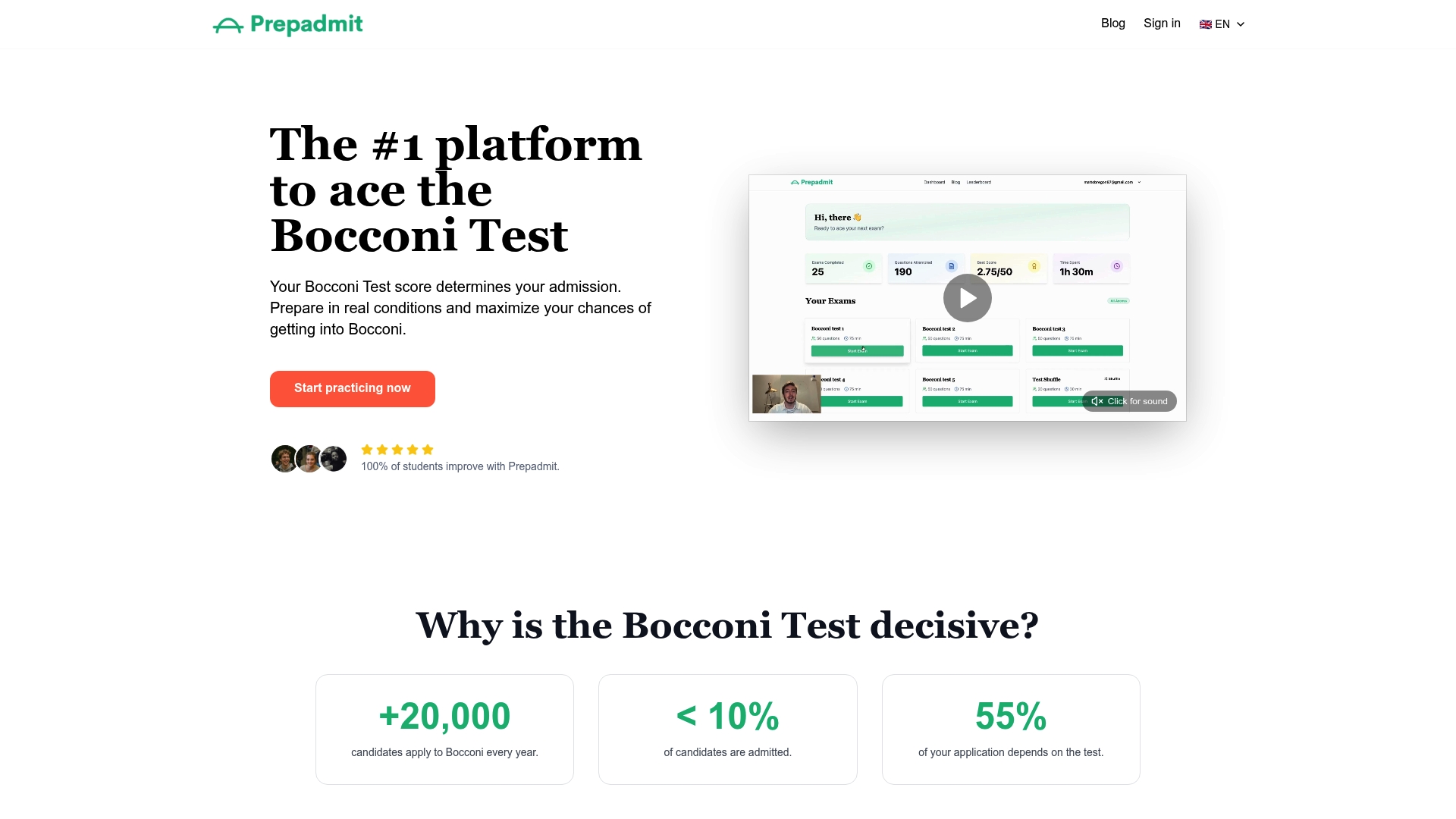
The platform maps directly onto the six-week plan outlined above. Start with a diagnostic mock to find your real baseline, move into skill-specific drills for whichever area your subscores flag as weakest, then layer in timed full mocks in the final two weeks to build genuine pacing instincts. Every attempt comes with detailed answer corrections, so you understand exactly why a question went wrong, not just that it did. Progress tracking and peer ranking dashboards show you where you stand before you ever spend €60 on a real attempt.
If your target date is four to eight weeks out, start with a diagnostic test on Prepadmit today and build your study schedule around what it actually reveals about your strengths.
Recommended
Related articles
Ready to ace your admission test?
Discover PrepAdmit, the platform that helps you succeed at top university admission tests.
Discover PrepAdmit