Fix Bocconi Test Weak Areas Before Exam Day

Fix Bocconi Test Weak Areas Before Exam Day
Most students preparing for the Bocconi admission test study hard but still feel unsure about where they actually stand. You might spend hours reviewing content only to realize on test day that your bocconi test weak areas fix was never really a plan. It was just wishful thinking. This guide gives you a structured approach to diagnosing your weaknesses, targeting them with focused practice, and verifying real progress through mock exams. No guessing. No wasted time. Just a clear path from where you are now to where you need to be.
Table of Contents
- Key Takeaways
- How to find and fix your Bocconi test weak areas
- Step 1: Use a diagnostic to pinpoint weak areas
- Step 2: Focused practice on your weakest sections
- Step 3: Mock tests to confirm real progress
- Common mistakes when fixing weak areas
- My honest take on fixing weak areas
- Start fixing your weak spots with Prepadmit
- FAQ
Key Takeaways
| Point | Details |
|---|---|
| Diagnose before you study | Take a diagnostic test first to find specific weak areas before spending time on broad review. |
| Math is the top priority | With nearly 48% of questions in Math, fixing gaps there gives the biggest score boost. |
| Penalty awareness changes strategy | Wrong answers lose points, so guessing only works when you can eliminate at least two choices. |
| Error types need different fixes | Time sinks, early skips, and wrong guesses are each a different problem requiring a different solution. |
| Mock tests confirm real progress | Full timed mocks reveal whether your improvements actually hold under real test pressure. |
How to find and fix your Bocconi test weak areas
Before you can fix anything, you need to understand what you are actually dealing with. Many students think their weak areas are about not knowing enough content. But weak areas often come from strategy and pace problems rather than pure knowledge gaps. A student who knows the math concept but runs out of time has a pacing problem, not a content problem. Those two issues need completely different solutions.
The first step is separating the two. Ask yourself after a wrong answer: did you not know how to solve it, or did you run out of time and rush? Did you skip it because you panicked, or because you genuinely had no idea? This distinction will shape everything else in your preparation.
What the test actually looks like
The Bocconi University admission test, formally called the Bocconi Test, is a 75-minute exam with 50 questions across four sections. Section timing breaks down as roughly 20 minutes each for Math, Logic, and Reading, with 15 minutes for English. That pacing gives you about two minutes per question in most sections and less than 30 seconds per English question.
| Section | Questions | Time | Wrong Answer Penalty |
|---|---|---|---|
| Mathematics | 24 | ~20 min | -0.2 |
| Logic | ~8 | ~20 min | -0.2 |
| Reading Comprehension | ~8 | ~20 min | -0.33 |
| English | 10 | ~15 min | -0.2 |
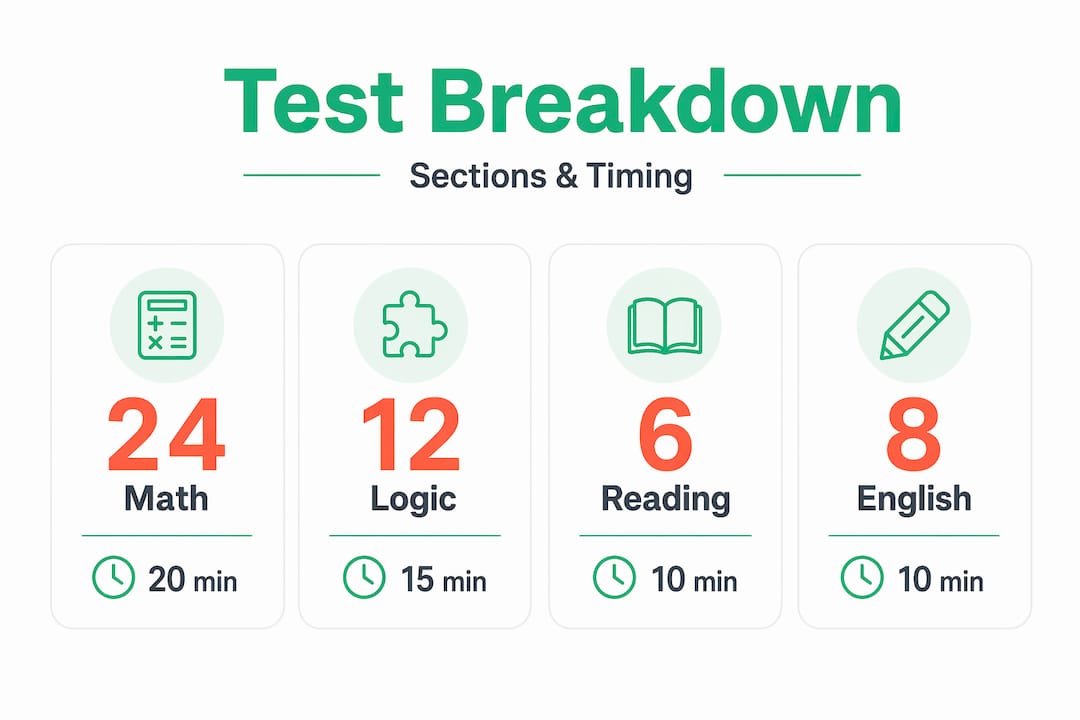
The scoring system penalizes wrong answers at either -0.2 or -0.33 depending on the section, while blank answers get zero points. This matters a lot. Skipping a question you are unsure about is often the smarter move, especially in Reading where the penalty is steeper.
Pro Tip: Track how long you spend per question in practice. If you are consistently taking over three minutes on Math problems, you have a pacing problem, not just a content problem.
Step 1: Use a diagnostic to pinpoint weak areas
Do not start week one with a full study plan covering every topic. Start with a diagnostic test. A 15-question diagnostic covering all test sections can immediately show you which areas need the most attention and what kind of errors you are making.
Here is how to run an effective self-diagnosis:
- Take a short timed diagnostic test that covers all four sections.
- Record every answer, including which ones you skipped and how long each one took.
- Sort your mistakes into two categories: content errors (you did not know how to approach it) and pacing or strategy errors (you knew the concept but ran out of time or second-guessed yourself).
- Count errors by section to see which area has the most content gaps.
- Look for patterns. If you are getting Logic questions wrong in the last five minutes of that section, that is a pacing issue. If you are getting them wrong at the start, that is a content issue.
Section timing differences are useful here. Errors concentrated near the end of a section usually signal time pressure. Errors spread throughout a section usually signal genuine knowledge gaps. Both show up as wrong answers, but they need completely different responses.
Pro Tip: Look for patterns in where your time goes, not just which answers are wrong. Time logs reveal as much as answer logs do.
Step 2: Focused practice on your weakest sections
Once you know your weak areas, resist the urge to study everything equally. Prioritize ruthlessly. Since Mathematics makes up nearly 48% of the exam, a math weakness costs you more than a weakness anywhere else. Fix it first.
Focused practice means working on your lowest-performing topics every single day for a set period before rotating to others. A simple weekly structure that works:
- Days 1 to 3: Deep practice on your single weakest section (likely Math or Logic)
- Day 4: Mixed timed drills across two sections to build switching speed
- Day 5: Review errors from earlier in the week. Categorize them by failure type.
- Days 6 to 7: Light review plus one short timed set to maintain other sections
The error categorization approach is what separates average preparation from great preparation. Here is how to use it:
- Time sinks: Questions that took you way too long. Fix with faster recognition drills. Practice spotting solution shortcuts.
- Early skips: Questions you gave up on immediately. Fix with confidence-building targeted topic work.
- Wrong after eliminating: You narrowed it down but guessed wrong. Fix by reviewing when to commit versus when to leave blank.
- Careless errors: You knew it but made a mistake. Fix with slow, deliberate practice before adding speed back.
On guessing strategy: effective guessing requires eliminating at least two answer choices. If you cannot eliminate two, skipping is statistically better than guessing, given the penalty structure. This is a skill you practice in drills, not something you figure out under pressure on test day.
Pro Tip: Do not practice guessing randomly. In each drill, force yourself to eliminate at least two choices before committing to any guess. Build the habit now.
Step 3: Mock tests to confirm real progress
Focused practice builds the skill. Mock exams confirm it holds under pressure. Without full timed mocks, you cannot know whether your improvements are real or just the result of studying in low-stakes conditions.

Timed practice under real exam conditions is not just about motivation. It is a distinct skill that requires deliberate training. Sitting down and pushing through 75 minutes without breaks, managing anxiety, and making fast decisions under pressure are all things you get better at through repetition.
Here is how to run a useful mock exam cycle:
- Set up your environment exactly as you would on test day. No phone, no music, no breaks.
- Complete all 50 questions within the 75-minute limit.
- After the mock, score it fully and categorize every error using the same failure-type system from Step 2.
- Identify whether your weak areas are shrinking or changing character. A content gap becoming a pacing issue is actually progress.
- Adjust your study plan based on what the mock reveals, not what you assumed before taking it.
A structured 12-week preparation plan typically places the first full mock around weeks six to seven, after initial targeted practice. After that, you take a mock every one to two weeks and use each result to update your study priorities.
| Mock exam stage | What to check | What to adjust |
|---|---|---|
| First mock (week 6) | Overall score and section breakdown | Reprioritize weakest section |
| Mid prep (week 9) | Error type patterns | Shift from content to pacing drills if needed |
| Final mock (week 11) | Speed and accuracy combined | Focus on mental stamina and skipping strategy |
Role of mock exams in test success goes beyond score measurement. They train your brain to perform under the specific conditions of this exam.
Common mistakes when fixing weak areas
Even motivated students fall into traps that slow progress. Knowing these in advance saves you significant time.
- Starting too late. Most students need at least eight to twelve weeks to meaningfully fix weak areas. Starting two weeks out just reduces anxiety without fixing the actual problems.
- Treating all areas equally. If you spend the same time on English (10 questions) as on Math (24 questions), your effort-to-score ratio is way off. Prioritize by question count and your personal error rate.
- Ignoring mock test feedback. Taking a mock and not analyzing it carefully is almost as wasteful as not taking one at all. The data from each mock is the most valuable study material you have.
- Using only one resource. Different resources explain the same concept differently. When you get stuck on a type of problem, a second explanation often unlocks it.
- Skipping rest before test day. Your brain consolidates learning during sleep. Cramming the night before does not add to your score. It reduces it.
Preparing smarter means using every practice session to learn something specific about yourself, not just to accumulate hours.
My honest take on fixing weak areas
I have worked with students preparing for the Bocconi Test, and the pattern I see most often is this: students who struggle are not unintelligent. They are undirected. They study for hours without a clear diagnosis, and they mistake effort for progress.
What actually shifted scores was not studying more content. It was helping students understand how the test thinks. The exam rewards decisiveness under time pressure. Once I started treating timed practice as a developed skill rather than a natural ability, students’ scores started moving in the right direction.
The diagnostic step is the one most students skip. They think they already know their weaknesses. They almost never do. Math feels hard when Logic is actually the real problem. Reading scores look fine until you realize you are burning time you needed for Math. You need data, not intuition.
My advice is simple: take one diagnostic session before you do anything else. Build your entire plan from that data. Do not let anyone tell you that generic study guides are enough. The test is specific. Your preparation should be too.
— quentin
Start fixing your weak spots with Prepadmit
You now have the framework. Putting it into practice is where Prepadmit makes the difference.
Prepadmit is built specifically for Bocconi Test preparation. The platform gives you access to official past papers, on-demand timed tests, and detailed error breakdowns by section and question type. It tracks your progress over time so you can see exactly which weak areas are improving and which ones still need work. The structured preparation system mirrors the approach in this article: diagnose, practice, verify. Students using Prepadmit improve their scores by an average of 34%. Start your preparation at Prepadmit and get real data on where to focus your time.
FAQ
What are the most common weak areas on the Bocconi Test?
Mathematics is the most impactful weak area since it makes up nearly 48% of the exam. Logic and Reading Comprehension are also common trouble spots because of their high per-question time demands.
How do I know if my weakness is content or pacing?
If you get questions wrong mostly near the end of a section, the issue is usually pacing. If errors appear throughout the section regardless of timing, you likely have a content gap that needs targeted practice.
Should I guess or skip on the Bocconi Test?
Skip unless you can eliminate at least two answer choices first. The penalty for wrong answers (-0.2 or -0.33 depending on the section) makes random guessing a net loss on your score.
How many mock exams should I take before test day?
Most structured preparation plans suggest two to four full timed mocks over a 12-week period, with the first around week six and the last about one week before the exam.
How long does it take to fix a weak area on the Bocconi Test?
With focused daily practice, most students see measurable improvement in a specific section within three to four weeks. Starting at least eight weeks before the exam gives you time to address multiple weak areas properly.
Recommended
Related articles
Ready to ace your admission test?
Discover PrepAdmit, the platform that helps you succeed at top university admission tests.
Discover PrepAdmit