Exam Prep Without Tutors: Your Bocconi Test Guide

Exam Prep Without Tutors: Your Bocconi Test Guide
Exam prep without tutors is defined as self-directed study where you take full ownership of your learning through structured practice, proven techniques, and targeted resources. For students preparing for the Bocconi Test, this approach is not a compromise. About 40% of top performers use pure self-study methods with disciplined routines and proper resources. Self-study is also often far more cost-effective than traditional tutoring. The key is replacing passive habits with active recall, spaced repetition, and timed practice tests. Done right, independent exam preparation builds the discipline and confidence that no tutor can give you.
What is exam prep without tutors, and does it actually work?
Independent exam preparation means you design your own study plan, select your own resources, and hold yourself accountable for results. The industry term for this approach is self-directed learning. It works when students apply evidence-based methods rather than relying on instinct or habit.
The Bocconi Test covers logical reasoning, mathematics, and reading comprehension. These are skills you can build on your own. The test rewards consistent practice and pattern recognition, not memorized lecture notes. Students who treat preparation as a skill-building process, rather than a content-cramming exercise, perform better.

Self-study is mindset-driven, requiring discipline and consistency rather than passive reading. That mindset shift builds qualities tutoring cannot replicate. You learn to identify your own weaknesses, adjust your approach, and take ownership of every mistake.
What are the most effective self-study exam techniques?
Active recall is the single most powerful study technique available to you. Active recall methods like practice testing outperform rereading and highlighting by a wide margin for retention. Passive techniques feel productive but produce weak memory traces.
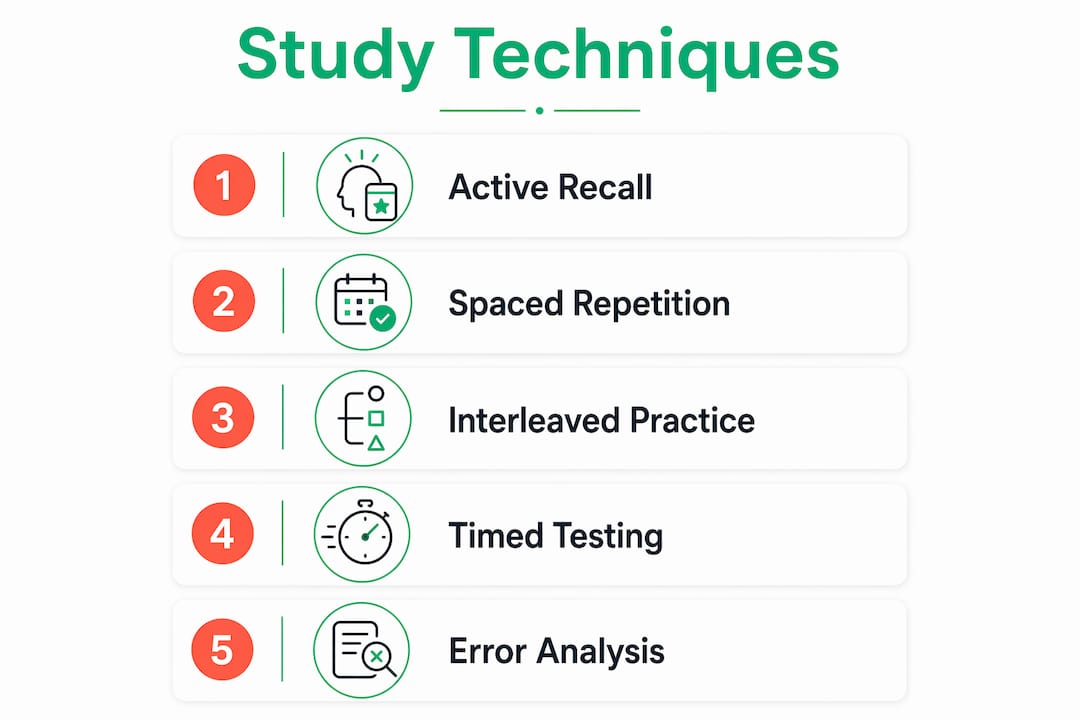
Here are the techniques that produce real results:
- Active recall: Close your notes and try to retrieve information from memory. This forces your brain to strengthen the neural pathways connected to that knowledge.
- Spaced repetition: Review material at increasing intervals. Revisit a topic after 24 hours, then after three days, then after a week. This converts short-term memory into long-term retention.
- Interleaved practice: Mix different question types within a single study session instead of blocking one topic at a time. This builds flexible problem-solving skills.
- Elaborative interrogation: Ask yourself “why” and “how” after reading any concept. Connecting new information to what you already know deepens understanding.
- Error-based flashcards: After every practice test, convert every wrong answer into a flashcard. Turning missed questions into flashcards for dedicated review is the key to avoiding repeat mistakes and boosting scores.
Pro Tip: Do not review flashcards randomly. Sort them by topic and difficulty. Spend 80% of your flashcard time on the cards you keep getting wrong.
Students who regularly self-test retain about 50% more information after one week compared to passive studying. That gap compounds over months of preparation.
How to create a structured study plan for the Bocconi Test
A study plan without structure is just a wish list. You need a fixed schedule that treats every study block as non-negotiable. A strict study schedule of 6–8 hours a day with planned spaced repetition accelerates mastery over the syllabus. That is the standard for serious independent preparation.
Build your plan in four steps:
- Map the syllabus. List every topic on the Bocconi Test. Assign each topic a priority based on how frequently it appears and how weak you currently are in it. Use a step-by-step Bocconi prep guide to confirm you have not missed any section.
- Set daily study blocks. Divide your 6–8 hours into focused 90-minute blocks with 15-minute breaks. Assign specific topics to each block. Never leave a block open-ended.
- Schedule spaced reviews. After studying a topic, revisit it within 48 hours, then again after one week, then once more before the exam. This three-stage review cycle is the backbone of long-term retention.
- Run timed practice exams weekly. Timed practice tests simulate exam conditions and build the confidence and pacing skills you need on test day. They also give you precise data on which topics still need work.
Pro Tip: Write your weekly schedule on paper and post it where you study. Treat it as a contract with yourself. If you miss a block, reschedule it the same day. Never let a missed session disappear.
A solid university entrance exam revision plan also builds in buffer days for review and rest. Burnout is a real risk when you study without external accountability.
What resources and tools support independent Bocconi Test prep?
The right resources make independent study far more effective. Cost is not a barrier. Independent exam prep can cost as low as £100–£300 on books and resources, compared to thousands for private tutoring. That gap is significant for most students.
The most useful resource categories are:
- Official past papers: These are the closest simulation of the real Bocconi Test. Work through every available past paper under timed conditions.
- Online practice platforms: Platforms that offer on-demand tests with detailed answer explanations let you practice at your own pace and track your progress over time.
- Peer study groups: Online communities of Bocconi Test candidates give you a space to discuss difficult questions and share strategies without paying for a tutor.
- Flashcard apps: Tools like Anki use spaced repetition algorithms to schedule your reviews automatically, removing the guesswork from your revision cycle.
| Resource type | Estimated cost | Key benefit |
|---|---|---|
| Official past papers | Free to low cost | Authentic test simulation |
| Online practice platforms | Low monthly fee | Progress tracking and analytics |
| Flashcard apps | Free or low cost | Automated spaced repetition |
| Peer study groups | Free | Doubt clearing and motivation |
| Prep books and guides | £100–£300 total | Structured content coverage |
A hybrid method combining self-study with structured online benchmarks often yields the best results for self-directed students. The benchmarking element tells you where you stand relative to other candidates, which pure solo study cannot provide.
What challenges do students face when studying without tutors?
Studying without a tutor removes external accountability. That is both the strength and the risk of independent preparation. The students who fail at self-study do not fail because they lack intelligence. They fail because they underestimate how much structure they need to create for themselves.
The most common challenges and their solutions:
- Procrastination: Without a tutor setting deadlines, it is easy to delay difficult topics. Fix this by scheduling your hardest subject first each day, when your focus is sharpest.
- Low-utility habits: Rereading notes and highlighting text feel productive but passive techniques produce weak retention. Replace them with active recall and problem-solving immediately.
- No feedback loop: Solo study means no one corrects your thinking in real time. Timed practice tests with detailed answer explanations fill this gap. Mock exams diagnose weaknesses and replicate the pressure of the actual test.
- Motivation dips: Motivation and accountability remain common challenges for solo students. A hybrid approach, where you supplement self-study with a structured online platform or occasional mentor check-in, addresses this without the cost of full tutoring.
- Neglecting health: Sleep deprivation and poor nutrition directly reduce cognitive performance. Protect 7–8 hours of sleep and treat meals as part of your study plan, not interruptions.
The students who succeed at independent preparation treat their study plan as a system, not a suggestion. Every session has a purpose, every error has a follow-up, and every weak topic gets revisited on schedule.
Key Takeaways
Independent exam prep works when students apply active recall, spaced repetition, and timed practice tests within a fixed daily schedule.
| Point | Details |
|---|---|
| Self-study is proven | About 40% of top performers use pure self-study with disciplined routines and proper resources. |
| Active recall beats passive review | Practice testing retains about 50% more information after one week than rereading or highlighting. |
| Structure is non-negotiable | A 6–8 hour daily schedule with spaced reviews at 48 hours, one week, and pre-exam drives long-term retention. |
| Cost advantage is real | Independent prep can cost as little as £100–£300 total, far below the cost of private tutoring. |
| Error review is the core loop | Converting wrong answers into flashcards after every practice test prevents repeat mistakes and accelerates score gains. |
What I have learned about going it alone for the Bocconi Test
The students I see struggle with independent prep almost always make the same mistake. They confuse being busy with being productive. They spend hours rereading their notes, feel exhausted, and wonder why their practice scores do not improve. The problem is not effort. It is method.
The mindset shift that actually changes results is treating every wrong answer as a gift. A wrong answer tells you exactly where your understanding breaks down. Most students gloss over errors and move on. The students who improve fastest stop, write the correct reasoning in their own words, and build a flashcard from that moment. That single habit compounds over weeks into a measurable score increase.
I also think students underestimate how much a leaderboard or ranking system can replace the accountability a tutor provides. Seeing where you stand among other candidates creates a specific kind of motivation that a study schedule alone cannot generate. You do not need a tutor to feel competitive pressure. You need the right environment.
Finally, flexibility within structure matters. If a topic takes longer than planned, adjust the schedule rather than skipping the review. The schedule is a tool, not a punishment. Students who treat it rigidly burn out. Students who abandon it entirely drift. The middle path, adapting the plan while protecting the core habits, is where consistent improvement lives.
— quentin
How Prepadmit supports your independent Bocconi Test preparation
Prepadmit is built specifically for students preparing for the Bocconi Test without a tutor. The platform offers timed practice tests based on official past papers, detailed answer corrections, and a leaderboard that shows exactly where you rank among other candidates.
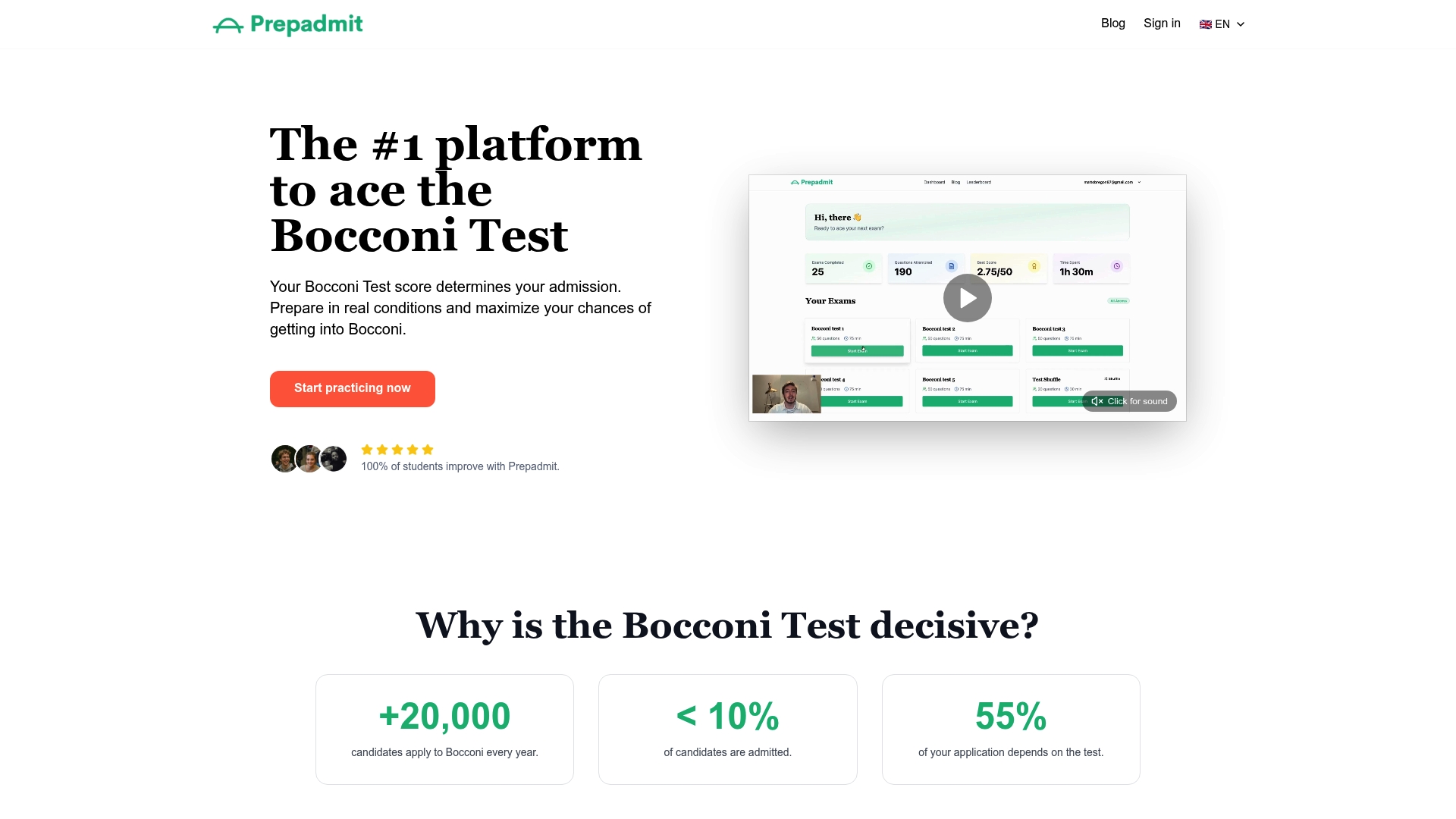
Students using Prepadmit report an average score improvement of 34%. The platform costs a fraction of private tutoring and gives you the feedback loop and benchmarking that solo study alone cannot provide. You can track your ranking against other Bocconi Test candidates and identify your weakest skill areas with precision. If you are serious about independent preparation, Prepadmit is the structured complement your self-study plan needs.
FAQ
What is exam prep without tutors?
Exam prep without tutors is self-directed learning where you design your own study plan and use structured resources, practice tests, and active recall techniques to prepare independently.
Can you pass the Bocconi Test without a tutor?
Yes. About 40% of top performers use pure self-study methods. Success depends on discipline, a structured schedule, and consistent use of timed practice tests rather than on having a tutor.
What study techniques work best for solo exam prep?
Active recall, spaced repetition, and interleaved practice are the most effective techniques. Converting wrong answers into flashcards after every practice test is the single most impactful habit for score improvement.
How many hours a day should you study without a tutor?
A study schedule of 6–8 hours a day with planned spaced reviews accelerates mastery. Divide sessions into focused 90-minute blocks and schedule your most difficult topics first.
How do you stay motivated when studying alone?
Use timed practice tests weekly to track measurable progress. Joining an online peer group or using a platform with a leaderboard creates external accountability without the cost of a tutor.
Recommended
Related articles
Ready to ace your admission test?
Discover PrepAdmit, the platform that helps you succeed at top university admission tests.
Discover PrepAdmit