Cost-Effective Test Prep for the Bocconi Test
Cost-Effective Test Prep for the Bocconi Test
Cost-effective test prep is the strategic use of affordable, targeted resources to maximize your exam score without overspending on methods that deliver little extra return. For Bocconi Test candidates, this matters more than most students realize. The cost spectrum runs from free official materials to private tutoring packages costing thousands of dollars, and the price tag rarely predicts the outcome. Knowing where to spend, where to save, and how to sequence your preparation is the skill that separates students who get into Bocconi University from those who simply spent the most money trying.
What is cost-effective test prep, and why does it matter for Bocconi?
Cost-effective test prep, known in academic research as “efficient test preparation,” means maximizing score improvement per dollar and hour invested. The cost range is wide: printed guidebooks run $20 to $50, online courses range from $100 to over $1,400, and private tutoring typically costs $40 to $200 per hour, with intensive blocks totaling $1,600 to $8,000. That spread means a student spending $8,000 is not automatically better prepared than one spending $150.
For the Bocconi Test specifically, the stakes are high. Bocconi University is one of Europe’s most selective business schools, and the admissions test assesses numerical, verbal, and logical reasoning under strict time pressure. You need a prep strategy that builds those specific skills, not a generic course designed for a different exam. Spending money on the wrong format is the most common and most avoidable mistake Bocconi applicants make.
How effective are free and low-cost test prep tools?
Free resources are more powerful than most students give them credit for. The College Board’s Official SAT Practice on Khan Academy is officially endorsed, includes full-length practice tests, and uses personalized adaptive technology to target your specific weak areas. While this tool is designed for the SAT, it demonstrates a broader principle: official, well-structured free resources can match or outperform paid alternatives when used consistently.
The catch is engagement. Only about 10% of students study more than six hours on free platforms, despite clear evidence of score gains for those who do. Free tools require self-discipline that paid courses partially substitute for. If you can commit to a schedule, free and low-cost resources deliver genuine results. If you struggle to stay on track without external accountability, that is the real gap a paid course fills.
Here is how to get the most from budget-friendly options:
- Use official past papers and practice tests as your primary material, since they reflect the actual exam format.
- Set a fixed weekly study schedule before you open any resource.
- Track every question you get wrong and categorize the error type.
- Review mistakes before moving to new material, not after.
- Use free diagnostic tools to measure progress every two to three weeks.
Pro Tip: Treat your error log like a study guide. The questions you got wrong once are the questions most likely to appear again in a form you will recognize. Reviewing them is worth more than practicing new questions you already understand.
What prep formats are available, and what do they cost?
Understanding the market helps you make a rational spending decision. The table below compares the main formats by cost, time commitment, and typical score impact.
| Format | Typical cost | Time commitment | Expected score impact |
|---|---|---|---|
| Free official materials | $0 | 150 to 300 hours | Moderate, with discipline |
| Budget online course | $100 to $400 | 100 to 200 hours | Moderate to good |
| Premium online course | $400 to $1,400+ | 80 to 150 hours | Similar to budget courses |
| Group in-person class | $300 to $800 | 40 to 80 hours | Moderate |
| Private tutoring (intensive) | $1,600 to $8,000 | 20 to 60 hours | Targeted, but modest overall |
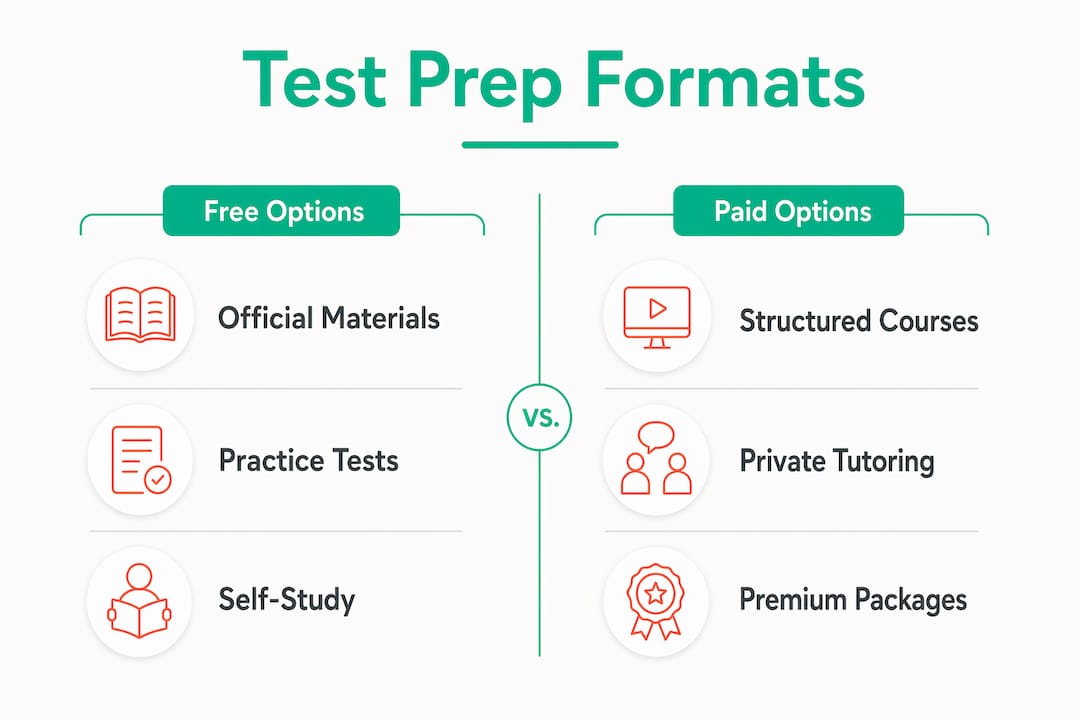
Structured courses improve completion rates to 60 to 75%, compared to 30 to 40% for self-study plans. That difference is not about content quality. It is about pacing and accountability. Students who finish their prep plan score better than students who abandon it halfway through, regardless of which format they chose.
Self-study takes more hours but costs less. Self-study yields a 3 to 8 percentile point gain over roughly 150 to 300 hours, while budget courses deliver 5 to 12 points over 100 to 200 hours. The time savings from a structured course are real. Whether those saved hours are worth $300 to $400 depends on your schedule and your discipline.
When does paying for test prep actually make sense?
Paid prep is worth considering under specific conditions, not as a default. Before you spend anything, you need a baseline score from a free diagnostic test. Investing heavily before benchmarking your starting point is the most common budgeting error in test prep. You cannot know what you need to fix until you know where you currently stand.
Once you have a baseline, consider paid options if any of the following apply:
- You have less than 90 days before the Bocconi Test and need to accelerate your preparation timeline.
- You have identified specific skill gaps, such as data interpretation or logical sequences, that free materials do not cover in enough depth.
- You have tried self-study for four or more weeks and your progress has stalled.
- You need external accountability to maintain a consistent study schedule.
One-on-one tutoring is the most targeted format but also the most expensive. Brookings research confirms that tutoring is likely more effective than other approaches, but the effects are still modest. A tutor who specializes in the Bocconi Test format will deliver more value than a general academic tutor, even at a lower hourly rate.
“High-priced private tutoring and ‘guaranteed score’ packages lack rigorous evidence of superior effectiveness.” — Brookings Institution
Be skeptical of money-back guarantees attached to premium packages. The conditions attached to those guarantees are often strict enough that very few students qualify for a refund. Spend based on your diagnosed needs, not on marketing promises.
Practical budgeting tips for Bocconi Test prep
A smart prep budget follows a sequence, not a price point. Here is how to build one that works for the Bocconi Test specifically.
Start with a free diagnostic. Use official Bocconi past papers or a structured mock exam to establish your baseline score across all tested sections. This takes two to three hours and costs nothing. It tells you exactly where to focus your money if you decide to spend any.
Use a hybrid model when budget allows. Combine free official practice materials for volume repetition with one targeted paid resource for your weakest skill area. This approach costs far less than a full premium course and addresses your actual gaps rather than covering ground you already know.
Opportunity cost matters in this calculation. If self-study requires 100 more hours than a structured course, and those hours come from time you could spend on university coursework or other applications, the paid course may be worth it even at $300 to $400. Value your time honestly before deciding.
Additional tips for keeping costs down:
- Register for the Bocconi Test early to avoid late fees and give yourself more prep time.
- Look for group discounts on online courses, since many platforms offer reduced rates for cohort enrollment.
- Use school or community library access to prep books before buying your own.
- Explore mock exam strategies to understand how timed practice under real conditions accelerates score gains faster than untimed review.
Pro Tip: Run a full timed mock exam every two weeks. Score it, log every error, and spend the next three days drilling only the question types you missed. This cycle costs nothing and consistently outperforms passive re-reading of prep materials.
Key takeaways
Cost-effective Bocconi Test prep means diagnosing your baseline first, using free official materials as your foundation, and spending money only on targeted resources that address specific, identified weaknesses.
| Point | Details |
|---|---|
| Diagnose before spending | Take a free diagnostic test before purchasing any paid prep resource. |
| Free tools work if you use them | Official practice materials deliver real score gains for students who stay consistent. |
| Paid courses save time, not just effort | Structured courses cut study time by 30 to 40% and improve completion rates significantly. |
| Tutoring is targeted, not magic | One-on-one tutoring helps with specific gaps but delivers modest overall score gains. |
| Error review beats volume practice | Analyzing mistakes and drilling weak question types outperforms consuming more new content. |
Why I think most students get this backwards
Most students treat test prep like a product purchase. They assume spending more signals commitment and produces results. That logic works for some things. It does not work for exam preparation.
The Brookings research is clear: test prep benefits are often modest, and high-priced packages do not deliver proportional results. What actually moves scores is targeted, disciplined practice focused on the question types you consistently get wrong. That process is free. The expensive part is usually the structure and accountability around it, not the content itself.
I have seen students spend $2,000 on premium courses and plateau after four weeks because they never built an error-analysis habit. I have also seen students use affordable digital tools and official past papers to improve their scores by double digits because they reviewed every mistake before moving on. The difference was not the price. It was the process.
For Bocconi Test candidates specifically, the exam rewards precision over breadth. You are not trying to learn everything. You are trying to eliminate the specific errors that cost you points on test day. That is a diagnostic and drilling problem, not a spending problem. Start free, identify your gaps, and spend only where the gap is real and the resource is specific.
— quentin
Start your Bocconi prep without overspending
Prepadmit is built specifically for the Bocconi Test, which means every practice question, mock exam, and correction is calibrated to the actual exam format. Students using Prepadmit see an average score improvement of 34%, and the platform costs a fraction of private coaching.
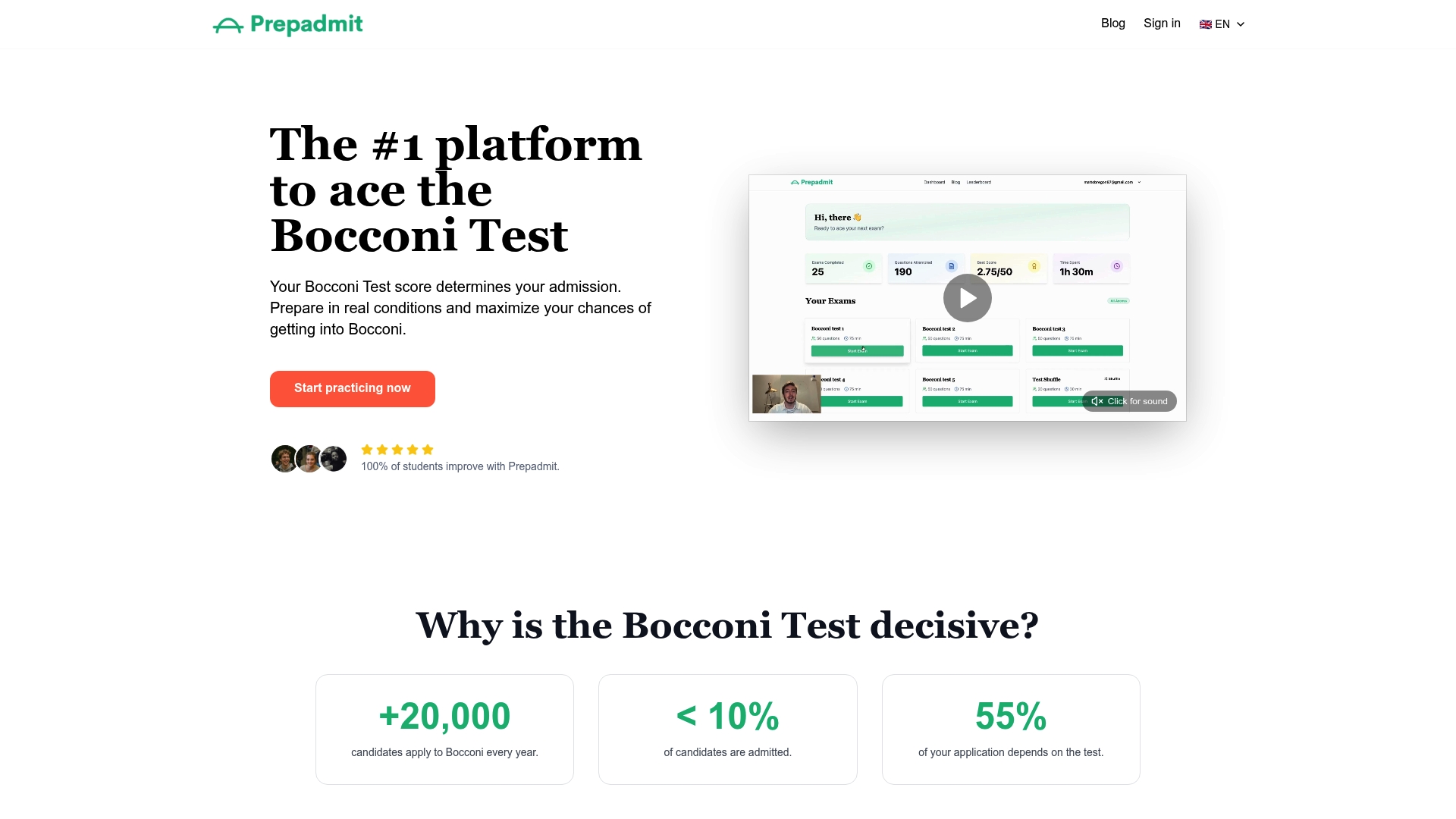
You can start with a diagnostic test to benchmark your current level, then use skill-specific practice modes to target your weakest areas. Progress tracking and peer ranking show you exactly where you stand relative to other Bocconi applicants. If the platform does not deliver results, a money-back guarantee covers you. Visit Prepadmit to explore plans and find the option that fits your timeline and budget.
FAQ
What does cost-effective test prep mean?
Cost-effective test prep means maximizing your score improvement relative to the time and money you invest. It prioritizes targeted practice over high spending.
Are free test prep resources good enough for the Bocconi Test?
Free official materials can be highly effective if used consistently and combined with structured error review. The main limitation is self-discipline, not content quality.
How much should I budget for Bocconi Test preparation?
Most students can prepare effectively for $100 to $400 using a combination of free official materials and one targeted paid resource. Spending more is only justified after diagnosing specific skill gaps.
Is private tutoring worth the cost for the Bocconi Test?
Private tutoring is worth considering for specific, identified weaknesses, but overall effects are modest even at high hourly rates. A tutor specializing in the Bocconi format delivers more value than a general academic tutor.
When should I start preparing for the Bocconi Test?
Start at least three to four months before the exam date. This gives you time to complete a diagnostic, build a targeted study plan, and run multiple timed mock exams before test day.
Recommended
Related articles
Ready to ace your admission test?
Discover PrepAdmit, the platform that helps you succeed at top university admission tests.
Discover PrepAdmit