Bocconi Test Time Pressure Explained for 2026

Bocconi Test Time Pressure Explained for 2026
The Bocconi Test is designed to measure your ability to think quickly and accurately under strict time pressure, not just your academic knowledge. Bocconi test time pressure explained simply: you have roughly 1.5 minutes per question across 50 multiple-choice questions, with a penalty scoring system (+1 correct, −0.25 incorrect, 0 unanswered) that punishes careless guessing. That combination of speed, accuracy, and scoring risk is what makes this exam genuinely difficult. The good news is that time pressure is a manageable skill. With the right pacing strategies, psychological tools, and section-specific tactics, you can turn the clock from your biggest threat into your biggest advantage.
How is the Bocconi Test structured timing-wise?
The Bocconi Test is not a content exam. It tests how fast and accurately you can think. Understanding the timing structure is the first step toward controlling it.
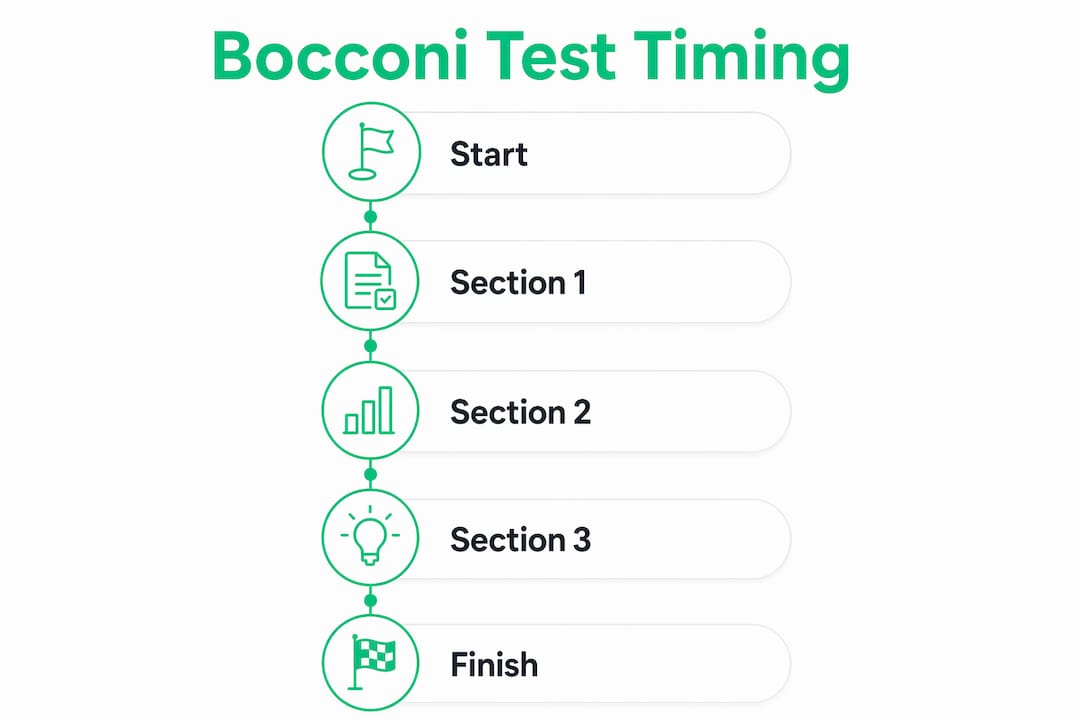
The test runs for approximately 75 to 90 minutes total, depending on your session. Always verify the exact duration for your specific test date, since timing may vary by session. The four sections break down roughly as follows:

| Section | Questions | Approximate Time | Time per Question |
|---|---|---|---|
| Math | 10 | 20 minutes | ~2 minutes |
| Logic | 10 | 20 minutes | ~2 minutes |
| Reading Comprehension | 10 | 20 minutes | ~2 minutes |
| English | 20 | 30 minutes | ~1.5 minutes |
These numbers are approximate. Some sessions allocate 15 minutes to English and 10 minutes to other sections. The key takeaway is that no section gives you generous time. Every minute counts.
Here is what these numbers mean in practice:
- Math and Logic give you roughly 2 minutes per question, but harder problems can easily consume 3 to 4 minutes if you are not disciplined.
- Reading Comprehension requires fast skimming. You cannot read every word at normal speed and still answer all questions.
- English moves fastest. With 20 questions in 30 minutes, you have 90 seconds per item on average.
Knowing your per-question budget before you sit down is not optional. It is the foundation of every pacing decision you will make during the test.
Pro Tip: Print out this timing table and review it the night before your exam. Visualizing the structure reduces cognitive load on test day and helps you shift gears between sections without hesitation.
What are the best time management strategies for the Bocconi Test?
Effective Bocconi exam time management is not about going faster. It is about spending time where it earns the most points.
Use the two-pass system
The two-pass workflow is the single most effective pacing method for this exam. On your first pass through any section, answer every question you can solve in under 60 to 90 seconds. Mark anything harder and move on without hesitation. On your second pass, return to skipped questions with whatever time remains. This approach prevents one difficult question from consuming time that belongs to five easier ones.
Apply the 90-second rule strictly
A common mistake under time pressure is spending too long on a single question. The 2-minute rule recommends skipping any question that exceeds 90 to 120 seconds and returning later. Students who ignore this rule often find themselves rushing through the final third of a section, making errors they would never make with adequate time.
Make smart guess-or-skip decisions
The penalty scoring system changes how you should think about unanswered questions. With a −0.25 deduction for wrong answers, random guessing is statistically neutral if you have no idea. But if you can eliminate even one or two answer choices, guessing becomes mathematically favorable. Only guess when you can eliminate options. Otherwise, leave the question blank and protect your score.
Here is a simple decision framework:
- Can you solve it confidently in under 90 seconds? Answer it.
- Can you eliminate at least two options? Make an educated guess.
- Are all options equally plausible? Skip it and move on.
- Do you have time left at the end? Return to skipped questions.
- Still uncertain with 30 seconds left? Apply the elimination rule one more time.
Pro Tip: Simulate real test conditions at least five times before your exam date. Use a timer, sit at a desk, and replicate the proctored environment. Students who practice under realistic pressure build the mental stamina to stay calm when the actual clock starts.
How does exam anxiety affect Bocconi Test performance?
Bocconi exam anxiety management is not a soft skill. It is a performance variable with measurable consequences.
When you feel intense pressure before or during an exam, your brain triggers a survival response. Cortisol and adrenaline flood your system, narrowing your focus and impairing the memory recall you need to solve problems. This is not a sign of weakness or poor preparation. It is a biological response that every test-taker experiences to some degree.
The practical implication: stress hormones temporarily impair memory and concentration, so calming techniques protect your actual score, not just your comfort level. Students who manage anxiety perform better on objective measures, not just subjectively.
Here are the most effective techniques for managing test anxiety before and during the Bocconi exam:
- Box breathing: Inhale for 4 counts, hold for 4, exhale for 4, hold for 4. Repeat three times. This activates the parasympathetic nervous system and lowers cortisol within minutes.
- Timed practice sessions: Repeated exposure to time pressure during preparation reduces the novelty of the stress response on test day. Familiarity with the format is one of the strongest anxiety reducers available.
- Pre-exam routine: Establish a consistent routine for the 30 minutes before your test. Same music, same snack, same breathing exercise. Routines signal safety to your nervous system.
- Technical setup in advance: Set up your proctoring software at least 48 hours before the exam. Last-minute technical failures create a spike of avoidable anxiety that can derail your entire session.
“Exam anxiety doesn’t mean you’re unprepared. It means your brain is taking the stakes seriously. The goal isn’t to eliminate the feeling — it’s to keep it from running the show.”
The students who perform best under Bocconi test conditions are not the ones who feel no pressure. They are the ones who have practiced enough that pressure feels familiar.
Section-by-section time strategies for the Bocconi Test
Each section of the Bocconi admission test demands a different approach. Applying the same pacing to Math and English is a mistake.
Math section
Calculators are not allowed. Mental calculation and elimination are your primary tools. Before starting any algebraic process, check whether you can substitute answer choices back into the problem or eliminate obviously wrong options. Many students waste 90 seconds setting up complex equations when a 15-second substitution check would have identified the answer. Never exceed 90 seconds on a single math question without marking it and moving on.
Logic section
Logic questions are the most time-variable on the test. Some take 30 seconds. Others take 3 minutes. In 20 minutes for 10 questions, your first pass should target every question solvable in under 60 seconds. Return to harder ones with remaining time. If you have partially eliminated options on a difficult question, guessing is better than leaving it blank.
Reading comprehension section
Speed reading is a trainable skill, and this section rewards it directly. Practice skimming for topic sentences and key data points rather than reading every word. Allocate roughly 5 minutes per passage if there are two passages, or adjust based on question count. Answer questions tied to specific lines first, then tackle broader inference questions.
English section
The English section moves fast. With 20 questions in approximately 30 minutes, accuracy matters more than speed here because most students find these questions more straightforward. Prioritize getting them right rather than rushing. Careless errors in English cost the same 0.25 points as careless errors in Math.
| Section | Questions | Time Budget | Primary Strategy |
|---|---|---|---|
| Math | 10 | ~2 min/question | Elimination before calculation |
| Logic | 10 | ~2 min/question | Two-pass, 60-second threshold |
| Reading | 10 | ~2 min/question | Skim first, then answer |
| English | 20 | ~1.5 min/question | Accuracy over speed |
Pro Tip: After each timed practice session, review which section consumed the most time relative to your score. That section is your highest-leverage area for improvement. Targeted drilling on your weakest section produces faster score gains than general review.
Key takeaways
Bocconi test time pressure is a scoring-management problem, and solving it requires combining structural knowledge, disciplined pacing, and psychological preparation before exam day.
| Point | Details |
|---|---|
| Know the timing structure | Each section gives roughly 2 minutes per question; verify your session’s exact timing in advance. |
| Use the two-pass system | Answer quick questions first, then return to harder ones to avoid time drains on difficult items. |
| Apply penalty-aware guessing | Only guess when you can eliminate at least two options; otherwise skip to protect your score. |
| Manage anxiety actively | Box breathing and repeated timed practice reduce cortisol’s impact on memory and focus. |
| Prepare your tech setup early | Test proctoring software 48 hours ahead to eliminate avoidable stress on exam day. |
What I’ve learned coaching students through Bocconi test pressure
Most students I work with make the same mistake: they treat the Bocconi Test like a content exam and study more material instead of practicing under real time conditions. The role of mock exams in building time management skills is consistently underestimated. Content knowledge matters, but it does not help you if you run out of time before reaching the questions you can answer.
The second pattern I see is students who know the strategies intellectually but have never practiced them under pressure. Knowing the two-pass system and actually executing it when the clock is running are two different skills. The only way to close that gap is repetition in realistic conditions.
One thing that surprises students: technical preparation is a legitimate anxiety reducer. Students who have tested their camera, microphone, and internet connection days before the exam report feeling noticeably calmer on test day. It sounds minor. It is not.
My honest advice is to treat time pressure as a skill to train, not a problem to endure. The students who improve the most are the ones who practice with on-demand tests repeatedly, review their timing data after each session, and adjust their pacing strategy based on real evidence. Pressure becomes manageable when it feels familiar.
— quentin
How Prepadmit helps you master Bocconi exam timing
Prepadmit is built specifically for students who want to turn time pressure into a competitive advantage on the Bocconi Test.
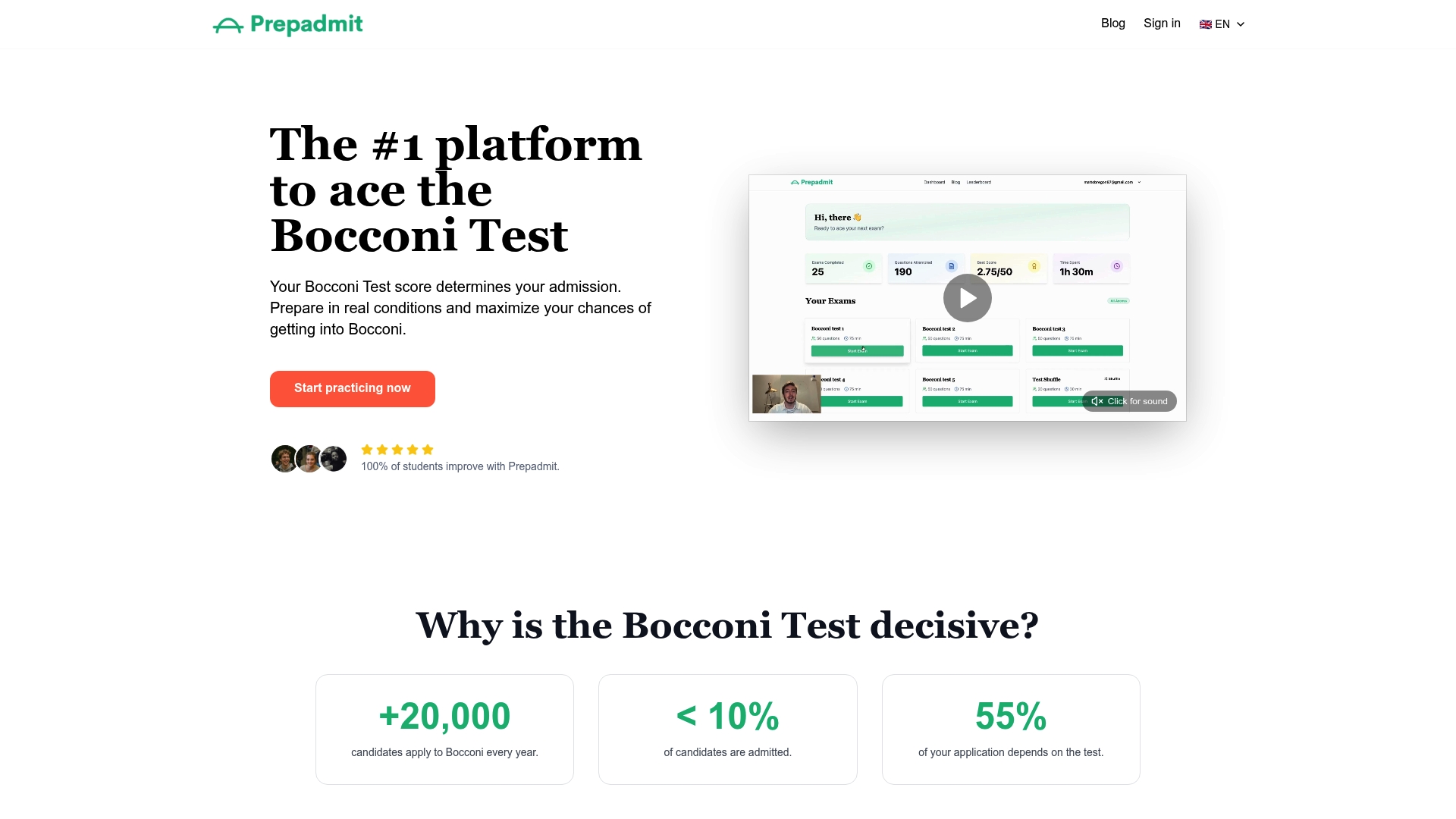
The platform offers timed mock exams that replicate real Bocconi conditions, including section-by-section timing and penalty scoring. After each session, you get detailed analytics showing exactly where you lost time and which question types slowed you down. Prepadmit also includes video tutorials covering penalty-aware guessing strategies, section-specific pacing drills, and a technical checklist to prevent proctoring issues before they happen. Students on the platform improve their scores by an average of 34%. Start your preparation at Prepadmit and practice the way the actual test demands.
FAQ
What is the Bocconi Test time limit?
The Bocconi Test runs for approximately 75 to 90 minutes across 50 multiple-choice questions, giving you roughly 1.5 minutes per question on average. Always verify the exact timing for your specific session, as it can vary.
How does the penalty scoring system work?
The test awards +1 for a correct answer, −0.25 for an incorrect answer, and 0 for an unanswered question. This means random guessing is neutral statistically, but guessing after eliminating two or more options is mathematically favorable.
Should I answer every question on the Bocconi Test?
No. Skipping questions you cannot confidently answer protects your score under the penalty system. Use the two-pass system: answer quick questions first, then return to harder ones with remaining time.
How do I reduce anxiety during the Bocconi exam?
Box breathing, repeated timed practice sessions, and a consistent pre-exam routine all reduce the cortisol response that impairs memory and focus. Technical setup completed 48 hours in advance also removes a major source of last-minute stress.
Which Bocconi Test section is hardest to manage time in?
Logic is the most time-variable section because question difficulty ranges widely. Apply the 60-second threshold on your first pass and return to harder questions only after completing the easier ones.
Recommended
Related articles
Ready to ace your admission test?
Discover PrepAdmit, the platform that helps you succeed at top university admission tests.
Discover PrepAdmit