What Is the Bocconi Admission Test: 2026 Guide

What Is the Bocconi Admission Test: 2026 Guide
If you are applying to Bocconi University, understanding the Bocconi Admission Test is non-negotiable. This is not a general aptitude exam you can wing with a few days of review. It is a 50-question, timed assessment covering mathematics, reasoning, and critical thinking, and it carries 55% of your total admission score. Get it wrong, and even a strong GPA may not save you. Get it right, and you open the door to one of Europe’s most respected business schools.
Table of Contents
- Key Takeaways
- What is the Bocconi Admission Test
- How the scoring system works
- Remote exam setup and technical requirements
- Preparation strategies and the SAT/ACT decision
- My honest take on cracking this exam
- Start your prep the smart way with Prepadmit
- FAQ
Key Takeaways
| Point | Details |
|---|---|
| Test format is structured | Four sections, 50 questions, 75 minutes with no ability to return to previous questions. |
| Scoring has real penalties | Wrong answers deduct points depending on section, so strategic skipping matters. |
| Test score carries heavy weight | Your result accounts for 55% of the admission decision, combined with your high school GPA. |
| Multiple attempts are allowed | You can take the test up to four times per year, with each attempt costing €60. |
| SAT and ACT are alternatives | Bocconi accepts all three tests and selects your highest score for the application. |
What is the Bocconi Admission Test
The Bocconi Admission Test is a standardized online exam required for undergraduate admission to Bocconi University in Milan, Italy. It is specifically designed for economics and business programs. Unlike the SAT or ACT, this test is built exclusively around Bocconi’s academic expectations, which means it does not test general knowledge of history or science. It tests how you think.
The test contains 50 multiple-choice questions divided across four sections, completed in 75 minutes. There is no reading period, no scratch work time. You start the clock and you move forward. The format rewards students who can make fast, confident decisions under pressure.
Understanding this exam goes beyond knowing what is on it. You also need to know what it is not. It is not purely a math test. It is not a vocabulary test. The Bocconi Admission Test is a logic and reasoning exam dressed partly in mathematical clothing. That distinction changes how you prepare for it entirely.
The four sections at a glance
| Section | Number of Questions |
|---|---|
| Mathematics | 24 |
| Reading Comprehension | 11 |
| Numerical Reasoning | 6 |
| Critical Thinking | 9 |
Here is what each section actually demands from you:
- Mathematics (24 questions): Algebra, geometry, statistics, and basic calculus concepts. These are not advanced university topics, but they require precision and speed.
- Reading Comprehension (11 questions): Short passages followed by inference and interpretation questions. The texts are often economics-related.
- Numerical Reasoning (6 questions): Data interpretation from charts or tables. You need to extract and analyze information quickly.
- Critical Thinking (9 questions): Logic puzzles and argument evaluation. These reward clear, structured thinking over instinct.
One critical detail most applicants miss: you cannot return to previous questions once you move past them. This makes in-the-moment decision-making a core skill. If you are unsure about a question, you must decide right then whether to answer or skip.
How the scoring system works

The Bocconi test scoring system is straightforward in structure but punishing if you are careless. The maximum score is 50. You earn +1 for every correct answer. You earn 0 for every skipped question. And you lose points for wrong answers depending on which section you are in.
The penalty breakdown is:
- Mathematics and Numerical Reasoning: -0.2 per wrong answer
- Reading Comprehension and Critical Thinking: -0.33 per wrong answer
That difference matters. A wrong answer in the Critical Thinking section costs you more than a wrong answer in Mathematics. So the decision to guess or skip is not the same across all sections. You need a section-specific strategy, not a one-size-fits-all approach.
The minimum score to avoid disqualification is 17. But 17 is not competitive. Students who receive offers typically score in the 35 to 40+ range. Think of 17 as the floor, not the target.
Pro Tip: If you are on the fence about answering a question in Reading Comprehension or Critical Thinking, skip it. The -0.33 penalty means a 50/50 guess has a negative expected value. In Mathematics, a reasonable guess has better math on your side.
Your test score combines with your high school GPA from your 3rd-last and 2nd-last years at a ratio of 55% test, 45% GPA. Physical education, behavior, and religion grades are excluded from the GPA calculation. This is good news if those grades pulled your average down.
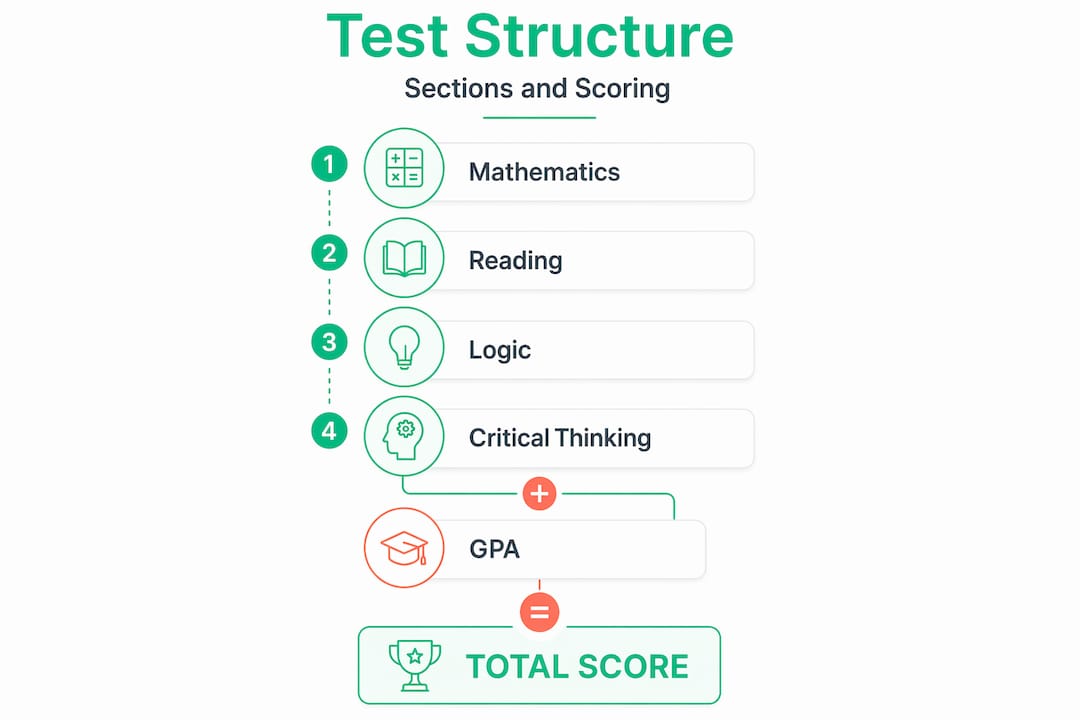
If you submit multiple test scores, the Apply2B portal selects the highest score automatically. You are never penalized for trying again.
Remote exam setup and technical requirements
The Bocconi Admission Test is fully remote. You take it from your own space, which sounds easier than sitting in an exam hall. In practice, the technical requirements and proctoring rules add a different kind of pressure.
Here is what you need on test day:
- A stable internet connection, webcam, and microphone are all required
- A lockdown browser must be installed and running before the test begins
- A secondary device is required to perform a room scan and monitor your environment throughout the exam
- Valid photo ID must be presented at the start of the session
- You must be alone in a quiet room with no notes, papers, or unauthorized materials visible
Violations during the online test can result in annulment of your score with no refund. Bocconi takes integrity seriously and the proctoring system is designed to detect irregularities automatically.
Pro Tip: Do a full technical dry run at least 48 hours before your exam. Test your internet speed, install the lockdown browser, confirm your webcam resolution, and practice the room scan procedure. Technical issues on exam day cannot be used as grounds for a reschedule.
The test must be taken on the specific date you booked. There is no same-day rescheduling. Testing windows run from mid-July 2025 through early April 2026, with early, winter, and spring sessions available. Each attempt costs €60 and must be booked at least two days before the session deadline.
Preparation strategies and the SAT/ACT decision
Preparing for the Bocconi Admission Test is not like studying for a traditional school exam. The test is logic-heavy, not content-heavy. You will not pass it by memorizing formulas alone. You need to practice the way you think under time pressure.
Here is an approach that works:
- Start with a diagnostic test. Take one full practice exam without any preparation to see where you actually stand. Your weak sections will become obvious immediately.
- Build section-specific skills. Do not treat all four sections equally. If Numerical Reasoning is your weakest area, give it more practice time than Mathematics.
- Practice pacing. Because you cannot return to previous questions, pacing is its own skill. Learn how many seconds you can afford per question in each section (roughly 90 seconds on average across the full test).
- Use mock exams to simulate conditions. Practicing in exam-like conditions, meaning timed, locked-browser style, no notes, is far more effective than doing practice questions casually.
- Space out your attempts. You have up to four attempts per year. Use your first attempt with solid preparation, evaluate what went wrong, and apply targeted fixes before the next session.
Pro Tip: Students with GMAT or GRE prep experience often find the Bocconi Test more manageable, because those exams train the same kind of analytical reasoning. If you have done GMAT-style practice, lean into that experience.
The SAT/ACT decision is worth thinking through carefully. The right choice depends on your application goals. If Bocconi is your only target, the dedicated Bocconi Test is the smarter path. It is shorter, more focused, and designed around exactly what Bocconi wants to see. If you are applying to universities in the US or UK as well, having SAT or ACT scores already in hand gives you flexibility and Bocconi accepts all three options.
Targeted Bocconi prep resources that focus on logic question mastery and diagnostic assessments are generally more efficient than generic test prep for students focused only on this exam.
My honest take on cracking this exam
I have watched a lot of students approach the Bocconi Test the wrong way. They spend weeks reviewing high school math formulas and then freeze when they hit a Critical Thinking question that has nothing to do with any formula they studied.
Here is what I have found to be true: the students who do best are the ones who prepare like chess players, not like cramming students. They know when to skip, when to commit, and they have practiced that decision hundreds of times before the real test.
The 75-minute time limit is not the enemy. Indecision is. Every second you spend agonizing over a question you should have skipped is a second taken away from a question you could answer confidently. Practicing that discipline, the ability to make a quick call and move forward without looking back, is the skill that separates a 32 from a 40.
I also think the GPA component is underused strategically. Many students tunnel-vision on the test and forget that 45% of their score comes from grades they already have. If your GPA is strong, you need a good score, not a perfect one. If your GPA is weak, you need to push your test score as high as possible. Know which situation you are in before you decide how many attempts to book.
My advice: treat the Bocconi Test as a strategy game with rules you can learn. Start early, test yourself honestly, and fix what the data tells you to fix.
— quentin
Start your prep the smart way with Prepadmit
If you are serious about getting into Bocconi, your prep needs to match the actual exam conditions, not just a stack of study notes.
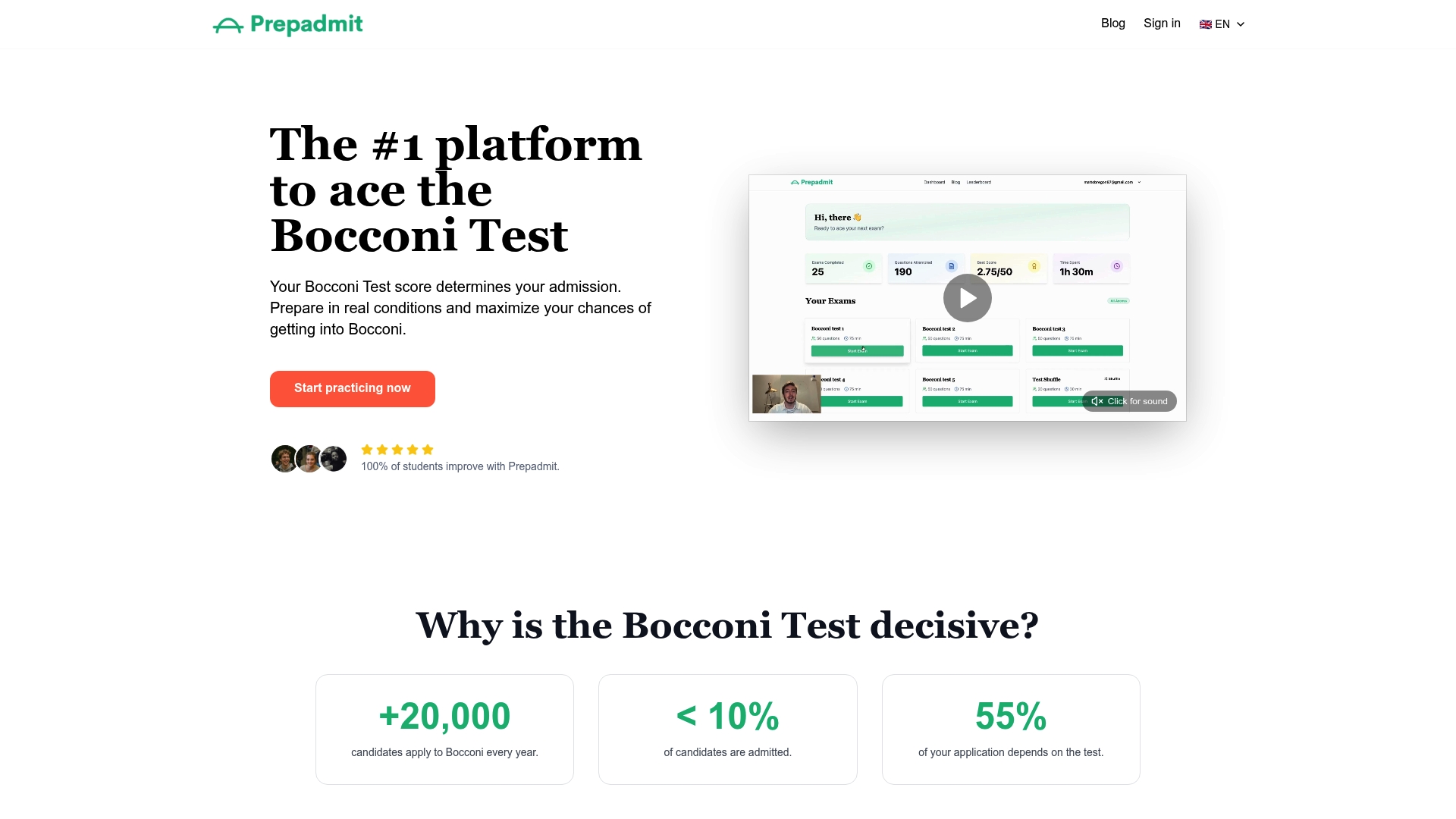
Prepadmit is built specifically for students preparing for the Bocconi Test. The platform gives you access to official past papers, on-demand mock exams, detailed answer corrections, and progress tracking that shows exactly where you are losing points. You can practice by section, track your score over time, and see how you rank against other Bocconi applicants. Students using Prepadmit’s prep platform improve their scores by an average of 34%. That kind of improvement, across the 55% weighted component of your application, translates directly into better admission odds. Prepadmit was built by experts with backgrounds from HEC and Bocconi. It costs a fraction of private coaching, comes with a money-back guarantee, and is available on demand so you can fit it around your school schedule.
FAQ
What is the Bocconi Admission Test made of?
The Bocconi Admission Test contains 50 multiple-choice questions across four sections: Mathematics (24), Reading Comprehension (11), Numerical Reasoning (6), and Critical Thinking (9), completed in 75 minutes.
What score do you need to get into Bocconi?
The minimum score to avoid disqualification is 17, but competitive applicants typically score between 35 and 40+. Your test result accounts for 55% of the admission decision.
Can you retake the Bocconi Test if you are not happy with your score?
Yes. You can take the test up to four times per year at €60 per attempt. Bocconi automatically uses your highest submitted score across the Bocconi Test, SAT, and ACT.
How does the Bocconi Test differ from the SAT?
The Bocconi Test is shorter (75 minutes, 50 questions) and focuses exclusively on logic, reasoning, and mathematics rather than reading and writing skills. The SAT is broader and accepted by universities worldwide, making it better suited for students applying to multiple institutions.
Do you take the Bocconi Test at a testing center?
No. The Bocconi Test is taken remotely with a lockdown browser, webcam, and microphone. A secondary device is required for a room scan. Violations can result in score annulment.
Recommended
Related articles
Ready to ace your admission test?
Discover PrepAdmit, the platform that helps you succeed at top university admission tests.
Discover PrepAdmit