Bocconi Test Cultural Context Understanding: 2026 Guide

Bocconi Test Cultural Context Understanding: 2026 Guide
Bocconi Test cultural context understanding is the ability to recognize and adapt to implicit cultural assumptions within test passages to accurately interpret meaning and avoid scoring pitfalls. The Bocconi Online Test is a 50-question, 75-minute multiple-choice exam delivered online with proctoring, offered in English or Italian. Reading comprehension and critical thinking sections carry a penalty of −0.33 for wrong answers, which means every misread cultural assumption costs you real points. Understanding how cultural defaults shape text interpretation is not a soft skill. It is a scoring strategy.
How does cultural intelligence theory apply to the Bocconi Test?
Cultural intelligence, commonly abbreviated as CQ, is defined as the ability to adapt interpretation and behavior across cultural contexts. CQ includes four dimensions: cognitive, metacognitive, motivational, and behavioral. Each dimension plays a distinct role in how you read and reason through Bocconi Test passages.
The cognitive dimension covers what you know about cultural norms and communication patterns. The metacognitive dimension is the most critical for test performance. It is your ability to notice when your own cultural lens is shaping how you interpret a sentence or argument. The motivational dimension drives your willingness to suspend judgment. The behavioral dimension is less relevant in a written test but still matters when you choose how to frame your reasoning.
Here is what this means practically for the Bocconi cultural assessment:
- Cognitive CQ helps you recognize that a passage may use a Western academic argument structure, even if you come from a different rhetorical tradition.
- Metacognitive CQ lets you pause and ask: “Am I reading this based on what the text says, or what I assume it means?”
- Motivational CQ keeps you engaged with unfamiliar or neutral academic texts without dismissing them as irrelevant.
- Behavioral CQ shapes how you eliminate answer choices that reflect your own cultural bias rather than the passage’s logic.
Bocconi’s cultural tests focus less on country-specific facts and more on your ability to interpret nuanced contextual assumptions embedded in passages. This is a metacognitive challenge, not a geography quiz. You are not being tested on what you know about Italian culture or American business norms. You are being tested on whether you can read a text on its own terms.
Pro Tip: Before each reading comprehension passage, take three seconds to ask yourself: “What assumptions am I bringing to this text?” That brief pause activates your metacognitive CQ and reduces the chance of importing your own cultural defaults into the answer.

What are the scoring rules and test structure that affect cultural context question strategy?
The Bocconi Test section breakdown is weighted as follows: Mathematics at 48%, Critical Thinking at 18%, Reading Comprehension at 22%, and Numerical Reasoning at 12%. Reading comprehension and critical thinking together account for 40% of your test score. That is a significant portion to lose points on due to cultural misreading.
| Section | Weight | Scoring Penalty |
|---|---|---|
| Mathematics | 48% | No penalty specified |
| Reading Comprehension | 22% | −0.33 per wrong answer |
| Critical Thinking | 18% | −0.33 per wrong answer |
| Numerical Reasoning | 12% | No penalty specified |
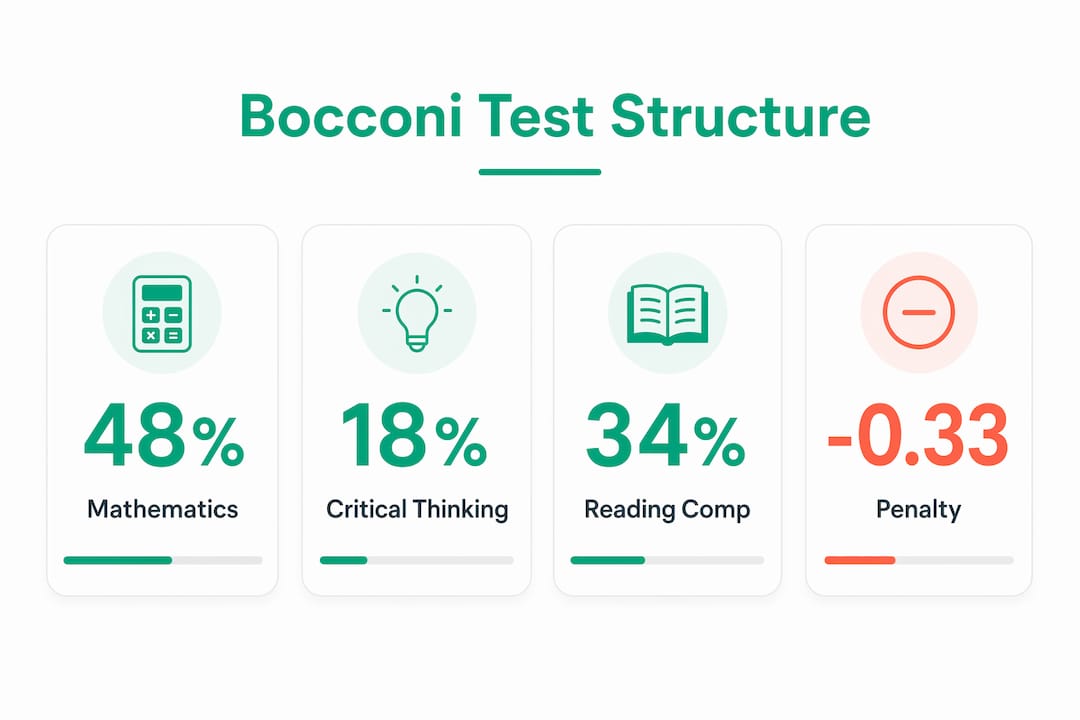
The test score itself counts for 55% of your total admission score, with the remaining 45% coming from your high school GPA. This weighting means that a strong GPA does not fully compensate for a poor test result. You need both.
The negative marking system changes how you should approach cultural context questions. Guessing when uncertain over cultural implications lowers your expected score. If you are genuinely unsure whether an answer is supported by the text or by your own cultural assumption, skipping that question is mathematically smarter than guessing. The expected value of a random guess across four options with a −0.33 penalty is negative.
Time management across sections also matters. With 75 minutes and 50 questions, you have an average of 90 seconds per question. Reading comprehension passages require more time per question than math problems. Budget roughly two minutes per reading question and use the remaining time on sections where you are more confident.
Pro Tip: Flag any reading comprehension question where you catch yourself thinking “I know this from experience.” That instinct is a signal that you may be importing outside cultural knowledge rather than reading the text. Come back to it after finishing the section.
How to identify and interpret invisible cultural assumptions in Bocconi Test passages
Invisible cultural defaults such as communication style, argument structure, and feedback conventions affect interpretation and are often unnoticed until you encounter a different set. On the Bocconi Test, these defaults appear in how passages frame arguments, present evidence, and signal conclusions. A passage written in a neutral academic register still carries assumptions about what counts as a valid reason or a logical conclusion.
Here is a step-by-step method for identifying and managing these defaults during the test:
- Read the passage once without answering anything. Your first read is for orientation only. Resist the urge to pre-answer. Notice the tone, the argument structure, and what the author treats as given.
- Tag explicit claims versus implied claims. As you reread, mentally label each sentence: Is this stated directly, or am I inferring it? Explicit claims are your safest anchor for answer choices.
- Practice inference restraint. Map every answer choice back to explicit textual evidence rather than personal assumptions. If you cannot point to a specific sentence that supports an answer, treat it as unsupported.
- Identify the argument style. Western academic texts often use a deductive structure: claim first, then evidence. Other traditions may build inductively. Recognizing the structure helps you locate the main point without projecting your own preferred logic.
- Check your eliminations. When you cross out an answer choice, ask: “Am I eliminating this because the text contradicts it, or because it feels wrong to me?” The first reason is valid. The second is a cultural bias trap.
- Anchor your final answer to a sentence. Before selecting an answer, identify the specific sentence or phrase in the passage that justifies it. If you cannot find one, reconsider.
This process takes practice. Reading diverse academic texts from different cultural traditions, such as policy papers from the United Nations, editorials from publications like The Economist or Le Monde in translation, and academic abstracts from non-Western institutions, trains your brain to read without defaulting to familiar patterns. The goal is not to become an expert in every culture. The goal is to recognize when your own defaults are doing the reading for you.
What are common mistakes and how to troubleshoot cultural context challenges?
Students preparing for the Bocconi Test consistently make the same errors in cultural context questions. Recognizing these patterns before test day gives you a concrete advantage.
- Overguessing on uncertain questions. The −0.33 penalty makes random guessing costly. Students who guess on every question they find ambiguous consistently score lower than those who skip strategically.
- Importing personal assumptions. This is the most common error. A passage describes a business negotiation style, and a student from a high-context culture reads “indirect communication” as evasive rather than respectful. The text does not say either. The student’s cultural default made the call.
- Ignoring explicit text limits. Answer choices on reading comprehension questions are often designed to test whether you stay within the text. Choices that are “true in general” but not supported by the passage are traps. Students with strong general knowledge fall into this trap more often than those with weaker backgrounds, because their knowledge feels like evidence.
- Rushing through cultural context passages. Time pressure increases the risk of misinterpretation. Students who spend less than 60 seconds on a reading passage before answering questions make significantly more errors on inference-based questions.
- Treating cultural understanding as fixed. Some students assume their cultural background is either an advantage or a disadvantage. Neither is true. Cultural awareness on the test is about metacognitive recognition of your own perspective’s limits, not about where you grew up.
The practical fix for most of these errors is the same: slow down and verify. For each answer you select, spend five seconds confirming it is grounded in the passage. For each answer you skip, confirm you are skipping because of genuine uncertainty, not avoidance.
Timed cultural distancing exercises involve reading neutral academic texts while suppressing outside cultural knowledge to reduce bias in interpretation. Training in this method improves accuracy in Bocconi reading comprehension. You can practice this by setting a timer, reading a neutral policy text, and writing a one-sentence summary that uses only words and ideas from the text itself.
Pro Tip: After each practice session, review the questions you got wrong and ask: “Did I miss this because I misread the text, or because I added something the text never said?” Keeping a log of your error type reveals whether your main challenge is reading speed, inference restraint, or cultural default bias.
Key takeaways
Mastering cultural context understanding for the Bocconi Test requires combining metacognitive CQ with evidence-anchored reading strategies under a negative marking scheme.
| Point | Details |
|---|---|
| CQ is a trainable skill | Practicing metacognitive awareness reduces cultural bias in reading comprehension answers. |
| Negative marking changes strategy | Skip questions where you cannot anchor your answer to explicit text support. |
| Reading and critical thinking carry 40% | These two sections together justify focused cultural context preparation. |
| Inference restraint is the core technique | Every answer choice must trace back to a specific sentence in the passage. |
| Timed practice reduces bias | Reading neutral texts under time pressure trains you to suppress cultural defaults. |
Why cultural context is the skill most students underestimate
Most students preparing for the Bocconi Test spend the majority of their time on mathematics. That makes sense. Math is 48% of the test and the rules are clear. But in my experience working with students preparing for this exam, the points lost in reading comprehension and critical thinking are almost never lost because students lack intelligence. They are lost because students read with their assumptions rather than with the text.
The students who score highest on the reading and critical thinking sections treat every passage as a foreign document. They do not assume they understand the author’s intent. They look for it. That discipline is not natural. It has to be trained.
What surprises most students is how quickly this skill develops with deliberate practice. Two or three weeks of reading diverse academic texts with active inference restraint produces a noticeable shift. You start catching yourself mid-sentence, thinking “wait, is that actually in the text?” That moment of self-correction is exactly what the test rewards.
Cultural intelligence also transfers beyond the exam. Bocconi University attracts students from over 100 countries. The ability to read and reason across cultural defaults is not just a test skill. It is the foundation of the academic environment you are trying to enter. Treating it as a trainable competency now pays dividends long after you receive your admission decision.
— quentin
How Prepadmit helps you build cultural context skills
Prepadmit is built specifically for students preparing for the Bocconi Test, and the platform’s reading comprehension and critical thinking modules are designed with cultural context awareness in mind.
The platform offers mock exams that replicate real test conditions, including timed sessions and the negative marking scheme. Detailed answer corrections explain not just what the right answer is, but why a specific passage sentence supports it. That feedback loop directly trains inference restraint. Prepadmit was developed by experts from HEC and Bocconi, and the platform has delivered an average score improvement of 34%. If you want structured preparation that covers cultural context skills alongside mathematics and reasoning, start with Prepadmit today.
FAQ
What is cultural context understanding on the Bocconi Test?
Cultural context understanding on the Bocconi Test is the ability to interpret text passages based solely on their explicit content, without importing your own cultural assumptions. It is a metacognitive skill that directly affects accuracy in reading comprehension and critical thinking sections.
Does the Bocconi Test penalize wrong answers?
Yes. Reading comprehension and critical thinking sections carry a −0.33 penalty for each incorrect answer. This makes skipping uncertain questions a smarter strategy than guessing.
How much does the Bocconi Test count toward admission?
The test counts for 55% of your total admission score, with the remaining 45% based on your high school GPA. Strong test performance is the single largest factor in your admission outcome.
How can I practice cultural context skills before the test?
Read neutral academic texts from diverse sources and practice writing one-sentence summaries using only words and ideas from the text itself. Timed cultural distancing exercises, as described in the Bocconi preparation guide, are particularly effective for reducing bias under time pressure.
Is cultural intelligence the same as knowing facts about different countries?
No. Cultural intelligence is about recognizing your own cultural lens and adapting your interpretation accordingly. The Bocconi Test does not reward country-specific knowledge. It rewards the ability to read a text on its own terms.
Recommended
Related articles
Ready to ace your admission test?
Discover PrepAdmit, the platform that helps you succeed at top university admission tests.
Discover PrepAdmit