Master Bocconi Systems in 6 Weeks With Full Simulations

Master Bocconi Systems in 6 Weeks With Full Simulations
Bocconi systems refers to the Bocconi Test system: a 50-question, 75-minute timed online admission test with sequential navigation and no way back once you move forward. The single best step you can take right now is to practice under realistic, proctor-style simulation conditions, find your weak areas, then run focused drills and track your progress over time.
TL;DR:
- Practicing full-length simulations that mimic the real test’s timing, navigation, and difficulty distribution improves pacing and decision-making under pressure.
- Using official past papers ensures questions match the actual content style and exposure, which generic drills cannot provide.
- Simulating the no-return rule and technical setup in the actual test environment reduces the risk of errors caused by unfamiliarity with the procedure.
- Building a structured six-week study cycle with targeted drills, timed simulations, and final tapering optimizes preparation without burnout.
Table of Contents
- How the official test works: format, timing, and score reports
- Why realistic simulations beat scattered practice
- A 6-week plan built around simulations and drills
- Matching your practice setup to exam-day conditions
- What preparing students for this test actually teaches you
- Where Prepadmit fits into this preparation plan
- Official pages and quick links
- Sources
- FAQ
How the official test works: format, timing, and score reports
The Online Bocconi test has two main variants. The standard version and the law version both draw from a pool of 50 multiple-choice questions, but the law variant splits questions across five thematic areas instead of the standard subject mix. Your degree area decides which version you take.
Every version gives you 75 minutes total. Questions cover mathematics, reading comprehension, numerical reasoning, and critical thinking, and they appear in a mixed order by topic and difficulty rather than grouped by section. That mix matters for how you prepare.
Navigation is sequential. The platform shows three questions per screen, and once you move forward, you cannot return to a previous screen. This single rule changes how you should manage time during practice.
A few other rules shape your prep:
- Score reports appear in your personal area within about 48 hours of finishing the test, showing your total score, area breakdowns, and counts of correct, incorrect, and omitted answers.
- Candidates may take up to four attempts per test type during the platform’s availability window, though you should confirm current booking dates for your academic year.
- There is no official prep manual. Bocconi points candidates toward its test structure guidance, a dedicated app, and online simulations instead.
These rules are not just procedural details. They tell you exactly what to simulate before test day.
Why realistic simulations beat scattered practice
Time management decides more of your score than raw skill does. Because questions are distributed randomly by topic and difficulty, you need to switch between a math problem and a reading passage without losing rhythm. Official guidance names this time-management skill directly as one of the test’s core demands. Practicing questions in isolated blocks, one subject at a time, does not train that switching muscle.
The no-return rule raises the stakes on every screen. If you linger too long on one of three questions, you carry that cost into the next screen with no way to fix it later. Simulating this constraint, not just the clock, is what separates useful practice from casual review.
Official past papers also matter more than generic aptitude drills. They match the actual content distribution and phrasing style of the real test, which a repurposed SAT or GMAT question set cannot replicate.
That kind of gain depends on consistent practice paired with feedback, not on volume alone.
A few habits make simulation practice pay off:
- Time yourself strictly at 75 minutes per full simulation, with no pauses.
- Review every missed question the same day, while the reasoning is still fresh.
- Compare your area scores across attempts to confirm which weaknesses are actually closing.
Pro Tip: Track accuracy and speed separately for each subject area; a fast wrong answer and a slow right one point to different fixes.
A 6-week plan built around simulations and drills
A structured six-week runway gives you enough repetitions to close real gaps without burning out before test day.
- Week 0, diagnostic. Take one full 75-minute simulation under strict timed conditions to set your baseline and flag your weakest thematic areas.
- Weeks 1 through 4, build cycle. Run one full timed simulation and two focused drill sessions each week, split across math, reading, and numerical or critical reasoning based on your diagnostic results.
- Week 5, consolidation. Keep one full simulation, shift drills toward your two lowest-scoring areas, and start reviewing timing patterns, not just correctness.
- Week 6, taper. Cut new drilling by midweek, run a final light simulation early in the week, and rest before your booked attempt.
Daily short drills between the weekly sessions help too:
- Spend 15 to 20 minutes a day reviewing missed questions from your last simulation.
- Rotate a short daily drill through your two weakest areas rather than your strongest one.
Use your score reports to set concrete micro-deadlines. If your reading comprehension area score trails your math score, give yourself a two-week target to close that gap by a set number of correct answers, not a vague “get better” goal. Peer-ranking percentiles help here too: a percentile tells you where you stand against other candidates preparing for the same test, which is more useful for goal-setting than a raw score alone. Treat it as a compass, not a scoreboard to obsess over.
In the final week before a booked attempt, resist the urge to cram new material. A tired brain on test day undoes weeks of careful pacing work. For more detail on sequencing drills against mock tests, see this breakdown of building a study plan around these resources.
Matching your practice setup to exam-day conditions
Your simulation setup should mirror the live test as closely as possible, down to the software and the room.
- Confirm your device meets the supported operating system and browser requirements, including Safe Exam Browser and any required proctoring app, before test day, not the morning of.
- Set up in a quiet room with one door, even lighting, and a clear line of sight for the camera the proctoring system checks.
- Practice the three-questions-per-screen, no-return workflow directly, since backing up to fix an earlier answer is not an option on the real test.
- Avoid common pitfalls that trigger technical flags: unstable internet, a cluttered desk visible on camera, or a second monitor left on.
Pro Tip: Run at least one full simulation in the exact room and on the exact device you plan to use for the real test, not just any quiet space.
What preparing students for this test actually teaches you
The most common early weak spot is numerical reasoning under time pressure, not lack of math knowledge itself. Short, repeated timed drills fix this faster than long untimed problem sets.

Full-length simulations change how candidates make decisions. Students who skip realistic timed practice tend to overinvest in early questions and rush the last screens. Once they run several full simulations, pacing becomes closer to automatic.
Peer ranking works best as a motivator, not a mirror. It helps a candidate see realistic goals, but comparing scores too closely to one other person can mislead more than it helps. Use it to check your general standing, then return to your own area scores for the real signal.
— quentin
Where Prepadmit fits into this preparation plan
Prepadmit builds this exact approach into one platform: official past-paper simulations, detailed answer corrections, skill-specific drill modes, a progress dashboard, and a peer leaderboard.
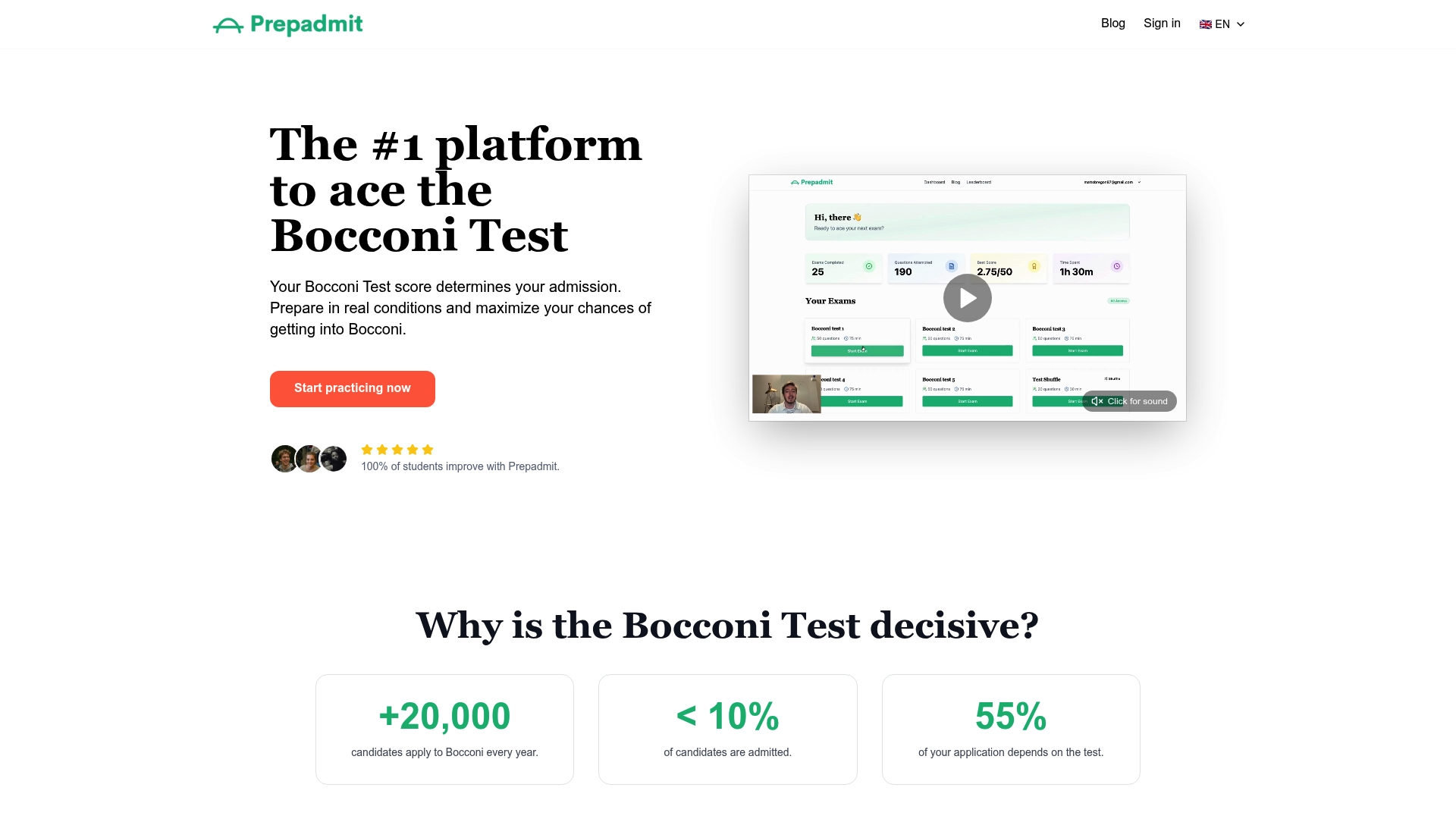
It offers a money-back guarantee and includes customer testimonials. If you want the simulation and drill cycle described above without building it yourself, you can access the full preparation platform, or start with a diagnostic simulation to see your baseline area scores. For more on how the feedback loop works in practice, see this look at Prepadmit’s structured approach.
- Official past-paper simulations that match the real test’s timing and navigation.
- Skill-specific drills targeted to your weakest score areas.
- A progress dashboard and peer leaderboard to track standing over time.
Official pages and quick links
For confirmed dates, technical requirements, and booking windows, check Bocconi’s own test instructions and rules of conduct directly.
FAQ
How many questions are on the Bocconi Test?
The Bocconi Test has 50 multiple-choice questions to complete in 75 minutes. Questions are mixed by topic and difficulty rather than grouped by section.
Can you go back to a previous question on the Bocconi Test?
No. The platform shows three questions per screen, and once you move forward, you cannot return to a previous screen. Practicing this no-return rule ahead of time helps you avoid losing time on a single question.
How long does it take to get Bocconi Test results?
Score reports become available in your personal area within about 48 hours of finishing the test. The report includes your total score, area breakdowns, and counts of correct, incorrect, and omitted answers.
What is the difference between the official simulation and the real test?
The official simulation allows you to review your answers after the session, while the live proctored test does not. Practicing under the real test’s timed, no-return conditions closes that gap before your actual attempt.
How much does Prepadmit cost?
Pricing for full access to Prepadmit’s preparation platform is available directly on its website. The platform includes a money-back guarantee alongside its simulations, drills, and tracking tools.
Recommended
Related articles
Ready to ace your admission test?
Discover PrepAdmit, the platform that helps you succeed at top university admission tests.
Discover PrepAdmit