Pick the Bocconi Main Idea in 1 Minute: Timed Method

Pick the Bocconi Main Idea in 1 Minute: Timed Method
The best way to answer a Bocconi main-idea question is to rebuild the author’s overall claim in your own words first, then match that paraphrase against the choices. Bocconi’s own test description confirms reading-comprehension items test both stated and implied meaning. Simulation data from test-preparation platforms backs this method with repeated practice results.
TL;DR:
- Main-idea questions mainly ask for the author’s implicit claim, which requires analyzing multiple paragraphs and transition signals, rather than restating the topic.
- To identify the main idea, readers should paraphrase the entire passage in a sentence and eliminate choices that focus on details, outside knowledge, or reverse qualifiers.
- Common distractors include topic-only answers, unsupported outside information, and overly absolute statements that are not supported by the passage.
- Effective practice involves timed reading and answer review, focusing on understanding why wrong options fail, supported by official past papers and detailed answer explanations.
- Test stamina and pacing can be improved by setting time limits per passage, marking difficult questions, and practicing with simulated timed exercises.
Table of Contents
- What a main idea question actually asks
- A step-by-step method for choosing the main idea under time pressure
- Worked practice: annotated main-idea examples
- Common traps and elimination shortcuts
- Timing and pacing across the 50-question test
- A note on practice and tracking progress
- Where Prepadmit fits into your preparation
- FAQ
- Sources
What a main idea question actually asks
A main idea is not the topic. The topic is what a passage discusses. The main idea is what the author claims about that topic. A passage about coral reefs might have the topic “coral reef decline.” Its main idea might be “coral reef decline is reversible with targeted local action, even without solving climate change first.” Those are different things, and test-makers build wrong answers around that gap.
Bocconi’s official guidance states that reading-comprehension questions test explicit information and implicit meaning together. A main-idea question almost always falls on the implicit side: no single sentence hands you the answer, you build it from the whole passage.
A few signals tell you a question is asking for the main idea rather than a detail:
- The question stem uses phrases like “the passage mainly argues” or “the author’s primary point is.”
- Answer choices are broad statements rather than specific facts or numbers.
- Correct answers tend to echo ideas repeated across multiple paragraphs, not just one.
- Opening and closing sentences of the passage often hint at the author’s overall claim, though they are rarely the full answer on their own.
Transitions matter too. Words like “however,” “despite,” or “in contrast” often mark the place where the author’s real argument appears, especially when earlier sentences present a common view before the passage pushes back on it.
A step-by-step method for choosing the main idea under time pressure
Use the same sequence every time. Consistency is what lets you work fast without second-guessing.
- Read the full passage once. Do not skim. Note the author’s stance, not just the subject matter.
- Write a one-sentence paraphrase that covers the whole passage, not just the opening or closing lines.
- Test each answer choice against that paraphrase. Reject any choice that adds a fact the passage never states, reverses a qualifier (turning “some” into “most,” or “can” into “always”), or narrows the scope to one detail instead of the whole argument.
- Before you commit, check that your chosen option explains the passage as a whole, including the paragraphs you might be tempted to skip on a second read.
This sequence rarely takes more than a minute once practiced, and it removes the guesswork that causes rushed wrong answers.
Pro Tip: Accept the passage’s claims as true for the purpose of the question, even if they contradict what you know or believe, since official Bocconi practice materials model answers strictly from the text.
One detail trips up strong readers more than weak ones: outside knowledge. If a passage claims something you know to be inaccurate in the real world, the test still wants the answer that follows from the passage’s own claims. The University of Manitoba’s reading guide recommends writing that one-sentence paraphrase immediately after reading, while the passage is still fresh, rather than trying to reconstruct it while scanning the answer choices.
Worked practice: annotated main-idea examples
Here are two short passages in Bocconi style, worked through the method above.
Example 1: explicit main idea. A passage describes how urban beekeeping has grown in several European cities, then spends three paragraphs explaining that city beekeepers report healthier colonies than rural beekeepers because cities offer more plant diversity and fewer pesticides. The correct answer restates that claim directly: “Urban environments can support healthier bee colonies than rural ones.” A tempting wrong answer says “Beekeeping has become more popular in cities,” which only restates the topic, not the author’s actual claim about health outcomes.
Example 2: implied main idea. A passage opens by describing a traditional view that written contracts are always more enforceable than verbal agreements, then presents three examples where courts upheld verbal agreements due to consistent behavior between parties. No sentence directly states the author’s conclusion. The paraphrase has to summarize the shift across all three examples: “Verbal agreements can be as enforceable as written ones when supported by consistent conduct.” A distractor that only restates one court case fails because it summarizes a detail, not the full pattern the author builds.
In both examples, each wrong choice fails a specific elimination rule:
- One choice restates the topic without the author’s claim about it.
- One choice summarizes a single supporting example rather than the whole passage.
- One choice reverses a qualifier, turning “can be” into “is always.”
Our own data from Prepadmit’s simulation practice shows that students who annotate wrong answers this way, rather than only checking which option feels right, retain the elimination logic for future passages.
Common traps and elimination shortcuts
Most wrong answers on main-idea items fall into a small set of trap types:
- Topic-only answers that describe the subject without the author’s actual claim.
- Outside-information answers that sound true in the real world but are never stated or implied in the passage.
- Reversed qualifiers that flip “some” to “most” or “can” to “will.”
- Example-for-thesis confusion, where the choice summarizes one supporting detail instead of the whole argument.
- Overly strong absolutes like “always” or “never” that the passage does not support.
When you are stuck between two choices, run this four-step check: does it match your paraphrase, does it stay within the passage’s scope, does it avoid unsupported absolutes, and does it cover the whole passage rather than one paragraph. Apply that same checklist to the examples above and the correct answer in each case passes all four steps while the distractors fail at least one.
Timing and pacing across the 50-question test
The undergraduate Bocconi Test includes 50 questions total, with 11 reading-comprehension items alongside mathematics, numerical reasoning, and critical thinking sections. Not every reading item is a main-idea question, so budget time by passage, not by section.
- Give each reading passage a set time limit before you start, and move on if you are still unsure after it passes.
- Mark a tough question and return to it only after finishing the rest of the section.
- Drill with timed mock sets built from official past papers so your pacing becomes automatic rather than something you calculate mid-test.
A note on practice and tracking progress
We recommend short daily sessions over long infrequent ones, paired with one full timed simulation each week. Reviewing why an answer was wrong matters more than reviewing that it was wrong. Our peer ranking data shows consistent error analysis moves students up faster than extra volume alone.
— quentin
Where Prepadmit fits into your preparation
We built our preparation around the exact gap this article covers: knowing the method is one thing, applying it fast under real test conditions is another. Test-preparation platforms offer official past papers, timed simulations, and skill-specific drills built around question types like main idea, so you can practice the method above until it becomes automatic rather than something you have to think through.
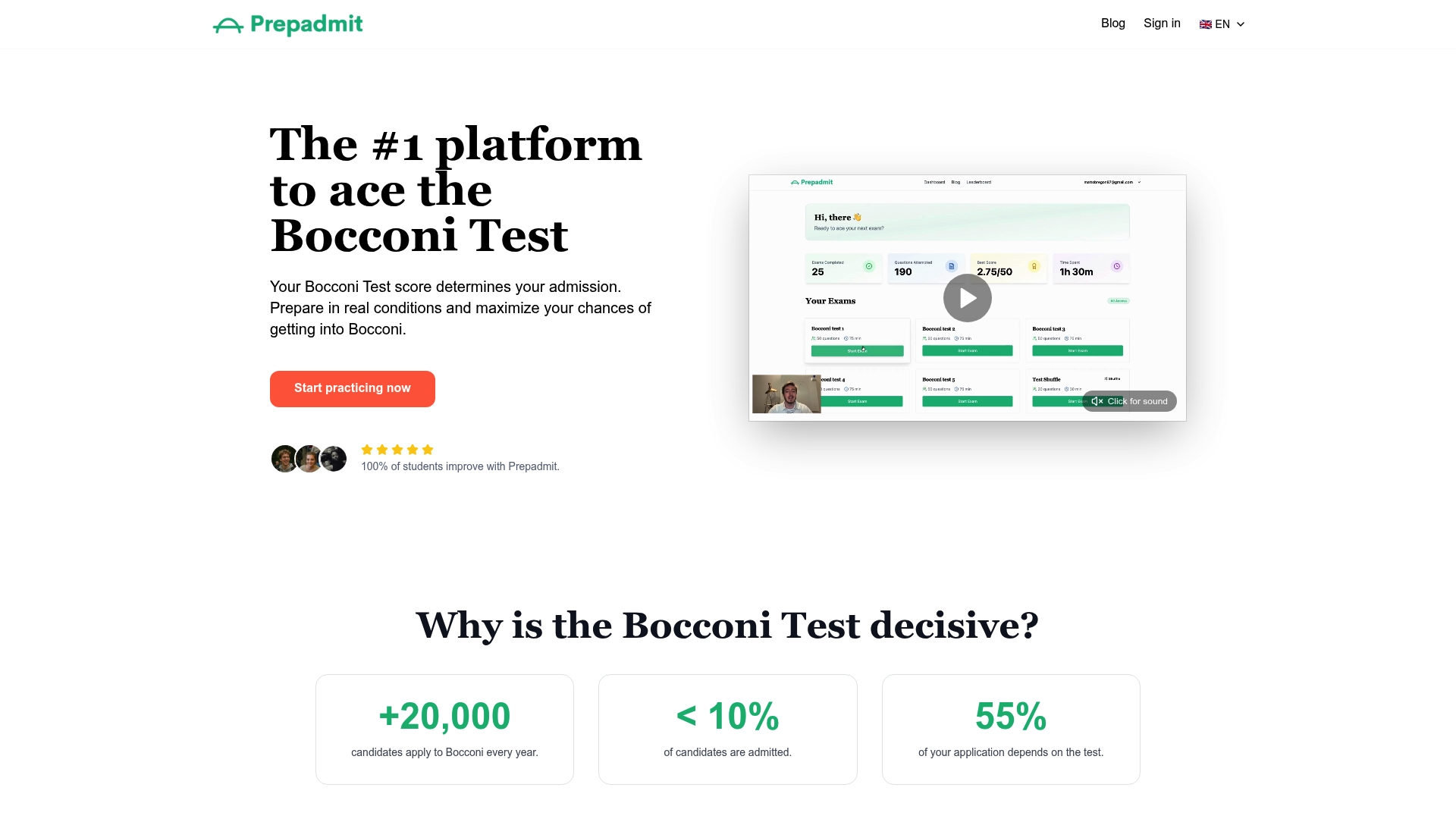
The platform includes timed simulations built from official past papers, detailed answer corrections explaining why each wrong choice fails, skill-specific drill modes targeted at reading comprehension, and a leaderboard that ranks progress against other test-takers.
Access the full preparation to see where you stand.

FAQ
What is the difference between a topic and a main idea?
The topic is what a passage is about in a few words, while the main idea is the specific claim the author makes about that topic. A Bocconi main-idea question always asks for the claim, not just the subject, so a choice that only restates the topic is wrong.
Does Bocconi test implicit meaning in reading comprehension?
Yes. Bocconi’s official test description confirms reading-comprehension items assess both explicit information and the passage’s implied meaning, which is why main-idea answers often require inference across the whole passage rather than a single quoted line.
How many reading comprehension questions are on the Bocconi Test?
The undergraduate Bocconi Test includes 11 reading-comprehension questions out of 50 total questions, alongside mathematics, numerical reasoning, and critical thinking sections. Not every reading item asks for the main idea specifically.
Should I use outside knowledge to answer main idea questions?
No. Official Bocconi practice materials model answers based strictly on what the passage states or implies, so you should accept the passage’s claims as given even when they conflict with what you already know.
How can I practice Bocconi main idea questions effectively?
We recommend timed practice using official past papers combined with detailed review of wrong answers, since recognizing why a distractor fails builds the elimination skill faster than repetition alone. Our platform offers simulations and skill-specific drills built around this approach.
Sources
- Online Bocconi test | Bocconi University
- Finding main ideas | University of Manitoba academic learning
Recommended
Related articles
Ready to ace your admission test?
Discover PrepAdmit, the platform that helps you succeed at top university admission tests.
Discover PrepAdmit