Why Test Prep Investment Pays Off for Applicants

Why Test Prep Investment Pays Off for Applicants
Many students treat test preparation as optional. You study a bit, take the exam, and hope for the best. But that approach leaves serious money and opportunity on the table. Understanding why test prep investment pays off means looking beyond the exam day score. It means recognizing that structured preparation builds skills, unlocks financial aid, and creates academic habits that follow you into university and beyond. This article breaks down the real return on test prep so you can make a smarter decision before your next exam.
Table of Contents
- Key takeaways
- Why test prep investment pays off financially
- Skills you keep long after the exam
- Addressing the test-optional myth
- Strategies that actually maximize your return
- My take on why most students get this wrong
- How Prepadmit helps you get the best return
- FAQ
Key takeaways
| Point | Details |
|---|---|
| Score gains are measurable | Structured programs improve scores by 90–120 points on average, with tutoring yielding even more. |
| Prep unlocks financial aid | Higher scores move you into merit aid tiers that can reduce annual tuition costs significantly. |
| Skills transfer beyond the exam | Test prep trains logical reading, time management, and grammar that serve you in college and work. |
| Strategy beats volume | Short daily practice and diagnostic targeting outperform last-minute cramming every time. |
| Test scores still matter | Even at test-optional schools, strong scores validate your GPA and secure scholarship thresholds. |
Why test prep investment pays off financially
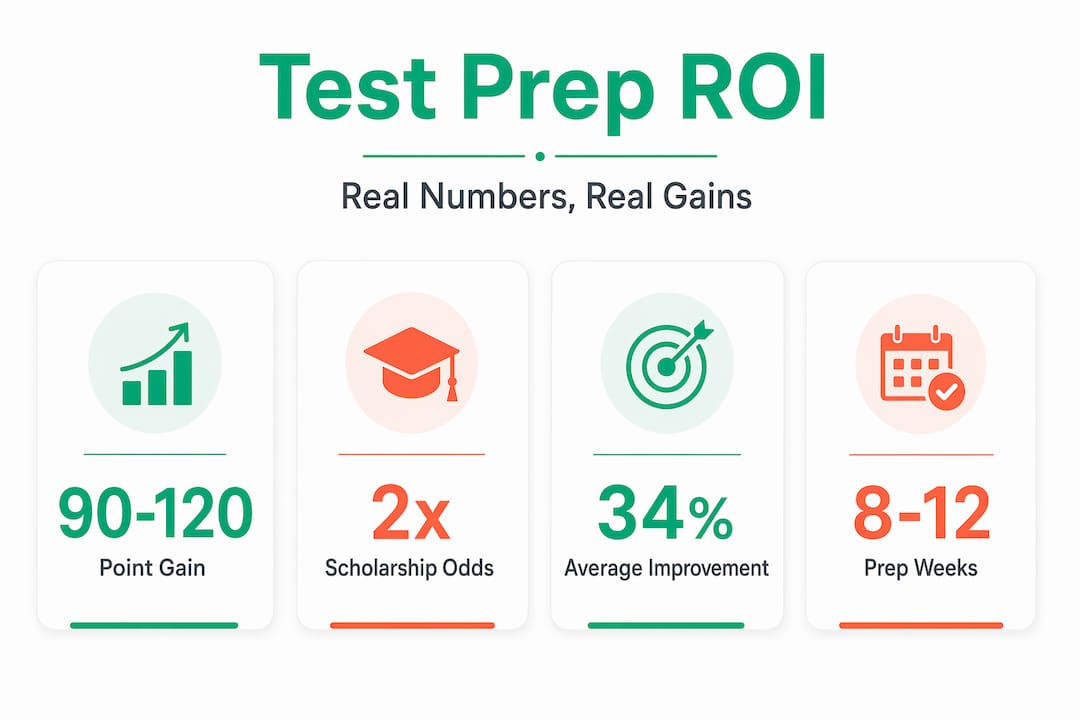
The most direct argument for test prep is the numbers. Structured SAT programs produce average score gains of 90 to 120 points, while expert one-on-one tutoring can push that figure to 150 to 250 points or more. Those are not small jumps. On a 1600-point scale, a 150-point improvement can move you from one admissions bracket to a completely different one.
Now connect that score gain to money. Many universities use specific SAT or ACT score thresholds to determine merit-based scholarship eligibility. Cross one of those thresholds and you might qualify for an award worth $5,000, $10,000, or more per year. Over four years, that is a difference of up to $40,000 in tuition costs. Merit aid thresholds are directly tied to test scores, which means a prep course costing a few hundred dollars can return tens of thousands in savings.
The table below shows how score ranges typically align with merit aid opportunities.
| Score range (SAT) | Typical merit aid access | Prep investment needed |
|---|---|---|
| Below 1200 | Minimal or need-based only | Significant structured prep |
| 1200–1350 | Some institutional aid | Targeted skills coaching |
| 1350–1450 | Competitive merit scholarships | Focused practice plus tutoring |
| 1450–1600 | Top-tier merit and honors awards | Advanced prep and mock testing |
Pro Tip: Before you choose a prep program, look up the exact merit aid score cutoffs at your target schools. Knowing the specific threshold you need to hit turns your prep into a financial strategy, not just an academic exercise.
The math is clear. Even a mid-range prep investment delivers a return that most financial decisions cannot match.
Skills you keep long after the exam
Here is what most students miss about test prep. The score is temporary. The skills are not.
Effective test preparation trains a specific set of competencies that apply directly to AP classes, college coursework, and professional internships. These are not abstract benefits. They show up in your work every week once you get to university.
The core skills test prep builds include:
- Logical reading. You learn to identify the main argument, spot unsupported claims, and distinguish evidence from opinion. This is exactly what professors expect in seminars and written assignments.
- Data literacy. Math and quantitative reasoning sections train you to read graphs, interpret tables, and draw conclusions from numbers. These skills matter in economics, business, and science courses.
- Grammar precision. Writing sections build your ability to construct clear, correct sentences under pressure. That transfers directly to essays, reports, and professional emails.
- Time management. Working through timed sections teaches you to allocate effort strategically. You learn when to move on and when to push through.
- Stress regulation. Repeated practice under exam conditions reduces anxiety. You get comfortable with discomfort, which is a skill that serves you in job interviews and high-stakes presentations.
Pro Tip: During prep, treat each practice session as a skill-building workout, not just a score check. After every session, write down one specific thing you got better at. This habit keeps your focus on growth, which is where the long-term value of test preparation actually lives.
Students who approach prep this way graduate with a toolkit that their peers often lack. The importance of test prep is not just about getting into a school. It is about arriving there ready to perform.

Addressing the test-optional myth
You have probably heard the argument: “Many schools are test-optional now, so why bother?” It sounds logical. It is also incomplete.
Strong scores remain critical for merit-based aid even at schools that do not require them for admission. A university can admit you without a score and still require one to unlock its scholarship program. That distinction matters enormously when you are comparing financial aid packages.
There is also a deeper point about equity. Access to quality test prep has historically been unequal. Students from higher-income families have had more access to private tutoring and expensive courses. But tailored prep can enable dramatic improvements for students who receive the right support, regardless of background. The key word is tailored. Generic prep produces modest average gains. Personalized, targeted prep is where the real test prep ROI shows up.
Consider the following comparison of common myths versus what the evidence actually shows.
| Common myth | Evidence-based reality |
|---|---|
| Test-optional means scores don’t matter | Scores still unlock merit aid and validate GPA at most schools |
| All prep programs deliver the same results | Personalized, diagnostic prep outperforms generic courses significantly |
| Natural ability matters more than prep | Targeted practice consistently improves scores across ability levels |
| Cramming before the exam is enough | Daily 10–15 minute practice far outperforms last-minute volume studying |
“The average gains reported by many prep courses mask significant variation. True value lies in providing the right support to the right student at the right time.” — Do test prep courses work?
The test preparation advantages available to you today are more accessible than ever. The question is whether you use them strategically.
Strategies that actually maximize your return
Knowing that test prep pays off is one thing. Knowing how to get the most from it is another. These four approaches consistently produce the best results.
-
Start with a diagnostic test. Before you study anything, take a full practice exam under real conditions. Diagnostic testing identifies subskill deficits so you can focus your time on the areas that will move your score the most. Studying what you already know is comfortable but wasteful.
-
Use retrieval practice, not passive review. Rereading notes feels productive. It is not. Students retain 50% more a week later when they use active recall and practice testing instead of passive review. Every study session should involve answering questions, not just reading content.
-
Practice the two-pass strategy. On exam day, go through the section once and answer every question you can solve quickly. Flag harder ones and return to them. This two-pass approach reduces stress and mirrors how professionals manage competing deadlines. It is a habit worth building before you sit the real exam.
-
Practice daily in short sessions. Targeted 10 to 15 minutes of daily skill reinforcement produces better long-term retention than marathon weekend sessions. Consistency beats intensity. Your brain consolidates learning during sleep, so spacing practice across days is not just convenient. It is scientifically more effective.
Pro Tip: Build a weekly study plan that targets one specific skill area per session. Monday might be reading comprehension, Wednesday might be algebra, Friday might be grammar. This rotation prevents fatigue and ensures you cover all sections without burning out on any one topic.
The return on test prep compounds when you combine these strategies. Each one reinforces the others. Diagnostic data tells you where to focus. Retrieval practice locks in what you learn. The two-pass strategy reduces wasted time on exam day. And daily practice keeps everything sharp.
My take on why most students get this wrong
I’ve watched a lot of students approach test prep the wrong way. They fixate on a target score, grind through practice tests without analyzing their mistakes, and then feel defeated when their score improves by only 30 points. The problem is not the prep. It is the mindset.
In my experience, the students who get the most from test preparation are not the ones who study the hardest. They are the ones who study the most deliberately. They look at every wrong answer as a data point. They ask why they got it wrong, not just what the right answer was. That shift in thinking is where the real value of test preparation lives.
I’ve also seen students skip prep entirely because they assume their natural ability will carry them. Sometimes it does. More often, it does not. And the cost of that gamble is not just a lower score. It is a missed scholarship, a weaker application, and a skill gap that follows them into their first year of university.
My honest advice: do not chase the maximum possible score gain. Chase meaningful, measurable progress. Know your baseline. Know your target. Work the gap systematically. That approach does not just pay off on exam day. It builds the kind of learner that universities actually want.
— quentin
How Prepadmit helps you get the best return
If you are preparing for the Bocconi Test and want to put these strategies into practice, Prepadmit is built exactly for this. The platform gives you access to official past papers and on-demand tests that simulate real exam conditions. You get detailed answer corrections after every session, skill-specific practice modes, and progress tracking that shows you exactly where you are improving.
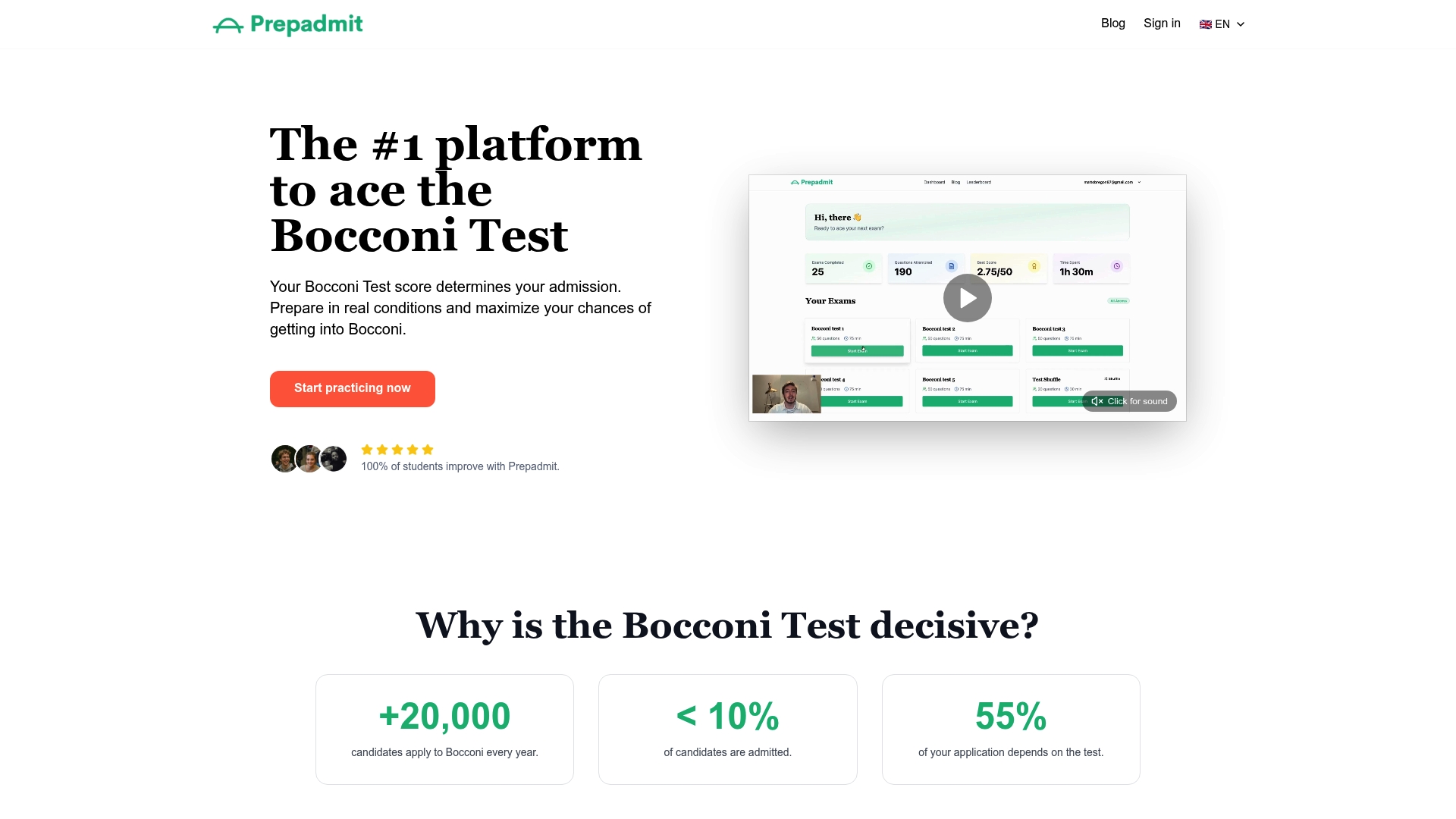
Prepadmit was developed by experts from HEC and Bocconi, and the platform reports an average score improvement of 34% among its users. That is the kind of result that moves you across merit aid thresholds. It is also a fraction of the cost of private tutoring. The platform includes a money-back guarantee, so the financial risk is minimal. If you want to see how mock exams build real results, Prepadmit gives you the structure to make it happen.
FAQ
Does test prep actually improve scores?
Yes. Structured programs improve scores by an average of 90 to 120 points, and personalized tutoring can produce gains of 150 to 250 points or more.
Is test prep worth it at test-optional schools?
Absolutely. Even at test-optional schools, strong scores are often required to qualify for merit-based scholarships, making prep a direct financial investment.
How long should I prepare for a high-stakes admissions test?
Most students benefit from 8 to 12 weeks of consistent, targeted practice. Short daily sessions spread over that period outperform intensive last-minute cramming.
What makes test prep more effective than self-study alone?
Structured prep includes diagnostic testing, targeted skill work, and timed practice under real conditions. These elements produce faster, more reliable score gains than unguided self-study.
Can test prep help students from all academic backgrounds?
Yes. Tailored prep enables dramatic improvements across ability levels. The key is personalized support that targets your specific weaknesses rather than generic content review.
Recommended
Related articles
Ready to ace your admission test?
Discover PrepAdmit, the platform that helps you succeed at top university admission tests.
Discover PrepAdmit