Why Realistic Exam Conditions Matter for Your Score
Why Realistic Exam Conditions Matter for Your Score
Why realistic exam conditions matter more than most students realize
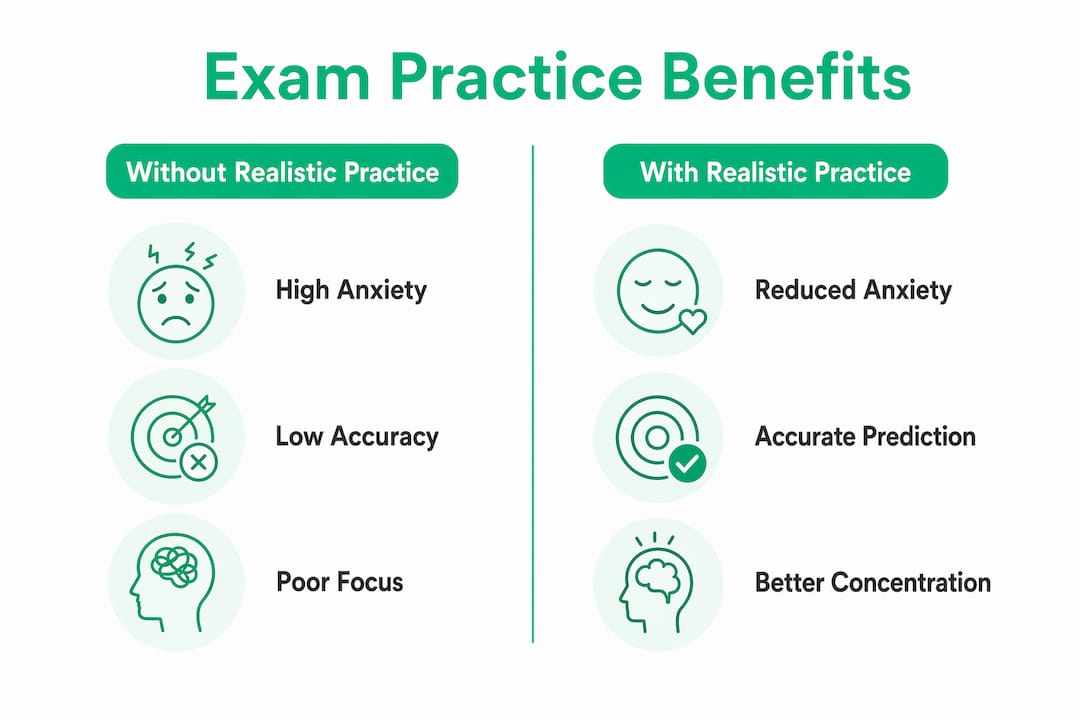
Practicing under realistic exam conditions is one of the most effective things you can do before test day. It reduces anxiety, sharpens time management, and gives you an honest read on where you actually stand. Most students study the content well but skip the simulation. That gap shows up on the day it counts.
Here is what practicing under real conditions does for you:
- Reduces anxiety through habituation. Repeated exposure to exam-like pressure makes the stress feel familiar, not paralyzing.
- Reveals genuine knowledge gaps. You find out what you do not know when you cannot look anything up.
- Builds time management instincts. Enforcing strict timing in practice trains your pacing before the real clock starts.
- Conditions your focus. Your brain learns to retrieve information on demand, not just during relaxed review sessions.
- Builds confidence through repetition. Each completed simulation proves to yourself that you can do it.
Table of Contents
- Key benefits of practicing under realistic exam conditions
- How to simulate real exam conditions effectively
- What to do after taking realistic practice tests
- Research insights and expert perspectives on realistic exam practice
- Prepadmit gives you the realistic practice that actually moves your score
- Key Takeaways
Key benefits of practicing under realistic exam conditions
Anxiety is the most common reason students underperform relative to their preparation level. Simulating exam conditions bridges the gap between study mode and test mode, programming your brain to recall under pressure rather than only in a quiet, comfortable setting. The more often you practice in that pressured state, the less shocking it feels on the actual day.
Realistic practice also gives you a far more accurate grade prediction than reviewing notes ever could. When you sit a timed, rules-bound test, your score reflects real performance, not an optimistic estimate. That honest feedback lets you adjust your study plan toward the areas that need it most.
Environmental factors matter more than most candidates expect. Research shows that seating, lighting, and noise are non-trivial performance variables. Practicing in a slightly uncomfortable chair, under office lighting, with ambient noise in the background prepares your brain for conditions you cannot fully control on test day. A separate study found that ceiling height in exam rooms is a statistically significant predictor of student scores, which tells you the physical environment is not a minor detail.

Pro Tip: Limit how often you glance at the countdown clock during practice. Checking the clock too frequently triggers anxiety that cascades into careless errors. Set a rule: check the time only at the halfway point and five minutes before the end.
How to simulate real exam conditions effectively
Getting the setup right is what separates a useful practice session from one that just feels productive. Follow these steps each time you run a full simulation.
- Match the official timing exactly. Use the same total duration and break structure as your actual exam. No pausing, no extending.
- Prepare your space the night before. Clear your desk, set up proper lighting, and use the same chair you will sit in for the full session.
- Follow all exam rules strictly. No phone, no unapproved notes, no browser tabs. Strict exam protocols during practice replicate the brain’s stress response so it is not new on test day.
- Start at the actual scheduled exam time. If your test begins at 9:00 AM, start your practice at 9:00 AM. Your alertness and focus patterns are time-dependent.
- Use only approved materials. If a calculator is not permitted, do not use one. If scratch paper is allowed, use exactly that.
- Add a proctor or accountability partner occasionally. Having someone else enforce the rules removes the temptation to bend them.
- Introduce minor controlled distractions sometimes. Playing low-level ambient noise during practice builds resilience to unexpected disruptions on the real day.
- Do not review answers mid-test. Finish the full session before looking at anything. Partial reviews break the simulation and train bad habits.
For AP exam candidates, effective study strategies that incorporate timed, conditions-matched practice follow the same logic and produce the same gains.
What to do after taking realistic practice tests
Your score is not the point. What you do with it is.
- Review answers immediately after finishing, then again 24 hours later. The delayed review catches errors your brain glossed over the first time and strengthens long-term retention.
- Categorize every wrong answer. Was it a content gap, a misread question, or a timing error? Each type needs a different fix.
- Adjust your study plan based on the pattern, not the total score. If you lost most points in one topic area, that area gets more time this week.
- Track your pacing data. Note which sections ran long and which felt rushed. Use that to set time targets per section in your next simulation.
- Treat results as diagnostic tools. Practice tests enhance metacognitive accuracy, meaning you get better at knowing what you know. That self-knowledge is what lets you study more precisely instead of just studying more.
The Cornell University Learning Strategies Center recommends simulating test conditions as the foundation of effective practice exam use, specifically because active retrieval under pressure is what makes information stick.
Research insights and expert perspectives on realistic exam practice
The science behind this is called the testing effect. Meta-analyses confirm that practice tests outperform passive review methods by reinforcing active recall, the mental act of pulling information from memory rather than recognizing it on a page. That distinction is why re-reading notes feels productive but often is not.
Beyond retention, realistic practice improves metacognition, your ability to accurately judge what you know and do not know. Students who practice under test conditions develop more accurate self-assessments, which directly improves how they allocate study time. Overconfident students study the wrong things. Students with calibrated self-knowledge do not.
| Factor | Without realistic practice | With realistic practice |
|---|---|---|
| Anxiety on test day | High, often paralyzing | Manageable through habituation |
| Time management | Frequently runs out of time | Pacing instincts built in advance |
| Self-assessment accuracy | Overestimates readiness | Calibrated to actual performance |
| Environmental adjustment | Disrupted by unfamiliar setting | Adapted through repeated exposure |
| Score improvement | Marginal gains from content review | Measurable gains from full simulation |
Prepadmit’s platform is built around this exact principle. Students who prepare using its official past papers, on-demand timed tests, and detailed answer corrections see an average score improvement of 34%. The platform was developed by experts from HEC and Bocconi, and every feature, from skill-specific practice modes to peer ranking, is designed to replicate the pressure and structure of the real Bocconi Test.
Prepadmit gives you the realistic practice that actually moves your score
Most students preparing for the Bocconi Test study the content but never practice the conditions. Prepadmit closes that gap directly.
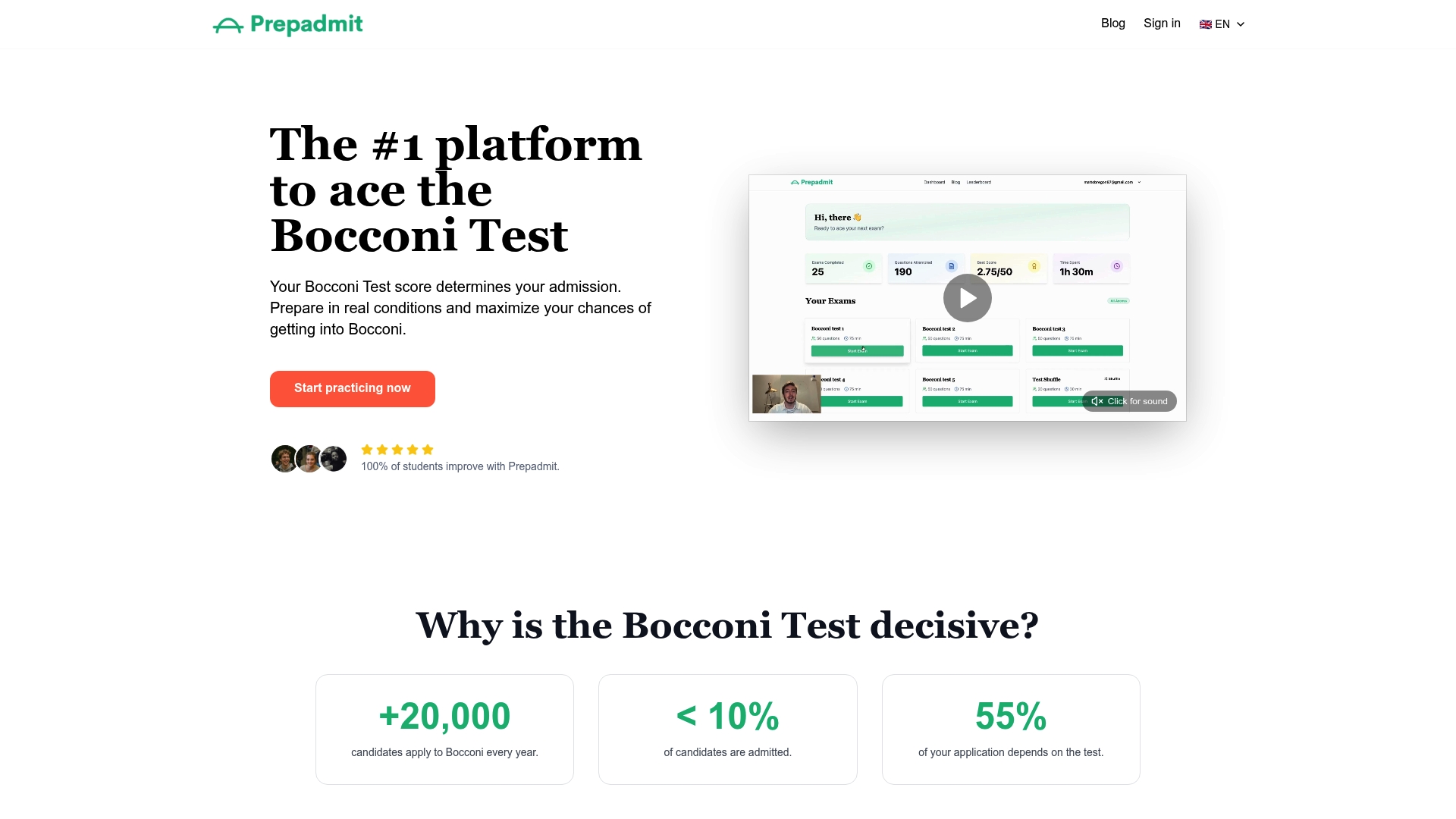
The platform gives you access to official past papers and on-demand timed tests that mirror the real exam format, not a simplified version of it. Answer corrections are detailed, not just right or wrong, so you understand exactly where your reasoning broke down. Progress tracking shows you how your performance shifts over time, and peer ranking tells you where you stand against other candidates. All of this at a fraction of the cost of private coaching, with a money-back guarantee behind it.
If you are preparing for the Bocconi Test and want practice that actually reflects what test day feels like, start your preparation on Prepadmit today.
Key Takeaways
Practicing under realistic exam conditions is the single most effective way to close the gap between preparation and performance on test day.
| Point | Details |
|---|---|
| Testing effect drives retention | Meta-analyses confirm practice tests outperform passive review by reinforcing active recall. |
| Environment affects performance | Seating, lighting, noise, and even ceiling height are statistically significant predictors of exam scores. |
| Metacognition improves with practice | Students who test under real conditions develop more accurate self-assessments and study more precisely. |
| Post-test review is where gains compound | Categorizing errors and adjusting study plans based on pacing data produces targeted improvement. |
| Prepadmit delivers measurable results | Students using Prepadmit’s realistic simulation tools see an average score improvement of 34%. |
Recommended
Related articles
Ready to ace your admission test?
Discover PrepAdmit, the platform that helps you succeed at top university admission tests.
Discover PrepAdmit