What Is Accessible Test Preparation for Students

What Is Accessible Test Preparation for Students
Accessible test preparation is not about making tests easier. It is about removing barriers that prevent students from showing what they actually know. If your child experiences test anxiety, has a learning disability, or your family is working with a tight budget, the playing field is not level by default. You have to build it yourself. This guide covers what accessible test preparation really means, the legal rights that protect students, how to find financial support, and how to build a study plan that actually fits the way your student learns.
Table of Contents
- Key takeaways
- What is accessible test preparation, really
- Your legal rights and accommodations
- Financial accessibility and fee waivers
- Personalized strategies for diverse learners
- Managing test anxiety and building confidence
- My take on what actually works
- How Prepadmit supports accessible preparation
- FAQ
Key takeaways
| Point | Details |
|---|---|
| Accessibility is not lowering standards | Accessible test prep removes barriers so students can demonstrate their true knowledge and ability. |
| Legal accommodations are your right | Students with documented disabilities are entitled to accommodations like extended time and assistive technology. |
| Financial support exists | Fee waiver programs can cover registration costs and prep resources for qualifying students. |
| Personalized prep outperforms generic study | Diagnostic-based strategies that target specific weaknesses produce better results than one-size-fits-all routines. |
| Alignment between prep and test day matters | Practicing with the same supports you will use on test day reduces stress and improves performance. |
What is accessible test preparation, really
The most common misconception is that accessible test preparation means watered-down content. It does not. Accessible test preparation involves legally required accommodations that allow students with disabilities to demonstrate their true aptitude, using the same content and the same standards as everyone else. The only thing that changes is the format or the conditions under which the test is taken.
This matters for a wide range of students. Students with dyslexia, ADHD, anxiety disorders, physical disabilities, or processing differences all benefit from preparation that accounts for their specific needs. But accessible exam strategies are not only for students with formal diagnoses. Students who are the first in their family to take a standardized test, students learning in a second language, and students without access to private tutoring all face real barriers that inclusive test preparation can help address.
Understanding accessible assessments starts with recognizing that fairness is not about identical conditions. It is about giving every student a genuine opportunity to perform. When a student with a visual impairment uses a screen reader, or a student with ADHD gets extended time, the goal of the test has not changed. The barrier has simply been removed.
Your legal rights and accommodations
The Americans with Disabilities Act sets a clear standard. Testing organizations must provide reasonable accommodations to students with documented disabilities. This is not optional, and it applies to major standardized tests including the SAT, ACT, GRE, and many state assessments.
Common accommodations include:
- Extended time (typically 50% or 100% additional time)
- Testing in a distraction-free room
- Use of a screen reader or text-to-speech software
- A scribe or speech-to-text tool for written responses
- Large print or braille versions of the test
- Sign language interpreters for spoken instructions
- Frequent breaks during the exam
The process for getting accommodations approved takes time. Accommodations approval involves a documentation review that can take two to four weeks, sometimes extending to eight weeks total. Families should plan to start this process at least two months before the intended test date. Waiting until the last month is one of the most common and most avoidable mistakes.
Pro Tip: Request accommodations through your school first. Many testing organizations require documentation of accommodations already in place at the student’s school, which makes the application process faster and more straightforward.
Here is a quick overview of how accommodations differ by test type:
| Test | Common accommodations offered | Approval body |
|---|---|---|
| SAT | Extended time, breaks, reader | College Board |
| ACT | Extended time, distraction-free room | ACT, Inc. |
| GRE | Screen reader, scribe, extended time | ETS |
| State assessments | Varies by state and IEP/504 plan | State education agency |
One thing families often miss: the accommodations you practice with during test prep should match the accommodations approved for test day. Mismatched supports between preparation and the actual exam cause avoidable stress and can hurt performance. If your student will use extended time on test day, they should practice with extended time from the very beginning.
Financial accessibility and fee waivers
Cost is a real barrier. Private tutoring can run hundreds or even thousands of dollars, and many families simply cannot afford it. The good news is that meaningful financial support exists, and most families who qualify do not take full advantage of it.
Fee waiver programs are the most direct form of help. In 2025, ACT’s fee waiver program provided over $20.5 million in support, helping more than 210,000 students access free registration and self-paced prep resources. That is not a small number. If your student is in 11th or 12th grade, meets income guidelines, and attends a public school, there is a strong chance they qualify.
Ways to reduce the cost of test preparation:
- Apply for ACT or College Board fee waivers through your school counselor
- Use free official practice tests published directly by the testing organization
- Access Khan Academy’s free SAT prep, which is officially partnered with College Board
- Look for public library programs that offer test prep workshops at no cost
- Check whether your student’s school offers test prep during school hours as part of college readiness programs
Beyond fee waivers, many accessible learning resources are available at no cost. Accessibility features like high-contrast display modes, audio support, and adjustable text sizing improve usability for all students, not just those with formal accommodations. These tools reduce cognitive fatigue and help students focus on the content rather than fighting the format.
Pro Tip: When applying for fee waivers, ask your school counselor to submit the request on your behalf. Counselors often have direct access to the application systems and can speed up the process significantly.
Personalized strategies for diverse learners
Generic test prep routines fail a lot of students. Not because the content is wrong, but because the approach does not match how the student actually learns. Diagnostic-based preparation significantly outperforms generic routines by identifying exactly why a student is struggling and building a plan around that specific gap.
The starting point for any personalized plan is a diagnostic assessment. This is a practice test or skills inventory that shows you where the student is strong and where they are losing points. Without this baseline, you are guessing.

How personalized prep compares to generic prep
| Approach | Generic prep | Personalized prep |
|---|---|---|
| Starting point | Fixed curriculum | Diagnostic assessment |
| Study focus | All topics equally | Targeted weak areas |
| Learning methods | Reading and drills | Multisensory, varied formats |
| Progress tracking | End-of-unit tests | Ongoing feedback loops |
| Accommodation alignment | Often ignored | Built into practice from day one |
Universal Design for Learning, or UDL, is a framework worth understanding. UDL is a proactive approach that builds flexibility into the learning process from the start, using multiple means of engagement, representation, and expression. In test prep, this means offering content through audio, video, written text, and interactive practice rather than just one format. It also means giving students choices in how they demonstrate understanding.
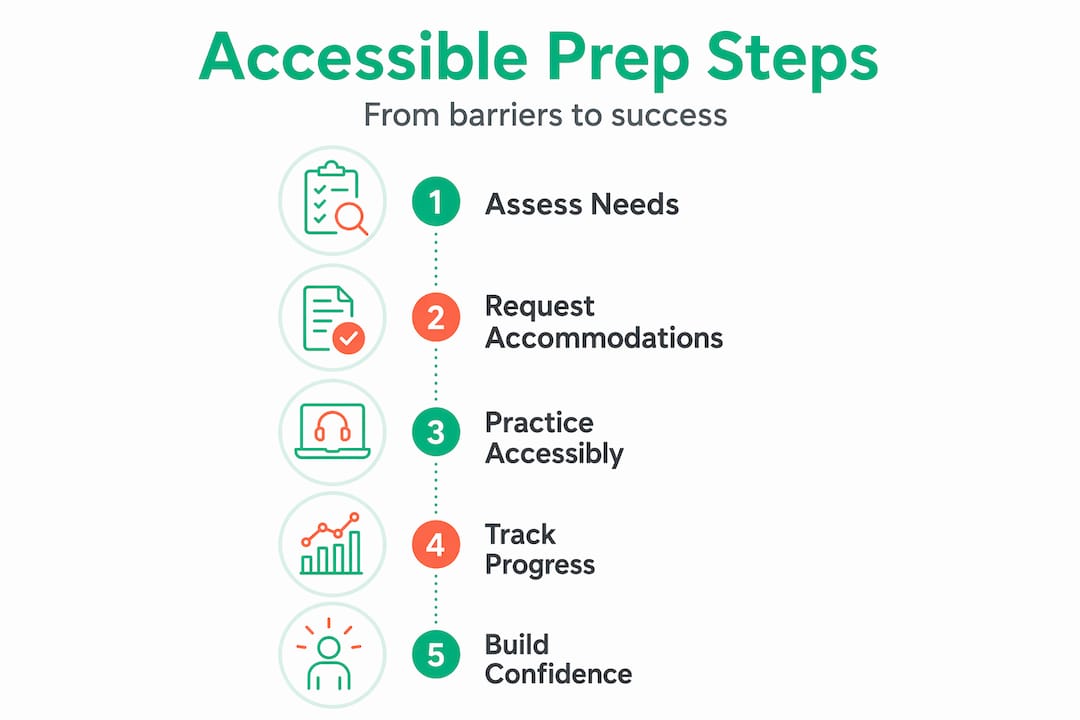
One critical point: UDL anticipates learner differences and reduces the need for some accommodations, but it does not replace legally required individual supports. A student with a documented disability still needs their formal accommodations in place. UDL and formal accommodations work together, not as substitutes for each other.
Pro Tip: If your student learns better through listening than reading, look for prep resources that offer audio explanations of answer choices, not just written ones. This is a simple shift that can meaningfully improve comprehension and retention.
For students preparing for the Bocconi Test, individualized diagnostics are especially useful because the exam tests a specific combination of logical reasoning and quantitative skills. Knowing which of those areas needs the most work changes how you allocate study time.
Managing test anxiety and building confidence
Between 40% and 60% of K-12 students experience moderate to severe test anxiety, and it can reduce performance by roughly half a letter grade. That is a significant and measurable effect. The good news is that it is manageable with the right approach.
Here are steps that actually help:
- Practice under realistic conditions. Use timed practice tests in a quiet space that mirrors the actual testing environment. Familiarity reduces fear.
- Build a consistent sleep schedule. Sleep deprivation amplifies anxiety and impairs memory recall. Aim for eight to nine hours in the weeks leading up to the test.
- Use controlled breathing before and during the test. Slow, deep breaths activate the parasympathetic nervous system and reduce the physical symptoms of anxiety.
- Exercise regularly during the prep period. Even 20 minutes of moderate activity per day improves focus and reduces cortisol levels.
- Eat a balanced meal before the test. Blood sugar stability directly affects concentration and emotional regulation.
“The goal of test preparation is not to produce a student who can perform under ideal conditions. It is to produce a student who can perform under real ones.”
The role of mock exams in building this kind of confidence is well established. Students who take multiple full-length practice tests before the real exam report lower anxiety and higher scores. Repetition under realistic conditions makes the actual test feel familiar rather than threatening.
My take on what actually works
I have seen a lot of students go through test preparation with every resource available and still underperform. And I have seen students with very limited resources outperform expectations. The difference almost always comes down to one thing: whether the preparation was built around the student or around a generic curriculum.
The families who struggle most are often the ones who wait too long to request accommodations. The approval process takes time, and starting it late means practicing without the supports your student will actually have on test day. That misalignment is one of the most damaging and most preventable problems in test prep for disabilities.
I also want to push back on the idea that UDL is a substitute for formal accommodations. I have heard this framing more than once, and it is wrong. UDL makes preparation more flexible and more effective for everyone. But a student with a documented disability still needs their legally protected accommodations in place. One does not cancel out the other.
What I have found actually works is this: start with a diagnostic, build the plan around what the data shows, practice with the exact supports that will be available on test day, and treat test anxiety as a real variable that needs its own strategy. That is what inclusive test preparation looks like when it is done right.
— quentin
How Prepadmit supports accessible preparation
If you are preparing for the Bocconi Test, you need a platform that is built around your specific exam, not a generic one-size-fits-all program.
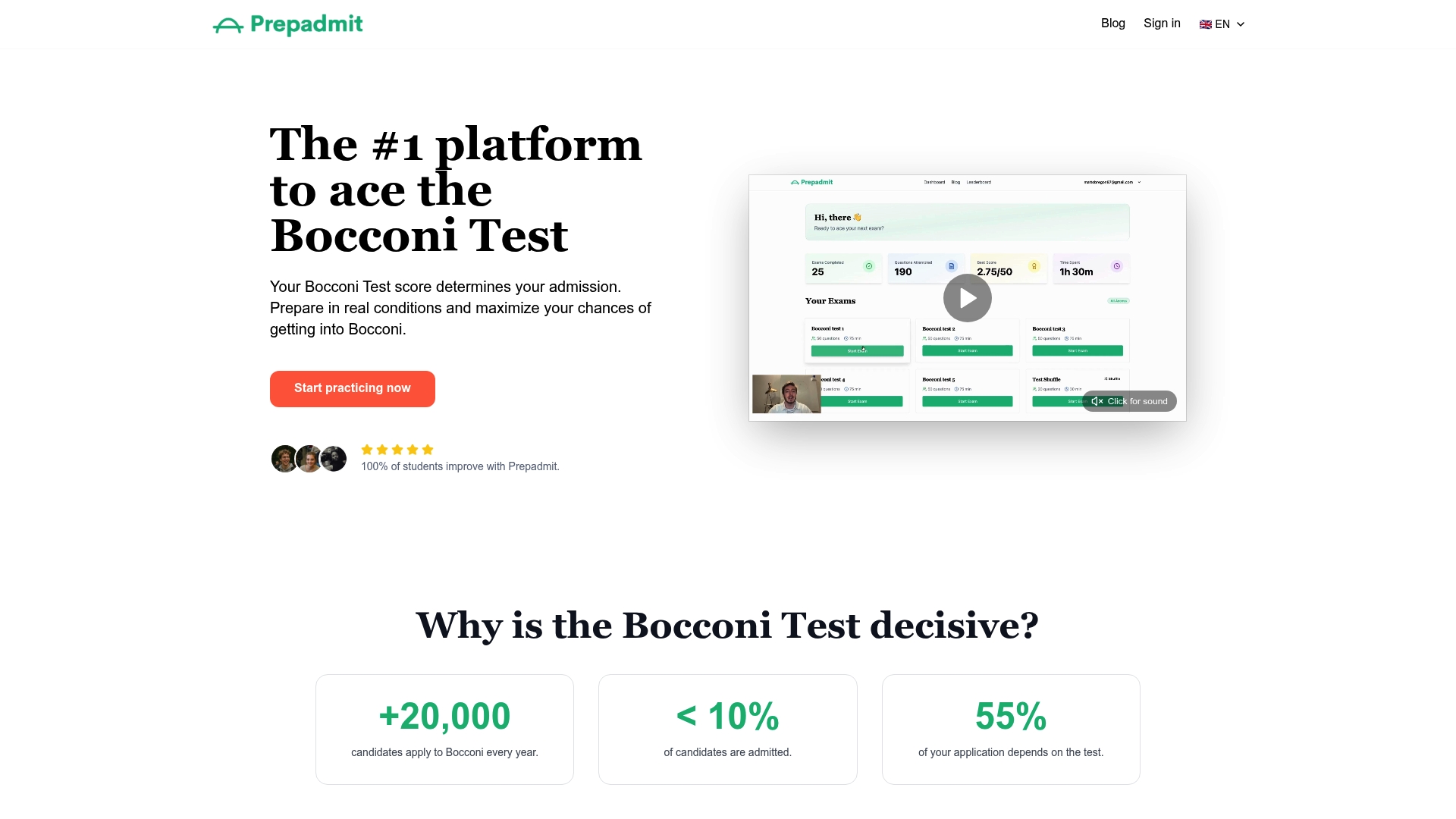
Prepadmit offers a preparation system built on official past papers, on-demand practice tests, and detailed answer corrections that show you exactly where you went wrong and why. The platform tracks your progress and ranks your performance against peers, so you always know where you stand. Students using Prepadmit see an average score improvement of 34%, and the platform is available at a fraction of the cost of private coaching. For families focused on accessible, affordable, and results-driven preparation, Prepadmit is the practical next step.
FAQ
What does accessible test preparation mean?
Accessible test preparation means preparing for a test in a way that removes barriers based on disability, learning differences, or financial constraints. It includes legal accommodations, personalized study strategies, and affordable or free resources.
Who qualifies for test accommodations?
Students with documented disabilities, including learning disabilities, ADHD, physical impairments, and anxiety disorders, qualify for accommodations under the Americans with Disabilities Act. Documentation from a qualified professional is typically required.
How early should families apply for accommodations?
Families should begin the accommodations approval process at least eight weeks before the test date. The review process can take two to eight weeks depending on the testing organization.
Are there free test prep resources for students with financial barriers?
Yes. Fee waiver programs from organizations like ACT cover registration and prep access for qualifying students. Free official practice tests and library-based programs are also widely available.
What is Universal Design for Learning in test prep?
UDL in test prep means offering content through multiple formats such as audio, video, and text so students can engage in the way that works best for them. It reduces barriers proactively but does not replace formal accommodations for students with documented disabilities.
Recommended
Related articles
Ready to ace your admission test?
Discover PrepAdmit, the platform that helps you succeed at top university admission tests.
Discover PrepAdmit