Languages Accepted for Bocconi Application: 2026 Guide

Languages Accepted for Bocconi Application: 2026 Guide
Getting your language documentation wrong is one of the fastest ways to derail a Bocconi application before it even gets reviewed. The languages accepted for the Bocconi application are more specific than most students expect, and confusing “accepted” with “sufficient” can cost you time, money, and a spot in a highly competitive cohort. This guide walks you through every language requirement, which certificates count, what scores you actually need, and how to position yourself strategically from day one.
Table of Contents
- Key takeaways
- 1. Languages accepted in the Bocconi application: the baseline
- 2. Accepted English certificates and minimum scores
- 3. Other languages accepted in Bocconi contexts
- 4. The admission test and its language implications
- 5. When language certificates factor into scholarships
- 6. Strategic tips for language compliance in your application
- 7. My honest take on language preparation for Bocconi
- Get test-ready with Prepadmit
- FAQ
Key takeaways
| Point | Details |
|---|---|
| English proficiency is required | All English-taught programs require at least B2 level, verified at enrollment. |
| Multiple certificates accepted | IELTS, TOEFL iBT, Cambridge, and Duolingo all qualify with specific minimum scores. |
| Admission test has language options | You can sit the Bocconi Online Test in English or Italian, giving non-native speakers flexibility. |
| Early application pays off | Applying in the Early Session improves scholarship access and gives you time to sort certificates. |
| Italian is not required but helps | Bocconi offers Italian courses for free; basic Italian makes daily life in Milan significantly easier. |
1. Languages accepted in the Bocconi application: the baseline
The core language of Bocconi’s undergraduate programs is English. Nearly all degree programs taught in English require formal proof of proficiency, and B2 level proficiency is the minimum standard across the board.
What surprises many students is when this verification happens. Language certificates are checked at enrollment, not during the selection phase. That means you can receive an offer without having submitted your certificate yet, but you cannot finalize enrollment without it. Knowing this distinction helps you sequence the international student Bocconi application steps properly.
Beyond English, Italian is the language of everyday life at Bocconi and in Milan. Proficiency in Italian is not a formal admission requirement, but it matters more than you might think once you arrive. More on that shortly.
Pro Tip: Do not wait for your admission result before chasing your language certificate. Start your IELTS or TOEFL preparation now, so the document is ready the moment you need it.
2. Accepted English certificates and minimum scores
Bocconi accepts multiple standardized certificates for English proficiency. Each comes with a defined minimum score. Here is a clear breakdown:
| Certificate | Minimum Score | Notes |
|---|---|---|
| IELTS Academic | 6.5 overall | At least 6.0 in each individual section |
| TOEFL iBT | 88 | Section minimums may apply per program |
| Cambridge (CAE/CPE) | Grade C or above | C1 Advanced or C2 Proficiency accepted |
| Duolingo English Test | Varies by program | Check current thresholds before registering |
The IELTS and TOEFL thresholds are well established. Bocconi requires a minimum IELTS score of 6.5 with no section falling below 6.0, and a TOEFL iBT minimum of 88.
A few important points about certificate validity and timing:
- Most English proficiency certificates are valid for two years from the test date.
- If your certificate expires before your enrollment date, you will need to retest.
- Cambridge qualifications (CAE and CPE) do not carry an expiration date, making them a strong long-term option.
- Duolingo is accepted at some programs but is not universally recognized across all tracks, so confirm with the admissions office before choosing it.
For competitive programs, the practical bar is often higher than the published minimum. A 7.0 IELTS or a 100+ TOEFL iBT will put you in a stronger position relative to other candidates in the pool.
3. Other languages accepted in Bocconi contexts
English is the dominant language for degree programs, but it is not the only language that matters in the Bocconi ecosystem. For exchange programs, Bocconi requires demonstrated proficiency in English, French, German, Spanish, or Portuguese depending on the host institution.
This means if you are targeting a semester abroad at a French or Spanish partner university during your degree, you need to show you can function in that language. The proficiency level typically required for exchange eligibility is B2 or above.
Here is a quick overview of how language fits across different program contexts:
- Undergraduate programs in English: English certificate mandatory at enrollment.
- Exchange programs: Proficiency in the host country’s language or English, depending on instruction language.
- Graduate programs: Similar English proficiency standards, sometimes higher for specialized tracks.
- Italian language: Not required for admission or graduation, but Bocconi provides free Italian courses for all international students.
On that last point: most students reach conversational Italian within six months through Bocconi’s own courses. Given that Milan is not an English-first city outside of campus, even a working knowledge of Italian changes your daily experience significantly. Grocery shopping, navigating bureaucracy, finding an apartment, all of these go much more smoothly with some Italian. You can get a head start by exploring how to learn Italian with music, which is a genuinely effective and low-effort approach for beginners.
Pro Tip: If you are targeting an exchange placement in France, Germany, or Spain, start building that language skill in your first year. Exchange spots are competitive, and your language proficiency is part of the selection criteria.
4. The admission test and its language implications
The Bocconi application for undergraduate programs involves an admission test. You have three options: the Bocconi Online Test, SAT, or ACT. Each choice has a different relationship with language.
The Bocconi Online Test can be taken in either English or Italian. This flexibility is meaningful. If you are a native Italian speaker or have very strong Italian skills, sitting the test in Italian could give you a genuine edge. If you are an international student with stronger English, the English version is the logical choice.

The SAT and ACT are conducted entirely in English. Choosing one of these tests carries strategic weight. The SAT is widely recognized internationally and may support your applications to other universities simultaneously. The Bocconi Online Test, by contrast, is purpose-built for Bocconi admission and may be more predictable if you prepare with Bocconi-specific materials.
Here is how the options compare at a glance:
| Test | Language options | Who it suits best |
|---|---|---|
| Bocconi Online Test | English or Italian | Students targeting Bocconi specifically |
| SAT | English only | Students applying to multiple universities |
| ACT | English only | Students with strong standardized test prep |
One thing to understand clearly: the admission test and the English language certificate are two separate requirements. Scoring well on an English-language SAT does not substitute for an IELTS or TOEFL certificate at enrollment. They serve different purposes in the process.
For a detailed breakdown of the on-demand test format and what to expect, the Bocconi On-Demand Test guide covers the structure clearly.
5. When language certificates factor into scholarships
Language readiness connects more directly to scholarships than most applicants realize. Bocconi offers merit-based financial aid, and the timing of your application affects your scholarship eligibility. The Early Session runs from October to November, and scholarships are awarded on a first-come, first-served basis within academic merit constraints.
If your language certificate is not ready when you apply in the Early Session, you risk either delaying your application or submitting an incomplete file. Neither is ideal when scholarship availability is time-sensitive. This is one of the more underappreciated aspects of the international bocconi application documents checklist.
What is bocconi merit scholarship criteria based on? Academic performance, standardized test scores, and demonstrated potential. Your English language score is not directly weighted as a scholarship criterion, but it is part of your overall academic profile and, more practically, it unlocks your ability to enroll in the first place.
Pro Tip: Take your English proficiency test at least three months before your target application session. This gives you time to retest if your first attempt falls short of the minimum.
6. Strategic tips for language compliance in your application
Getting the language side of your Bocconi application right comes down to planning and timing. Here is what actually moves the needle:
- Test early, not just once. Book your IELTS or TOEFL well in advance. If you score below the minimum on your first attempt, you have time to retest before deadlines close.
- Match your certificate to your program. Some programs have slightly higher thresholds than the published minimums. Check the specific program page, not just the general admissions page.
- Upload certificates as soon as you have them. Uploading language certificates early reduces friction at enrollment and signals organization to the admissions team.
- Do not assume native speaker status exempts you. Unless your prior education was entirely in English at an accredited institution, you will typically still need a formal certificate.
- Invest in Italian from day one. Not for admission, but for your own quality of life. International students who arrive with even basic Italian settle into Milan considerably faster.
Understanding how international connections unlock language skills can also help you think about language preparation as a broader personal development investment, not just a checkbox exercise.
7. My honest take on language preparation for Bocconi
I have worked with enough Bocconi applicants to say this clearly: the language requirement is not where students struggle, but it is where they procrastinate. Almost everyone knows they need an English certificate. Far fewer treat it with the same urgency as the admission test itself.
Here is what I have seen happen more than once. A student prepares seriously for the Bocconi Online Test, scores well, and then realizes their IELTS from two years ago expired. Or they never took one at all because they assumed strong English would be self-evident from their grades. Neither assumption holds.
My advice is simple. Treat the language certificate as a parallel track to your admission test preparation, not a follow-up task. Book the test date now, even if it feels premature. The students who handle this early are the ones who apply in the Early Session with a complete file and qualify for merit scholarships without scrambling.
On Italian: I would push back against the common advice that “you can get by with English in Milan.” You can survive on English, but surviving and thriving are different things. Even a month of Italian study before arrival noticeably changes how you experience the city. Bocconi’s free Italian courses are genuinely good. Use them before you get there if you can, not after.
The students who do best at Bocconi are not always the ones with the highest test scores. They are often the ones who showed up prepared for the full environment, linguistically included.
— quentin
Get test-ready with Prepadmit
Language certificates get you to enrollment. The admission test gets you to the offer. If you are preparing for the Bocconi Test, Prepadmit gives you access to official past papers, on-demand practice tests, and detailed answer corrections built specifically for Bocconi applicants.
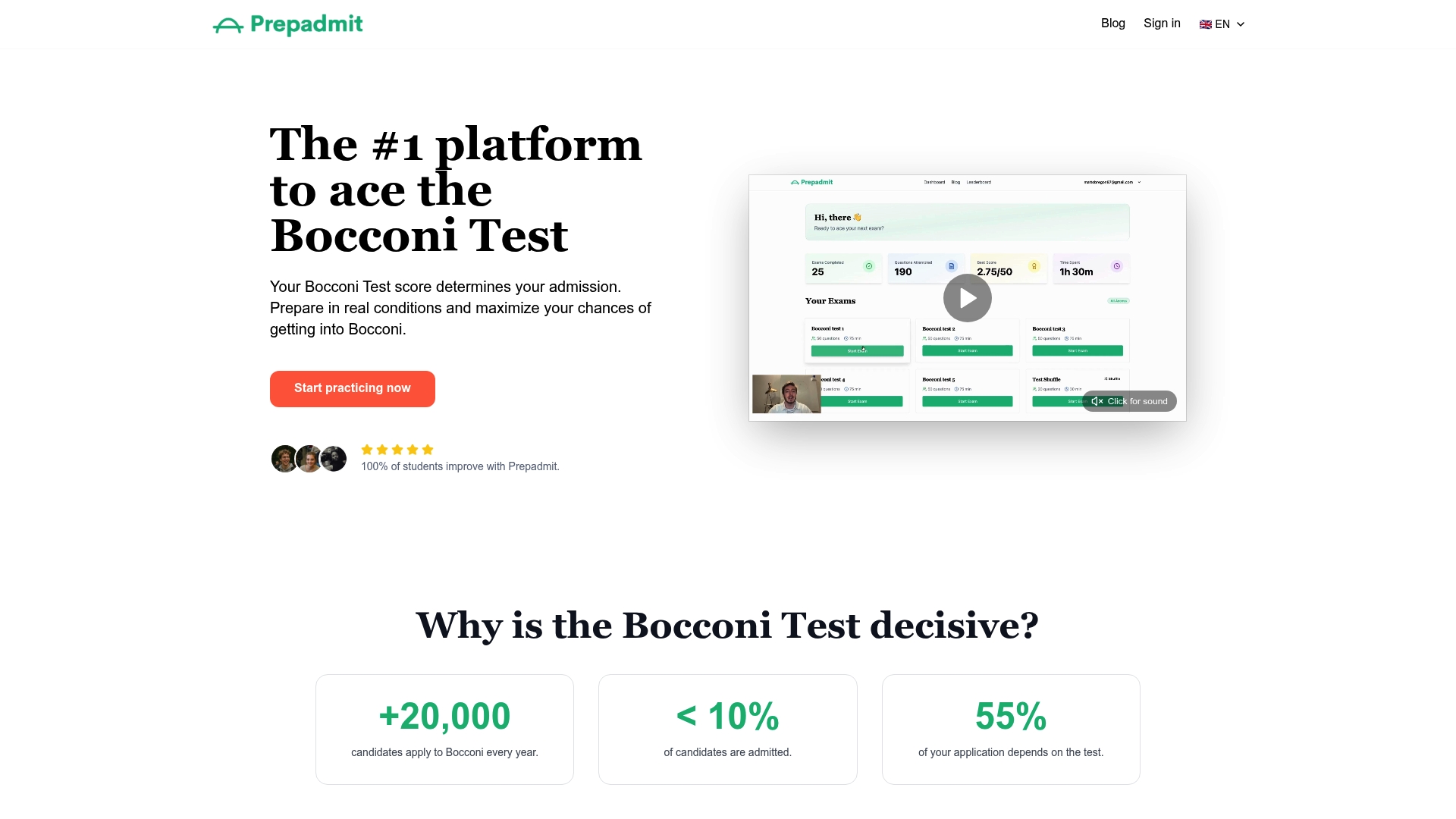
The platform was built by experts from HEC and Bocconi itself. Students improve their scores by an average of 34%, and there is a money-back guarantee if the results do not follow. Practicing with Bocconi-specific mock exams is one of the most direct ways to close the gap between where you are and where you need to be. Affordable, focused, and proven.
FAQ
What English score does Bocconi require?
Bocconi requires a minimum IELTS Academic score of 6.5 overall (no section below 6.0) or a TOEFL iBT score of at least 88. These are enrollment requirements, not selection criteria.
Can you take the Bocconi admission test in a language other than English?
Yes. The Bocconi Online Test is available in both English and Italian, giving applicants flexibility based on their strongest language.
Is Italian required to apply to Bocconi?
Italian proficiency is not a formal requirement for admission or graduation. Bocconi offers Italian courses to international students, and basic Italian is strongly recommended for daily life in Milan.
Does a good SAT score replace the English language certificate?
No. The SAT and an English proficiency certificate like IELTS serve separate purposes. A strong SAT supports your admission application, but a dedicated English certificate is still required for enrollment.
When should international students submit their language certificates?
Uploading your language certificate as early as possible is recommended. Doing so before the Early Session deadline (October to November) helps secure full enrollment eligibility and positions you better for merit scholarship consideration.
Recommended
Related articles
Ready to ace your admission test?
Discover PrepAdmit, the platform that helps you succeed at top university admission tests.
Discover PrepAdmit