How International Students Prepare Remotely for Bocconi

How International Students Prepare Remotely for Bocconi
Start a phased 12–16 week prep plan anchored to Bocconi local time, with weekly timed mocks, targeted language practice at IELTS 6.0–6.5 level for undergraduate entry, or 7.0+ for medical and law programs, and a confirmed tech backup before you sit the test. Three markers tell you you’re on track: your mock scores consistently clear the Bocconi admission threshold, your English proficiency meets the program’s minimum (typically IELTS 6.0–6.5 for undergraduate entry, 7.0+ for medical and law programs), and you’ve run at least one full connectivity dry run. A significant number of U.S. students took at least one online class recently, so the infrastructure and habits you need already exist. The gap is structure. Bocconi University sets the content standard; Prepadmit provides the timed mock engine and official past papers built around it.
Table of Contents
- Your one-week remote prep checklist
- How to build a 12–16 week study plan across time zones
- Which materials to use and how to simulate exam conditions
- How to improve listening, academic writing, and exam-specific language skills
- Managing time zones, LMS access, and faculty communication
- What to confirm and rehearse in the final week
- How to evaluate online prep platforms and tutors from the US
- Key Takeaways
- The fastest way to fix the most common remote-prep mistakes
- Prepadmit is built for exactly this situation
- Useful sources to bookmark
Your one-week remote prep checklist
Get these done before anything else:
- Register for the Bocconi test. Confirm the exact deadline on the Bocconi University admissions page and complete your student account setup now.
- Set your master calendar to CET/CEST (Bocconi local time). Every study block, mock window, and live session goes in at that time zone.
- Reserve weekly mock-test windows. Block two 90-minute slots per week, treat them as non-negotiable.
- Confirm LMS logins. Log into every platform you’ll use and reset passwords before week one.
- Book a language certification mock. If you haven’t sat IELTS yet, schedule a practice test now. Check which English tests Bocconi accepts before registering.
- Scan and save all documents. Passport, acceptance letter, ID, and any enrollment forms go into a dated cloud folder.
- Run a connectivity test today. Confirm your primary internet speed, then identify one backup option (portable hotspot, coworking space, or a neighbor’s network).
- Secure housing early if you’re planning to relocate. Booking 3–6 months ahead typically improves both cost and availability.
Pro Tip: Follow a strict phased sequence to avoid early burnout: diagnostic testing first, language gap second, application packaging third. Trying to run all three tracks at once is the most common reason students stall in week four.
How to build a 12–16 week study plan across time zones
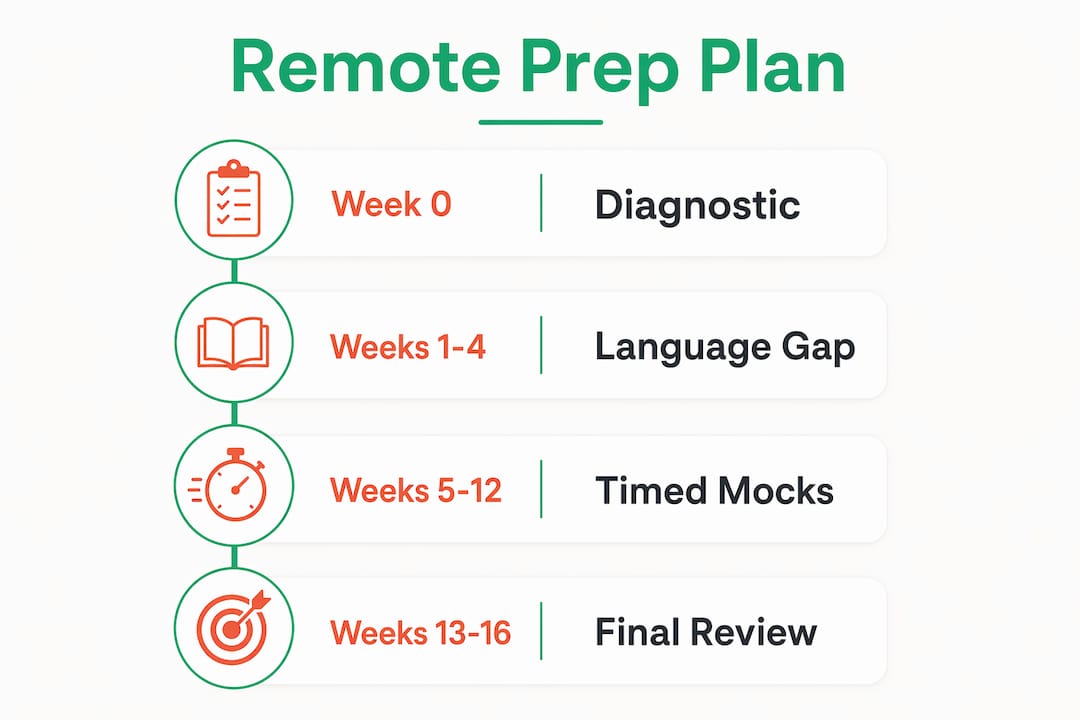
A dedicated study environment and a fixed routine are the two factors that most reliably separate students who improve from those who plateau. Build your schedule around those two anchors.
Phased sequence:
- Week 0: Take a full diagnostic mock. Identify section-level weaknesses, not just a total score.
- Weeks 1–4: Language focus. Academic listening, writing structure, and vocabulary tied to Bocconi test domains.
- Weeks 5–10: Topic blocks mapped to each test section. Two focused practice blocks per day: one active practice session, one review session.
- Weeks 11–14: Weekly timed mocks with structured review. By week 6, aim for mock scores consistently within your target band.
- Week 15–16: Taper. One mock per week, light review, and full tech rehearsal.
For time-zone management, batch live sessions and study blocks into windows that overlap with Bocconi business hours when possible, and schedule recorded-lecture catch-up in the early morning before your US workday starts.
| Week range | Goal | Deliverable |
|---|---|---|
| Week 0 | Baseline diagnostic | Section-level weakness map |
| Weeks 1–4 | Language foundation | IELTS practice score at or above 6.0–6.5 for undergraduate entry, or 7.0+ for medical and law programs |
| Weeks 5–10 | Test-domain mastery | Two mocks per week, error log updated |
| Weeks 11–14 | Mock consolidation | Consistent scores within target band |
| Week 15–16 | Taper and tech rehearsal | Full dry run completed |
A solid exam revision framework keeps this schedule from drifting when life gets busy.
Which materials to use and how to simulate exam conditions
Official past papers are the only materials that reliably mirror what Bocconi actually tests. Use them under full exam conditions: no notes, strict timing, same breaks as the real test. On-demand timed mocks add volume and let you practice at any hour.
Remote simulation checklist:
- Device and browser set to exam mode (close all other tabs).
- Webcam and ID visible if the test is proctored.
- Noise-controlled environment; use headphones if needed.
- Stopwatch app running for each section independently.
- No phone within reach.
Practice log template (update after every mock):
| Field | What to record |
|---|---|
| Date and mock number | Sequential tracking |
| Score per section | Raw and percentage |
| Time per section | Over/under target |
| Error types | Concept gap vs. careless mistake |
| Corrective action | Specific drill or review assigned |
Progress tracking against peer benchmarks and detailed answer corrections materially improve mock-to-real score translation, but only when you use the feedback to correct errors before the next mock. Logging without acting on the data is the most common waste of prep time.
How to improve listening, academic writing, and exam-specific language skills
Transcribing and shadowing academic lectures is one of the most effective remote listening exercises. Schedule three academic-listening sessions per week and one focused transcription exercise.
- Listen to a 10-minute recorded lecture, transcribe it, then compare your version to the original or a summary.
- Shadow the speaker’s pacing and sentence structure aloud.
- For academic writing, run one timed essay per week. Focus on structure: claim, evidence, analysis.
- Practice APA and MLA citation formats; Bocconi-level academic writing expects source awareness.
- Use IELTS-style listening and writing practice sets as your weekly benchmark. Undergraduate programs typically require 6.0–6.5; medical and law programs often require 7.0+.
Pro Tip: If your writing scores drop after long workdays, move timed essay practice to weekend mornings and use weekday evenings for lower-effort tasks like vocabulary review or annotating a past paper.
Managing time zones, LMS access, and faculty communication
Keep your master calendar in CET/CEST. Every deadline, mock window, and live session is entered at Bocconi local time, not your local time. This single habit eliminates most missed-session errors.

Tech checklist:
| Item | Minimum standard |
|---|---|
| Primary internet | Stable broadband, tested weekly |
| Backup connectivity | Portable hotspot or local SIM confirmed |
| Device redundancy | Second device or coworking space identified |
| LMS login | Tested and password current |
| Audio/video tools | Headset tested, camera confirmed |
Securing backup connectivity before a critical exam period is standard advice from institutions that run large remote cohorts. Don’t wait until the week of the test.
For faculty communication, contact professors and TAs early in the term. Being proactive typically results in access to recorded lectures or alternative arrangements when time-zone conflicts arise. A short, direct email works:
For scheduling tools that help coordinate sessions across time zones, automated scheduling reminders can reduce the friction of managing multiple calendar systems.
What to confirm and rehearse in the final week
- Confirm the exact test start time in CET/CEST and convert it to your local time.
- Verify ID requirements and proctoring rules with the test center or online proctor.
- Complete two full timed mocks under real conditions.
- Run a full equipment and connectivity dry run 48 hours before test day.
- Establish a contingency plan: identify a coworking space or a friend’s address with reliable internet, and save the proctor’s emergency contact.
- Follow a consistent sleep and hydration routine for the three days before the test.
Pro Tip: Save the proctoring platform’s support number and your test confirmation email on your phone the night before. If a login issue occurs, you need that contact in under 60 seconds, not after five minutes of searching.
How to evaluate online prep platforms and tutors from the US
Use this checklist to score any platform or tutor before committing:
- Official past papers: Does the platform use real Bocconi test content, not generic aptitude questions?
- Timed mock quality: Are mocks timed at section level, not just total time?
- Detailed answer corrections: Does each wrong answer come with an explanation, not just the correct answer?
- Progress tracking: Can you see score trends over time and compare against other test-takers?
- Expert-authored content: Is the material developed by people with direct Bocconi or equivalent institutional experience?
- Time-zone support: Are resources available on demand, or do live sessions require attendance at inconvenient hours?
- Refund or guarantee policy: Is there a clear, written money-back guarantee?
- Accreditation check: For any credit-bearing course, verify recognition through ACE or NCCRS before enrolling.
Request a sample correction before purchasing. If the platform can’t show you what a corrected mock answer looks like, move on. The role of expert-designed prep materials in score improvement is well documented; generic content rarely moves the needle.
Key Takeaways
Remote preparation for the Bocconi test works when you follow a phased 12–16 week plan with weekly timed mocks, IELTS-level language targets, and a confirmed tech backup before test day.
| Point | Details |
|---|---|
| Start with a diagnostic | Run a full mock in week 0 to map section-level weaknesses before studying anything else. |
| Follow phased sequencing | Language first, test-domain blocks second, mock consolidation third — never all at once. |
| Hit language thresholds | Target IELTS 6.0–6.5 for undergraduate entry; 7.0+ for medical and law programs. |
| Secure tech redundancy | Confirm a backup internet option before the final week, not during it. |
| Use Prepadmit for timed mocks | Prepadmit’s official past papers, peer ranking, and detailed corrections are built for Bocconi-specific remote prep. |
The fastest way to fix the most common remote-prep mistakes
Most students preparing for the Bocconi test from the US make the same two errors. They start too broadly, spreading time across language, test content, and application materials simultaneously, and they treat mock tests as a performance check rather than a diagnostic tool. Both habits slow progress.
The fix is straightforward: run a diagnostic first, then follow the phased sequence. When you sit a timed mock, the review session afterward matters more than the score itself. If you’re not correcting errors between mocks, you’re just measuring the same gap repeatedly. Use official past papers, verify that any paid course was developed by people with real institutional alignment, and check international student success examples to calibrate what a realistic improvement timeline looks like.
Prepadmit is built for exactly this situation
Preparing for the Bocconi test from the US means you need content that matches the actual exam, not a generic aptitude platform. Prepadmit was developed by experts with HEC and Bocconi backgrounds, and it delivers official past papers, a timed mock engine, detailed answer corrections, skill-specific practice modes, and peer-ranking so you always know where you stand.
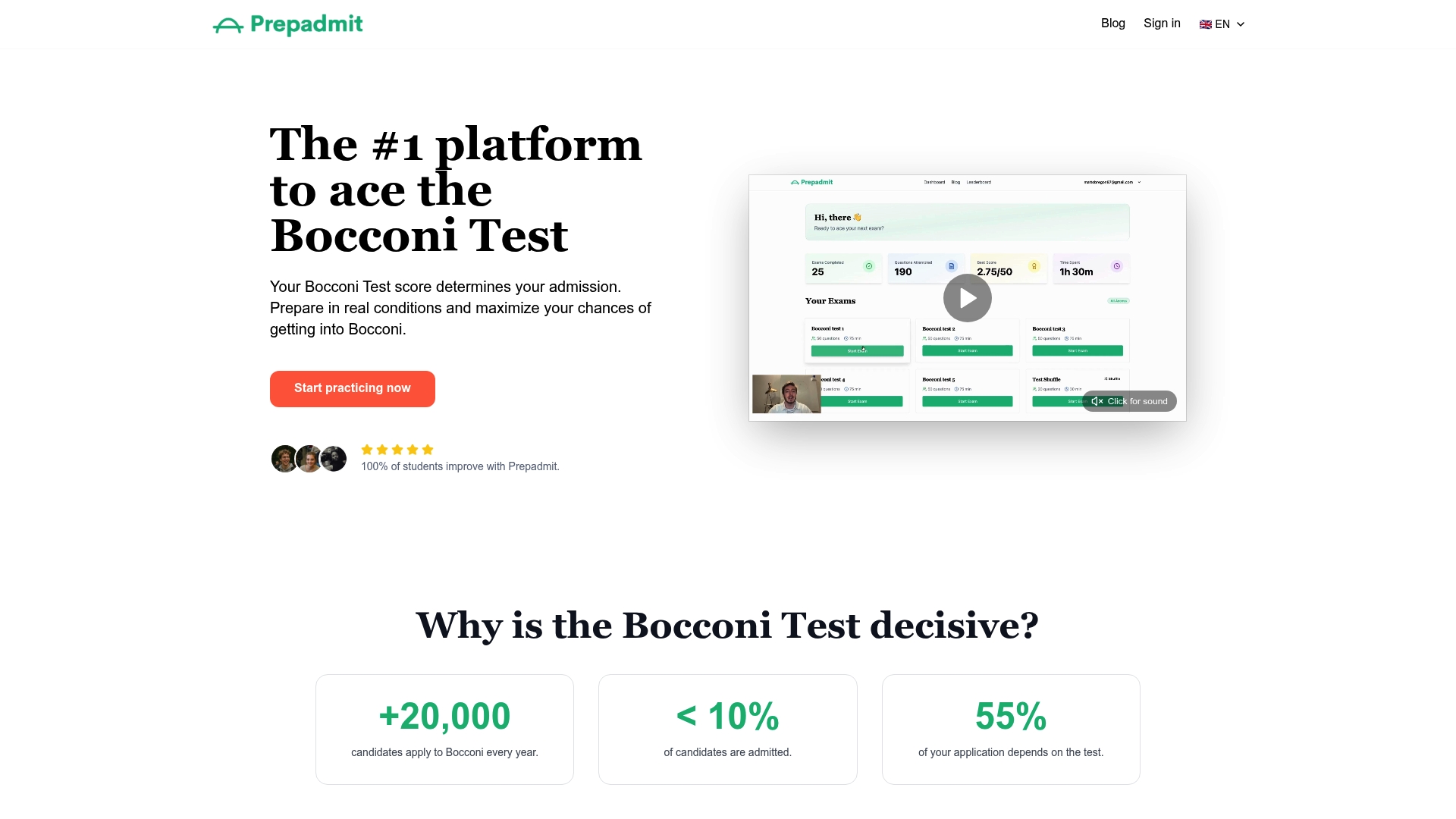
The platform reports an average score improvement of 34% among students who use it consistently. It costs a fraction of private coaching, and it comes with a money-back guarantee. For US-based international students who need Bocconi-specific content available on demand across any time zone, it’s a direct fit with the evaluation criteria in this article. Start with a diagnostic mock on Prepadmit to see your baseline score and the platform’s correction depth before committing.
Useful sources to bookmark
- Bocconi non-EU student admission guide — Registration deadlines, document requirements, and timelines specific to non-EU applicants.
- Which English tests Bocconi accepts — Official score thresholds and accepted certifications for 2026 entry.
- Carnegie Mellon: time-zone teaching strategies — Practical calendar and batching guidance for remote students across time zones.
- APU: remote learning space setup — Connectivity backup options and study environment recommendations.
- UNSW: tips for studying remotely from overseas — Listening and transcription exercises for academic skill building.
- ACE accreditation guidance — Verify whether a prep course carries recognized credit before enrolling.
- Prepadmit: how to access prep materials abroad — Practical strategies for organizing and accessing Bocconi prep resources from the US.
- Prepadmit: step-by-step Bocconi test prep guide — Full exam prep sequencing for students who want a broader preparation framework alongside this remote-focused plan.
Recommended
Related articles
Ready to ace your admission test?
Discover PrepAdmit, the platform that helps you succeed at top university admission tests.
Discover PrepAdmit