How Exam Prep Platforms Work: a Student's Guide

How Exam Prep Platforms Work: a Student’s Guide
Most students assume an exam prep platform is just a digital question bank. Log in, answer questions, repeat until test day. That assumption is costing students real points. Understanding how exam prep platforms work reveals a far more sophisticated system underneath — one that diagnoses your weaknesses, adapts to your pace, and uses proven learning science to help you retain information under pressure. If you or your child is preparing for a high-stakes university admissions test, knowing what actually happens inside these platforms will change how you use them.
Table of Contents
- Key takeaways
- How exam prep platforms work at their core
- Adaptive learning and personalized study paths
- Evidence-based strategies built into the software
- Performance analytics and progress tracking
- Platform types and what to expect from each
- My take on actually getting the most from these platforms
- Prepare smarter for the Bocconi Test with Prepadmit
- FAQ
Key takeaways
| Point | Details |
|---|---|
| Platforms start with diagnosis | A baseline assessment maps your skills before any practice begins, so the system knows where to focus. |
| Adaptive algorithms personalize study paths | Questions adjust in difficulty based on your real-time performance, targeting the edge of your current knowledge. |
| Learning science is built in | Spaced repetition and retrieval practice are automated features, not optional add-ons, in quality platforms. |
| Analytics replace guesswork | Dashboards show topic-level gaps and score trends, so you study with purpose rather than hoping for coverage. |
| Platform type matters | A question bank and a full learning solution are not the same product — matching features to your goals matters. |
How exam prep platforms work at their core
Not all platforms are built the same way. At the foundation, every serious platform starts with a diagnostic step that maps a student’s ability across the specific domains covered by the target exam. This is not just a score. It is a skill profile that tells the system where you are strong, where you are weak, and what you are ready to learn next.
Beneath the interface you see, a well-built exam preparation platform runs on five interconnected layers:
- Content management system. Stores every question, explanation, video, and reading passage, tagged by topic, difficulty, and skill type.
- Assessment engine. Administers questions, records response accuracy and timing, and scores answers in real time.
- Learner profile database. Holds your entire history: which topics you have practiced, how many attempts you needed, how your performance has changed over time.
- Analytics layer. Processes your data to identify patterns, calculate mastery rates, and estimate your likely performance on the real exam.
- Delivery surface. The interface you actually see — the test screen, the dashboard, the review mode.
These five layers talk to each other constantly. When you answer a question, the assessment engine passes that result to the learner profile, which updates your skill map, which signals the analytics layer to recalculate your readiness, which tells the delivery surface what to show you next. That feedback loop is what separates a real exam preparation platform from a static PDF of practice questions.
Understanding this architecture matters when you are choosing a platform. If a platform cannot show you a skill-level breakdown of your performance, its analytics layer is probably missing. If it never changes the difficulty of what you see, its assessment engine is not connected to your learner profile. The five layers should all be present and working together.
Adaptive learning and personalized study paths
Here is where the real difference shows up. The best platforms do not just track right and wrong answers. They use that data to decide what you should study next, and how hard it should be.
The technical method behind this is called Item Response Theory, or IRT. IRT-based scoring systems estimate your current ability level based on which questions you get right, how difficult those questions are, and how consistent your performance is across a topic. The system then selects questions calibrated to sit just above your current ability. This zone, often called the “frontier” of your knowledge, is where learning is most efficient. Questions that are too easy waste your time. Questions that are too hard demoralize without teaching.
A practical example of how this plays out in real exams: the Digital SAT uses multi-stage adaptive testing, where your performance on Module 1 determines which version of Module 2 you receive. Students who perform well get a harder second module with access to the highest score range. Students who struggle get an easier second module, which caps their scoring ceiling. Platforms that prepare students for adaptive exams must mirror this logic in their own practice sessions — otherwise, students arrive at test day unprepared for the real difficulty sequencing.
Beyond difficulty adjustment, advanced platforms now use AI-generated explanations that respond to the specific mistake you made, not a generic answer key. They also use dependency-aware scheduling, meaning if you have not mastered fractions, the platform will not advance you to algebra problems that assume fraction fluency.
Pro Tip: When evaluating any platform, ask whether its adaptive engine is transparent. Platforms that show you why a question was selected, or which skill it targets, are far easier to trust and use strategically than those that just present the next question without context.
Evidence-based strategies built into the software
Good platforms do not just test you repeatedly and hope something sticks. They embed two research-backed strategies directly into the study flow: retrieval practice and spaced repetition.
Retrieval practice means actively pulling information from memory rather than re-reading notes. Every time you answer a practice question from memory, you strengthen the neural pathway for that knowledge. Retrieval and spaced practice combined produce significantly better long-term retention than either technique alone, and regular low-stakes testing has also been shown to reduce exam anxiety by making the test format familiar rather than threatening.
Spaced repetition takes this further by scheduling review sessions at increasing intervals. You see a difficult concept one day after first learning it, then three days later, then a week later. Each review resets the forgetting curve and deepens the memory trace. A platform that automates this scheduling removes the burden of figuring out when to review what.
“Scheduled retrieval and spaced practice embedded throughout [a study program] reduce exam stress and produce deeper learning.” — Evidence Based Education
The combination of these two methods is what allows students who study 90 minutes a day on a quality platform to outperform students who cram for six hours the night before an exam. The science is clear on this, and the best platforms are built around it. If a platform you are considering does not space out its review prompts or offer a dedicated retrieval practice mode, it is missing two of the most powerful tools available to you.
Performance analytics and progress tracking
Raw practice is not enough. You also need to know what the practice reveals about you. This is where analytics dashboards become genuinely useful rather than decorative.

A good analytics layer translates your test data into three categories of insight:
| Insight type | What it shows | How to use it |
|---|---|---|
| Topic-level mastery | Which subjects you have covered sufficiently and which still need work | Redirect study time toward weak areas instead of re-practicing strengths |
| Score trajectory | Whether your overall performance is improving, plateauing, or declining across sessions | Adjust pacing or identify burnout early if scores stop improving |
| Pacing and timing data | How long you spend per question relative to time available on the real exam | Practice answering faster on topics where you consistently run over time |
Platforms with detailed mastery reports help students stop studying blindly and start studying purposefully. The difference is significant. Blind studying means practicing whatever feels familiar or comfortable. Purposeful studying means spending most of your time on the topics the data identifies as your actual weak points.
One underappreciated risk: platforms that only show you a total score can create false confidence. A student might score 75% overall but be scoring 40% on the specific question type that appears most on the real exam. Multi-level reporting that breaks down performance by topic, by question format, and by difficulty band is what gives you an accurate picture.
Pro Tip: Check your analytics at least once every three sessions, not just at the end of your prep cycle. Catching a persistent weak spot early gives you time to fix it.
Platform types and what to expect from each
Not every platform offers the same things, and understanding the differences helps you pick the right tool for your situation.
Some platforms are primarily practice exam engines. They give you access to a large question bank, simulate real test conditions, and report your score. They are useful for students who already understand the content and need to build test-taking stamina and familiarity with the format. These platforms work best as the final phase of preparation, not the whole program.
Other platforms offer end-to-end learning solutions. They combine video lessons, guided explanations, adaptive practice, and analytics in one place. A comparison of AlphaPrep and CBT Nuggets illustrates this split clearly: one focuses on practice exams while the other leads with instruction before assessment. Neither is universally better. The right choice depends on whether you need to build understanding from scratch or sharpen existing skills.
When evaluating any platform, look at these specific features before subscribing. Does it include official or officially representative past papers? Does it explain wrong answers in detail, not just mark them incorrect? Does it offer a peer comparison or ranking feature so you can benchmark your readiness against real applicants? Does it simulate actual exam timing and conditions? These questions separate tools that give you realistic preparation from those that give you a false sense of readiness.
QR-based adaptive testing tools have also emerged as a complement to traditional platforms, particularly in classroom settings, showing how adaptive logic can be applied across different delivery formats. Most students will still do their heaviest preparation on a dedicated platform, but the underlying adaptive principles are consistent across well-designed systems.
My take on actually getting the most from these platforms
I have seen students approach exam prep platforms in two completely opposite ways. Some treat the platform as a question machine and burn through as many questions as possible, convinced that volume is the path to a higher score. Others open the dashboard once, feel overwhelmed by the data, and revert to their old habits of rereading notes. Both approaches miss the point.
The technology inside a quality platform is only as useful as your willingness to engage with what it tells you. Your analytics dashboard is not decoration. It is a direct signal about where your time should go. When I look at how students actually improve their scores, the pattern is consistent: they do a diagnostic, they take the analytics seriously, they work through adaptive practice in the areas the data flags as weak, and they use timed simulations to build real exam stamina.
The pitfall I see most often is over-relying on answer reviews without fixing the underlying gap. Reading why you got a question wrong is not the same as practicing the skill until you get it right. The blended approach of platform plus human support works better for students who are genuinely struggling with a concept, because a tutor aligned with your platform’s mastery data can target their help precisely.
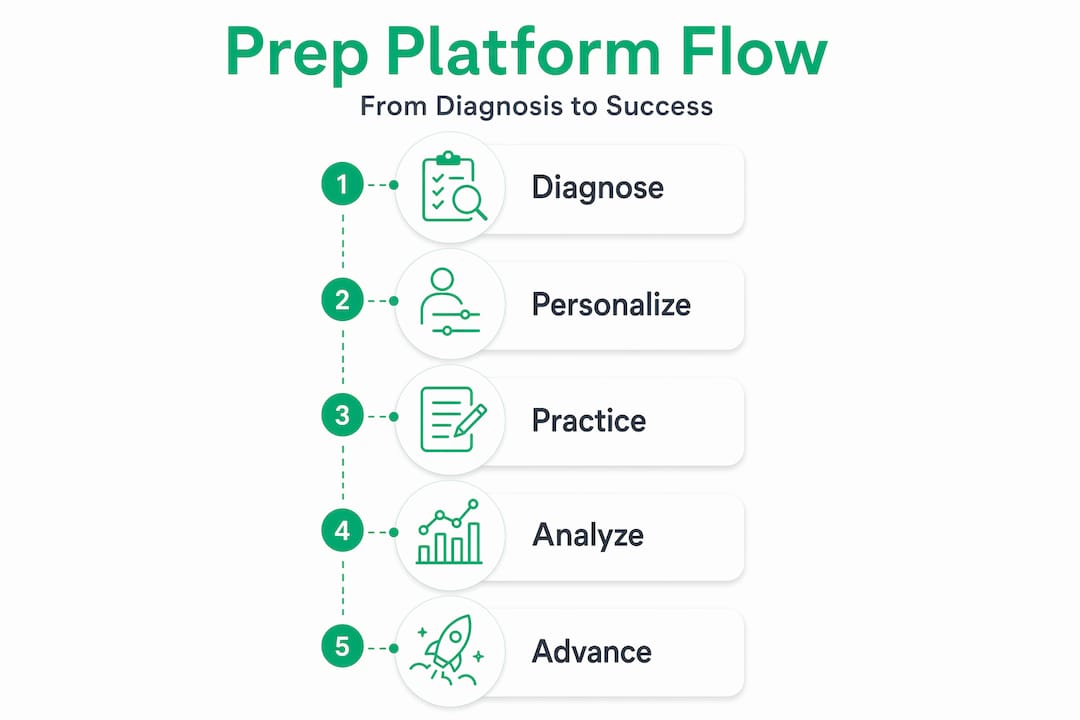
Use the platform the way it was designed to be used: diagnostics first, adaptive practice second, analytics review third, and timed simulation throughout. That sequence is not arbitrary. It reflects how learning actually works.
— quentin
Prepare smarter for the Bocconi Test with Prepadmit
If you are preparing for the Bocconi Test specifically, the stakes are real and the competition is high. Prepadmit was built for exactly this purpose by experts from HEC and Bocconi University.
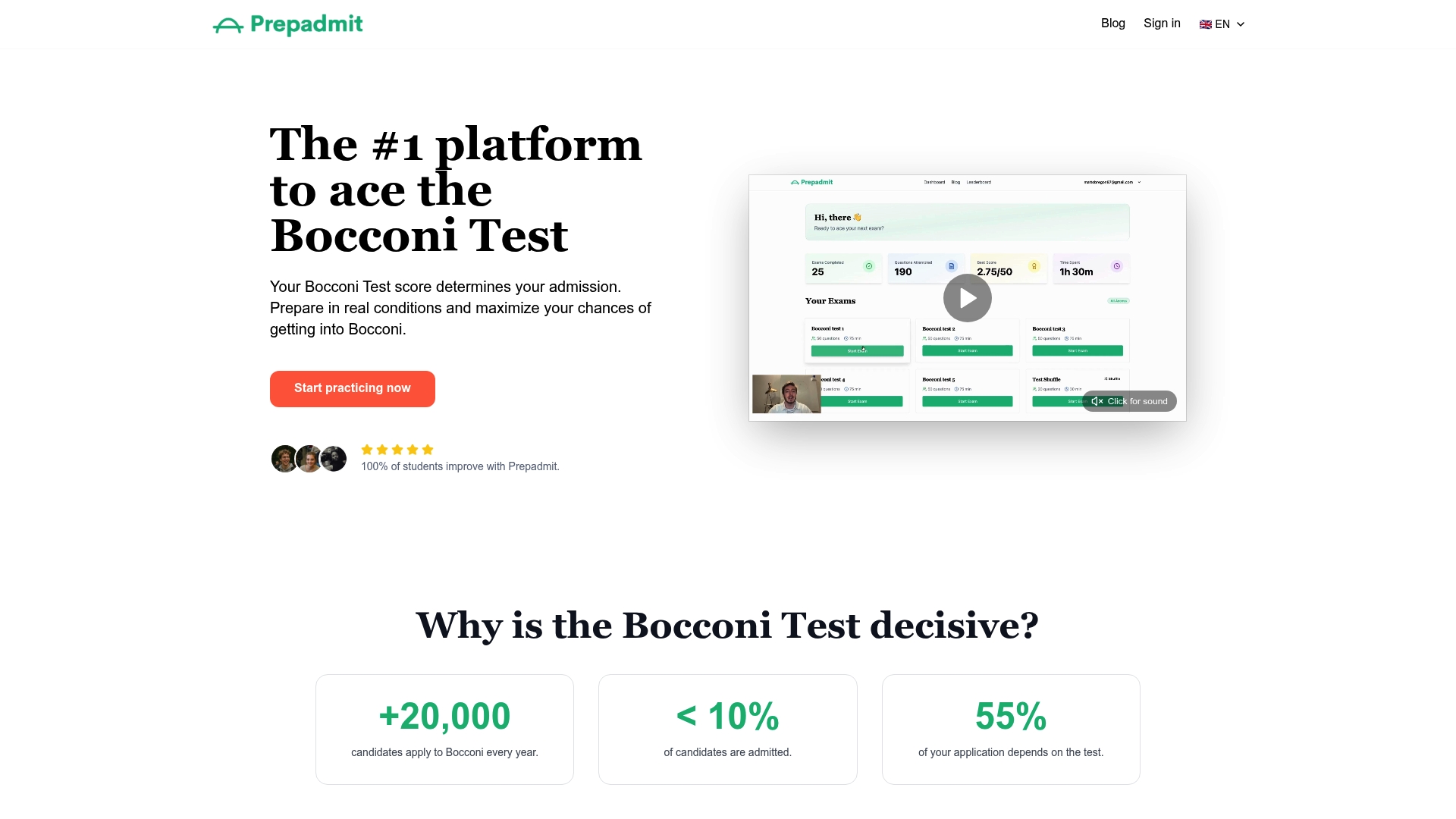
The Prepadmit platform offers official past papers, on-demand simulated tests, and detailed answer corrections that go beyond marking you right or wrong. The analytics dashboard shows you exactly where your score is coming from and where you are losing points. You can benchmark your performance against other applicants and track your improvement over time. Students using Prepadmit see an average score improvement of 34%, and the platform comes with a money-back guarantee. The advantages of on-demand diagnostic testing are built directly into how Prepadmit works from day one. It is a fraction of the cost of private coaching with measurably better targeted results.
FAQ
What does an exam prep platform actually do?
An exam prep platform diagnoses your current skill level, delivers adaptive practice questions calibrated to your ability, and tracks your progress through an analytics dashboard. The goal is to prepare you for a specific exam efficiently, not just to expose you to more questions.
How does adaptive learning work in exam prep?
Adaptive learning uses your performance data to select questions at the right difficulty level for your current ability. Systems based on Item Response Theory continuously update your skill profile and route you toward the topics and difficulty levels where you will grow fastest.
Are exam prep platforms better than traditional study methods?
Quality platforms automate spaced repetition and retrieval practice, two study strategies with strong research backing for long-term retention. When used consistently with regular analytics review, they outperform passive methods like rereading notes or cramming.
What features should I look for in an exam prep platform?
Look for diagnostic assessments, adaptive question delivery, detailed answer explanations, topic-level analytics, and timed practice simulations that reflect real exam conditions. Platforms that include mock exams tied to real results give you the most accurate readiness signal.
How often should I practice on an exam prep platform?
Consistent daily sessions of 60 to 90 minutes are more effective than infrequent long sessions. Spaced practice spread over weeks produces deeper retention than cramming, and regular short sessions also help reduce test anxiety through familiarity with the exam format.
Recommended
Related articles
Ready to ace your admission test?
Discover PrepAdmit, the platform that helps you succeed at top university admission tests.
Discover PrepAdmit