Close a 10 Point Gap: Bocconi Prep With One Paid Boost

Close a 10 Point Gap: Bocconi Prep With One Paid Boost
Students with more than three months before their test date and no major weak areas should start with free materials. Students with a tight timeline, a persistent gap on mock scores, or high stakes for admission should add a paid resource like Prepadmit to target those gaps. Most candidates do best mixing both: free tools for foundational skills, one paid boost for realistic timed practice and detailed feedback.
TL;DR:
- Using official Bocconi past papers and simulation tests is essential for practicing the test’s no-return, sequential navigation rules and time management.
- Paid resources should include official-style timed mocks, detailed explanations, and progress analytics to identify persistent weak areas faster than free tools alone.
- If your mock score gap exceeds 10 points after three months of study, investing in targeted paid practice can significantly accelerate score improvement.
- For students with less than three months before the test or aiming for highly competitive programs, combining free foundational review with a paid platform like Prepadmit offers the most effective preparation.
- Always verify that paid programs use official-style questions, provide clear analytics, and include transparent refund policies before committing financially.
Table of Contents
- Free resources: the official Bocconi simulation and top no-cost study sources
- Paid options explained: platforms, courses, tutoring, and typical prices
- When paid prep is worth the cost
- How to choose: what to check before you buy
- Sample 8-week study plan mixing free and paid resources
- Prepadmit proof points: what the platform offers and how it fits your plan
- What actually moves your score
- Start with Prepadmit: what to expect on day one
- Sources
- FAQ
Free resources: the official Bocconi simulation and top no-cost study sources
Start with the official Bocconi test simulation. It runs a set number of questions in a timed session similar to the real test’s length and pacing. The simulation lets you revise answers before submitting, which the actual test does not allow, so treat it as a content preview rather than an exact rehearsal of conditions.
Bocconi does not publish a single official prep book for the online test. Instead, candidates are pointed toward the test’s subject areas and the app and simulation themselves. That means your free study plan needs to pull from several sources, mapped by subject:
- Math and numerical reasoning: free high school review sites, Khan Academy modules on algebra and data interpretation, and past exam questions shared in student forums.
- Logical reasoning: free logic puzzle sets and timed practice apps built for general admissions tests.
- Verbal and reading comprehension: short passage drills from free English test-prep sites, read against a timer.
- Full mixed practice: the official simulation itself, run at least twice under quiet, distraction-free conditions.
A simple workflow keeps free study from becoming scattered: run a diagnostic first to see where you stand, then drill your two or three weakest areas for a week, then take a full timed mock, then review every wrong answer before moving to the next block. Skipping the review step is the most common reason free prep plateaus.
The Bocconi online test uses sequential navigation. You cannot return to a previous question once you move forward. That single rule changes how you should practice. A checklist for imitating real conditions:
- Use the same device and browser you plan to use on test day, tested at least twice beforehand.
- Confirm a stable internet connection in the room where you will sit the test.
- Set a hard 90-second-per-question pace and force yourself to submit and move on, no exceptions.
- Practice full sections in one sitting, without pausing the timer, so no-return pressure feels familiar rather than shocking.
Paid options explained: platforms, courses, tutoring, and typical prices
Paid Bocconi prep falls into a few clear categories, and the differences matter more than the price tag alone.
Self-paced platforms give you a library of timed mocks, instant scoring, and analytics you review on your own schedule. Live courses add a scheduled class with an instructor walking through strategy and content, usually in small groups. Private tutoring is one-on-one, built around your specific weak spots, and priced accordingly. Bootcamps compress several weeks of content into an intensive short program, often over a single week or weekend.
A quality paid offer, whatever the format, should include:
- Timed mocks built from official-style questions, not generic aptitude test banks.
- Detailed answer corrections that explain the reasoning, not just the correct choice.
- Progress analytics that show which subject areas are improving and which are not.
- A clear, written refund policy in case the product does not match what was advertised.
Pricing bands vary widely. Self-paced platforms tend to sit at the lower end of the paid spectrum. Live courses and bootcamps cost more because they include instructor time. Private tutoring is priced per hour and adds up fastest for students who need many sessions.
Pro Tip: Before paying for anything, ask to see a sample mock report. If a provider cannot show you what your feedback will actually look like, that is a signal to look elsewhere.
Watch for programs that promise a guaranteed score, refuse to describe their refund terms, or built their materials from generic test banks rather than anything resembling the Bocconi format. Those are signs of low value, whatever the price.
When paid prep is worth the cost
Paid prep tends to pay off for a specific set of students, not everyone.
- Time-limited candidates: if you have less than three months left and a gap of more than 10 points between your mock scores and your target, a paid resource focused on timed practice can close that gap faster than unguided free study.
- Persistent weak areas: if the same subject keeps dragging down your score after several weeks of free drilling, targeted paid feedback often finds the specific error pattern faster than self-review.
- High-competition targets: if you are aiming for a program with limited spots, small score gains matter more, and the analytics from a paid platform can show exactly where those gains are available.
- Budget-conscious estimate: weigh the price against the likely score lift. If a modest paid product could move you from a borderline score to a safely competitive one, the cost is easier to justify than for a student already scoring comfortably above target.
If a full course feels like too much, smaller commitments exist: a short block of tutoring focused on one weak subject, or trial access to a platform before buying full features.
How to choose: what to check before you buy
A short checklist keeps this decision objective instead of emotional.
- Does the provider use official-style past papers, or a generic question bank relabeled as Bocconi prep?
- Do the mocks run timed, with the same sequential no-return structure as the real test?
- Can you see a sample analytics report before paying?
- Is the refund policy written down, not just implied in a sales conversation?
Ask providers directly: do your mocks use official-style papers? Can I see a mock report before I commit? What happens if the platform does not fit my needs, is there a refund window?
Red flags that should stop a purchase outright: no visible refund terms, no sample materials, vague claims about “official” content without evidence, or pressure to buy immediately.

Pro Tip: Score each option on four criteria, official-style content, timed mock quality, analytics depth, and refund clarity, on a simple 1 to 3 scale. A provider that cannot score at least a 2 on all four is not worth your budget.
Sample 8-week study plan mixing free and paid resources
- Weeks 1 to 2: run a diagnostic using free practice sets across math, logic, numerical reasoning, and verbal. Identify your two weakest areas.
- Weeks 3 to 4: drill those weak areas daily using free subject-specific resources. Take the official simulation once at the end of week 4 to check progress.
- Weeks 5 to 6: if your mock score gap is still wide, add a paid platform here for timed mocks and detailed corrections. This is where paid analytics earn their cost, since they isolate error patterns free review often misses.
- Week 7: run full timed mocks under strict no-return conditions, practicing the sequential navigation rule the real test enforces. Review every miss the same day.
- Week 8: taper practice volume, focus on pacing and technical readiness checks, browser, connection, device, and take one final full mock three or four days before the real test.
Set a checkpoint after week 4: if your score has closed most of the gap to your target, continue with free resources. If it has not moved much, that is the clearest signal to bring in paid tutoring or a platform for the remaining weeks.
Prepadmit proof points: what the platform offers and how it fits your plan
Prepadmit was built specifically around the Bocconi test, which matters more than it sounds, since generic aptitude platforms do not replicate the format or the no-return timing.
The platform’s features map directly onto the evaluation checklist covered above:
- Official past papers used as the basis for practice questions, not a generic test bank.
- On-demand timed tests you can run whenever your schedule allows.
- Detailed answer corrections explaining the reasoning behind each question.
- Progress tracking and peer ranking, so you can see improvement over time and against other candidates.
The platform was developed by a team with relevant academic backgrounds, and it provides an average score improvement among users, with a refund policy available. In the 8-week plan above, this is the resource to add during weeks 5 and 6, once free diagnostics have shown you where the remaining gaps are.
What actually moves your score

Free resources cover the fundamentals well. Where they fall short is realistic timed pressure and feedback specific enough to catch the exact reasoning error behind a wrong answer. Most students underestimate how much the no-return navigation rule affects performance until they have practiced under it directly, not just read about it.
If you are choosing between free and paid, the honest answer is neither wins alone. Free builds the base, paid closes the last stretch. This site is run by Prepadmit, which is worth knowing as you weigh the recommendation.
— quentin
Start with Prepadmit: what to expect on day one
Getting started takes a few minutes. After signing up, you land in a dashboard with timed simulations, detailed analytics, and drills organized by subject, ready to run on your own schedule.
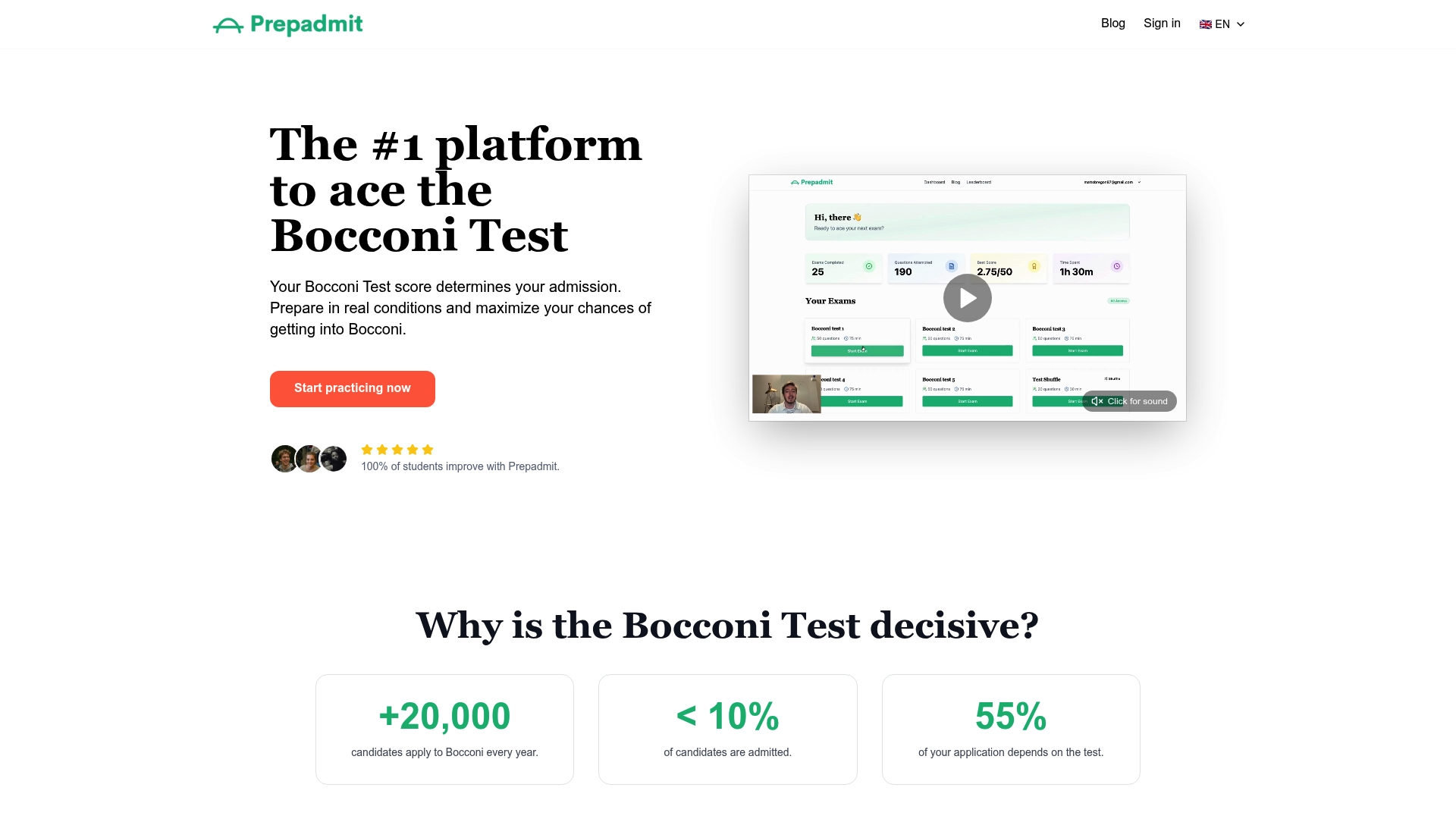
What you get immediately:
- Timed mocks built from official-style Bocconi questions.
- Analytics showing exactly which subject areas need more work.
- Targeted drill modes for math, logic, numerical reasoning, and verbal.
Access is backed by a money-back guarantee, so trying it carries little risk. Access the full preparation and see where your practice score stands today.
FAQ
Is $1,500 enough for Bocconi prep?
Prep costs vary widely depending on whether you choose a self-paced platform, tutoring, or a bootcamp, and no single figure applies to every student. A mixed approach using free fundamentals plus one focused paid resource often costs far less than many expensive options while covering the same ground.
What is the tuition waiver Bocconi offers eligible students?
Bocconi runs a support scheme called Bocconi4Access to Education, which can grant a 100% tuition waiver to eligible applicants after application and document review. Eligibility and benefits depend on verification by Bocconi’s Fees, Funding and Housing Office.
How difficult is the Bocconi admission test?
Difficulty depends on your starting skill level and how well you handle the test’s strict pacing, since the online format uses sequential navigation with no way to return to earlier questions. Students who practice under timed, no-return conditions beforehand tend to adapt faster than those who only study content.
Is Bocconi considered a top university?
Bocconi is widely regarded as one of the more selective business and economics universities in Italy, drawing applicants from many countries. Admission is competitive, which is part of why structured test preparation, free or paid, makes a measurable difference for many candidates.
What does the Bocconi test cost per attempt?
The registration fee is €60 per attempt, with specific rules on refunds and the number of attempts allowed per academic year. Checking those rules before booking helps avoid losing a fee to a missed technical requirement.
Recommended
Related articles
Ready to ace your admission test?
Discover PrepAdmit, the platform that helps you succeed at top university admission tests.
Discover PrepAdmit