Bocconi Prep Without a Private Tutor: 2026 Guide

Bocconi Prep Without a Private Tutor: 2026 Guide
Bocconi test prep without a private tutor is achievable through disciplined self-study using official practice materials, timed simulations, and targeted review. The Bocconi Online Test lasts 75 minutes with 50 questions across multiple skill areas. A competitive score starts at 40, while top programs require 80 or above. You do not need expensive coaching to hit those numbers. What you need is a structured plan, the right free resources, and the discipline to follow through.
What resources do you need for Bocconi exam self-study?
The best starting point for independent preparation is the official Bocconi test simulation. Bocconi University publishes practice materials directly, and the CISIA portal offers free question banks that mirror the real exam format. These are not supplementary extras. They are the primary tools that high-scoring students rely on.
The official Bocconi app allows you to practice by skill area. That matters because the test covers math, logic, reading comprehension, and language skills. Drilling each section separately before combining them into full simulations is a proven method for building section-level confidence.

| Resource type | Cost | Best use |
|---|---|---|
| Official Bocconi simulation test | Free | Baseline assessment and full mock practice |
| CISIA question bank | Free | Targeted section drilling |
| Official Bocconi app | Free | Skill-specific practice by section |
| Math and logic drill books | Low cost | Reinforcing weak quantitative skills |
| Prepadmit platform | Affordable | Timed mocks, error review, peer ranking |
Supplementary materials like math drill workbooks and logic puzzle sets fill gaps that free portals sometimes leave. The goal is not to collect resources. The goal is to use a small number of high-quality tools consistently.
Pro Tip: Do not start with five different prep sources. Pick the official simulation plus one supplementary tool, and master those before adding anything else.
How to design a self-study plan for the Bocconi test
A structured plan separates students who improve from students who spin their wheels. The recommended preparation window is 6–12 weeks, with a target of at least 300 practice questions over that period for students aiming at 80 or above.
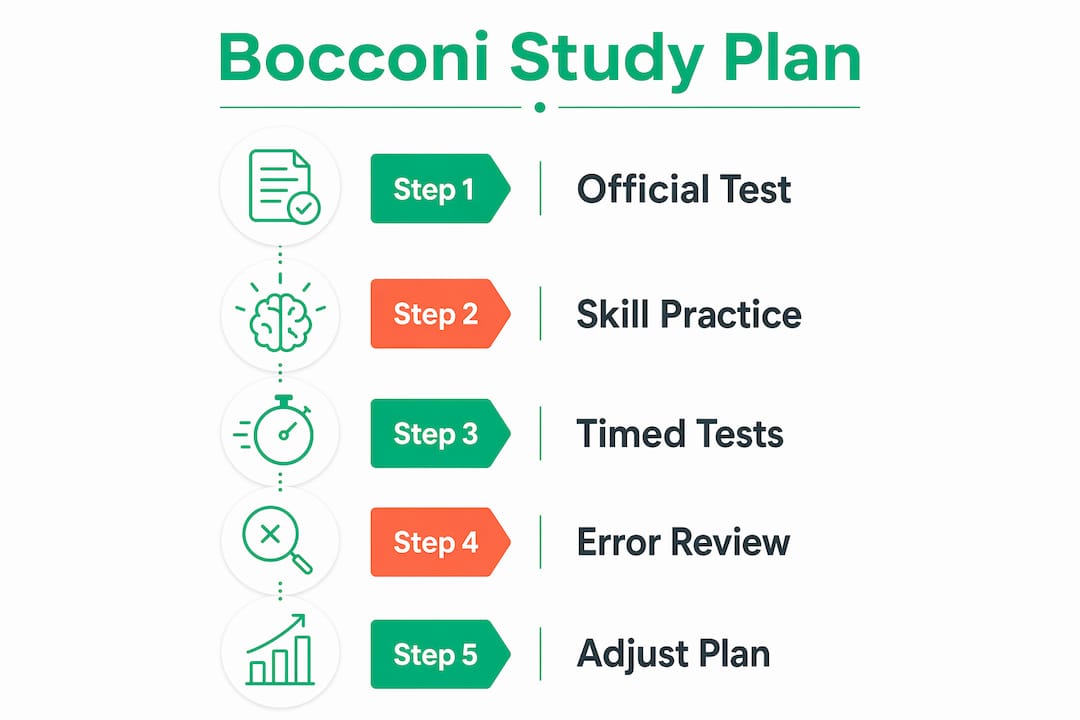
The most effective approach follows a three-pass strategy.
- Benchmark test. Take a full timed simulation on day one. Do not study first. This gives you an honest baseline score and shows exactly which sections cost you the most points.
- Targeted drilling. Spend weeks 2–6 working section by section on your weakest areas. Use the official app for skill-specific practice. If math costs you 10 points and reading costs you 2, spend more time on math.
- Full mock simulations. From week 7 onward, run complete 75-minute timed tests repeatedly. High-scoring students simulate the full exam multiple times before test day. Each mock should be followed by a detailed error review session.
A practical weekly structure looks like this. Dedicate two days to math and quantitative reasoning, two days to logic and critical thinking, one day to reading and language skills, and one day to a full timed mock. The seventh day is for error review only, not new material.
Time management inside the exam is its own skill. The Bocconi test penalizes wrong answers with negative points. A blank answer scores zero. A wrong answer can deduct up to 0.33 points depending on the question type. That means skipping a question you are unsure about is often the better choice. Practice this decision-making process during every timed session, not just on test day.
Pro Tip: Set a personal rule during practice: if you cannot eliminate at least two answer choices, skip the question and flag it. Return only if time allows.
What common mistakes to avoid when preparing without a tutor?
Self-study without a tutor works. But it fails when students repeat the same avoidable errors week after week.
- Starting too late. Beginning prep less than 30 days before the test significantly lowers score gains. Six to eight weeks is the minimum effective window. Less than that, and you are cramming rather than building real skill.
- Practicing untimed. Untimed practice creates false confidence. The real exam is 75 minutes for 50 questions. Timed practice builds stamina and real performance. If you never practice under the clock, you will feel the pressure for the first time on test day.
- Skipping error review. Reviewing mistakes consistently is more effective than learning new theory. Most students finish a mock, check their score, and move on. The students who improve are the ones who spend as much time analyzing wrong answers as they do answering new questions.
- Ignoring the “not deducible” option. In logic and reading sections, choosing “not deducible” when a statement cannot be confirmed from the text is a top-scorer skill. Many students underuse this option and guess instead, losing points unnecessarily.
- Neglecting mental stamina. Seventy-five minutes of focused test-taking is physically tiring. Students who only practice in short bursts often hit a wall at the 50-minute mark during the real exam. Full-length simulations build the endurance you need.
Reviewing mistakes consistently over multiple weeks is more effective than cramming new material just before the test. The students who improve most are not the ones who study the most new content. They are the ones who understand exactly where they went wrong and fix it.
How to monitor progress and adjust your study plan independently
Tracking your own progress is the part of Bocconi preparation without coaching that most students underestimate. Without a tutor pointing out patterns, you have to build that feedback loop yourself.
- Log every error. After each practice session, write down which question type you missed and why. Was it a knowledge gap, a timing issue, or a misread question? The cause determines the fix.
- Track section scores over time. Keep a simple spreadsheet with your scores by section after every mock. If your logic score improves but your math score stays flat across three mocks, that is a clear signal to shift your drilling focus.
- Use official score feedback. The official Bocconi simulation provides performance breakdowns by skill area. Use that data to adjust your weekly plan every two weeks, not just at the end of your prep period.
- Schedule rest before test day. The final three days before the exam should include no new material. Run one light review of your error log, then rest. Mental sharpness on test day is worth more than one extra practice session.
Adaptive planning is what separates students who plateau from students who keep improving. If a strategy is not moving your score after two weeks, change it. Self-study gives you the flexibility to do that without waiting for a tutor to notice the problem.
Key Takeaways
Structured self-study using official resources, timed simulations, and consistent error review is the most effective path to a competitive Bocconi test score without a private tutor.
| Point | Details |
|---|---|
| Start early | Begin preparation 6–12 weeks before the test for meaningful score gains. |
| Use official tools first | The Bocconi simulation and CISIA portal are the primary free resources for self-study. |
| Follow the three-pass method | Benchmark, drill weak areas, then run full timed mocks in the final weeks. |
| Master the penalty rule | Skip questions you cannot confidently answer to avoid negative point deductions. |
| Review errors, not just scores | Analyzing wrong answers consistently drives more improvement than studying new content. |
Why I think self-study beats tutoring for most Bocconi students
I have watched students spend thousands on private tutors and still underperform on test day. I have also watched students prepare entirely on their own and score in the top tier. The difference was never the tutor. It was the discipline to review errors and the willingness to simulate real exam conditions repeatedly.
The biggest mistake I see in self-study is treating practice as a performance rather than a diagnostic. Students want to feel good about their scores. They avoid timed tests because timed tests are uncomfortable. But discomfort during practice is exactly what builds composure on test day.
The “not deducible” insight is one that tutors rarely emphasize enough. Distinguishing between what is explicitly stated and what is merely implied is a defining skill for top scorers. You can teach yourself this skill through deliberate practice with logic passages. No tutor required.
My honest advice: trust the official materials, commit to the three-pass structure, and treat every error as data. The students who approach self-study that way do not need a tutor. They need time and consistency.
— quentin
How Prepadmit supports your independent Bocconi preparation
Students who want the structure of a prep program without the cost of a private tutor have a direct option in Prepadmit.
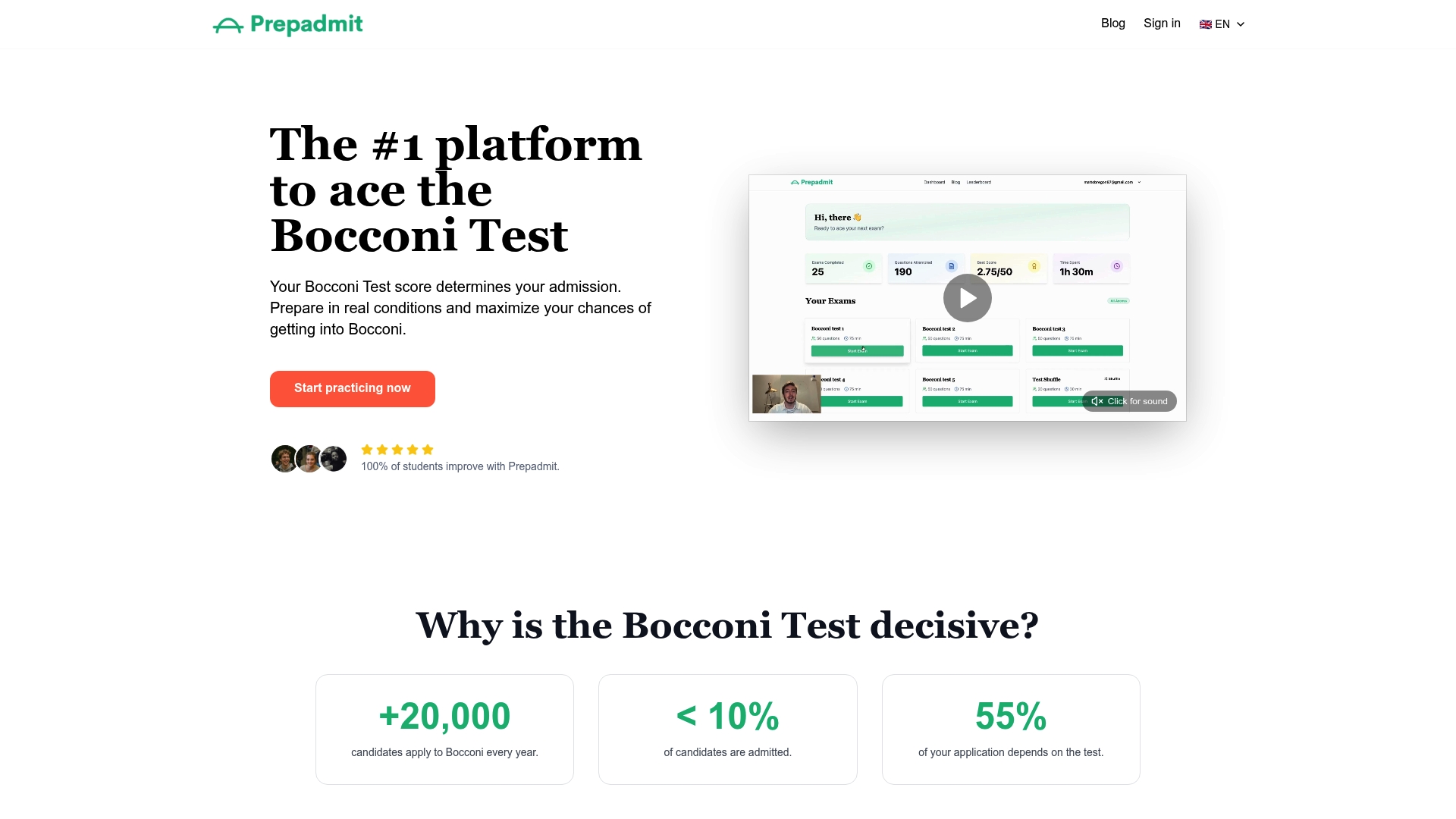
Prepadmit is built specifically for the Bocconi Test. The platform offers official past papers, on-demand timed simulations, detailed answer corrections, and skill-specific practice modes. Students can track their progress over time and see how they rank against other candidates preparing for the same exam. Prepadmit was developed by experts with backgrounds from HEC and Bocconi, and it reports an average score improvement of 34% for its users. The platform costs a fraction of private tutoring and comes with a money-back guarantee. If you are preparing independently, start your prep on Prepadmit and put a real structure behind your self-study.
FAQ
How long should I prepare for the Bocconi test without a tutor?
Six to twelve weeks is the recommended preparation window. Students targeting a score of 80 or above should aim to complete at least 300 practice questions over that period.
What is the penalty for wrong answers on the Bocconi test?
A wrong answer can deduct up to 0.33 points depending on the question type. A blank answer scores zero, so skipping uncertain questions is often the better choice.
Can I prepare for the Bocconi test using only free resources?
Yes. The official Bocconi simulation and the CISIA question bank are both free and cover the full range of skills tested. These tools are sufficient for a strong preparation if used consistently and with timed practice.
What is the “not deducible” option and why does it matter?
In logic and reading sections, “not deducible” is the correct answer when a statement cannot be confirmed from the given text. Top scorers use this option deliberately rather than guessing, which protects their score from unnecessary deductions.
How do I know if my self-study plan is working?
Track your section scores after every mock test and log the types of errors you make. If a section score does not improve after two weeks of focused drilling, adjust your approach. The Bocconi test difficulty varies by section, so targeted tracking is the fastest way to find and fix weak spots.
Recommended
Related articles
Ready to ace your admission test?
Discover PrepAdmit, the platform that helps you succeed at top university admission tests.
Discover PrepAdmit