Bocconi English Comprehension Question Examples: 2026 Guide

Bocconi English Comprehension Question Examples: 2026 Guide
Bocconi English comprehension questions are designed to test your ability to read dense academic passages and answer questions on inference, tone, vocabulary, and main ideas. The English section carries up to 30 questions in some test versions, making it one of the highest-volume sections on the exam. That weight means your performance here directly shapes your total score. Working through real Bocconi English comprehension question examples is the fastest way to build the specific skills the exam rewards.
1. Common types of Bocconi English comprehension question examples
The Bocconi Test includes 15–17 reading comprehension questions out of 50 total, all based on passages covering economics, history, and science. Each question type targets a different reading skill. Knowing which type you are facing lets you apply the right approach immediately.

Main idea and primary purpose questions
These questions ask what the passage is mainly about or why the author wrote it. The correct answer always reflects the full passage, not just one paragraph.
- Example: “The primary purpose of this passage is to…”
- A) Argue that free trade increases inequality
- B) Explain the historical origins of trade agreements
- C) Compare two economic models of globalization
- D) Describe the benefits of protectionist policy
- Example: “Which title best captures the main idea of the passage?”
- Example: “The author’s central claim is best described as…”
The trap in these questions is picking an answer that fits one paragraph but not the whole text. Always ask yourself what the author is doing from start to finish.
Inference and implied meaning questions
Interpreting author intent and implied meaning is the core skill tested here. The answer is never stated directly in the text.
- Example: “It can be inferred from paragraph 3 that the author believes…”
- Example: “The passage implies that economists who oppose the policy are…”
- Example: “What does the author suggest about the long-term effects of the reform?”
Students who focus only on stated facts consistently miss these questions. The answer lives between the lines.
Tone and author attitude questions
These questions ask how the author feels about a subject. Common answer choices include words like skeptical, optimistic, neutral, critical, and ironic.
- Example: “The author’s tone in the final paragraph is best described as…”
- Example: “How does the author regard the scientists mentioned in line 12?”
- Example: “Which word best describes the author’s attitude toward the policy?”
Read the adjectives and verbs the author uses. Those word choices reveal attitude more reliably than the topic itself.
Vocabulary in context questions
These questions give you a word from the passage and ask what it means in that specific sentence. The correct answer fits the passage’s meaning, not just the dictionary definition.
- Example: “As used in line 8, the word ‘mitigate’ most nearly means…”
- Example: “The word ‘contentious’ in paragraph 2 is closest in meaning to…”
Sentence completion questions
These questions present a sentence with a blank and ask you to choose the word or phrase that fits best. They test both vocabulary and logical flow.
- Example: “Despite the initial resistance, the reform was eventually ______ by the majority of legislators.”
- A) rejected B) adopted C) debated D) ignored
2. How to practice Bocconi English comprehension questions effectively
Effective practice follows a clear structure. Random reading does not build the timed, focused skill the exam demands.
- Simulate real test conditions every session. Practicing without a timer creates a false sense of readiness. Set a clock for 15 minutes and work through 15–17 questions without stopping.
- Use Bocconi-style passages. Generic reading exercises do not replicate the density of Bocconi texts. Work with passages on economics, history, or science that run 400–700 words.
- Apply the dual-review method. Review errors immediately after each session, then revisit the same questions two weeks later. This spaced repetition cements understanding rather than just memorization.
- Target Cambridge B2/C1 materials if English is not your first language. Cambridge B2/C1 level resources match the linguistic complexity of the Bocconi English section without overshooting the level.
- Track your accuracy by question type. If you miss three tone questions in a row, that is a pattern. Drill that specific type before moving on.
- Complete at least 300 practice questions across all sections. Reaching 300 practice questions over six weeks is linked to scoring above 80. Volume builds speed and pattern recognition.
Pro Tip: Never review your answers the same way you answered them. If you answered quickly, review slowly. Read every wrong answer’s explanation fully, not just the correct one.
3. How Bocconi English comprehension compares to other exams
Knowing where Bocconi sits relative to other tests helps you calibrate your preparation, especially if you have already studied for the SAT or similar exams.
| Feature | Bocconi Test | SAT Reading |
|---|---|---|
| Passage length | 400–700 words | 500–750 words |
| Question focus | Inference, tone, vocabulary | Comprehension, evidence, grammar |
| Number of reading questions | 15–17 | 52 |
| Time per question | ~1 minute | ~1.25 minutes |
| Topic range | Economics, history, science | Literature, social science, science |
Bocconi passages are shorter but denser than SAT texts. That density means you cannot skim. Every sentence carries weight. Students who trained on SAT reading often find Bocconi passages more compressed and the inference questions more demanding. The SAT mixes comprehension with grammar; Bocconi focuses almost entirely on reading interpretation. If you have SAT experience, redirect your practice toward tone and implied meaning rather than evidence-based questions.
4. Sample Bocconi English comprehension questions to practice now
Work through these questions as if you are in the exam. Give yourself one minute per question maximum.
Passage excerpt (economics topic): “The assumption that markets self-correct without intervention has been challenged repeatedly by economic crises. Critics argue that deregulation, far from promoting efficiency, accelerates systemic risk. Proponents, however, maintain that temporary instability is the price of long-term growth.”
-
Question 1 (Main idea): “The passage is primarily concerned with…”
- A) Proving that deregulation causes recessions
- B) Presenting a debate about market intervention
- C) Defending the benefits of free markets
- D) Explaining the history of economic regulation
- Correct answer: B. The passage presents both sides without taking a firm position.
-
Question 2 (Tone): “The author’s tone in this passage is best described as…”
- A) Strongly critical B) Clearly optimistic C) Balanced and neutral D) Dismissive
- Correct answer: C. The author presents opposing views without favoring either.
-
Question 3 (Vocabulary in context): “As used in the passage, ‘systemic’ most nearly means…”
- A) Occasional B) Widespread and structural C) Financial D) Predictable
- Correct answer: B. Systemic risk refers to risk embedded across an entire system, not isolated events.
-
Question 4 (Inference): “It can be inferred that proponents of deregulation…”
- A) Deny that instability ever occurs
- B) Accept some short-term disruption as worthwhile
- C) Oppose long-term economic growth
- D) Agree with critics on the risks of deregulation
- Correct answer: B. The phrase “temporary instability is the price of long-term growth” implies acceptance of short-term costs.
-
Question 5 (Sentence completion): “Despite widespread criticism, the policy was ______ by the government as a necessary measure.”
- A) abandoned B) defended C) ignored D) revised
- Correct answer: B. “Despite widespread criticism” signals contrast, meaning the government stood by the policy.
The English section can represent the highest question volume in some Bocconi test versions. That fact alone makes timed practice with these question types a non-negotiable part of your preparation. Check your Bocconi test difficulty level to calibrate how much time to allocate to this section.
Key takeaways
Mastering Bocconi English comprehension requires targeted practice with inference, tone, vocabulary, and main idea questions under timed conditions.
| Point | Details |
|---|---|
| High question volume | The English section carries up to 30 questions, making it a top score driver. |
| Question type awareness | Identify the question type first; each type requires a different reading approach. |
| Timed practice is non-negotiable | Untimed practice builds false confidence; always set a 15-minute clock. |
| Dual-review method works | Review errors immediately, then retest two weeks later to lock in learning. |
| Cambridge B2/C1 materials help | Non-native speakers benefit from B2/C1 level texts that match Bocconi’s complexity. |
What I have learned from watching students prepare for Bocconi English
Most students I have seen prepare for this section make the same mistake. They read a lot, but they do not practice the right way. They work through passages at their own pace, feel confident, and then freeze when the clock starts on exam day.
The students who improve fastest do one thing differently. They treat every practice session as a real exam. They set a timer, they do not look up words mid-passage, and they commit to an answer before moving on. That discipline is what separates a 70 from an 85.
The other pattern I notice is that students over-index on main idea questions because those feel manageable. Tone and inference questions get skipped or guessed. That is a costly habit. Tone questions are often the easiest to get right once you know what to look for, and they appear consistently across every test version.
My honest recommendation: spend one week doing nothing but tone and inference questions. Read the step-by-step Bocconi prep guide to build your full study plan around that focus. The payoff is faster than students expect.
— quentin
Prepadmit’s English comprehension practice for Bocconi students
Prepadmit builds its English comprehension question bank directly around the Bocconi exam format. Every practice set is timed to replicate real test pressure, and every question comes with a detailed explanation so you understand not just the right answer but why the wrong ones fail.
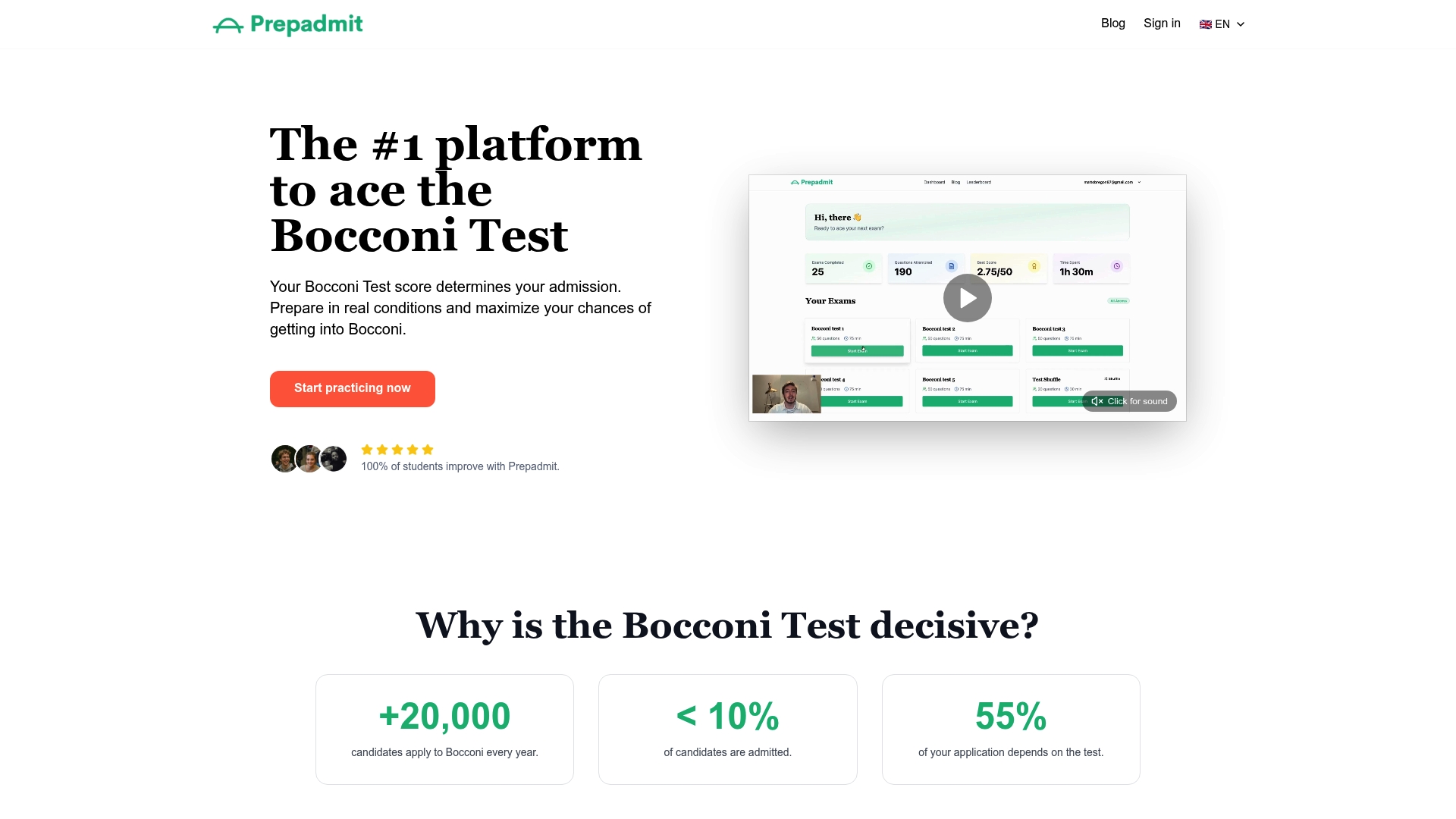
Students who use Prepadmit report an average score improvement of 34%. The platform lets you track your progress and compare your performance against other students preparing for the same exam. If you want to practice with questions that mirror the actual Bocconi English section, start on Prepadmit today. The practice is affordable, the feedback is specific, and the format is exactly what you will face on test day.
FAQ
How many English comprehension questions are on the Bocconi Test?
The Bocconi Test includes 15–17 reading comprehension questions out of 50 total, and the English section can reach up to 30 questions in some versions.
What question types appear in Bocconi English comprehension?
The main types are main idea, inference, tone, vocabulary in context, and sentence completion. Inference and tone questions are the most frequently missed.
How long should I spend on each comprehension question?
Aim for roughly one minute per question. The full reading comprehension section fits within a 15-minute window, so pacing is as important as accuracy.
Are Cambridge B2/C1 materials useful for Bocconi English prep?
Yes. Cambridge B2/C1 materials match the linguistic complexity of the Bocconi English section and are especially useful for non-native English speakers building vocabulary and reading speed.
How many practice questions should I complete before the exam?
Completing at least 300 practice questions across all sections over six weeks is linked to scoring above 80 on the Bocconi Test.
Recommended
- Which English Test Is Accepted by Bocconi? Official 2026 Requirements — PrepAdmit Blog
- International Bocconi Student Success Examples: 2026 Guide — PrepAdmit Blog
- Bocconi Admission Non-EU Student Guide for 2026 — PrepAdmit Blog
- How to Prepare for the Bocconi Test: A Step-by-Step 2026 Guide — PrepAdmit Blog
Related articles
Ready to ace your admission test?
Discover PrepAdmit, the platform that helps you succeed at top university admission tests.
Discover PrepAdmit