Best Tools for Improving Entrance Exam Scores on the Bocconi Test

Best Tools for Improving Entrance Exam Scores on the Bocconi Test
For the Bocconi Test, the most effective exam prep tools combine realistic full-length simulations, mistake-pattern analytics, spaced-repetition flashcards, and meta-skill trainers in one place. Prepadmit is the platform built specifically for this. Users report an average score improvement of 34% when they follow its structured practice plan. Start with a diagnostic full mock today to get your baseline and error profile.
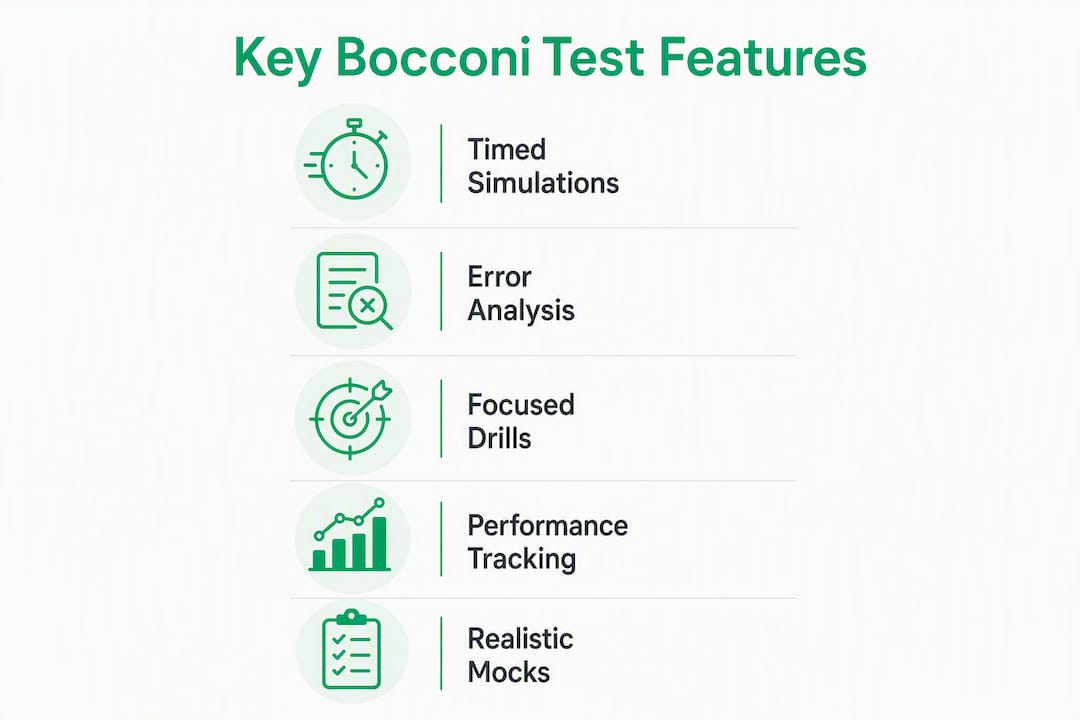
- Full-length timed simulations replicate Bocconi test conditions so your pacing is calibrated before test day
- Mistake-pattern analytics show exactly which topics cost you points
- Spaced-repetition flashcards lock in formulas and vocabulary for the long term
- Meta-skill trainers teach you when to skip, when to guess, and how to manage fatigue
- Peer ranking dashboards let you benchmark your progress against other Bocconi candidates
Table of Contents
- Which tool features actually raise your Bocconi Test score?
- How do you pick the right online tool for the Bocconi Test?
- How to turn practice sessions into real score gains
- Why simulations and analytics predict real score gains
- Your 8-week Bocconi-focused study plan
- Key Takeaways
- Why this approach works for Bocconi candidates
- What Prepadmit gives you for the Bocconi Test
- Sources and further reading
Which tool features actually raise your Bocconi Test score?
Not every study app is built the same. For the Bocconi Test specifically, a handful of features drive the real score gains.
- Full-length timed simulations: Practicing under real mock conditions trains your pacing and builds predictive accuracy. A 90-minute mock at home is not the same as a timed, format-accurate simulation that mirrors the actual paper.
- Mistake-pattern analytics: The highest-value function of any prep platform is analyzing which error types repeat. Error-tagging by cause (concept gap, misread, trap, time-out) lets you drill the root cause, not just re-solve the same questions.
- Adaptive diagnostics and prioritized study lists: Analytics that rank chapters by your accuracy and their exam weight maximize points gained per study hour.
- Spaced-repetition active-recall flashcards: Spaced repetition outperforms passive review for long-term retention. Self-rated confidence per card deepens learning further.
- Meta-skill trainers: Skip/EV practice, elimination techniques, and pacing drills are as critical as content drills. They convert knowledge into correct exam-day decisions under time pressure.
- Targeted chapter drills: Skill-specific practice modes let you isolate weak areas without running a full mock every session.
- Peer ranking and progress dashboards: Seeing your percentile rank against other Bocconi candidates keeps your preparation honest.
Prepadmit reports users achieve an average score improvement of 34% on the Bocconi Test when following the platform’s structured analytics-driven plan. Materials are designed by experts with backgrounds at HEC and Bocconi.
Pro Tip: In any free trial, go straight to the analytics dashboard after your first mock. If the platform cannot show you a chapter-by-chapter error breakdown within two minutes, it will not help you prioritize effectively.
| Feature | Why it raises your score |
|---|---|
| Full-length timed simulation | Trains pacing; improves predictive accuracy for final performance |
| Mistake-pattern analytics | Targets root causes of lost marks, not surface errors |
| Spaced-repetition flashcards | Builds long-term retention of formulas and vocabulary |
| Meta-skill trainers (skip/EV) | Converts knowledge into net points under timed conditions |
| Adaptive study plan | Concentrates hours on highest-yield gaps |
| Peer ranking dashboard | Benchmarks real standing against Bocconi applicants |
How do you pick the right online tool for the Bocconi Test?
Use this checklist before you pay for any platform. A tool that scores well on most of these criteria is worth your time and money.
- Bocconi-format full mocks: Does it replicate the exact timing, question types, and section structure of the Bocconi Test?
- Past-paper alignment: Are questions drawn from or modeled on real Bocconi past papers?
- Mistake-category analytics: Does it tag errors by type (concept gap, trap, misread, time-out)?
- Spaced-repetition flashcards: Are they built in, or do you have to manage them manually?
- Meta-skill trainers: Is there explicit skip/EV and pacing practice?
- Adaptive study plan: Does the platform reprioritize your topics after each session?
- Score forecast accuracy: Can it predict your likely score range based on practice data?
- Free diagnostic sample: Can you test the platform before paying?
- Mobile and desktop parity: Does it work equally well on both?
- Money-back guarantee: Is there a clear refund policy if results do not meet expectations?
- Transparent pricing: Is the full access cost stated upfront, with no hidden subscription tiers?
Prepadmit offers a feature comparison that maps each of these criteria to its platform. Check it before you evaluate alternatives.
| Criterion | What to look for during a trial |
|---|---|
| Bocconi-format mocks | Confirm timing and question-type match the official test |
| Error-category tagging | Look for concept/trap/misread labels on wrong answers |
| Adaptive reprioritization | Check whether the study plan updates after each session |
| Money-back policy | Read the refund terms before purchasing |
How to turn practice sessions into real score gains
Start every preparation cycle with a diagnostic full mock. This gives you a baseline score and a concrete error profile. From there, follow an adaptive plan that puts your highest-yield gaps first.
A practical session structure:
- Warm-up (10 min): Review your SRS flashcard queue. Focus on cards you rated low confidence in the previous session.
- Targeted drill (20–25 min): Work one chapter or skill type flagged by your analytics. Use the platform’s chapter-drill mode, not a full mock.
- Timed practice block (30 min): Simulate a section under real timing. No pausing.
- SRS review (10 min): Add new error cards from today’s drill to your spaced-repetition queue.
- Debrief (5 min): Open the analytics dashboard. Identify one recurring error type and note the root cause.
For meta-skill training, schedule two dedicated EV/skip sessions per week. Tag each answer as “sure,” “unsure,” or “guess” during timed practice. Review your accuracy per bucket afterward. When your “guess” accuracy is below the penalty threshold, skipping is the better play.
Pro Tip: Never study blind. Before each session, open your analytics dashboard and select the drill that targets your single lowest-accuracy chapter. Choosing randomly wastes the most valuable resource you have: time.

Using feedback loops effectively means acting on mistake categories within 24 hours of a mock, not days later when the reasoning has faded.
Why simulations and analytics predict real score gains
Full-length simulations under timed conditions improve predictive accuracy for final exam performance. The mechanism is straightforward: your brain learns to allocate time, manage fatigue, and make skip decisions under the same constraints it will face on test day. Passive review does not train any of those skills.
Expert-designed prep materials add a second layer. When questions are built by people who know the Bocconi Test’s exact structure, the difficulty calibration and trap design match what you will actually see. Generic question banks do not replicate that.
Error-pattern logging prevents the most common prep failure: repeating the same mistakes. When a platform tags errors by cause and schedules targeted review, you stop losing marks to the same traps. That targeted remediation is where most score gains come from.
| Trust signal | Detail |
|---|---|
| Average score improvement | 34% on the Bocconi Test (Prepadmit internal data) |
| Expert authorship | Materials designed by HEC and Bocconi experts |
| Past-paper alignment | Official-style simulations based on real past papers |
| Money-back guarantee | Refund policy listed on the platform |
Your 8-week Bocconi-focused study plan
Week 1 — Diagnostic: Take one full mock under real conditions. Record your baseline score and error profile. Do not study before this mock; you need an honest baseline.
Weeks 2–3 — Focused topic work: Use your analytics to identify the two or three chapters with the highest gap between exam weight and your accuracy. Run chapter drills daily. Start your SRS queue with vocabulary and formulas from these chapters.
Weeks 4–5 — Simulation ramp: Add one full mock per week. After each mock, update your error-category log and reprioritize your drill list. Run two EV/skip training sessions per week.
Weeks 6–7 — Timed full-mock rehearsals: Two full mocks per week, both under strict exam conditions. Review analytics within 24 hours. Micro-sessions targeting recurring error types fill the remaining days.
Week 8 — Taper and final rehearsal: Reduce new content. Run one full mock at the start of the week and one two days before the exam. Focus SRS sessions on your lowest-confidence cards only.
- Each full mock session: approximately 2 hours including debrief
- Daily drill sessions: 45–60 minutes
- Weekly SRS review: 15–20 minutes per day
- EV/skip training: two sessions of 20 minutes per week
When the platform’s analytics show a chapter moving from low to mid accuracy, shift that drill time to the next lowest-accuracy chapter. The plan should update every week based on what the data shows.
Key Takeaways
Prepadmit users who follow a structured simulation-and-analytics plan achieve significant average score improvement on the Bocconi Test.
| Point | Details |
|---|---|
| Start with a diagnostic mock | Take a full timed mock first to get your baseline score and error profile. |
| Prioritize analytics-driven drills | Use mistake-category data to target your highest-yield gaps every session. |
| Add SRS from day one | Build your spaced-repetition queue with formulas and vocabulary from weak chapters. |
| Train meta-skills twice a week | Schedule EV/skip and pacing sessions; they convert knowledge into net points. |
| Prepadmit for Bocconi prep | Prepadmit combines full mocks, analytics, SRS, and meta-skill trainers with a 34% average improvement and a money-back guarantee. |
Why this approach works for Bocconi candidates
The conventional wisdom in exam prep is to study more. Read more chapters, do more questions, spend more hours. That advice misses the point entirely for a structured test like the Bocconi.
The Bocconi Test rewards decision-making under time pressure as much as it rewards content knowledge. A student who knows the material but cannot manage pacing, cannot decide when to skip, and has never practiced under fatigue will underperform relative to their actual knowledge. That gap between knowledge and score is exactly what meta-skill training and realistic simulations close.
Generic platforms give you question banks. Bocconi-specific preparation gives you a model of your own performance: where you lose marks, why, and what to do about it in the time you have left. The difference in outcome is not small.
Prepadmit was built around this logic by people who understand both the Bocconi Test structure and how students actually prepare. The expert-designed materials and the 34% average improvement figure reflect a method, not a marketing claim.
What Prepadmit gives you for the Bocconi Test
Prepadmit is the direct alternative to expensive private coaching for Bocconi Test preparation. At a fraction of the cost of a tutor, you get official-style full mocks, real past papers, chapter-level analytics, spaced-repetition flashcards, meta-skill trainers, and a peer ranking dashboard. Every feature on the checklist above is covered.
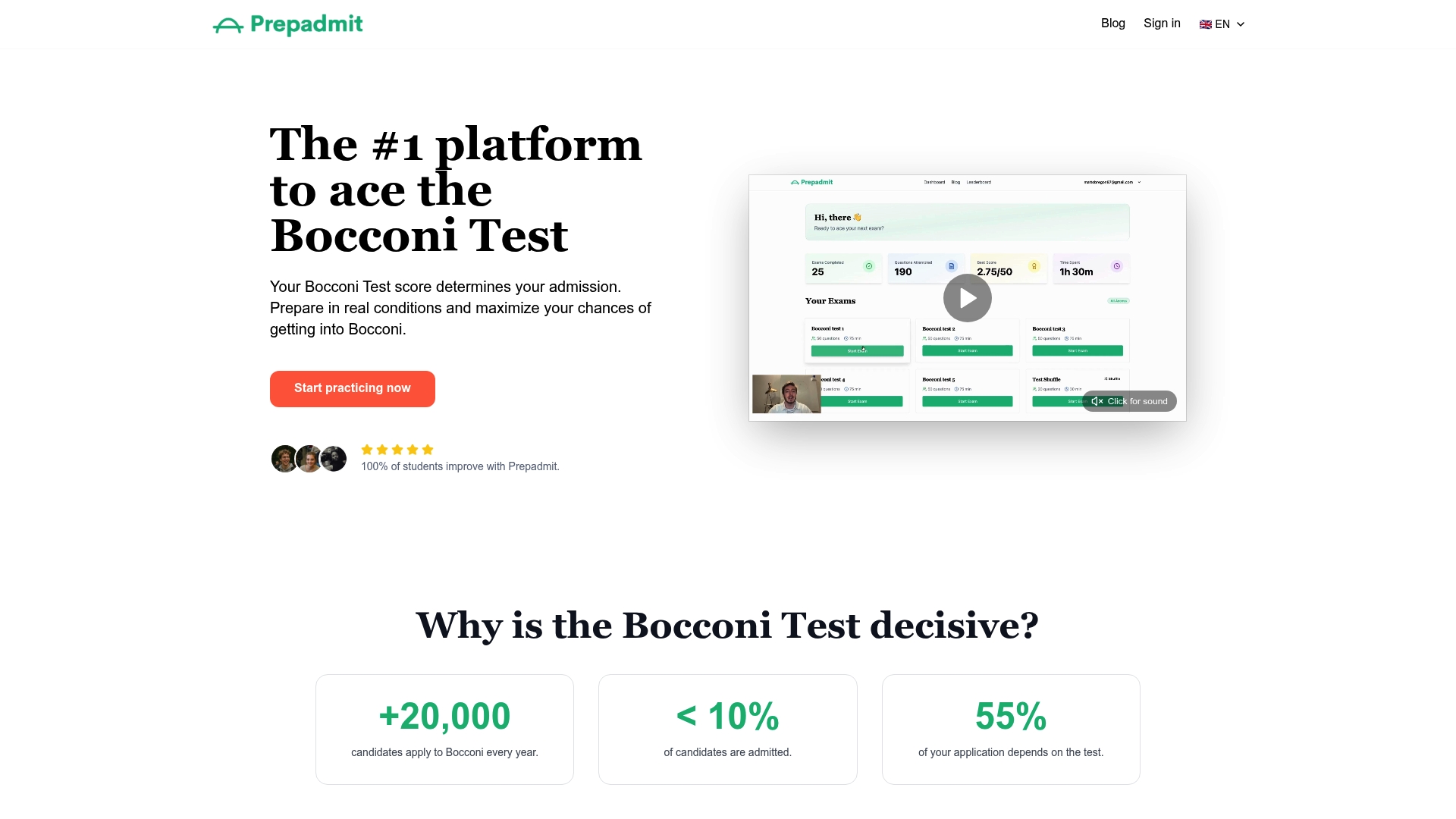
The 34% average score improvement comes with a money-back guarantee. You are not paying for access to a question bank. You are paying for a structured system that tells you what to fix, when to fix it, and whether you are on track. Materials are designed by HEC and Bocconi experts, so the difficulty calibration and trap design match the real test.
Take your first diagnostic full mock on Prepadmit today. Your baseline score and error profile will be ready immediately after.
Sources and further reading
- Prepadmit — Bocconi Test preparation platform
- Bocconi Test Simulation: What a Real Mock Looks Like (2026)
- The Role of Expert-Designed Prep Materials in Exam Success
- Bocconi Online Platform Features Comparison 2026
- University Admission Test Feedback Use: 2026 Guide
- Spaced Repetition Exam Prep: A Science-Backed Guide
- Why Exam Simulation Boosts Results for Students
Recommended
Related articles
Ready to ace your admission test?
Discover PrepAdmit, the platform that helps you succeed at top university admission tests.
Discover PrepAdmit