ATAS Test in NY: What Candidates Must Know in 2026

ATAS Test in NY: What Candidates Must Know in 2026
The ATAS (Assessment of Teaching Assistant Skills) is New York State’s required exam for initial teaching assistant certification, and as of 2026, it is being retired. The NYSTCE has announced that the ATAS (095) will be replaced by the National Evaluation Series Foundations of Classroom Support and Instruction (NES 519). If you haven’t registered yet, your first move is to check the official last registration date and decide: take the ATAS before the cutoff, or shift your preparation to the newer Foundations of Classroom Support and Instruction exam.
Your three immediate next steps:
- Check the official ATAS last-registration date on the NYSTCE site and decide which exam fits your timeline.
- If you choose ATAS, book your appointment now. Seats at Pearson test centers fill up, and the window is closing.
- Run a diagnostic with official NYSTCE practice materials before you study anything else.
Key Takeaways
The ATAS is a retiring NY exam with a fixed last-registration date, and candidates who miss that cutoff must prepare for the replacing exam instead.
| Point | Details |
|---|---|
| ATAS retirement | Check the NYSTCE site for the last-registration date; after that, NES 519 is the required path. |
| Passing score | A scaled score of 220 or above on the 100–300 NYSTCE scale satisfies the requirement. |
| Four subareas | Reading, Writing, Mathematics, and Instructional Support; Writing’s constructed response is the most common weak point. |
| Waiver eligibility | Holders of a valid NY teaching certificate or a passed CST may qualify for a waiver; verify on NYSED before registering. |
| Prepadmit | Offers diagnostic-first exam simulations with detailed corrections and progress tracking for candidates who want structured, measurable practice. |
Table of Contents
- What is the ATAS test and what does it measure?
- What each ATAS subarea actually tests
- How to register, where to test, and the retirement timeline
- How ATAS scoring works and when the requirement can be waived
- Fees, official prep materials, and where to find them
- A practical study plan: diagnostic to mock test
- How ATAS fits into NY teaching assistant certification
- What to expect on test day
- A realistic view of what the ATAS actually certifies
- Prepadmit offers structured practice for high-stakes exams
- Sources
What is the ATAS test and what does it measure?
The ATAS is a criterion-referenced exam. That means you pass by meeting a fixed proficiency standard, not by outscoring other candidates. The NYSTCE preparation guide defines four subareas: Reading, Writing, Mathematics, and Instructional Support. Each subarea tests a specific slice of the academic and classroom-support skills a teaching assistant needs on the job.
The test is computer-based, runs for several hours, and contains about a hundred selected-response items. The passing score is set by NYSTCE on a scaled score range.
| Feature | Details |
|---|---|
| Format | Computer-based testing (CBT) |
| Number of items | ~100 selected-response |
| Testing time | ~3 hours |
| Passing score | 220 (scaled) |
| Subareas | Reading, Writing, Mathematics, Instructional Support |
Pro Tip: Before you open any third-party study guide, download the free NYSTCE preparation guide for ATAS. It lists the exact test objectives and sample questions, which are the most reliable map of what will actually appear on your exam.
What each ATAS subarea actually tests
The four subareas are not equal in how they surprise candidates. Here is what each one covers and where the difficulty tends to land.
Reading
- Identifying the main idea and supporting details in a passage
- Understanding vocabulary in context
- Recognizing an author’s purpose or point of view
- Drawing inferences from informational and literary texts
Sample task: Read a short passage about a classroom policy and identify which sentence best states the author’s central argument.
Writing
- Organizing a written response with a clear thesis and supporting evidence
- Applying standard grammar, usage, and mechanics
- Constructing a short essay in response to a prompt
Sample task: Write a response explaining how a teaching assistant might support a student who is struggling with reading comprehension. Use specific examples.
The writing subarea is the one that catches candidates off guard most often. Instructor reports and candidate feedback consistently flag the constructed-response format as the riskiest section for anyone who hasn’t written academically in a while. You can’t multiple-choice your way through it.
Mathematics
- Arithmetic operations and number sense
- Basic algebra and problem-solving
- Data interpretation (charts, tables, simple graphs)
- Measurement and geometry fundamentals
Sample task: A teacher asks you to divide 24 students into equal groups of 4. How many groups are there, and if one student is absent, how does that change the grouping?
Instructional Support
- Understanding how to assist students with learning tasks
- Recognizing appropriate classroom-support strategies
- Applying basic knowledge of child development and learning principles
Sample task: A student is having difficulty staying on task during independent reading. Which of the following strategies would best support the student’s focus?
A scaled score of 220 does not correspond to a fixed percentage of correct answers. NYSTCE converts raw scores to a 100–300 scale, and the conversion accounts for slight variation in difficulty across test forms. Think of 220 as the point where the exam considers you academically ready to support instruction.
How to register, where to test, and the retirement timeline
Registration happens through the NYSTCE/NESINC portal. The process is straightforward, but the retirement deadline adds urgency.
- Create or log in to your NYSTCE account at the NESINC registration site.
- Select the ATAS (095) from the test list and confirm it is still available for registration.
- Choose a test date and a Pearson VUE test center near you, or check whether remote proctoring is currently offered for this exam.
- Pay the test fee at checkout.
- Request any testing accommodations at this stage if you need them. Do not wait until closer to your date.
The retirement decision point: The NYSTCE has published a last-registration date for the ATAS. Once that date passes, new registrations close and NES 519 becomes the required path. During the current transition window, Molloy College’s continuing-education program notes that candidates may choose between the two exams, and that NES 519 differs modestly from ATAS, with a somewhat different question count and a slightly adjusted math emphasis. If you are already mid-preparation for ATAS, finishing on that exam before the cutoff is the cleaner path.
Timeline snapshot: Check the NYSTCE site for the exact last-registration date. If that date has passed, your exam is NES 519. If it hasn’t, you have a choice. Make it now.
How ATAS scoring works and when the requirement can be waived
Your score report shows a scaled score between 100 and 300. A score of 220 or above means you passed. Below 220, you can retake the exam, subject to NYSTCE retake rules.
NYSED’s teaching assistant certification page explains that a passing ATAS score is required for an initial TA certificate in New York. However, the requirement can be waived in certain situations:
- You hold a valid New York State teaching certificate.
- You have passed a relevant Content Specialty Test (CST) that satisfies the requirement under your specific certification pathway.
- Other pathway-specific conditions may apply depending on your level of TA certification (Level I, II, or III).
Scores do carry forward. If you pass the ATAS and later apply for a higher-level TA certificate or a renewal, the passing score remains on record with NYSED. You do not need to retest for the same requirement.
Pro Tip: Before you schedule a single study session, log in to your NYSED account and check your certification pathway. Some candidates spend weeks preparing for an exam they are already exempt from.
Fees, official prep materials, and where to find them
The test fee is listed on the NYSTCE preparation materials page. NYSTCE also sells an official full-length practice test for $14 and offers Right Start online course subscriptions in 30-day and 90-day options.
The official materials you should gather before anything else:
- NYSTCE Preparation Guide (ATAS 095): Free download. Contains test objectives, sample questions, and a written-response scoring guide. This is your study blueprint.
- Test framework: Also free. Defines the content domains and the weight of each subarea.
- Official full-length practice test ($14): The closest simulation of the real exam. Worth every dollar as your first diagnostic.
- Right Start course: A structured online course from NYSTCE. Available in 30-day and 90-day subscriptions. Useful if you want guided review rather than self-directed study.
- Computer-based testing tutorial: Free on the NYSTCE site. Walk through it before test day so the interface is not new to you.
Secondary prep options worth considering: timed section drills, writing workshops focused on constructed-response format, and math review courses targeting arithmetic through basic algebra. The role of expert-designed prep materials in closing skill gaps is well-documented, and official materials give you the most accurate signal of where you actually stand.
A practical study plan: diagnostic to mock test
A backward-planning approach works best here. Pick your test date first, then build your schedule around it.
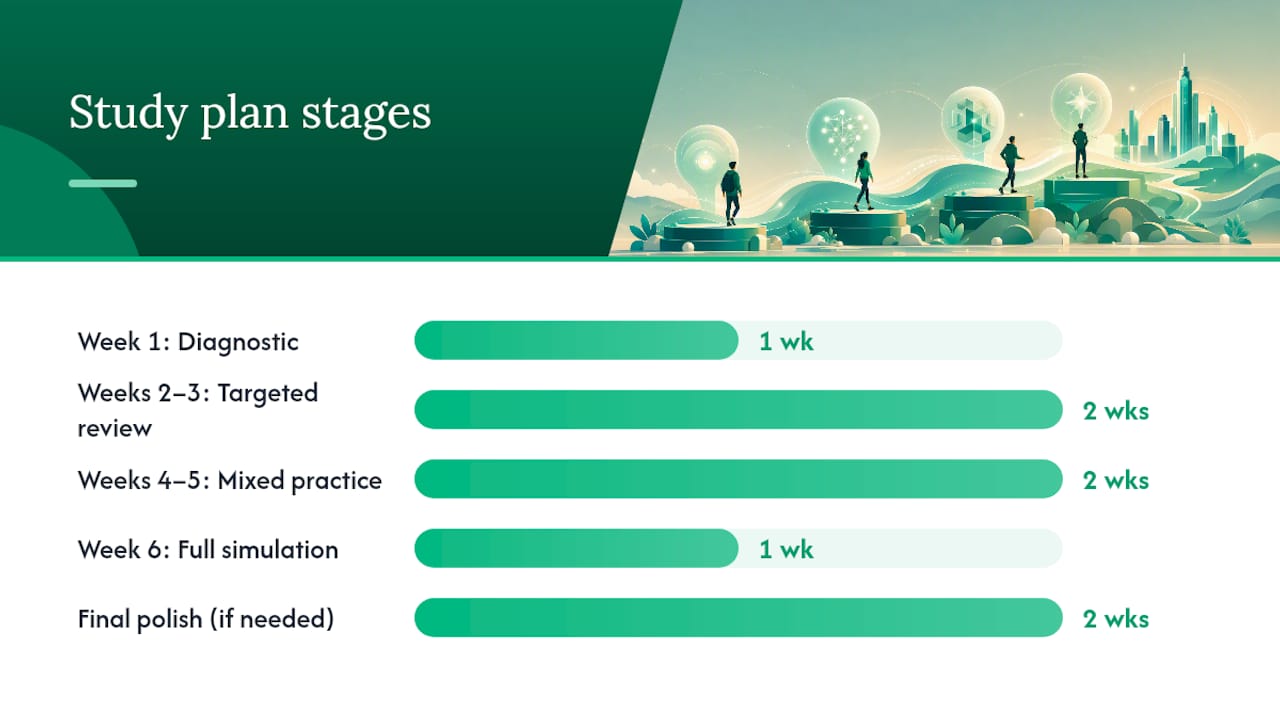
- Week 1: Diagnostic. Take the official NYSTCE practice test under timed conditions. Score each subarea separately. Your lowest subarea is your first priority.
- Weeks 2–3: Targeted content review. Work through the preparation guide objectives for your two weakest subareas. For Writing, practice at least one constructed response per session. For Math, drill arithmetic and basic algebra daily.
- Weeks 4–5: Mixed practice. Alternate between full-length timed sections and targeted drills. Log every error and note the objective it maps to.
- Week 6: Full simulation. Take a second full-length timed practice test. Compare your subarea scores to Week 1. Adjust focus for any subarea that hasn’t improved.
- Weeks 7–8 (if needed): Final polish. Repeat timed sections for weak objectives. Limit new content. Focus on pacing and constructed-response quality.
A 4-week plan works if your diagnostic shows only one or two weak subareas. If math or writing shows a significant gap, budget 6–8 weeks.
Pro Tip: Log errors by objective, not just by subarea. “I missed three Reading questions” tells you nothing. “I missed three questions on drawing inferences from informational text” tells you exactly what to review next.
Pro Tip: For constructed-response practice, set a 25-minute timer and write a full response before checking any model answer. Reviewing a model answer without writing first is not practice. It’s reading.
Timed practice tests are not just about content. They train your pacing and reduce the cognitive load of managing time on test day, which is a real performance factor.
How ATAS fits into NY teaching assistant certification
The ATAS sits at the entry point of the NY TA certification structure. NYSED requires a passing score for an initial TA certificate. The three TA certificate levels in New York are:
- Level I: Introductory, time-limited. Does not require the ATAS but has other requirements.
- Level II: Requires passing the ATAS (or an approved waiver) plus coursework.
- Level III: Requires additional education and experience beyond Level II.
The ATAS retirement changes the path for anyone who hasn’t tested yet. Candidates who register and pass before the cutoff date satisfy the requirement with their ATAS score. Candidates who miss the cutoff will need to pass NES 519 instead. The Molloy College continuing-education note confirms that NES 519 is modestly different, so if you switch exams mid-preparation, review the NES 519 framework before your test date.
| Scenario | Action |
|---|---|
| Haven’t registered yet, ATAS cutoff still open | Register for ATAS now or decide to prepare for NES 519 |
| Already registered for ATAS | Proceed with ATAS prep; no change needed |
| Missed ATAS cutoff | Prepare for NES 519 using its own framework |
| Hold a valid NY teaching certificate | Check NYSED for waiver eligibility before registering |
What to expect on test day
Knowing the logistics in advance removes a layer of stress that has nothing to do with your actual knowledge.
- Bring a valid, government-issued photo ID. Your name must match your registration exactly.
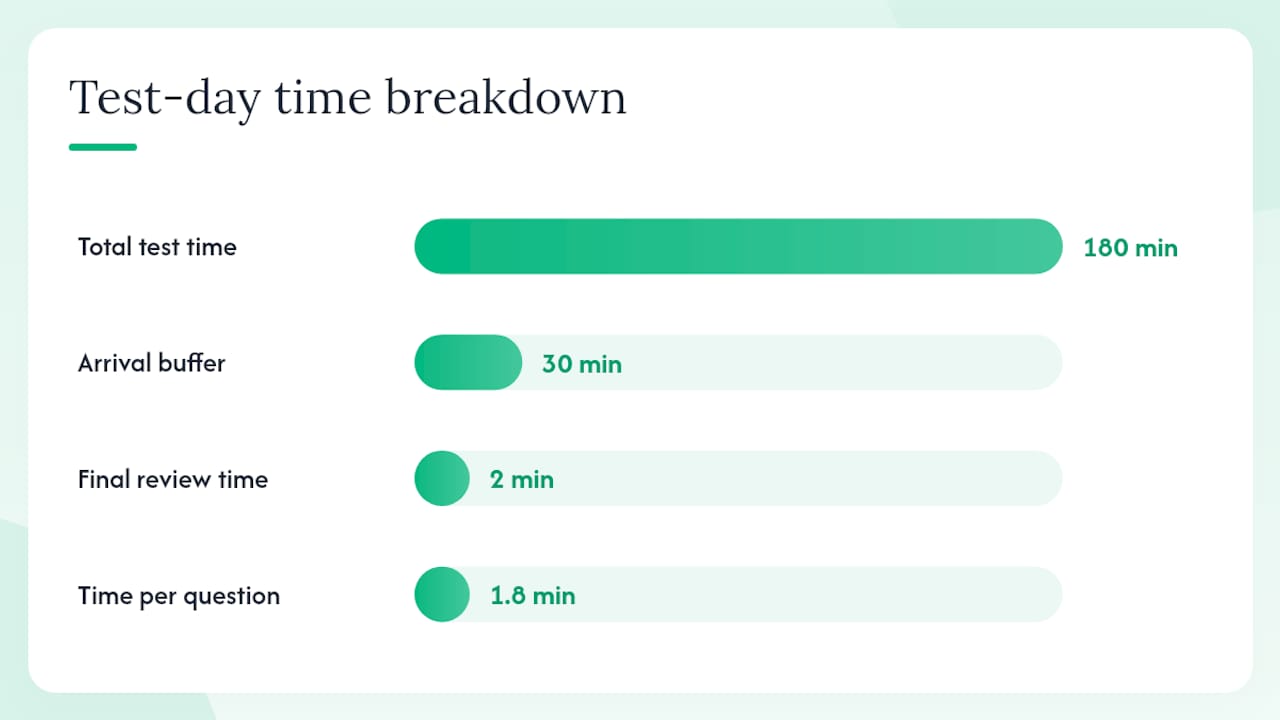
- Arrive at least 30 minutes early. Pearson test centers run a check-in process that includes palm-vein scanning and a locker for your belongings.
- No personal items at the workstation. No phones, notes, or scratch paper from home. The center provides scratch paper or a whiteboard.
- Calculator policy: Check the NYSTCE site for the current ATAS calculator policy. For most selected-response math items, no calculator is provided, so arithmetic fluency matters.
- Pacing: With roughly 100 items and three hours, you have about 1.8 minutes per question. Flag difficult items and return to them. Do not spend five minutes on one question.
- After the test: Unofficial scores for selected-response sections often appear on screen immediately. Official score reports are released on the NYSTCE score-release schedule.
Pro Tip: On constructed-response items, spend the last two minutes re-reading your response for one thing only: does your first sentence clearly state your main point? Graders read fast. A clear thesis in sentence one recovers a lot of ground.
For broader confidence strategies before test day, exam confidence-building techniques like progressive practice and controlled breathing have a measurable effect on performance under pressure.
A realistic view of what the ATAS actually certifies
The ATAS measures academic readiness. It does not measure how well you will actually work with students. The Bureau of Labor Statistics describes the daily work of teaching assistants as heavily interpersonal: managing small groups, adapting to individual student needs, and supporting classroom routines. None of that appears on the ATAS.
That gap is worth keeping in mind as you prepare. A passing score means you have the academic foundation the state requires. It does not mean you are ready for everything the job demands. Pair your test preparation with classroom observation hours or a workshop on instructional strategies if you can. The exam gets you certified. The experience makes you effective.
Most candidates who prepare consistently for 4–8 weeks pass. If your diagnostic shows strong Reading and Instructional Support scores but a weak Writing or Math score, focus there first and give yourself the longer end of that range. The exam is not designed to fail you. It is designed to confirm a baseline.
Prepadmit offers structured practice for high-stakes exams
If you are the kind of learner who needs more than a PDF prep guide and a practice test, Prepadmit’s platform gives you exam simulations built around real past-paper content, detailed answer corrections, and progress tracking that shows exactly which skills need more work.
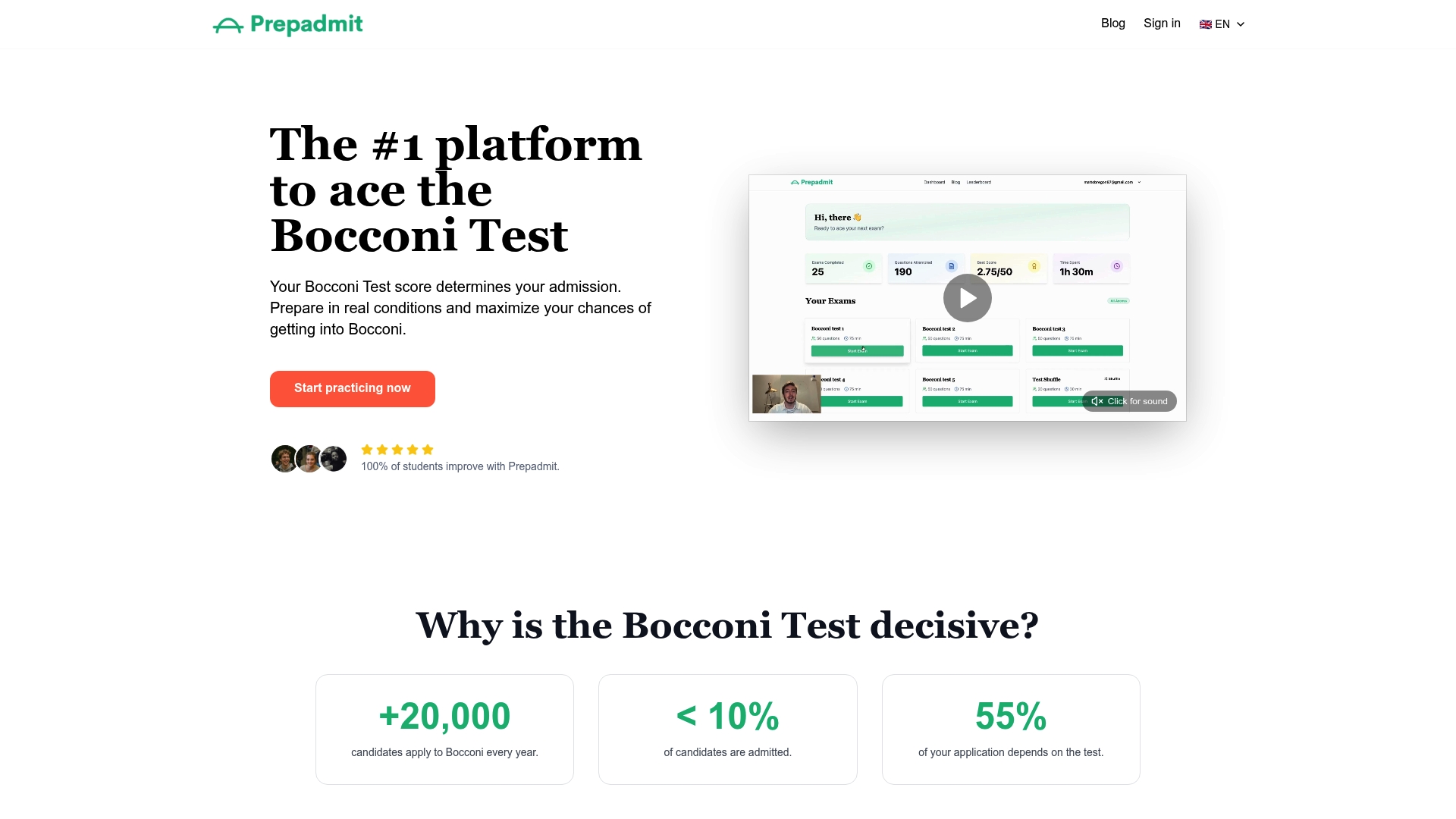
The platform was built by experts from HEC and Bocconi for students who want realistic, structured practice at a fraction of the cost of private coaching. You get skill-specific drill modes, peer ranking dashboards, and a diagnostic-first workflow that mirrors the backward-planning approach this article recommends. If you are preparing for a high-stakes standardized exam and want a system that tracks your progress and tells you where to focus next, start with Prepadmit and run your first diagnostic today.
Sources
Bookmark these pages and use them as your primary references throughout preparation.
- Assessment of Teaching Assistant Skills (ATAS) (095)
- Teaching Assistant Certification | New York State Education Department
- Assessment of Teaching Assistant Skills: What the ATAS Exam Actually Tests — Pigment
- Teacher Assistant Certification Exam (ATAS) — Molloy College continuing education
- Teacher assistants — Occupational Outlook Handbook (BLS)
- Pearson VUE test center locator
Recommended
- Bocconi Test Format 2026: What Changed & How to Practice It — PrepAdmit Blog
- Standardized University Admission Tests: A 2026 Guide — PrepAdmit Blog
- Is the Bocconi Test Hard? An Honest 2026 Difficulty Breakdown — PrepAdmit Blog
- Which English Test Is Accepted by Bocconi? Official 2026 Requirements — PrepAdmit Blog
Related articles
Ready to ace your admission test?
Discover PrepAdmit, the platform that helps you succeed at top university admission tests.
Discover PrepAdmit