Why the Bocconi Test Is Language Neutral: 2026 Guide

Why the Bocconi Test Is Language Neutral: 2026 Guide
The Bocconi Test is language neutral because it measures reasoning and comprehension skills rather than knowledge of any specific local curriculum or cultural context, even though the test itself is delivered in English. This distinction matters enormously for the roughly 10,000 students from dozens of countries who sit the exam each year. Understanding why bocconi test is language neutral changes how you prepare, what you prioritize, and how you manage your time on test day. The short version: the test is in English, but it is not about English.
Why the Bocconi test is language neutral, explained
Language neutrality in standardized testing does not mean the test contains no language. It means the test minimizes construct-irrelevant language load so that scores reflect the skills being measured, not a candidate’s fluency advantage. The Bocconi Test applies this principle by stripping out content that would favor students from specific countries or school systems.
Think about what a non-neutral test looks like. A history question referencing the Italian Risorgimento rewards Italian students. A math problem using terminology specific to the British A-Level syllabus rewards British students. The Bocconi Test avoids local curriculum content entirely, focusing instead on reasoning patterns that any well-prepared student can access regardless of nationality.
Here is what language neutrality actually protects against in the Bocconi context:
- Questions that assume familiarity with a specific country’s history, politics, or culture
- Math problems requiring advanced calculus or content taught only in certain national curricula
- Reading passages built around idioms or cultural references that non-native speakers would not recognize
- Grammar questions testing obscure rules rather than functional reading comprehension
“Language fairness aims to minimize irrelevant language demands so scores reflect skills, not language fluency differences among candidates.” — Testlify, Language Fairness in Assessments
The Bocconi Test fairness criteria rest on this foundation. Every applicant, whether from Milan, Mumbai, or Mexico City, faces the same reasoning challenges without being penalized for where they went to school.
How the test structure supports neutrality despite using English
The Bocconi Test is delivered fully in English and runs approximately 75 minutes in total. That fact surprises many applicants who assume “language neutral” means the test avoids English altogether. It does not. What it avoids is English that requires cultural insider knowledge.

Here is a breakdown of the main sections and how each one reflects the neutrality principle:
| Section | Content focus | Language demand |
|---|---|---|
| Mathematics and statistics | Numerical reasoning, data interpretation | Minimal language; universal notation |
| Logical reasoning | Pattern recognition, argument analysis | Simple, standardized phrasing |
| English grammar and vocabulary | B2–C1 CEFR level items | Functional grammar, not cultural idioms |
| English reading comprehension | Passage analysis and inference | Academic reading speed and logic |
The English section targets B2 to C1 CEFR proficiency, which is the standard for academic study in English, not native-speaker cultural fluency. The passages test whether you can read quickly and extract meaning under time pressure. They do not test whether you know British slang or American pop culture references.
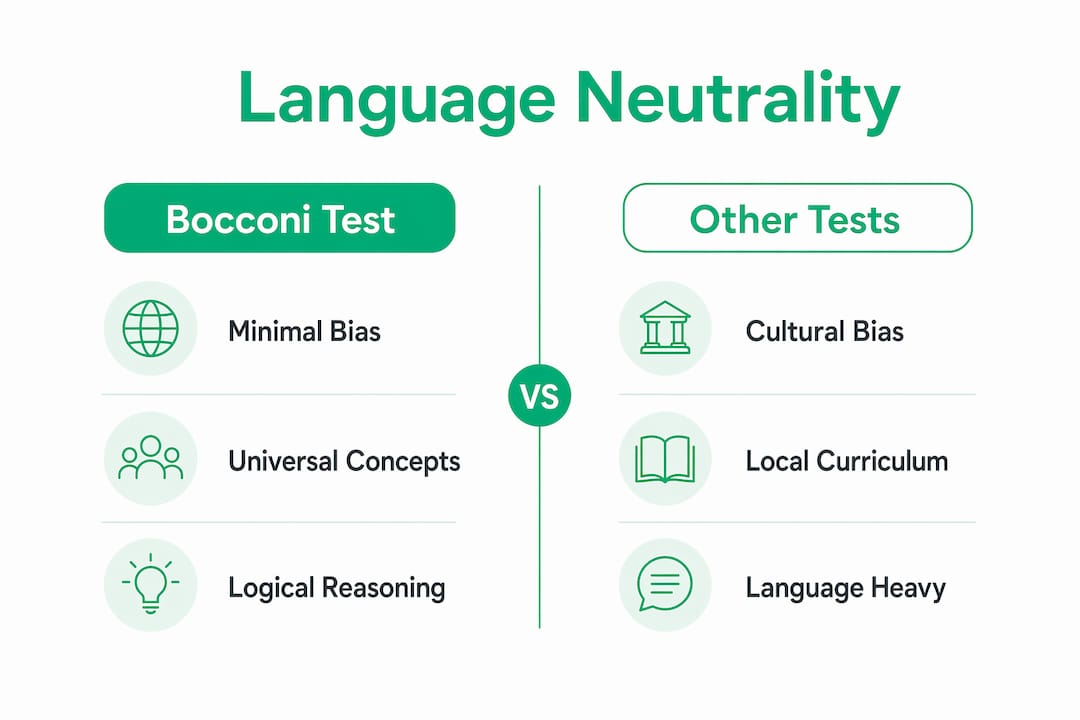
Compare this to the SAT, which uses passages rooted in American civic and literary traditions. A student from South Korea or Brazil reading an SAT passage about the Federalist Papers faces a cultural gap that has nothing to do with their reasoning ability. The Bocconi Test selects neutral academic texts specifically to avoid that problem.
Pro Tip: When practicing reading comprehension, choose academic articles on economics, science, or global policy rather than culturally specific literature. This mirrors the type of passages the Bocconi Test actually uses.
The math and logic sections reinforce neutrality even further. Numerical problems use universal mathematical notation. Logical reasoning questions rely on abstract structures, not real-world scenarios tied to any one country’s context. The focus on reasoning speed rather than memorized content is the clearest expression of the language neutral design.
What language neutrality means for your preparation
Understanding the Bocconi test explanation behind language neutrality changes your preparation strategy in concrete ways. Most students waste time studying vocabulary lists or memorizing grammar rules. That is the wrong approach.
Here is what actually moves your score:
-
Build reading speed first. Non-native English speakers can lose points under time pressure even when their language knowledge is adequate. The bottleneck is not vocabulary. It is how fast you process sentences and extract the key claim. Practice reading academic English texts at speed every day for at least four weeks before the exam.
-
Practice timed full-length tests. The 75-minute total runtime means every section competes for your attention. Official Bocconi practice materials give you the most accurate picture of the real time pressure. Untimed practice builds familiarity but does not build the processing speed you need on test day.
-
Learn section-specific strategy, not just content. Math and numerical sections reward elimination and smart guessing. The scoring system penalizes guessing differently across sections, so knowing when to skip and when to commit is a skill worth developing separately from content knowledge.
-
Balance your preparation across sections. Many students over-invest in English grammar because it feels like the most familiar territory. The math and logic sections carry significant weight. A student who scores at the top of the reasoning sections but only averages on English will outperform a student who does the reverse.
-
Use mock exams for timing practice. Simulating real exam conditions, including the time limit and the section order, trains your brain to operate efficiently under pressure. This is especially valuable for non-native English speakers who need to build automatic reading fluency rather than deliberate translation.
Pro Tip: Do not translate passages into your native language as you read. Train yourself to understand English text directly. Translation adds seconds per sentence, and those seconds compound across a 75-minute exam.
The importance of language neutrality for your prep is this: because the test does not reward cultural knowledge or advanced vocabulary, your ceiling is determined by how fast and accurately you reason, not by how much English content you have memorized.
Common misconceptions about Bocconi test language neutrality
Several misunderstandings circulate among applicants each year. Clearing them up saves you from preparing for the wrong exam.
-
“Language neutral means no English.” This is the most common mistake. The test is entirely in English, including the interface and all instructions. Language neutrality refers to the absence of cultural bias and local curriculum content, not the absence of English.
-
“I need an advanced English vocabulary to score well.” The English section targets B2 to C1 CEFR, which most students who have studied English seriously for several years already possess. The real challenge is reading speed and comprehension accuracy under time pressure, not vocabulary breadth.
-
“Native English speakers have a major advantage.” Native speakers do read faster on average, but the test’s reasoning and logic sections level the field significantly. A student from France or India who has practiced timed reading and reasoning consistently can match or beat a native English speaker who has not prepared strategically.
-
“The test changes significantly year to year.” The format and language demands are stable, though slight shifts are possible from year to year. Using official practice resources keeps you calibrated to the current version.
-
“Preparing for the SAT or IELTS is equivalent preparation.” It is not. The SAT is culturally rooted in American academic content. IELTS tests language production, including writing and speaking. The Bocconi Test is a reasoning exam that uses English as its medium. The preparation overlap exists but is partial.
Understanding these distinctions is the foundation of a smart preparation plan. You are not preparing for a language exam. You are preparing for a reasoning exam that happens to be in English.
Key takeaways
The Bocconi Test is language neutral because it excludes culturally specific content and local curriculum knowledge, not because it avoids English.
| Point | Details |
|---|---|
| Language neutral definition | Minimizes cultural and curriculum bias; does not eliminate English from the test. |
| English proficiency required | B2 to C1 CEFR level; reading speed and comprehension matter more than vocabulary depth. |
| Biggest performance factor | Processing speed under a 75-minute time limit affects scores across all sections. |
| Preparation priority | Timed practice with official materials outperforms vocabulary memorization or grammar drills. |
| Fairness across nationalities | Math and logic sections use universal content, giving all applicants equal footing. |
Why most students are preparing for the wrong version of this test
I have seen hundreds of students walk into Bocconi Test preparation with the same assumption: this is an English test, so I need to study English. They spend weeks on grammar workbooks and vocabulary flashcards. Then they sit a timed practice test and run out of time on the reading section, not because they did not know the words, but because they could not process the sentences fast enough.
The language neutral design of the Bocconi Test is genuinely good news for non-native English speakers. It means the exam is not rigged against you. But it does require a specific kind of preparation that most students do not instinctively reach for. Reading speed is a trainable skill. Logical reasoning under time pressure is a trainable skill. Neither one improves from studying a grammar textbook.
The students I have seen perform best are the ones who treat this like an athletic event. They practice at full speed, under real conditions, repeatedly. They review their mistakes not to memorize correct answers but to understand where their reasoning broke down. They use official Bocconi practice tests as their primary benchmark, not third-party materials that may not reflect the actual language load.
One more thing worth saying directly: do not let the English medium of the test intimidate you into over-preparing for language and under-preparing for reasoning. The test is designed to be fair to you. Meet it on its own terms.
— quentin
Start practicing the way the test actually works
If you have read this far, you understand that the Bocconi Test rewards reasoning speed and comprehension accuracy, not memorized content. Prepadmit is built around exactly that reality.
Prepadmit offers timed practice tests built from official past papers, detailed answer corrections that show you where your reasoning went wrong, and skill-specific modes so you can target your weakest sections. The platform was developed by people who studied at HEC and Bocconi, so the content reflects what the test actually demands. Students using Prepadmit improve their scores by an average of 34%. You can start preparing today at a fraction of the cost of private coaching, with a money-back guarantee if you do not see results.
FAQ
Does the Bocconi Test contain English questions?
Yes. The Bocconi Test is delivered entirely in English and includes a dedicated English section covering grammar, vocabulary, and reading comprehension at B2 to C1 CEFR level.
What does “language neutral” mean for the Bocconi Test?
Language neutral means the test avoids culturally specific content and local curriculum knowledge, so applicants from any country compete on equal reasoning terms rather than being rewarded for national school content.
Do non-native English speakers have a disadvantage?
Non-native speakers can face slower reading speeds under time pressure, but the math and logic sections use universal content that levels the field. Consistent timed practice closes the reading speed gap significantly.
How is the Bocconi Test different from the SAT in language terms?
The SAT uses passages rooted in American civic and literary traditions, which creates a cultural advantage for American students. The Bocconi Test uses neutral academic texts and avoids culturally specific references, making it more accessible to international applicants.
What is the best way to prepare for the language component?
Practice reading academic English texts at speed, focusing on extracting the main argument quickly. Use on-demand timed tests that mirror real exam conditions rather than studying grammar rules in isolation.
Recommended
Related articles
Ready to ace your admission test?
Discover PrepAdmit, the platform that helps you succeed at top university admission tests.
Discover PrepAdmit