What Is Test-Taking Strategy? Your 2026 Exam Guide

What Is Test-Taking Strategy? Your 2026 Exam Guide
A test-taking strategy is a deliberate set of methods students use to maximize their exam score beyond what studying alone can achieve. These techniques cover everything from how you scan a question paper to how you manage anxiety in the final minutes. Students using active recall, spaced repetition, and systematic exam-day strategies score 12–18% higher than those who only passively review notes. That gap is not about intelligence. It is about method. Whether you are preparing for university entrance exams, the Bocconi Test, or a high-stakes standardized test, knowing what is test-taking strategy gives you a real, measurable edge.
What are the most effective test-taking strategies supported by research?
Effective exam strategies fall into two categories: preparation methods and exam-day tactics. Both matter, and neither replaces the other.
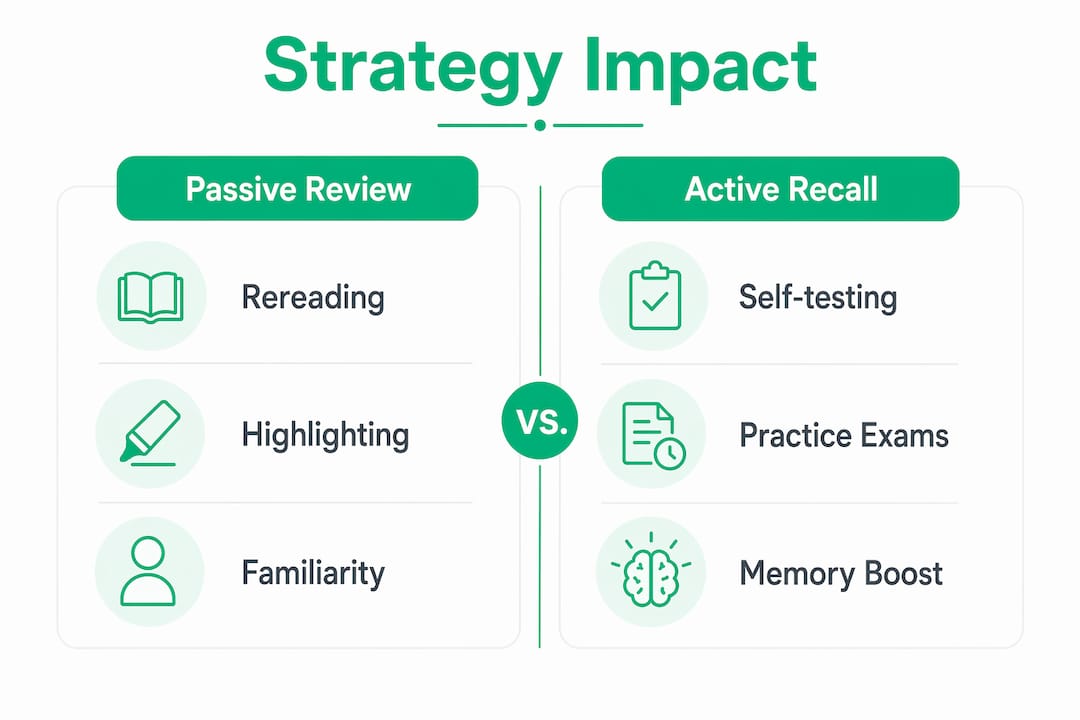
On the preparation side, active recall beats passive review every time. Students who confuse familiarity with mastery overestimate their study time by 30–50%. Active retrieval, by contrast, improves long-term retention by about 50%. That means testing yourself with flashcards or practice questions, not just rereading your notes.

On exam day, the sequence of your actions matters as much as your knowledge. Reading directions carefully and budgeting time accordingly prevents careless mistakes that cost easy points. Identifying keywords in each question stops you from answering the wrong thing correctly. A solid university entrance exam revision plan combines both preparation and exam-day habits into one repeatable system.
The table below shows how passive and active strategies compare in practice.
| Strategy type | Example | Performance impact |
|---|---|---|
| Passive review | Rereading notes, highlighting | Low retention, low score gain |
| Active recall | Self-testing, flashcards | ~50% better long-term retention |
| Spaced repetition | Reviewing material over days | Reduces forgetting curve significantly |
| Exam-day scanning | Previewing full test before answering | Builds momentum, lowers anxiety |
| Time budgeting | Allocating minutes per section | Prevents running out of time |
Pro Tip: In the first five minutes of any exam, write down formulas, mnemonics, or key facts on your scratch paper. Dumping memorized facts early lowers the risk of forgetting them under pressure.
How to manage test anxiety and maintain focus during exams
Test anxiety is a biological response, not a character flaw. The good news is that specific techniques reduce it reliably before and during the exam.
The most direct method is a pre-exam brain dump. Writing down specific worries before the test starts frees working memory and measurably improves performance. Spend two minutes listing what you are afraid of forgetting. Once it is on paper, your brain stops holding it in reserve.
During the exam, deep breathing and muscle relaxation practiced intermittently reduce tension and sharpen focus. A slow four-count inhale followed by a four-count exhale resets your nervous system in under thirty seconds. You do not need to leave your seat or close your eyes.
Structuring the exam into phases also reduces overwhelm. Breaking an exam into phases, specifically a warm-up phase, a writing phase, and a verification phase, helps you stay organized and calm throughout. Here is how to apply that structure:
- Warm-up phase: Scan the entire exam. Note which questions look easiest and which carry the most points.
- Writing phase: Answer easy questions first to build confidence, then move to harder ones.
- Verification phase: Return to skipped questions. Check your answers for careless errors.
Pro Tip: Before you write a single answer, spend the first two minutes listing your biggest fears about the exam on scratch paper. This pre-exam writing clears mental clutter and lets you focus on what you actually know.
What guessing strategies should students use on multiple-choice tests?
Guessing strategy depends entirely on whether your test penalizes wrong answers. The rules are different, and mixing them up costs points.
On tests with no penalty, always answer every question. A blank is a guaranteed zero. A guess gives you a chance. On penalty-based tests, the math changes significantly. Guessing after narrowing to two options is statistically beneficial. Guessing blindly when you cannot eliminate any option is not. The expected value of a random guess on a four-option penalty test is zero or negative, so hold back unless you can cut the field in half.
For true/false questions, absolute words like “always,” “never,” and “all” usually signal a false statement. Qualified words like “often,” “sometimes,” and “generally” tend to appear in true statements. This is not a rule, but it is a reliable pattern worth using when you are stuck.
| Test type | Can you eliminate options? | Best action |
|---|---|---|
| No penalty | Yes or no | Always answer |
| Penalty-based | Yes, down to two | Guess |
| Penalty-based | No elimination possible | Skip |
| True/false | Absolute language present | Lean toward false |
| True/false | Qualified language present | Lean toward true |
One more rule applies across all test types: trust your first instinct. Changing answers during multiple-choice often leads to errors unless concrete information elsewhere in the test directly contradicts your first choice. Overthinking a question you already answered correctly is one of the most common ways students lose points.
- Eliminate obviously wrong answers before guessing.
- Never change an answer based on anxiety alone.
- Use context clues from other questions to confirm your reasoning.
- Mark skipped questions clearly so you can return to them efficiently.
How to plan and allocate time during an exam for optimal results
Time management is the single most controllable variable on exam day. Students who run out of time do not fail because they do not know the material. They fail because they spent too long on the wrong questions.
Previewing the entire test immediately after receiving it is the first step. Identify which questions are worth the most points and which ones you can answer quickly. Tackle those first. This builds momentum and guarantees you collect the easiest points before time pressure sets in.
Here is a practical time allocation framework for a 60-minute exam:
- Minutes 1–3: Scan the full exam. Note point values and question types.
- Minutes 4–10: Write down any formulas or key facts on scratch paper.
- Minutes 11–40: Answer all questions you know confidently, skipping anything that stalls you.
- Minutes 41–52: Return to skipped questions. Use elimination and guessing strategies where needed.
- Minutes 53–60: Review flagged answers. Check for careless errors in calculations or wording.
The table below shows how to allocate time by question type in a mixed-format exam.
| Question type | Suggested time per question | Priority order |
|---|---|---|
| Easy multiple-choice | 30–60 seconds | First |
| High-point short answer | 3–5 minutes | Second |
| Difficult multiple-choice | 60–90 seconds | Third |
| Essay or long answer | 10–15 minutes | Fourth |
| Review pass | Remaining time | Last |
The rule that matters most: never spend more than twice the average time on a single question. If a question is taking too long, mark it and move on. You can always return. You cannot recover lost time.
Pro Tip: Use the exam time structuring approach of scanning, writing, and verifying as three distinct phases. Treating them as separate tasks stops you from mixing up your pace and losing track of where you are.
Key Takeaways
Effective test-taking strategy combines preparation methods, exam-day tactics, time management, and anxiety control to produce measurably better scores than studying alone.
| Point | Details |
|---|---|
| Active recall beats passive review | Self-testing improves long-term retention by about 50% compared to rereading notes. |
| Scan before you answer | Previewing the full exam first builds momentum and helps you prioritize high-value questions. |
| Guessing has rules | On penalty-based tests, only guess when you can narrow options down to two. |
| Anxiety is manageable | Writing down fears before the exam frees working memory and directly improves performance. |
| Time is your most limited resource | Allocate minutes by question value and never spend too long on a single question. |
What I have learned from watching students ignore good strategy
Most students treat exam preparation and exam performance as the same thing. They are not. You can know the material cold and still underperform because of poor pacing, anxiety, or a bad guessing call. I have seen this pattern repeat across every type of high-stakes test.
The most common mistake is overthinking answers you already got right. Students second-guess their first instinct, change the answer, and lose the point. The research is clear on this. Your first response is usually more accurate unless you find concrete evidence in the test itself that contradicts it. Anxiety is not evidence.
The second mistake is treating the exam as one long task instead of three short ones. Warm-up, writing, and verification are genuinely different mental modes. Students who blur these phases tend to rush the review or skip it entirely, which is where careless errors live.
Mock exams fix both problems. Practice and mock exams combined with strategy coaching improve readiness and reduce anxiety on test day. Repeated exposure to timed, realistic conditions trains your brain to apply strategy automatically, so you are not thinking about the method while you are taking the test.
The mindset shift that matters most: your goal is to show what you know, not to be perfect. Answers that directly address the question score points. Off-topic responses, even well-written ones, do not. Focus on the question in front of you, not the ones you are afraid of.
— quentin
How Prepadmit helps you apply these strategies under real exam conditions
Knowing the strategy is one thing. Executing it under timed, pressure-filled conditions is another. That gap is exactly what Prepadmit is built to close.
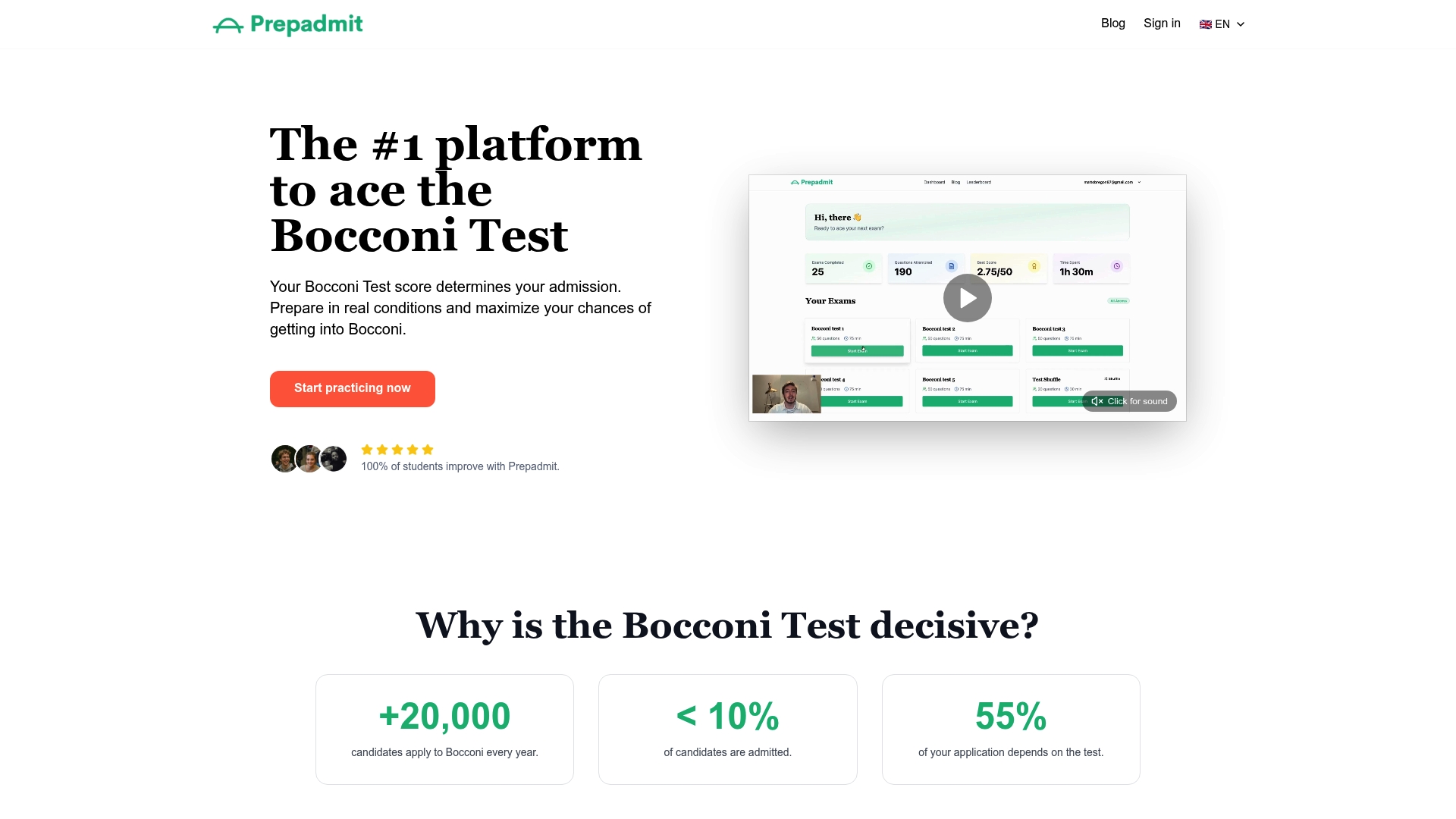
Prepadmit is an online preparation platform built specifically for students targeting the Bocconi Test. It uses official past papers and on-demand timed exams to simulate real test conditions, so you practice scanning, pacing, and guessing under the same pressure you will face on exam day. The platform tracks your progress, shows you where your time goes, and ranks you against other students so you know exactly where you stand. Students on Prepadmit report an average score improvement of 34%. That result comes from repeated, structured practice with strategy built in, not from studying harder in isolation.
FAQ
What is a test-taking strategy, exactly?
A test-taking strategy is a deliberate method used during an exam to maximize your score. It includes techniques like scanning the test first, budgeting time, and managing anxiety.
How much can test-taking strategies improve my score?
Students using evidence-based strategies score 12–18% higher than those who only passively review material. The gain comes from better time use and reduced anxiety, not from knowing more content.
Should I guess on multiple-choice questions?
It depends on the scoring rules. On tests with no penalty, always guess. On penalty-based tests, only guess when you can eliminate at least two options and narrow the field to two.
How do I reduce test anxiety before an exam?
Write down your specific worries on paper before the exam starts. This frees working memory and measurably improves performance by stopping your brain from holding those fears in reserve.
How do I know if I am spending too long on one question?
Calculate the average time per question before you start. If a single question takes more than twice that average, mark it, move on, and return during the verification phase.
Recommended
Related articles
Ready to ace your admission test?
Discover PrepAdmit, the platform that helps you succeed at top university admission tests.
Discover PrepAdmit