The Best Test Prep Materials: An Official-First Guide

The Best Test Prep Materials: An Official-First Guide
Start with official test prep materials from the test maker, not a third-party book. That single decision separates students who get surprised on exam day from those who don’t. Here’s how to begin:
- Step 1 (next 24 hours): Take a free official diagnostic. ACT, College Board, and ETS each publish at least one full-length practice test at no cost.
- Step 2 (this week): Schedule your first timed, full-length simulation using the test maker’s official app or PDF.
- Step 3 (ongoing): Set a weekly review cycle. Log every wrong answer, identify the pattern, and drill that skill before your next full test.
The four resources you should know by name: ACT Test Prep, College Board’s SAT Suite, ETS for GRE/TOEFL/Praxis, and Khan Academy as the College Board’s official SAT partner.
Key Takeaways
Official test prep materials from the test maker are the single most reliable foundation for any standardized exam, and realistic full-length simulations are the most effective way to close the gap between studying and performing.
| Point | Details |
|---|---|
| Start with official materials | ACT, College Board, and ETS publish free full-length tests that match real format and scoring logic. |
| Simulate before you test | Take at least two full-length timed practice tests before exam day to build stamina and timing. |
| Review every wrong answer | Categorize errors by type (content, careless, timing) and drill the specific gap before your next test. |
| Free tools cover most needs | Bluebook, PowerPrep, and Khan Academy’s SAT prep provide official content at no cost. |
| Prepadmit for Bocconi prep | Prepadmit offers official past papers, adaptive simulations, and progress tracking built for the Bocconi Test. |
Table of Contents
- Where to find official test prep materials by exam
- What types of study materials exist and when to use each
- How to choose the right prep materials for your situation
- How to use practice tests to actually improve your score
- Free versus paid materials: what you actually get
- Why official materials give you an edge that third-party tools can’t
- The prep approach that actually works, in my experience
- Prepadmit: exam-specific simulation for Bocconi aspirants
- Sources
Where to find official test prep materials by exam
Official test-maker materials are the only resources guaranteed to reflect the current test format, question style, and scoring logic. Third-party books can approximate, but they can’t replicate the exact question language or the adaptive behavior of a live digital exam. Go to the source first.
ACT
The ACT publishes free practice questions, a full-length practice test, and official self-paced courses directly on its website. The free full-length test is your best baseline. It uses real question types, real timing, and real scoring. ACT also sells additional official prep through its store, including subject-specific practice and score reports.
SAT Suite (College Board)
College Board offers three tools that work together:
- Bluebook: The official app for taking full-length digital SAT practice tests. It replicates the exact interface, tools, and adaptive behavior students see on test day. Download it first.
- Student Question Bank / My Practice: Thousands of authentic SAT and PSAT questions. You can build custom quizzes by domain and difficulty, then get a score report showing where you stand.
- Tailored Practice: Uses your Student Question Bank results to suggest targeted study activities. It’s the closest thing to a personalized study plan built on official content.
GRE (ETS)
ETS publishes PowerPrep, two free full-length practice tests that simulate the actual GRE format and scoring logic. ETS also provides free sample questions and official math conventions notes. For the GRE specifically, the scoring algorithm and question sequencing are proprietary, so practicing on PowerPrep is the only way to experience the real adaptive behavior before test day.
TOEFL and Praxis (ETS)
ETS handles both. TOEFL prep includes official practice sets and a free sample test. Praxis candidates can access the Praxis store for subject-specific study companions and practice tests aligned to each test code. Both programs publish official prep that matches current content frameworks.
Accessibility note: If you need prep materials in an alternate format, ETS Disability Services provides guidance and alternate-format materials on request.
Pro Tip: After every official practice test, open the score report before you review individual questions. The report tells you which content areas cost you the most points. Drill those first.
| Exam | Official resource | Best for | Cost |
|---|---|---|---|
| ACT | ACT.org practice tests and courses | Format accuracy, scoring logic | Free to paid |
| SAT | Bluebook app, Student Question Bank | Digital interface, adaptive practice | Free |
| GRE | PowerPrep I and II | Adaptive simulation, scoring conventions | Free |
| TOEFL | Official practice sets, sample test | Format familiarization | Free to paid |
| Praxis | Praxis store study companions | Subject-specific content alignment | Paid |
What types of study materials exist and when to use each
University library guides classify exam review materials into three broad categories: official materials, independent supplemental resources, and integrated learning platforms. Knowing which type serves which study phase saves you from wasting weeks on the wrong tool.
Full-length practice tests belong in the middle and late stages of prep. Use them every one to two weeks once you’ve covered the core content. They measure stamina and timing, not just knowledge.

Timed section drills are useful earlier. If you can’t finish a math section in time, isolating that section and running it under strict timing tells you whether the problem is speed or content.
Question banks are the workhorse of targeted practice. Sites like Test-Guide offer free practice questions with instant scoring, which works well for early-stage diagnostics and low-cost drilling between full tests.
Flashcards suit rapid recall tasks: vocabulary for the GRE verbal section, math formulas for the SAT, or key concepts for Praxis subject tests. They don’t replace timed practice, but they compress review time for high-frequency facts.
Study guides and books provide content structure. They’re most useful in the first two to three weeks when you need a map of what the exam covers before you start drilling.
Online test prep courses add instruction and pacing. They’re worth the cost when you need someone to explain why an answer is wrong, not just that it is.
Tutoring is the highest-cost, highest-leverage option for specific, persistent weaknesses. One session on a concept you’ve missed ten times in a row can be worth more than a month of self-study.
Pro Tip: Don’t use flashcards as your primary tool for any exam that tests reasoning rather than recall. The GRE and SAT reward pattern recognition, not memorization. Flashcards supplement; they don’t substitute.
| Dimension | Official materials | Third-party materials |
|---|---|---|
| Format accuracy | Exact match to test day | Approximation only |
| Best for | Simulation, scoring logic, interface | Content review, targeted drills |
| Cost | Free to low-cost | Free to $300 |
| Realism | Timed, adaptive, proctored simulation | Varies widely |
How to choose the right prep materials for your situation
The right choice depends on four things: which exam you’re taking, how much time you have, where your skill gaps are, and what you can spend. Run through this sequence before buying anything.
- Confirm the exam format. Is it adaptive? Is it digital? If yes to either, the official app is non-negotiable. Bluebook for the SAT and PowerPrep for the GRE are not optional supplements. They’re the only way to practice the real interface.
- Take a free official diagnostic first. Don’t buy anything until you know your baseline score and which content areas need work. Spending $200 on a course before you know your weak spots is a common and expensive mistake.
- Check what the official package already includes. College Board’s free Bluebook and Student Question Bank cover most of what you need for SAT prep. ACT’s free test covers format. ETS’s free PowerPrep covers GRE simulation. You may not need to pay for anything beyond official materials.
- Add targeted third-party drills only for identified gaps. If your diagnostic shows weak math skills, a focused question bank or a resource like Math Vault for concept review makes sense. Don’t buy a full course when you need to fix one skill.
- Set a realistic timeline. Eight to twelve weeks gives you room for a baseline test, skill building, and two to three full-length simulations. Three weeks or fewer means prioritizing full-length timed tests and error review over content study.
Red flags to avoid when evaluating any prep product:
- No answer explanations (you can’t learn from wrong answers without them)
- Questions with no stated source (unofficial question banks often misrepresent difficulty)
- No full-length timed test option (section drills alone don’t build test-day stamina)
- No score tracking or progress reporting
Pro Tip: Ask one question before buying any prep book or course: “Does this include at least one full-length, timed practice test with an answer key and explanations?” If the answer is no, keep looking.
How to use practice tests to actually improve your score
A practice test you don’t review is just a timed exercise. The review is where the score improvement happens.
- Take a baseline diagnostic under real conditions. Strict timing, no interruptions, the official app if the exam is digital.
- Score it immediately and log the result. Write down your section scores, not just the total.
- Categorize every wrong answer into one of three buckets: content gap (you didn’t know it), careless error (you knew it but rushed), or timing issue (you didn’t reach it).
- Spend the next three to five days drilling the content gaps. Use official question banks or targeted third-party drills for the specific skill. Don’t re-read chapters. Practice the question type.
- Run timed section drills mid-week to build speed on the skills you just reviewed.
- Take a second full-length test after seven to ten days. Compare section scores to your baseline. If a category didn’t improve, the problem is likely careless errors or timing, not content.
- Repeat the cycle until your target score is consistent across two consecutive full tests.
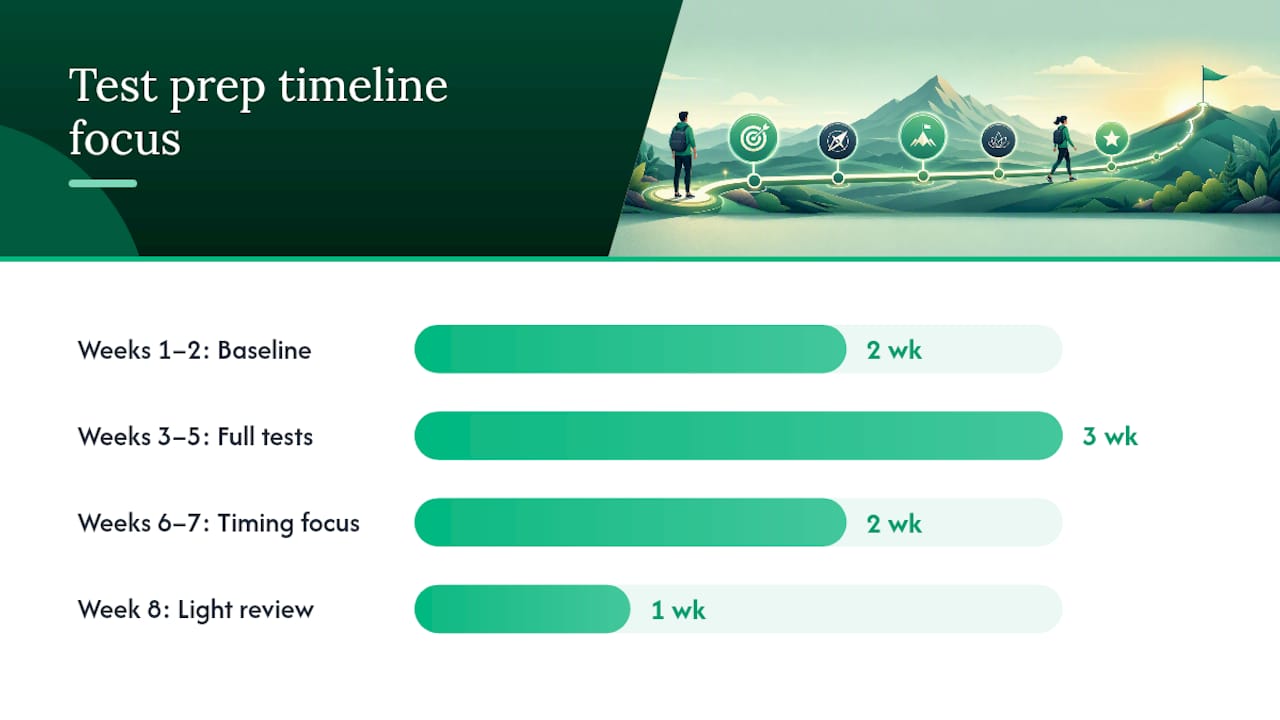
Sample 8-week timeline:
- Weeks 1–2: Baseline diagnostic, content review, section drills
- Weeks 3–5: Full-length test every 10 days, error review, targeted drills
- Weeks 6–7: Two full-length simulations, focus on timing and careless errors
- Week 8: Light review, one final full-length test, rest before exam day
Condensed 2–3 week timeline: Take a diagnostic on day one, run a full-length test every four to five days, and spend every other day on error review. Skip content study unless a gap is severe. Focus on timing and test-taking strategy.
Pro Tip: For digital or adaptive exams, always practice on the official app. Bluebook for the SAT and PowerPrep for the GRE replicate the real interface. Practicing on paper or a third-party site for a digital exam is practicing the wrong thing.
Free versus paid materials: what you actually get
Free official materials cover more ground than most students realize. The question isn’t always whether to pay. It’s whether what you’re paying for adds something the free tools don’t.
Free materials: what works
- Official full-length practice tests from ACT, College Board, and ETS cover format, scoring, and question style at no cost
- Khan Academy’s SAT prep is College Board-endorsed and tied directly to the Student Question Bank. It’s the most complete free SAT resource available
- Library test prep collections often include free access to prep databases and study guides for a wide range of exams
- Free diagnostic sites provide instant scoring useful for early-stage practice
Paid materials: when they’re worth it
- Self-paced online courses typically run $100–$300 and add structured instruction, video explanations, and pacing guidance
- Live tutoring ranges from $50 to $200 per hour and is most valuable for persistent, specific weaknesses
- Premium prep books run $20–$40 and are worth buying when the official content review is thin for your exam
Getting maximum value from free tools: Use the official diagnostic first. Then combine the official question bank with Khan Academy’s guided lessons for SAT, or PowerPrep’s full tests for GRE. Add a free practice site for extra drilling between full tests. Most students can reach their target score without spending anything beyond the exam registration fee.
Note: Some testing programs include free access to premium official prep through fee-waiver policies. Check with your school counselor or the test maker’s website to see if you qualify before paying for any prep resource.
Why official materials give you an edge that third-party tools can’t
Test makers are explicit about this. ETS states that official prep simulates the actual test format and scoring logic in ways that third-party materials simply can’t guarantee. That’s not marketing. It reflects a real structural advantage.
Three specific advantages official materials hold:
- Scoring logic: The GRE’s adaptive algorithm and the SAT’s scoring scale are proprietary. Only official practice tests score the way the real exam does.
- Question language: Test makers use specific phrasing conventions. A question that “seems” like an official question but uses slightly different language trains you for the wrong thing.
- Digital interface: For Bluebook and PowerPrep, the interface itself is part of the test. Students who haven’t practiced on the actual app lose time on test day figuring out tools they’ve never used.
Realistic simulation and progress tracking better replicate test pressure and structure than generic guides. One official full-length simulation under real conditions tells you more about your readiness than five untimed, unscored practice sets.
The prep approach that actually works, in my experience
Most students spend too much time on content review and not enough time on simulation. They read chapters, do a few practice questions, and then take the real exam without ever experiencing what it feels like to sit through a full, timed test. That gap between “I studied this” and “I can perform under pressure” is where scores fall apart.
The workflow that holds up is simple: official diagnostic first, targeted drills for the gaps you find, then full-length simulations on a fixed schedule. The simulation is not the reward at the end of studying. It’s the core of the preparation.
For Bocconi Test aspirants specifically, the same principle applies. The exam has its own format, question style, and scoring conventions. Generic test prep won’t prepare you for it. You need exam-specific simulations built on official past papers, with detailed answer corrections and progress tracking that shows you where you’re losing points. That’s exactly what Prepadmit is built for.
A practical checklist:
- Week 1: Take an official diagnostic. Log section scores. Identify your two weakest areas.
- Mid-prep: Run a full-length timed simulation every 7–10 days. Review every wrong answer before the next session.
- Final week: One last full-length test under real conditions. Light review only. Rest.
The students who improve the most aren’t the ones who study the longest. They’re the ones who simulate the most and review the most honestly.
Prepadmit: exam-specific simulation for Bocconi aspirants
If you’re preparing for the Bocconi Test, the general prep tools above get you only so far. The Bocconi Test has a specific format, specific question types, and a scoring system that generic SAT or GRE prep doesn’t address.
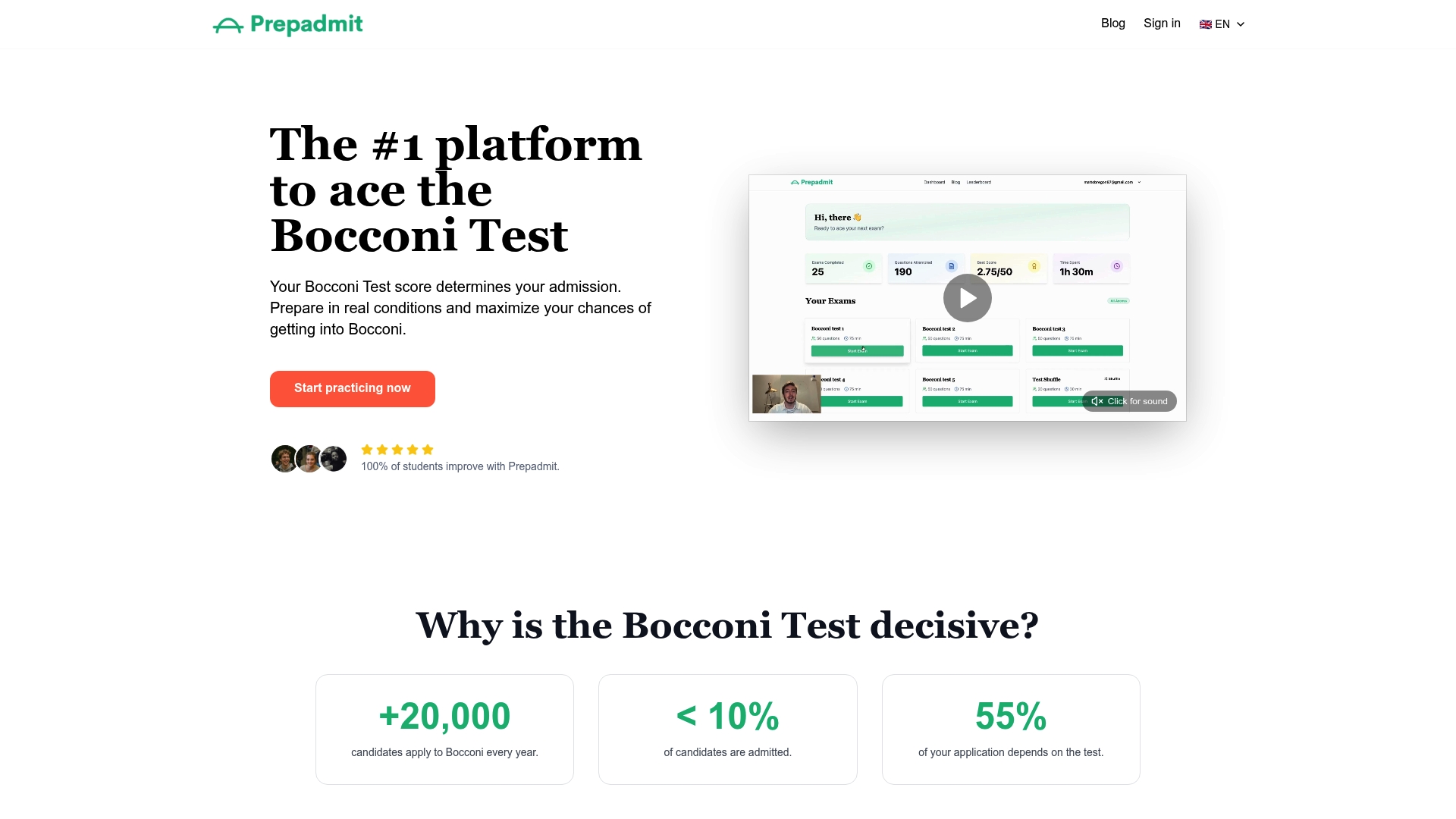
Prepadmit is built specifically for this exam. The platform gives you official past papers, on-demand adaptive practice tests, detailed answer corrections, and a peer ranking dashboard so you know exactly where you stand against other applicants. The platform offers significant average score improvement across users, and costs less than private coaching. There’s no guesswork about whether the content matches the real exam: it’s built on official material by experts from HEC and Bocconi.
If you’re serious about admission, start your Bocconi simulation on Prepadmit and see your baseline score before your next study session.
Sources
Official prep pages by exam:
- ACT Test Prep
- Practice and Preparation – SAT Suite | College Board
- Prepare for the test | ETS (GRE)
- Khan Academy test prep
- Test Prep Collection | MSU Libraries
- Bluebook | College Board
Reputable supplemental resources:
When to move from free to paid: If you’ve used all available official free tests, your score has plateaued, and you still have time before the exam, a targeted paid course or tutoring session for your specific weak area is worth considering. Don’t pay before you’ve exhausted the free official tools.
Recommended
Related articles
Ready to ace your admission test?
Discover PrepAdmit, the platform that helps you succeed at top university admission tests.
Discover PrepAdmit