Your Bocconi Post-Exam Study Guide: Act in 48 Hours

Your Bocconi Post-Exam Study Guide: Act in 48 Hours
After every Bocconi practice attempt or official test, do four things before anything else: download your score report, log every incorrect and blank question with a reason, schedule a targeted drill block in your weakest section, and book your next simulation only after completing that remediation. That sequence is your post exam study guide in its simplest form. Students who skip the error-logging step tend to repeat the same mistakes across attempts. The ones who improve fastest, treat every score report as a diagnostic, not a verdict.
Pro Tip: Keep one running spreadsheet with columns for date, test type, total score, section scores, and a percentage improvement goal. Update it within 24 hours of every attempt.
Key Takeaways
The single most effective post-exam move is to log every error with a reason within 48 hours, then assign targeted drills before booking another official attempt.
| Point | Details |
|---|---|
| Download the score report fast | The report is available within 48 hours; save it and note your reference number immediately. |
| Log errors by reason type | Separate knowledge gaps from timing errors; each calls for a different fix. |
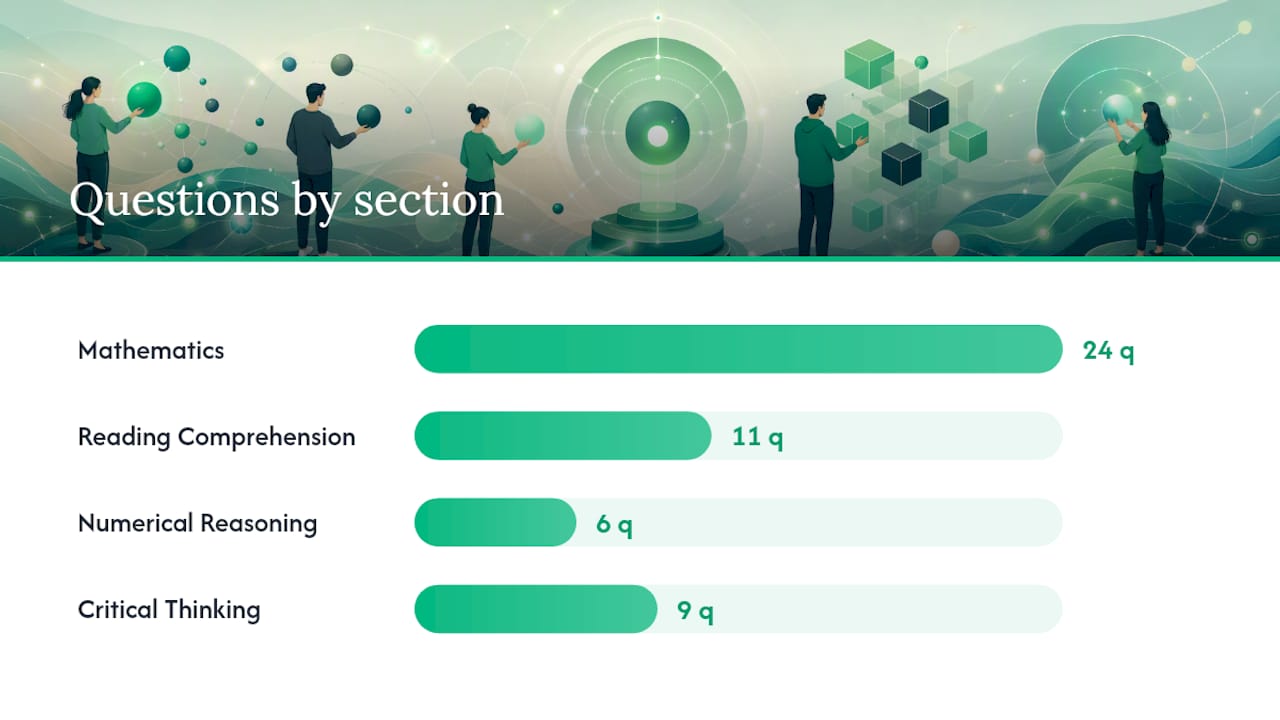
| Math carries the most weight | With 24 of 50 questions, Mathematics has the largest impact on your total score. |
| Each attempt costs €60 | Several attempts are available per cycle; only retake after a full mock plus remediation. |
| Prepadmit tracks your progress | The platform reports an average 34% user improvement using timed mocks, drills, and error-log workflows. |
Table of Contents
- What should you do in the 48 hours after a Bocconi test?
- How do you read the Bocconi score report?
- How to build a subject-by-subject remediation plan
- How do you replicate real Bocconi test conditions at home?
- What are the technical and booking requirements for the Bocconi webtesting platform?
- When should you retake the Bocconi test?
- How does Prepadmit support your post-test workflow?
- What most students get wrong after a Bocconi attempt
- Prepadmit gives you the fastest path from score report to improvement
- Sources
What should you do in the 48 hours after a Bocconi test?
The two days after an attempt are the highest-leverage window you have. Here is the exact sequence:
- Download your score report. The official Instructions and Rules of Conduct confirm the report is available within 48 hours of your attempt. Save it and note the reference number.
- Screenshot the section breakdown. Capture total score, per-section scores, and correct/wrong/blank counts before the window closes.
- Build an error log. For every question you missed or left blank, record: question ID, correct answer, and the reason (knowledge gap, misread, calculation slip, or ran out of time).
- Enter results into your progress tracker. Log date, test typology (Online Bocconi Test or Law variant), total score, and section scores alongside your baseline.
- Pick up to three remediation targets. One primary weakness, two secondary. Schedule focused drills for the week before your next simulation.
If the platform flagged a technical or conduct issue during your attempt, go to the webtesting platform immediately and follow the assistance steps there.
Pro Tip: Color-code your error log by reason type. A column that fills up with “ran out of time” tells a different story than one full of “knowledge gap,” and each calls for a different fix.
How do you read the Bocconi score report?
The Online Bocconi Test is 50 multiple-choice questions in 75 minutes. For the bachelor variant, the section split is: Mathematics (24 questions), Reading Comprehension (11), Numerical Reasoning (6), and Critical Thinking (9). Mathematics carries the largest share of total questions, so a weak math score pulls your total down more than a weak Critical Thinking score does.
Scoring works on a penalty system: correct answers earn points, wrong answers carry a negative deduction, and blank answers score zero. That asymmetry matters for guessing strategy. If you have no idea, leaving a question blank is safer than a random guess. If you can eliminate two options, the math shifts in favor of answering.
Use your correct/wrong/blank counts to separate two different problems:
- High wrong count, low blank count: You are attempting questions you do not know. Slow down and be more selective.
- High blank count: You are running out of time or skipping too aggressively. Your pacing plan needs work.
- Low wrong and low blank, but low total: Your knowledge gaps are real. Targeted content drills are the fix.
Score report availability: The report is accessible within 48 hours of your attempt. Use that window to schedule your next steps before the details fade.
Note: if you are applying as an international graduate applicant, your test format differs (verbal reasoning 24, data insight 16, quantitative reasoning 10), and the section weights in your report will not match the bachelor breakdown above.
How to build a subject-by-subject remediation plan
Check the 2026 format updates before locking in your drill plan, then work through each section in priority order.
Mathematics (24 questions). This is where most students recover the most points. Focus on algebra, functions, and basic geometry. Work 30–60 minute focused sessions with fully worked solutions, not just answer checks.
Reading Comprehension (11 questions). Practice reading for topic sentences and inference flags rather than reading every word. Passage-mapping (a quick margin note on each paragraph’s main point) cuts time and improves accuracy.
Numerical Reasoning / Data Insight (6 questions). Translate charts and tables into one-sentence data statements before answering. Practice quick-estimate calculations so you are not doing full arithmetic under pressure.
Critical Thinking (9 questions). Split your practice into two modes: statement-true/false/not-deducible drills and short-passage argument analysis. These are different skills and need separate sessions.
| Week | Focus | Drill type | Target |
|---|---|---|---|
| 1 | Weakest section | Targeted content drills | targeted accuracy on drill set |
| 2 | Second weakest | Mixed drills + 1 timed mock | Improve section score by 10% |
| 3 | All sections | 2 timed mocks + error review | Reduce blank count by 50% |
| 4+ | Full simulation | Weekly timed mock + error log | Match or beat previous total |
Pro Tip: Run a 15-minute micro-session on your weakest topic every day, not just on designated study days. Frequency beats duration for retention.
How do you replicate real Bocconi test conditions at home?
The real test is 75 minutes, 50 questions, delivered through a lockdown browser with no-back navigation. The Instructions and Rules of Conduct confirm that the platform presents questions in groups of three per screen and does not allow you to return to previous screens once you advance. That behavior is not intuitive. Practicing without it gives you a false sense of control.

Use the official Bocconi simulation before relying on any third-party mock. It sets the correct pacing baseline. A 12-week structured plan typically starts with that official simulation in week one and adds weekly full-length timed mocks from the midpoint onward.
| Section | Questions | Suggested time | Strategy |
|---|---|---|---|
| Mathematics | 24 | 30–60 minutes | Answer what you know; flag uncertain ones |
| Reading Comprehension | 11 | 16 minutes | Skim first, answer, move on |
| Numerical Reasoning | 6 | 10 minutes | Estimate before calculating |
| Critical Thinking | 9 | 15 minutes | Eliminate clearly wrong options first |
Increase your mock frequency as your official attempt approaches: zero full mocks in week one, one per week from week two, two per week in the final stretch.
Pro Tip: Run at least one simulation using a lockdown browser or a carefully configured setup that enforces no-back navigation. Practicing with a normal browser builds the wrong muscle memory.
What are the technical and booking requirements for the Bocconi webtesting platform?
The test runs through the webtesting platform at bocconiwebtesting.giuntipsy.com. Create your account there, select your test typology (Online Bocconi Test or Law variant), and purchase your attempt before booking a slot. Confirm you have selected the correct typology: the two variants restrict which programs you can apply to, and you cannot switch after booking.
Each attempt costs €60. You may take up to four attempts during the testing window, depending on the cycle. Factor that cost into your retake decisions before spending an attempt on an underprepared session.
Technical requirements you must have ready:
- Safe Exam Browser installed on your test computer
- Chrome extension for screen sharing active
- A separate mobile device for lateral room scanning and filming
- Stable internet connection throughout the session
Room setup rules: single-door room, full lighting, no other people present. Run a complete system check 48 hours before your booked slot. The Instructions and Rules of Conduct note that missing audio/video or an incorrect proctoring launch counts as an irregularity. That can void your attempt.
Tech check reminder: Run the full proctoring launch test at least 48 hours before your official slot, then again immediately before starting.
Pro Tip: Use the exact same devices for your tech check that you plan to use on test day. Switching laptops or phones at the last minute introduces new failure points.
For general guidance on device and connection requirements for online exams, AskSmarty’s admissions resource covers the basics worth confirming before your slot.
When should you retake the Bocconi test?
One rule covers most situations: do not use another official attempt until you have completed at least one full timed mock plus targeted remediation in your weakest section. Spending €60 on an attempt you are not ready for is a worse outcome than waiting two more weeks.
Use this checklist to decide:
- Did your mock score improve over your last official score? If no, continue drilling.
- Have you addressed the top error type from your log? If no, schedule one more focused week.
- Do you have a clean tech setup confirmed? If no, fix that first.
- Is your next official attempt at least 7 days away? If not, push the booking.
For surface-level gaps (pacing, careless errors), 7–14 days between attempts is enough if you run a focused remediation cycle. For real content gaps in Mathematics or Critical Thinking, allow 3–6 weeks. Avoid booking an attempt during the same week as major school obligations. The booking window and support hours on the webtesting platform are fixed, so check availability before committing.
How does Prepadmit support your post-test workflow?
Prepadmit maps directly onto the steps above. After each attempt, you get per-question worked solutions, not just answer keys, so your error log builds itself. The platform’s skill-drill modes let you assign targeted sessions by section (Math, Reading, Numerical, Critical Thinking) rather than running full mocks when you only need to fix one area.
The progress dashboard records your baseline and tracks improvement over time, including peer-ranking so you know where you stand relative to other applicants. Prepadmit reports an average user score improvement of 34% across its user base, built on a combination of spaced-repetition study methods and weekly timed mocks. The platform was designed by experts with backgrounds from HEC and Bocconi, which shows in how the simulations replicate the no-back navigation and lockdown-browser behavior of the real test.
| Week | Prepadmit action | Goal |
|---|---|---|
| Post-attempt (day 1–2) | Review per-question corrections | Identify top 3 error types |
| Week 1 | Run skill-drill sessions by section | Hit 80% accuracy in weakest area |
| Week 2 | Full timed mock + dashboard review | Confirm score improvement vs. baseline |
| Week 3+ | Repeat mock cycle, track peer ranking | Close gap to target score |
Improvement benchmark: Prepadmit users improve an average of 34% from their baseline score when combining targeted drills with weekly full timed mocks.
For a step-by-step preparation guide that maps the full 12-week arc, the Prepadmit blog covers the complete workflow from first simulation to official attempt.
What most students get wrong after a Bocconi attempt
Students consistently over-invest in topics they already understand and under-invest in timing drills. A student who scores 18/24 in Math but spends three more weeks on algebra is not using their error log. The log exists to redirect effort, not confirm what you already know.
The other common mistake is treating a full timed mock as a study session. A mock is a diagnostic. You run it, you score it, you log errors, and then you do the targeted drills. Running mock after mock without an error-review cycle in between produces flat scores, not improvement.
Spaced repetition works here. A 15-minute daily micro-session on your weakest topic, spread across a week, outperforms a single three-hour block. The PrepAdmit blog covers the science behind this if you want the research behind the method.
Pro Tip: Build a “mistake-to-master” list from your error log. Every question you missed goes on the list. Every question you get right in a later drill comes off. When the list is empty, you are ready to attempt again.
Prepadmit gives you the fastest path from score report to improvement
Private coaching for the Bocconi Test can run hundreds of dollars per session. Prepadmit delivers the same core tools at a fraction of that cost: official past-paper simulations, detailed per-question corrections, skill-specific drills, and a progress dashboard that tracks your improvement against peers.
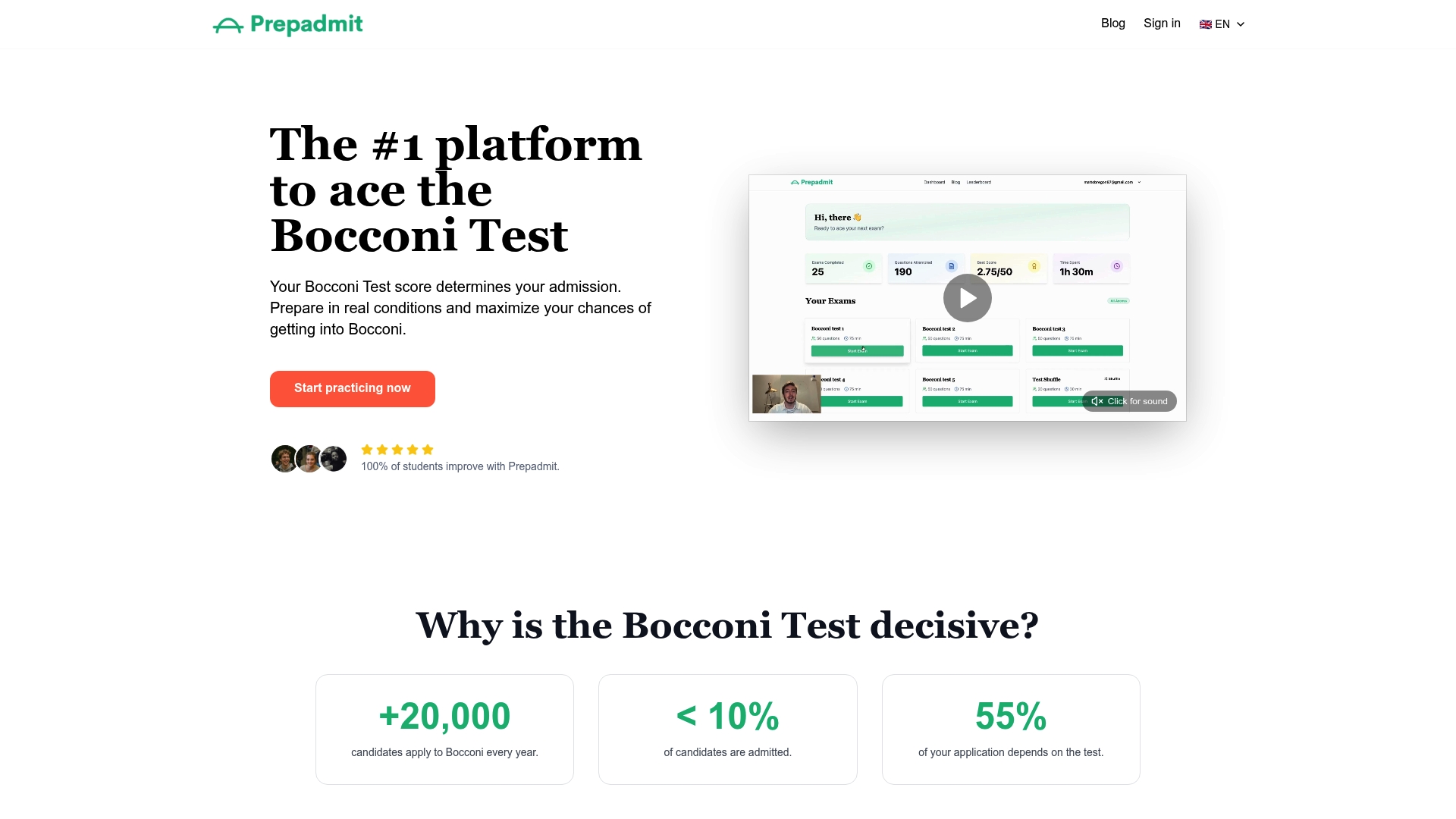
The platform was built by HEC and Bocconi alumni who know exactly which question types appear most often and how the scoring penalty affects guessing strategy. Every simulation replicates the 75-minute, no-back-navigation format of the real test. Students who use it consistently report measurable gains, backed by a money-back guarantee if the results do not follow.
Start with a timed simulation on Prepadmit today, set your baseline, and let the progress dashboard show you exactly where to focus next.
Sources
Before any official attempt, read the full Instructions and Rules of Conduct for AY 2026-2027. It covers every technical requirement, room setup rule, and proctoring step.
- ONLINE ADMISSION TEST AY 2026-2027 — INSTRUCTIONS AND RULES OF CONDUCT
- How to Prepare for the Bocconi Test 2026: Complete 12-Week Study Plan
Recommended
Related articles
Ready to ace your admission test?
Discover PrepAdmit, the platform that helps you succeed at top university admission tests.
Discover PrepAdmit