How Test Simulation Replicates Real Exams: 2026 Guide

How Test Simulation Replicates Real Exams: 2026 Guide
Test simulation replicates real exams by reproducing the exact timing, content structure, question format, and psychological conditions students face on test day. This is not casual practice. It is a deliberate method called high-fidelity simulation, and research from 2026 confirms it produces stronger knowledge transfer than any other study approach. Platforms like Prepadmit and tools like the College Board’s Bluebook for the Digital SAT are built on this principle. When you practice under conditions that mirror the real exam, your brain encodes information the same way it will need to retrieve it. That is the core mechanism behind every effective preparation system.
How test simulation replicates real exams: the key features
A simulation replicates a real exam when it reproduces five specific elements: timing, content alignment, interface behavior, feedback timing, and psychological pressure. Miss any one of these and your practice score stops predicting your real score.
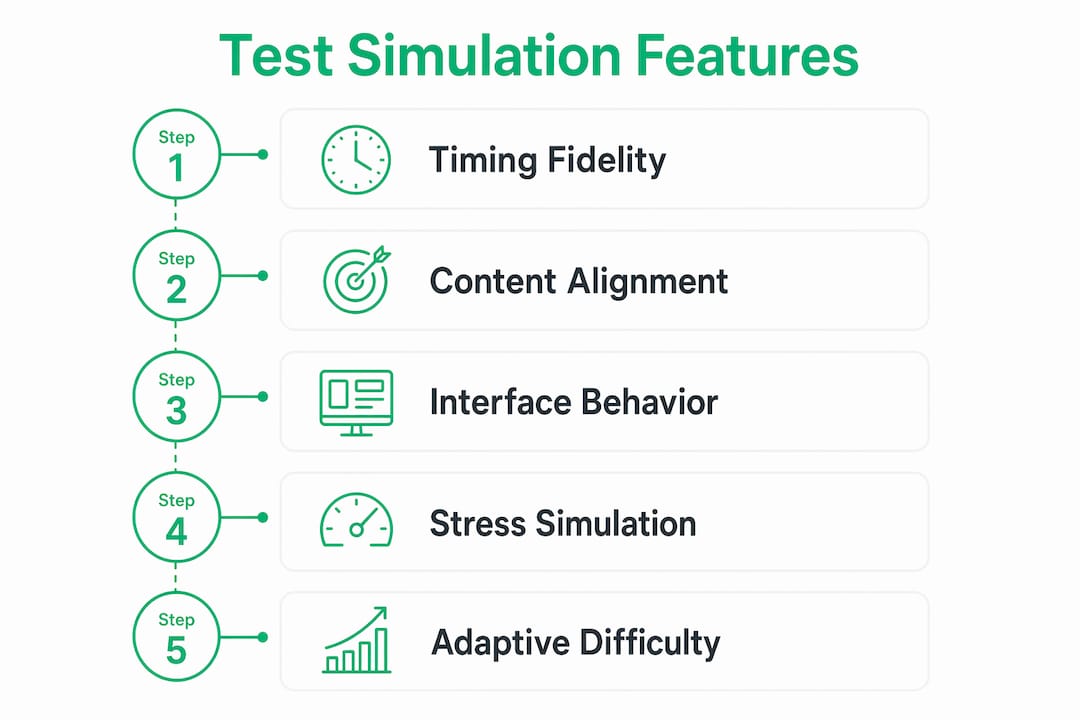
Timing and pacing are the most commonly neglected factors. Practice tests with exact timing require section-level timers, not just a total session clock. Many students run a full practice session without enforcing internal section limits. That approach trains the wrong pace and reduces stamina. You need to replicate break schedules too, because switching from one section to another after a timed break is a real cognitive cost.

Content alignment is what researchers call blueprint alignment. Matching topic weightings and difficulty to the real exam ensures your practice score gives a meaningful signal about whether you will pass or fail. A practice test that overloads easy questions will inflate your confidence without improving your readiness.
Interface and interaction matter more than most students expect. For digital exams, the way questions are displayed, how you flag items, and whether the test adapts to your answers are all part of the experience. Reproducing the operational exam experience including feedback delay and interaction patterns is what separates a genuine simulation from a simple quiz.
- Use official retired exam papers whenever available
- Set section timers independently, not a single countdown for the full test
- Follow the exact break schedule listed in the official exam guide
- Practice in exam mode, not study mode, to delay answer feedback
- Replicate the physical setup: same desk, same materials, same time of day
Pro Tip: Switch your phone to airplane mode and close every browser tab before starting a simulation. The goal is zero interruptions for the full duration, including breaks.
How does stress simulation improve exam readiness?
Stress is not the enemy of performance. Unmanaged stress is. Practicing under realistic pressure trains your brain to retrieve information even when your body is in a high-alert state.
Retrieval practice under stress conditions prevents the memory and inference impairment that acute stress typically causes. The mechanism is neural reactivation. When you practice recalling information under timed, pressured conditions, your brain builds stronger retrieval pathways. Those pathways hold up on test day when cortisol levels rise. Students who only study in calm, low-stakes settings often find their recall collapses under real exam pressure, not because they did not learn the material, but because they never practiced retrieving it under stress.
“Retrieval practice under constrained exam-like conditions directly counters the mismatch between calm studying and high-stakes performance stress.” — eLife, 2026
Research on retrieval practice using virtual patient simulations found that short-answer retrieval practice produces significant knowledge gains that transfer to entirely new scenarios. This is not just about memorizing answers. It is about building the mental flexibility to apply knowledge under pressure.
Practical stress simulation does not require extreme conditions. Set a timer you cannot pause. Sit at a desk rather than on a couch. Do not allow yourself to check answers mid-section. These small constraints add up to a meaningfully different cognitive experience than relaxed studying.
Pro Tip: Schedule at least two full simulations in the weeks before your exam at the same time of day as your actual test. Your alertness patterns are biological. Train them like an athlete trains for race conditions.
Online adaptive tests vs. traditional paper mocks: which replicates better?
The right simulation format depends on what your real exam looks like. Choosing the wrong format reduces the predictive value of your practice scores.
| Feature | Online adaptive simulation | Traditional paper mock |
|---|---|---|
| Difficulty adjustment | Adjusts based on your responses | Fixed difficulty throughout |
| Interface replication | Mirrors digital exam environment | Does not replicate screen-based exams |
| Annotation and processing | Limited margin notes | Full annotation freedom |
| Timing behavior | Built-in section timers | Requires manual timing |
| Predictive validity | High for digital exams | High for paper-based exams |
| Accessibility | Requires device and internet | Works anywhere |
For the Digital SAT, the adaptivity loop is a critical fidelity component. Adaptive difficulty adjustment based on your responses is built into the real exam’s scoring model. A flat-difficulty paper mock cannot replicate that experience. Your score on a paper mock will not predict your Digital SAT score with the same accuracy as a properly adaptive digital simulation.
Paper mocks still have real value. For exams like the Bocconi Test, which uses a fixed-format paper structure, a well-designed paper mock with strict timing is the most faithful simulation available. Paper also lets you annotate, cross out answers, and process information spatially, which some students find genuinely helpful for comprehension.
The key principle is construct validity: your simulation must measure the same skills under the same constraints as the real exam. A mismatch between simulation format and real exam format weakens the predictive signal your practice scores give you.
- Choose digital adaptive simulations for exams like the Digital SAT or GRE
- Choose paper mocks for fixed-format exams like the Bocconi Test or traditional A-levels
- Never use a paper mock as your only preparation for a digital adaptive exam
- Always verify that your simulation source uses retired official content, not invented questions
How to set up an effective test simulation at home
You can replicate exam conditions at home with discipline and the right setup. The environment matters as much as the content.
- Choose a quiet, dedicated space. Use the same room every time. Avoid your bed or couch. A desk with nothing on it except your exam materials signals to your brain that this is a performance context, not a study session.
- Print or load the correct materials. For paper exams, print at the correct scale. For digital exams, use the official platform or a certified simulation tool. Do not substitute a PDF version of a digital exam.
- Set independent section timers. Use a stopwatch or a phone timer set to each section’s exact duration. Do not use a single countdown for the full test. Exact section timing replicates the mental switching costs between sections.
- Follow the official break schedule. Stand up, step away from your desk, and do not review your answers during breaks. This mirrors what you will experience on test day.
- Review results critically after the simulation. Do not just count correct answers. Identify which question types you missed, how your pacing held up in each section, and where your confidence was misplaced. A structured revision plan built around simulation results is far more effective than general review.
Practice tests that closely simulate real conditions produce a stronger testing effect and better transfer of knowledge to actual exam performance. That finding from 2026 SSRN research confirms that fidelity factors like timing and question format directly influence how much your practice improves your real score.
Pro Tip: After each simulation, write down three specific weaknesses before you look at the answer key. This forces honest self-assessment and sharpens your focus during review.
Key takeaways
Test simulation replicates real exams most effectively when it reproduces timing, content alignment, interface behavior, and psychological pressure together, not in isolation.
| Point | Details |
|---|---|
| Timing fidelity is non-negotiable | Set independent section timers and follow official break schedules every time you simulate. |
| Blueprint alignment predicts real scores | Match your practice content to the real exam’s topic weightings and difficulty distribution. |
| Stress practice builds retrieval strength | Practicing recall under timed pressure trains the neural pathways that hold up on test day. |
| Format must match your real exam | Use adaptive digital simulations for digital exams and paper mocks for fixed-format exams. |
| Critical review drives improvement | Analyze pacing, question type errors, and misplaced confidence after every simulation. |
Why fidelity is the one thing most students get wrong
Students consistently underestimate how much the format of their practice affects the quality of their preparation. I have seen this pattern repeatedly. A student completes 20 practice tests but times the whole session loosely, skips breaks, and checks answers after each section. On test day, they hit the 45-minute mark of a 60-minute section and their pacing collapses. They have never trained for that moment.
The research on mock exam effectiveness for Bocconi aspirants makes this point clearly. High-fidelity practice is not about volume. It is about accuracy of replication. Ten simulations done with strict timing and proper review outperform 30 loosely timed sessions every time.
The other mistake I see is treating exam mode and study mode as interchangeable. Delayed feedback in exam mode forces effortful recall and uncertainty that mirrors the actual exam. Study mode, where you see the correct answer immediately, trains a completely different cognitive process. Both have a place in preparation, but only exam mode builds the specific skill of performing under uncertainty.
Start simulations earlier than you think you need to. Most students begin full simulations two weeks before the exam. The students who improve the most start six to eight weeks out, use early results to identify weak areas, and then return to full simulations in the final two weeks to confirm their gains. That cycle is what high-fidelity simulation is actually for.
— quentin
Prepadmit: realistic Bocconi Test simulations that match the real exam
Prepadmit is built specifically for students preparing for the Bocconi Test, and its simulation system is designed around the principles covered in this article.
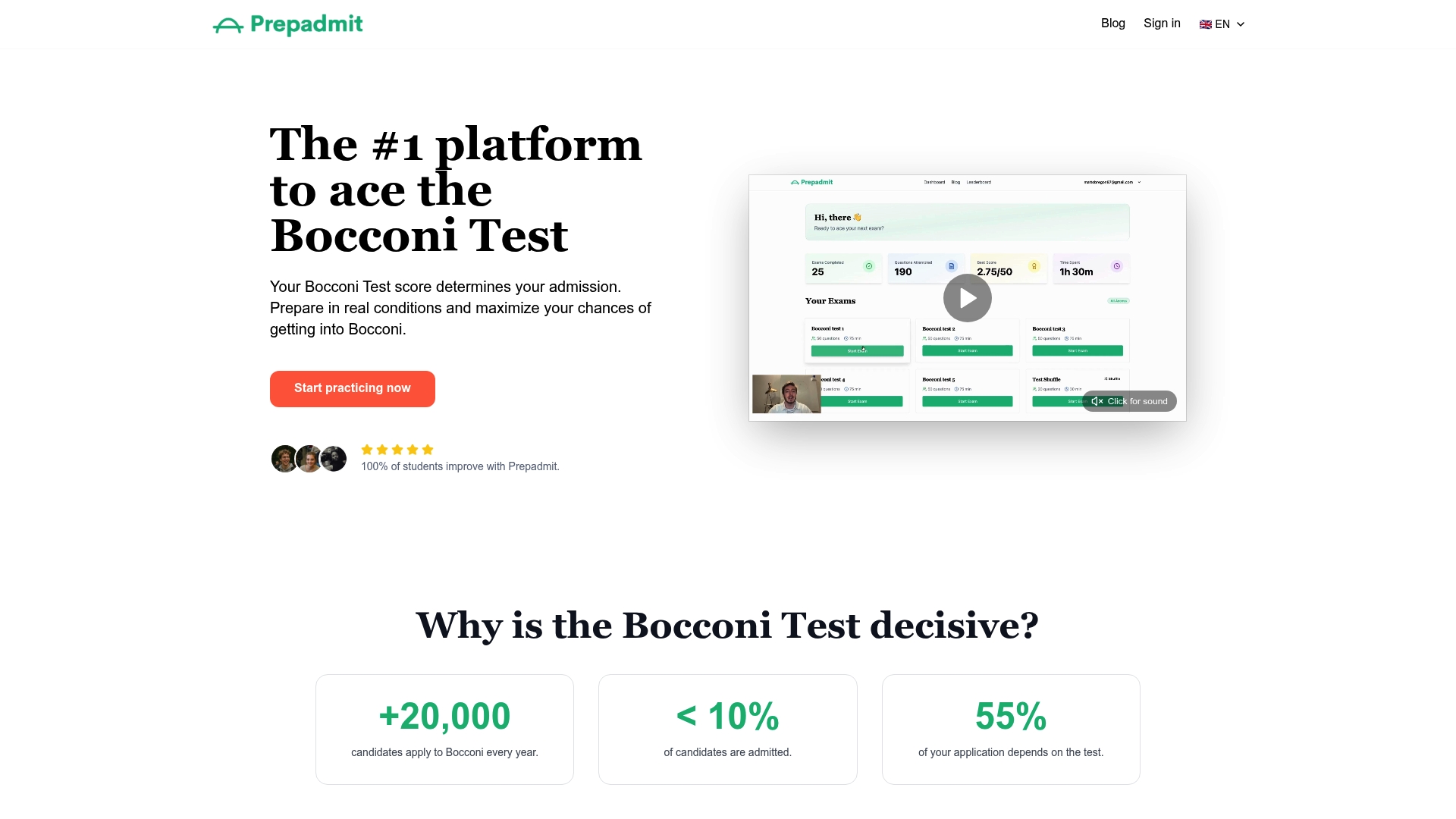
Prepadmit uses official past papers and on-demand tests that align directly with the Bocconi Test’s blueprint, including content weighting, question difficulty, and timing structure. The platform replicates the real exam interface and tracks your progress against a peer ranking, so you know exactly where you stand. Students using Prepadmit report an average score improvement of 34%, and the platform backs that claim with a money-back guarantee. If you are preparing for Bocconi and want practice that actually predicts your real score, start with Prepadmit today.
FAQ
What does test simulation mean in exam preparation?
Test simulation is a practice method that reproduces the real exam’s timing, content, format, and conditions as closely as possible. The goal is to make practice performance a reliable predictor of real exam performance.
How many simulations should I do before my exam?
There is no single correct number, but starting full simulations six to eight weeks before your exam and completing them regularly gives you enough data to identify weaknesses and track improvement.
Does exam mode really make a difference compared to study mode?
Yes. Exam mode delays feedback and forces effortful recall under uncertainty, which mirrors real test conditions and builds stronger memory encoding than immediate-feedback study mode.
Can I simulate a digital adaptive exam on paper?
No. Paper mocks cannot replicate the difficulty adjustment loop that digital adaptive exams like the Digital SAT use. For adaptive exams, you need a certified digital simulation platform.
How does the Bocconi Test simulation work on Prepadmit?
Prepadmit uses official past papers and on-demand tests aligned with the Bocconi Test’s exact blueprint, including timing, content weighting, and difficulty, to give students a realistic and predictive practice experience.
Recommended
Related articles
Ready to ace your admission test?
Discover PrepAdmit, the platform that helps you succeed at top university admission tests.
Discover PrepAdmit