How Test Scores Predict University Success for Bocconi Applicants

How Test Scores Predict University Success for Bocconi Applicants
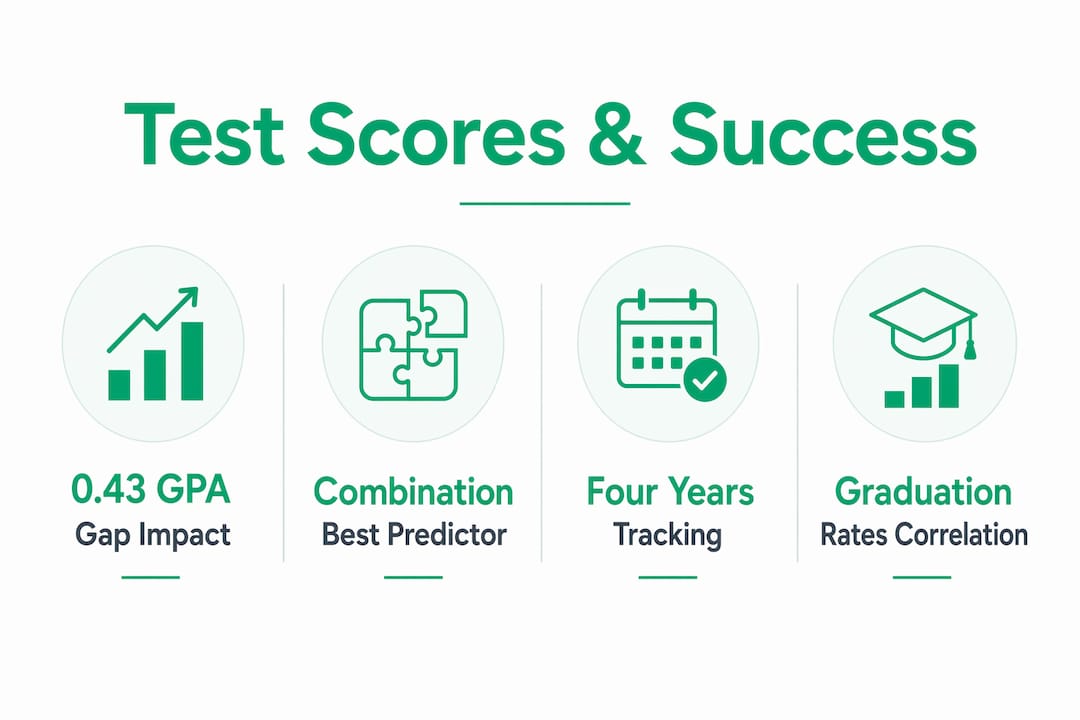
Standardized test scores reliably predict first-year university GPA, and that finding holds directly for Bocconi Test applicants. Opportunity Insights research shows students with the highest scores earn roughly 0.43 GPA points more in their first year than mid-range scorers. Prepadmit users see an average score improvement of 34%, which means focused preparation translates into a real admissions edge.
The core finding: Standardized test scores predict first-year college GPA four times better than high school GPA alone when controlling for student background. Combining both measures gives the strongest prediction of all.
Table of Contents
- How do test scores predict university success? What the research shows
- What this evidence means for your Bocconi Test application
- How to plan your Bocconi Test preparation
- How much score improvement is realistic?
- What test scores cannot tell you, and why that matters
- Key Takeaways
- A direct word on what actually moves the needle
- Prepadmit gives you a structured path to a higher Bocconi Test score
- Useful sources
How do test scores predict university success? What the research shows
The evidence comes from several independent sources, and they point in the same direction for early college performance.
First-year GPA. Opportunity Insights analyzed admissions and transcript records across multiple Ivy-Plus colleges. Students with the highest possible scores (1600 SAT / 36 ACT) earned roughly 0.43 GPA points more in their first year than students scoring around 1200 SAT / 25 ACT. The same study found no calibration bias: scores did not underpredict performance for students from less advantaged backgrounds.
Incremental value over HSGPA. College Board validity research tracked students through all four undergraduate years. SAT scores added a consistent 0.06 incremental validity above HSGPA every single year, from first-year GPA through fourth-year cumulative GPA. A student with a 3.80 HSGPA and an SAT score of 1000 had a 76% chance of earning a 3.0+ fourth-year GPA; the same student with a 1400 SAT had a 90% chance. That 14-percentage-point gap persisted even after controlling for high school grades.
Graduation rates tell a different story. An NBER working paper studying a large urban public university system found that HSGPA is four to six times more predictive of six-year graduation rates than SAT scores. The outcome matters: test scores are strongest for short-term academic performance, while HSGPA dominates for long-term degree completion in broad-access settings.
Combining both measures wins. The ACT validity report confirms that combining test scores with HSGPA produces more accurate predictions of first-year GPA than either measure alone. English and math section scores are particularly strong individual predictors.

| Study | Outcome measured | Key finding |
|---|---|---|
| Opportunity Insights | First-year GPA | ~0.43 GPA gap between highest and mid-range scorers |
| College Board national validity | Cumulative GPA, years 1–4 | SAT adds 0.06 incremental validity above HSGPA each year |
| NBER (public university system) | Six-year graduation rate | HSGPA is 4–6× more predictive than SAT for graduation |
| ACT validity report | First-year GPA | Combined score + HSGPA outperforms either alone |
What this evidence means for your Bocconi Test application
The research translates into concrete decisions for you as a Bocconi applicant.
Short-term vs. long-term implications. A strong Bocconi Test score signals readiness for first-year coursework. That matters for placement decisions, advising, and early academic standing. For long-term graduation, your academic track record carries more weight.
Your score and HSGPA work together. Bocconi uses the test as a standardized yardstick that normalizes for differences in high school grading standards worldwide. A high HSGPA from a school with grade inflation looks different alongside a strong test score than it does alone. The two measures complement each other.
Practical consequences by score tier:
- High score: Strengthens your application directly, may open scholarship consideration, and signals readiness for Bocconi’s quantitative first-year curriculum.
- Mid-range score: Pair it with a strong HSGPA, a focused personal statement, and evidence of subject-specific strength to build a complete picture.
- Lower score: Prioritize targeted preparation before the test date. A lower score combined with a strong HSGPA still tells a story, but a score improvement removes doubt. Check what a good Bocconi Test score looks like before setting your target.
How to plan your Bocconi Test preparation
A clear plan matters more than raw study hours. Here is a step-by-step approach.
- Run a diagnostic first. Take a timed mock exam under real conditions before you study anything. Your baseline score tells you which sections need the most work and how far you are from your target.
- Set a realistic target score. Use Bocconi’s published score ranges to define reach, target, and safe tiers. Understand the Bocconi Test format so your target reflects the actual structure.
- Build an 8–12 week schedule. Aim for four to five focused sessions per week, each 60–90 minutes. Include at least one full timed mock exam per week in the final four weeks.
- Prioritize weak components. ACT research confirms that English and math section performance are the strongest individual predictors of first-year GPA. Drill those sections first if they are your weak points. International students comparing math curricula may find this qualification comparison useful for mapping their background to Bocconi’s expectations.
- Weigh cost against benefit. Self-study with official past papers is free but slow. A structured platform costs less than private coaching and delivers faster feedback. The admissions edge from a meaningful score jump is worth the investment.
Immediate next steps checklist:
- Complete a full diagnostic mock exam this week
- Note your score by section, not just overall
- Register for the Bocconi Test and confirm the deadline
- Schedule your 8–12 week prep window backward from test day
- Review why timed practice tests matter before your first session
How much score improvement is realistic?
Focused, structured preparation produces measurable gains. Prepadmit reports an average score improvement of 34% for its users, which can impact admission chances in Bocconi’s competitive environment.
The research supports this. Deliberate practice with feedback, specifically timed mock exams followed by detailed answer review, is the mechanism behind score gains. The ACT report identifies targeted subject practice as the driver of section-level improvement. Generic review without feedback produces far smaller gains.
On tracking progress: Score stability across two or three consecutive mocks is the signal that you have genuinely improved, not a single good result. If your scores vary widely, your preparation needs more consistency, not more volume.
Practice checklist for Bocconi Test prep:
- Use official past papers for every timed mock
- Review every wrong answer before moving to the next session
- Track section scores separately to spot patterns
- Set a score-stability checkpoint at week six: if variance is high, adjust your approach
- Use expert-designed prep materials to avoid practicing bad habits
What test scores cannot tell you, and why that matters
Test scores are useful predictors, but they have real limits. Knowing those limits helps you build a stronger overall application.
What scores do not measure: motivation, program fit, leadership, resilience, or the quality of your written application. Frontiers in Education research notes that predictive strength is strongest for early college outcomes and can weaken for longer-term measures like degree completion.
On equity and fairness. The Opportunity Insights study found no systematic calibration bias in its Ivy-Plus sample: scores did not underpredict performance for students from less advantaged backgrounds. Still, grade inflation and school-resourcing differences mean HSGPA alone is not a clean signal either. That is exactly why combining both measures produces fairer, more accurate predictions.
Context matters: A student from a lower-resourced school with a mid-range score and a strong HSGPA may be a stronger candidate than the score alone suggests. Admissions officers at selective universities are trained to read discrepant profiles with additional evidence.
Pro Tip: If your test score is lower than your HSGPA suggests it should be, use your personal statement and subject-specific grades to explain the gap directly. Do not leave admissions officers to guess.
Key Takeaways
Test scores reliably predict first-year university GPA, and combining them with HSGPA gives the strongest prediction of academic performance across all four undergraduate years.
| Point | Details |
|---|---|
| Scores predict first-year GPA | Highest scorers earn roughly 0.43 GPA points more in year one than mid-range scorers. |
| Incremental value persists | SAT adds 0.06 incremental validity above HSGPA every year through year four. |
| Graduation is HSGPA-driven | In broad-access systems, HSGPA is 4–6× more predictive of six-year graduation than test scores. |
| Combined measures win | Pairing your Bocconi Test score with a strong HSGPA gives admissions the clearest picture. |
| Prepadmit improves scores | Structured platform prep delivers an average 34% score improvement, directly raising your admissions odds. |
A direct word on what actually moves the needle
The research is clear, but most students misread it. They focus on whether test scores “matter” as a binary question. The real question is: how much does your score add to what your HSGPA already says?
If your HSGPA is strong, a good Bocconi Test score confirms the signal. If your HSGPA is uneven, a strong score can reframe your application. Either way, the score is not decoration. It carries weight in placement, scholarship consideration, and early advising decisions at Bocconi.
Start with a diagnostic. Set a specific target. Practice with timed mocks and detailed feedback. Do not add more study hours until you have reviewed what went wrong in the last session. That sequence, repeated consistently over 8–12 weeks, is what produces the gains the research describes.
Prepadmit gives you a structured path to a higher Bocconi Test score
Scoring higher on the Bocconi Test is not about studying more. It is about practicing the right way, with the right materials, and knowing exactly where you stand.
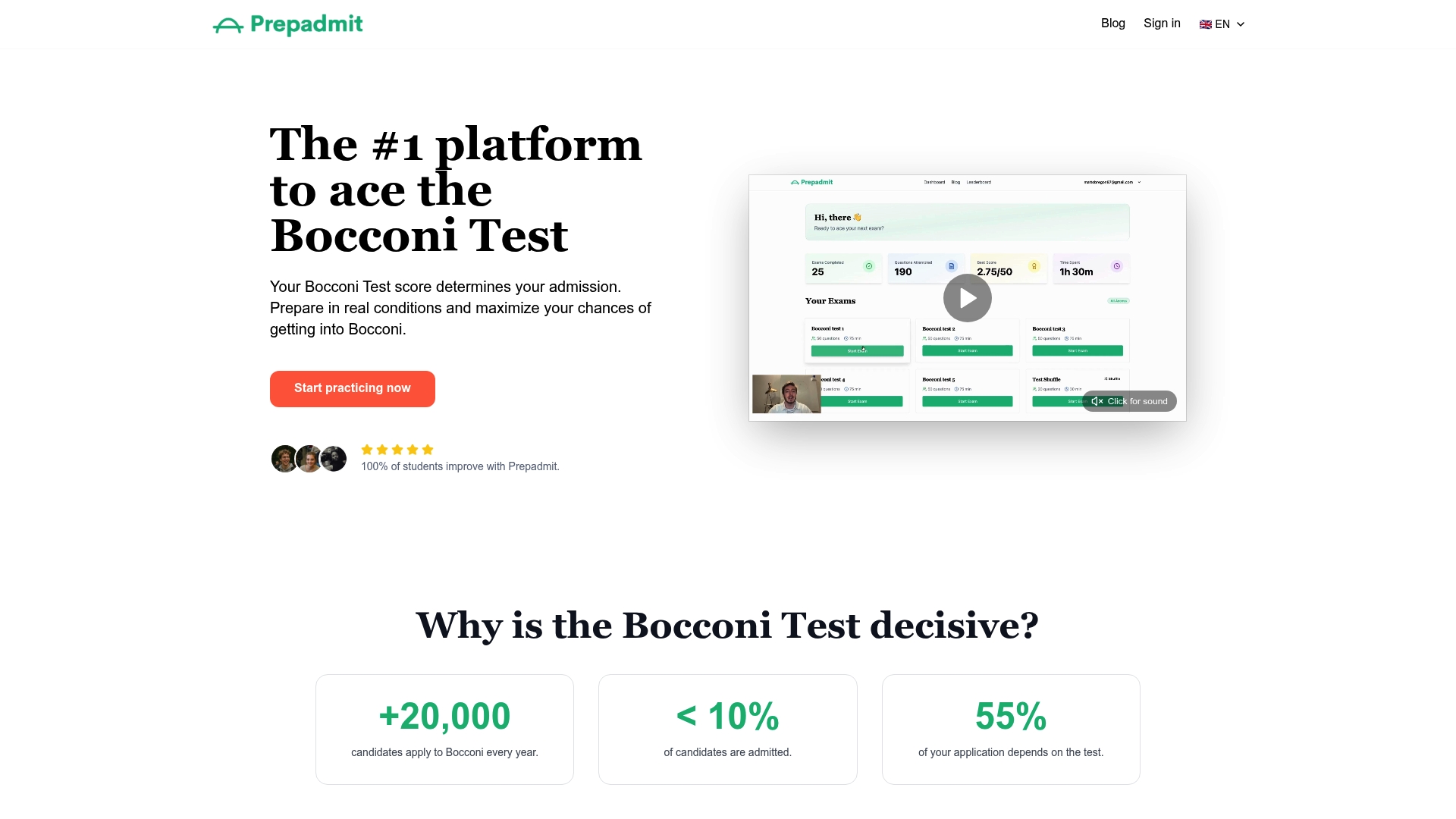
Prepadmit is built specifically for this. The platform gives you official past papers, on-demand adaptive tests, detailed answer corrections, and skill-specific drills that target your weak sections directly. A peer ranking dashboard shows you where you stand against other applicants, so your target score is grounded in reality, not guesswork. The platform was developed by experts from HEC and Bocconi, and users see an average score improvement of 34%. There is a money-back guarantee if the results do not follow.
Start your diagnostic on Prepadmit and find out exactly where you stand before your next study session.
Useful sources
| Source | What it covers |
|---|---|
| Opportunity Insights: Standardized Test Scores and Academic Performance at Ivy-Plus Colleges | First-year GPA predictive strength; calibration bias analysis across subgroups |
| College Board national SAT validity study | Incremental validity of SAT above HSGPA across all four undergraduate years |
| College Board validity research | SAT score relationships with first-year and cumulative college GPA |
| NBER working paper on graduation predictors | HSGPA vs. SAT as predictors of six-year graduation rates at a public university system |
| ACT: Predicting Academic Success in College | Combined score + HSGPA prediction; subject-section importance |
| Frontiers in Education research | Time-horizon nuance; predictive strength for early vs. long-term outcomes |
| Prepadmit | Platform proof point: 34% average score improvement for Bocconi Test preparation |
Recommended
- What Is a Good Bocconi Test Score? Benchmarks and Targets for 2026 — PrepAdmit Blog
- prepadmit.com - La plateforme n°1 pour réussir le Bocconi Test
- International Bocconi Student Success Examples: 2026 Guide — PrepAdmit Blog
- Is the Bocconi Test Hard? An Honest 2026 Difficulty Breakdown — PrepAdmit Blog
Related articles
Ready to ace your admission test?
Discover PrepAdmit, the platform that helps you succeed at top university admission tests.
Discover PrepAdmit