How Practice Tests Predict Real Scores for Students

How Practice Tests Predict Real Scores for Students
Practice tests are calibrated tools designed to estimate your real exam score by simulating the actual test’s structure, difficulty, and timing conditions. The scientific term for this is predictive validity, and it describes how well a test score forecasts future performance on the real exam. Understanding how practice tests predict real scores is not just reassuring. It is the first step toward using them strategically. The College Board confirms that a full-length SAT practice score is highly indicative of your actual result when taken close to exam day under official timing. This guide explains exactly why that works, and how to make it work for you.
How practice tests predict real exam performance
Predictive validity is the core principle behind why practice tests work. A practice test has predictive validity when its design closely mirrors the real exam in difficulty, structure, and scoring. Consistent performance patterns across well-designed practice tests are what actually forecast your real score, not any single attempt.
Several specific factors determine whether a practice test can reliably predict your outcome:
- Use of real or calibrated questions. The strongest practice tests draw directly from previous official exams or use questions calibrated to match their difficulty. The SAT practice tests published by College Board use questions from past administrations, which is why their predictive accuracy is high.
- Test equating and psychometric calibration. High-quality practice tests use a process called test equating to keep scores comparable across different test forms. This relies on psychometric methods like Item Response Theory (IRT) and anchor items. IRT parameter stability across equating conditions is what allows a score on one version of a test to mean the same thing as a score on another version.
- Structural alignment. A practice test that skips certain question types or changes the time per section will produce scores that do not transfer cleanly to the real exam. Format mismatches reduce predictive accuracy directly.
- Scoring fidelity. If a practice test does not penalize guessing the same way the real exam does, or uses a different scoring scale, the score you get tells you less about what you would actually earn on test day.
Pro Tip: Always choose official practice tests or those built on real past papers. Generic quiz-style tests may help you review content, but they lack the psychometric calibration needed to give you a reliable score estimate.
The role of mock exams in predicting real outcomes depends entirely on how closely they replicate the real test. A well-built practice exam is not just a study tool. It is a measurement instrument.

Does timing affect how accurate practice test scores are?
Yes, and the effect is larger than most students expect. Practice tests taken closer to the exam date yield more accurate predictions because your knowledge and skills are more stable. A test taken three months before the exam captures a snapshot of your ability at that point, not where you will be on exam day. Taking practice tests close to exam day under similar conditions is a College Board recommendation precisely because it improves score prediction accuracy.
Beyond timing, the conditions under which you take the practice test matter just as much. Here is what to control:
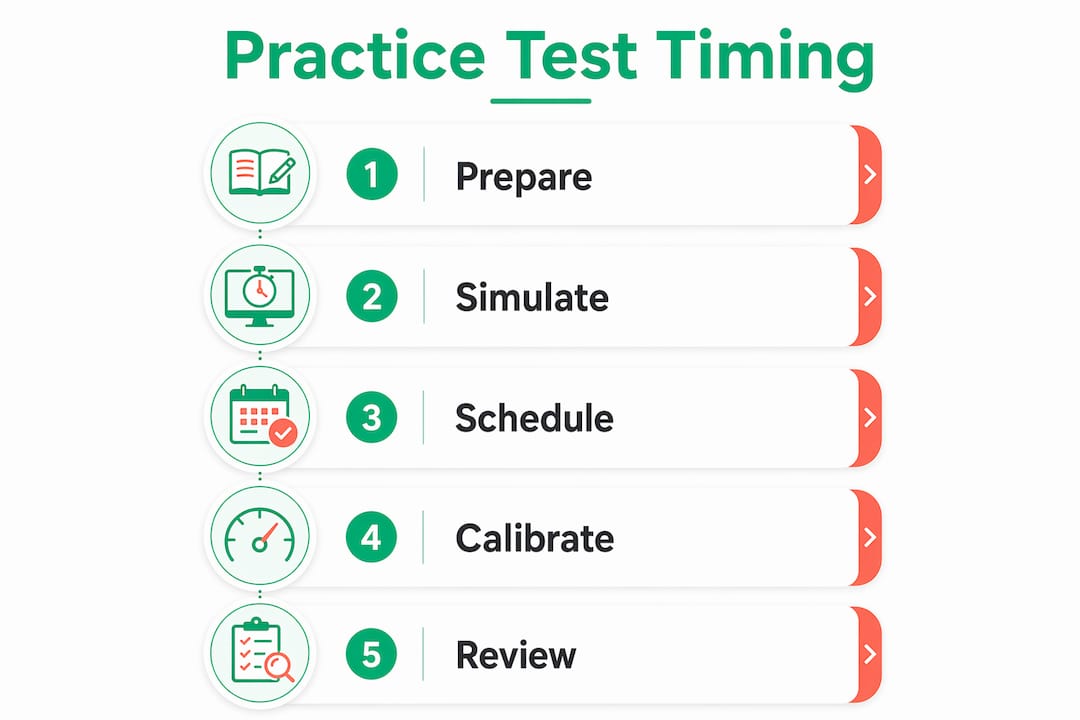
- Use strict official timing. If the real exam gives you 35 minutes for a section, do not give yourself 40. Even five extra minutes can inflate your score by several points and create false confidence.
- Eliminate distractions. Take the test in a quiet room. No phone, no music, no interruptions. The real exam hall will not accommodate distractions, and your practice environment should not either.
- No mid-test review. Do not pause to check answers or look up information during the test. This breaks the simulation and distorts your score.
- Replicate physical conditions. Sit at a desk. Use paper if the real exam is paper-based. Eat and sleep the same way you plan to on exam day.
- Take the full test in one sitting. Splitting a practice test across two days removes the fatigue factor, which is a real variable on test day.
Deviation from test-day conditions is the most common cause of overestimating real exam performance. Students who take practice tests casually often walk into the real exam expecting a score they have not actually earned.
Pro Tip: Schedule your final practice test exactly one week before your real exam. Use the score as a calibration point, not a prediction of perfection. Then spend the remaining days reviewing weak areas, not cramming new content.
Why practice scores and real scores sometimes differ
Practice scores predict trends and overall performance levels, not exact scores. Expecting a perfect match between your practice result and your official result sets you up for unnecessary anxiety. Several factors cause natural variation between the two.
Here is what drives score differences:
- Test anxiety. Many students perform worse on the real exam simply because the stakes feel higher. Anxiety affects working memory and processing speed, both of which matter on timed tests.
- Question variability. No two test forms are identical. Even with equating, some forms are slightly harder than others. Your real exam may include question types you encountered less in practice.
- Fatigue and pacing. The real exam is longer and more draining than most students anticipate. Stamina built through full-length practice tests reduces this gap.
- Guessing behavior. Students often guess more strategically during practice when there is no real consequence. On exam day, pressure changes decision-making.
| Score gap cause | What it signals |
|---|---|
| Anxiety on exam day | Build familiarity through more full-length simulations |
| Harder real exam form | Normal variation; equating adjusts for this |
| Fatigue in later sections | Practice full tests without breaks to build stamina |
| Inconsistent guessing | Develop a consistent guessing strategy during practice |
Trend analysis across multiple practice tests reduces the noise caused by item set variability and personal factors. A single practice score is a data point. Three or four scores taken over several weeks form a pattern, and that pattern is what actually predicts your real result. If your scores cluster between 1350 and 1400 across four SAT practice tests, your real score will almost certainly land in that range.
Use score differences constructively. A drop in a specific section across multiple tests points to a skill gap worth addressing. A single bad score on one test is not a crisis. It is information.
How practice tests improve learning beyond just predicting scores
The benefits of practice exams go beyond score prediction. Practice tests actively improve the knowledge and skills they measure, a phenomenon researchers call the testing effect. Retrieval practice increases retained learning by about 50% compared to passive study methods like rereading notes. That is not a marginal gain. It means students who test themselves regularly retain far more of what they study than those who simply review material.
The mechanism is straightforward. When you retrieve information under test conditions, your brain strengthens the neural pathways associated with that knowledge. Passive review does not trigger the same process. This is why a student who takes ten practice tests will typically outperform a student who spent the same hours rereading textbooks, even if both started at the same level.
“Effortful retrieval strengthens memory and application skills in ways that passive study cannot replicate. Practice tests do not just measure learning. They accelerate it.” — npj Science of Learning
The practical implication for your study plan is clear. Spaced, repeated testing across several weeks builds durable knowledge that transfers to the real exam. A revision plan built around testing rather than passive review produces better results. Confidence also rises naturally when you have proven to yourself, repeatedly, that you can perform under timed conditions.
Key takeaways
Practice tests predict real exam scores most reliably when they are well-calibrated, taken under strict conditions, and analyzed as a trend across multiple attempts rather than a single result.
| Point | Details |
|---|---|
| Predictive validity requires calibration | Only official or psychometrically calibrated tests reliably forecast real scores. |
| Conditions determine accuracy | Strict timing and no distractions minimize the gap between practice and real scores. |
| Trends beat single scores | Analyzing patterns across three or more tests gives a far more reliable prediction. |
| Testing effect boosts retention | Retrieval practice improves memory by roughly 50% compared to passive study. |
| Score gaps are diagnostic | Differences between practice and real scores reveal specific areas to target, not overall failure. |
What I have learned from watching students prepare for high-stakes exams
Students consistently underestimate how much the conditions of a practice test shape its predictive value. I have seen students score 1450 on a practice SAT taken at home with music playing and a phone nearby, then score 1310 on the real exam. They were not unprepared. They were unpracticed at performing under real conditions.
The other pattern I see constantly is over-reliance on a single practice score. One good score creates confidence. One bad score creates panic. Neither reaction is useful. What matters is the line you can draw through five or six scores over several weeks. That line tells you where you actually stand.
There is also a misconception worth addressing directly. Many students treat practice tests as a way to measure what they already know. The research says otherwise. Practice tests are one of the most effective ways to build knowledge, not just assess it. Students who take more tests learn more, full stop.
My honest recommendation: take your first practice test in the first week of preparation, not to get a good score, but to get a baseline. Then take one every week or two under strict conditions. Review every mistake with the same seriousness you would give a wrong answer on the real exam. By the time you sit the actual test, the format, the timing, and the pressure will feel familiar. That familiarity is worth more than any last-minute content review.
— quentin
Start predicting your Bocconi Test score with Prepadmit
If you are preparing for the Bocconi Test, the same principles apply. Your practice scores will only predict your real result if the tests you use are built to the same standard as the official exam.
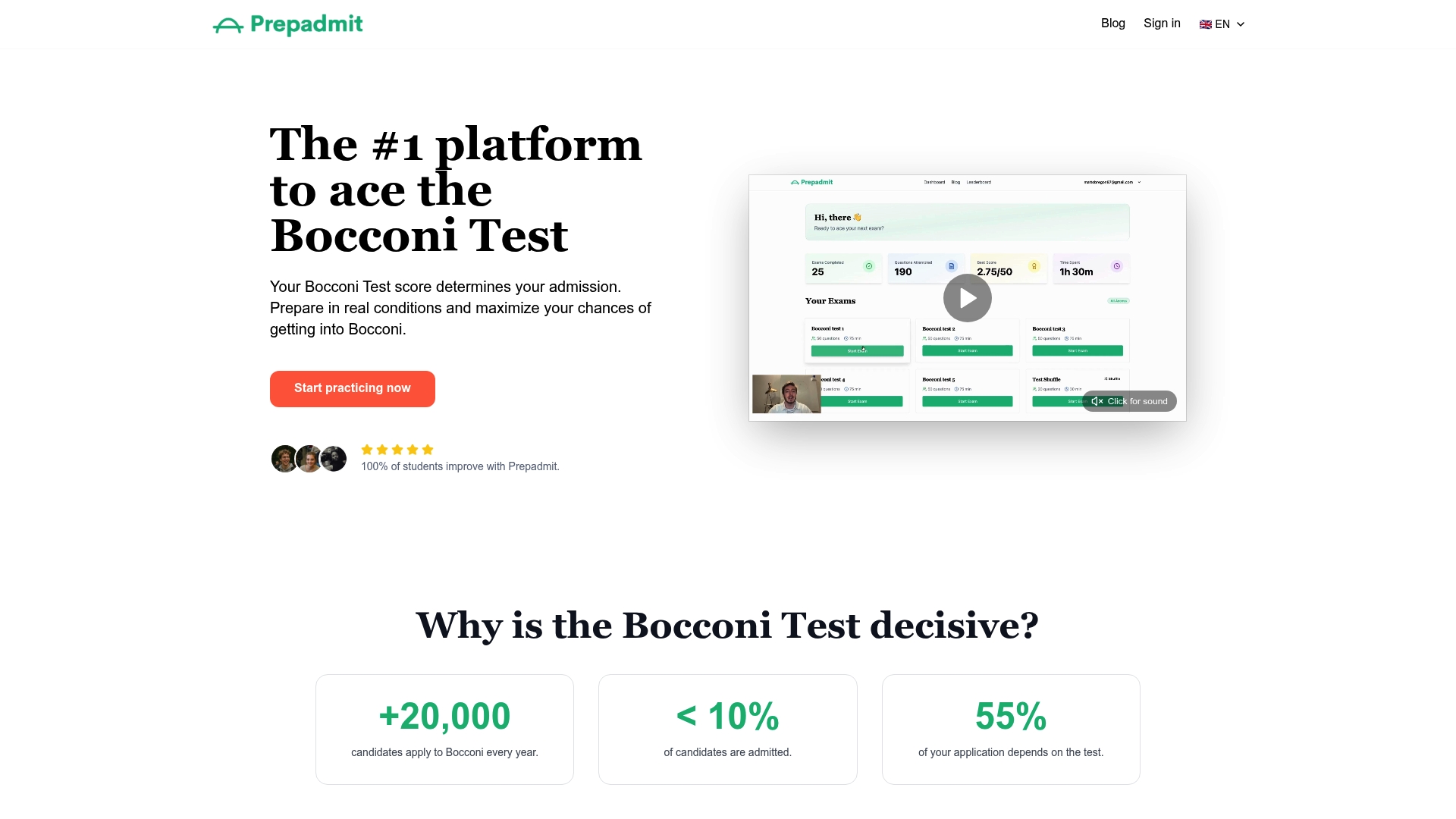
Prepadmit is built specifically for Bocconi Test candidates. The platform uses official past papers and on-demand tests calibrated to match the real exam’s difficulty and format. You get detailed answer corrections, skill-specific practice modes, and progress tracking that shows your score trend over time, not just a single result. Students using Prepadmit improve their scores by an average of 34%. Start your preparation today and find out exactly where you stand before exam day.
FAQ
How reliable are practice tests for predicting real exam scores?
Practice tests are highly reliable predictors when they use real past questions or psychometrically calibrated equivalents and are taken under strict exam conditions. The College Board confirms that SAT practice scores closely indicate real results when taken near the exam date with official timing.
Why do practice test scores sometimes differ from real exam scores?
Score differences are caused by test anxiety, question variability between test forms, fatigue, and changes in guessing behavior under real exam pressure. These factors are normal, and analyzing trends across multiple practice tests reduces their impact on your prediction.
How many practice tests should I take before my real exam?
Three to five full-length practice tests taken under strict conditions give you enough data to identify a reliable score trend. A single practice score is too variable to trust on its own.
What is the testing effect and why does it matter for exam prep?
The testing effect is the proven cognitive benefit of retrieval practice. Retrieval-based learning improves retention by roughly 50% compared to passive study, meaning practice tests do not just predict your score. They actively raise it.
Does taking a practice test the day before the exam help?
No. Taking a full practice test the day before the exam increases fatigue without providing enough time to act on the results. Use the final 48 hours for light review of weak areas and rest.
Recommended
Related articles
Ready to ace your admission test?
Discover PrepAdmit, the platform that helps you succeed at top university admission tests.
Discover PrepAdmit