High School to Bocconi Roadmap for U.S. Students

High School to Bocconi Roadmap for U.S. Students
Getting into Bocconi University from a U.S. high school comes down to two numbers: your selection test score (55% of the admission decision) and your GPA from your 3rd-last and 2nd-last years of secondary school (45%). That’s it. No essays, no recommendation letters, no extracurriculars. Just two quantifiable factors that you can plan for starting today.
Here’s what success looks like:
- Test score: Sit the Online Bocconi Test, SAT, or ACT. Competitive SAT scores start around 1400+; for the Bocconi Test, aim to understand your benchmark early by taking a diagnostic.
- GPA focus: Your junior and sophomore year grades are what Bocconi sees. Senior year grades don’t count. Protect those two years.
- Coursework emphasis: Quantitative courses (Calculus, Statistics, Economics) build the skills the Bocconi Test rewards and prepare you for first-year BSc content.
Three things to do today: register for a diagnostic test or book your Bocconi Test slot, pull your official transcripts for the two required years, and block out an 8–12 week prep window before your target application session.
Table of Contents
- How does Bocconi evaluate applicants?
- Apply2B sessions, deadlines, and what U.S. students need to know
- What should your 2–3 year high school course plan look like?
- Which selection test should you take, and how do you prepare?
- How does Bocconi use your U.S. GPA?
- How to build an effective prep workflow with Prepadmit
- Final pre-application checklist
- Key Takeaways
- An honest perspective on what this process actually requires
- Prepadmit gives you the practice reps that actually move your score
- Useful sources and where to verify current dates
How does Bocconi evaluate applicants?
Bocconi’s undergraduate admissions formula is unusually transparent. Most selective universities weigh a dozen soft factors. Bocconi uses two, and it tells you exactly how much each one counts.
The admission decision is based on two criteria only: the selection test score (55%) and the high school GPA from the 3rd-last and 2nd-last years of secondary school (45%). Motivation letters, CVs, and recommendation letters are not considered.
— Bocconi University Admissions
For undergraduate programs, accepted selection tests are the Online Bocconi Test, the SAT, and the ACT. If you’re applying to Law programs, the accepted options shift to the Bocconi online test (Law version) or the LSAT. Applying to both tracks? You’ll need two separate applications and two separate €100 fees through the Apply2B portal.
What Bocconi does not use: motivation letters, CVs, personal statements, teacher recommendations, extracurricular records, or predicted grades. Time spent polishing any of those is time not spent on test prep or GPA accuracy. The strategic implication is clear: every hour you invest should go toward timed practice and making sure your grade entry in Apply2B is correct.
Apply2B sessions, deadlines, and what U.S. students need to know
Bocconi runs three admission sessions per cycle: Early, Winter, and Spring. The distribution of available spots is heavily front-loaded. Roughly 90–95% of places are filled by the end of the Winter session, which means the Spring session is not a safety net. It’s a last resort with very few seats remaining.
Applying in the Early session also opens more scholarship opportunities. That alone makes it worth planning your test timeline around September, not January.
Sample session timeline for U.S. applicants
| Session | Application window | Results released | Approximate share of places |
|---|---|---|---|
| Early | Early–late September | Mid-November | a large portion of places |
| Winter | Late November–late January | Mid-March | a significant portion of places |
| Spring | Late March–mid-April | End of May | a small number of places |
The Online Bocconi Test must be completed at least two days before the application deadline. For the Winter session, that means booking your test slot well before mid-January, since slots near deadlines sell out quickly on the webtesting platform. Book early.
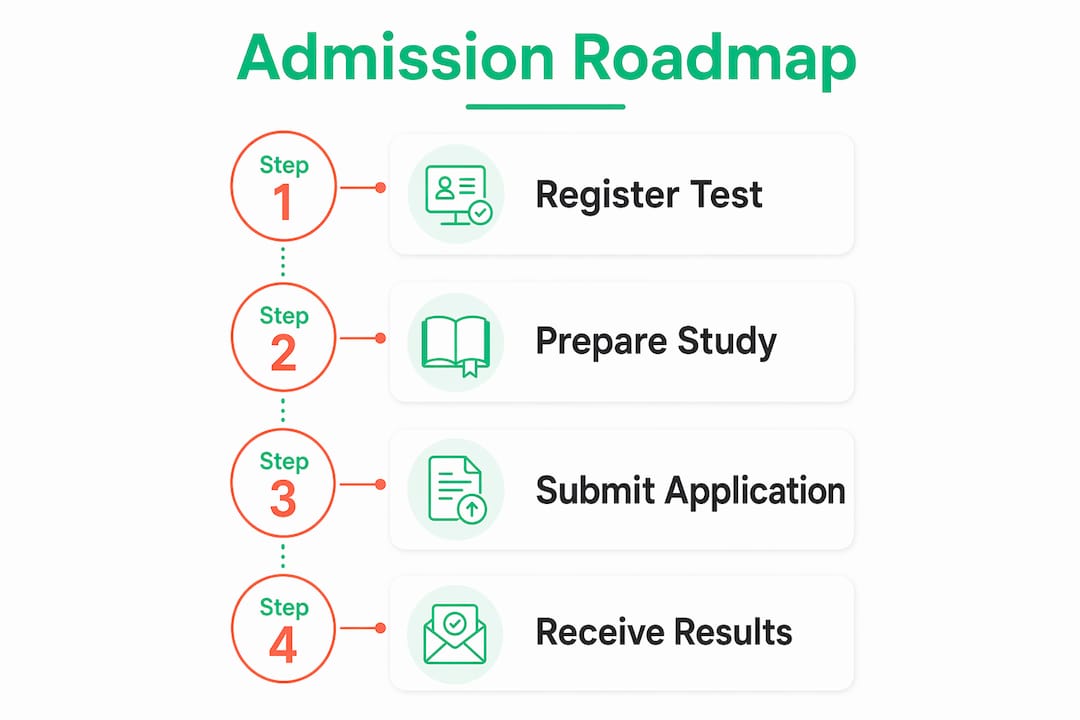
Apply2B step-by-step
- Create your Apply2B account and complete your profile accurately.
- Enter your grades from the 3rd-last and 2nd-last years of secondary school using Bocconi’s GPA calculator.
- Upload any supporting documents when prompted.
- Select up to four program preferences and rank them.
- Pay the €100 non-refundable application fee (per application, not per session).
- Submit before the session deadline.
A few administrative notes for U.S. students: request your official transcripts from your high school at least four to six weeks before you need them. If you’re applying to both undergraduate and Law programs, submit two separate applications with separate fees. Some programs, including the World Bachelor in Business and the HEC-Bocconi double degree, have their own timelines and procedures, so check those dedicated pages separately.
For visa and student residence permit requirements, U.S. citizens should consult the Italian consulate serving their region well before their admission result date. Visa processing timelines vary and can take several weeks.
What should your 2–3 year high school course plan look like?
Bocconi doesn’t require specific subjects for admission. But it explicitly recommends quantitative coursework — math, physics, business studies, and economics — to prepare students for the rigor of its BSc programs. That guidance shapes the entire course strategy below.

Junior year (11th grade): build your quantitative foundation
This is one of your two GPA years. Every grade counts toward your Bocconi admission score. Choose courses that are rigorous enough to signal academic strength but manageable enough to protect your GPA.
Priority APs:
- AP Calculus AB (or BC if you’re confident in your math foundation)
- AP Microeconomics or AP Macroeconomics
- AP Statistics (pairs directly with Bocconi Test quantitative reasoning sections)
Supporting courses: Pre-AP Physics or AP Physics 1, a strong English course, and one elective aligned with your program interest (e.g., AP Computer Science Principles for tech-adjacent BSc programs).
The tradeoff here is real. AP Calculus BC is more impressive than AB, but a B in BC hurts your GPA more than an A in AB. If your math foundation is solid, go BC. If not, AB with a strong grade is the better call for your Bocconi application.
Senior year (12th grade): deepen and prepare for the test
Senior year grades do not count in Bocconi’s GPA calculation. That changes the calculus. You can take harder APs without worrying about GPA damage, and you should use the fall semester to complete your Bocconi Test prep and sit the test before the Early or Winter session deadline.
Recommended APs for senior year:
- AP Calculus BC (if you took AB in junior year)
- AP Statistics (if not taken in junior year)
- AP Language and Composition (strengthens verbal reasoning for the Bocconi Test)
- AP Economics (the other half of Micro/Macro if not completed)
Summer between junior and senior year: This window is valuable. Consider online courses in introductory economics or data analysis through platforms like Coursera or edX. Start your Bocconi Test prep in earnest. This is also when you should pull your junior year transcript and verify the grades you’ll enter in Apply2B.
Pro Tip: Don’t stack four or five APs in junior year to look impressive. Bocconi doesn’t see your AP scores or course rigor — only your GPA. Two or three strong AP grades beat five mediocre ones every time.
Sophomore year (10th grade): the overlooked GPA year
Most students don’t realize that sophomore year is the other GPA year Bocconi uses. If you’re reading this as a sophomore, that’s an advantage. Focus on building strong grades in math and science, and take at least one AP if your school allows it (AP Human Geography or AP World History are manageable entry points that don’t threaten GPA).
Which selection test should you take, and how do you prepare?
The Online Bocconi Test, SAT, and ACT all carry the same 55% weight in the admission formula. The right choice depends on your existing scores, your timeline, and which test you can prepare for most effectively.

Test comparison
| Test | Format | Timing relative to application | Notes |
|---|---|---|---|
| Online Bocconi Test | 50 questions, 75 minutes | Must be completed 2+ days before deadline | Up to 4 attempts; taken on webtesting platform |
| SAT | Standard SAT format | Score must be available before deadline | Competitive scores start at 1400+ |
| ACT | Standard ACT composite | Score must be available before deadline | Bocconi converts to a comparable scale |
If you already have a strong SAT or ACT score, submit it. If you have both a Bocconi Test score and an SAT score, enter both in Apply2B — the system automatically selects the higher one. There’s no penalty for submitting multiple scores.
For most U.S. students without an existing strong SAT/ACT, the Online Bocconi Test is the most direct path. You control the timing, you can attempt it up to four times, and you can prepare specifically for its format. Check the Bocconi Test format details before you start prep so you know exactly what the four sections cover.
8–12 week study plan skeleton
Weeks 1–2 (Diagnostic phase): Take a full timed mock under real conditions. Identify your weakest sections. Don’t study randomly — study what your score report tells you to fix.
Weeks 3–6 (Targeted drills): Work section by section on your weak areas. Use official past papers for authentic question types. Do at least two timed section drills per week.
Weeks 7–9 (Full mock phase): Take one full timed mock per week. Review every wrong answer. Track your score trajectory. Understanding how mock exams raise scores matters more than raw hours logged.
Weeks 10–12 (Consolidation): Light review of persistent weak spots, one final full mock, and a technical check of the webtesting platform setup before test day.
Pro Tip: The Bocconi Test gives you 75 minutes for 50 questions — 90 seconds per question. On test day, triage immediately. Mark questions that feel slow and skip them. Return only if time allows. Spending three minutes on one hard question costs you two easy ones.
How does Bocconi use your U.S. GPA?
Bocconi uses final grades from the 3rd-last and 2nd-last years of secondary school. For a U.S. student graduating in 2027, that means sophomore year (2024–25) and junior year (2025–26). Senior year grades are not used. Predicted grades are not used.
Three subjects are excluded from the calculation regardless of your school’s grading system: physical education, behavior/conduct, and religious studies. Every other subject’s final annual grade goes in.
A note on grade format: if your school provides both term grades and an annual grade, Bocconi uses the annual grade. If only term grades exist, the final term grade is accepted.
What to do right now
- Collect official transcripts for both required years from your high school registrar.
- Confirm your school uses annual grades (not just semester grades) and request the correct format.
- Use Bocconi’s GPA calculator in Apply2B to enter grades manually. Do not estimate or round.
- Have your school counselor review the entries before you submit.
Common errors that hurt applications
- Entering junior year and senior year grades instead of sophomore and junior year grades.
- Including PE, conduct, or religion grades in the calculation.
- Using semester grades when annual grades are available.
- Misreading the grade scale (e.g., entering a 4.0 GPA on a 4.0 scale without applying the correct conversion formula).
Bocconi will request official transcripts from admitted students. The grades you enter must match exactly. A discrepancy can cost you your offer. Request transcripts early — at least six weeks before you need them — and keep a copy for your own verification.
How to build an effective prep workflow with Prepadmit
The most effective preparation for the Bocconi Test combines three things: official past papers, timed simulations under real exam conditions, and structured review of every wrong answer. Raw content review alone isn’t enough given the test’s tight timing.
Core resource types
Official past papers are the highest-value study material. They show you exactly what question types appear, how they’re worded, and where the difficulty spikes. Use them for timed section drills, not casual reading.
Timed full mocks train the mental stamina and pacing judgment the 75-minute format demands. One mock per week in the final four weeks of prep is a reasonable target.
Diagnostic score reports tell you where to spend your next study session. Without them, you’re guessing.
Skill-specific drills let you isolate a weak section and work it intensively without burning time on areas you’ve already mastered.
Where Prepadmit fits
Prepadmit is built specifically for the Bocconi Test. The platform offers exam simulations using official past papers, on-demand adaptive practice tests, detailed answer corrections, skill-specific drill modes, progress tracking, and a peer ranking dashboard. That combination maps directly onto the prep workflow above: start with a diagnostic simulation, use the score report to target drills, then run full mocks and track your improvement over time.
Students using Prepadmit report an average score improvement of 34%. The platform costs a fraction of private coaching and comes with a money-back guarantee. For a step-by-step prep guide that walks through how to use these tools week by week, the Prepadmit blog has a detailed breakdown.
Pro Tip: When reviewing official past papers, don’t just check whether your answer was right. Read the explanation for every question, including the ones you got right. Understanding why a correct answer is correct is what builds pattern recognition for new questions.
Final pre-application checklist
Use this in the two to four weeks before your application deadline.
Documents and account setup
- Official transcripts for 3rd-last and 2nd-last years collected and verified
- Grades entered in Apply2B using Bocconi’s GPA calculator (no PE, behavior, or religion included)
- Apply2B account created and profile completed accurately
- Up to four program preferences selected and ranked
- €100 application fee ready to pay (non-refundable; separate fee if applying to both undergraduate and Law tracks)
- Passport valid for the duration of your intended enrollment
Test score readiness
- Online Bocconi Test score received at least two days before the application deadline
- SAT or ACT score entered in Apply2B if available (system selects the highest)
- Correct test submitted for your program track (standard test for undergraduate; Law-specific test or LSAT for Law)
Test-day technical checklist
- Webtesting platform account active and login confirmed
- Device, browser, and internet connection tested against platform requirements
- Government-issued photo ID ready for proctoring
- Quiet, private space secured for the full 75-minute window
Post-test follow-up
- Log back into Apply2B after receiving your score to confirm it’s recorded correctly.
- If you have a second test score (e.g., both a Bocconi Test score and an SAT), enter both so the system can select the higher one.
- Check Apply2B regularly after your session’s result date for admission decisions and any document requests.
Pro Tip: Don’t wait until the week of the deadline to check your Apply2B entries. Log in two weeks before and review every field: grade entries, program preferences, and test score status. Errors caught early can be corrected; errors caught after submission often can’t.
Key Takeaways
Bocconi’s undergraduate admission is a two-factor formula: your selection test score (55%) and your GPA from your sophomore and junior years (45%), with no essays or recommendations considered at any stage.
| Point | Details |
|---|---|
| Test score carries the most weight | The selection test (Online Bocconi Test, SAT, or ACT) accounts for more than half of your admission score. |
| Only two GPA years count | Bocconi uses final grades from your 3rd-last and 2nd-last years only; senior year grades are excluded. |
| Apply in the Early session | Most seats fill by the end of Winter; the Spring session has very few spots left. |
| Quantitative APs matter most | AP Calculus, Statistics, and Economics build the skills the Bocconi Test rewards and prepare you for BSc coursework. |
| Prepadmit accelerates prep | Prepadmit’s exam simulations and official past-paper practice substantially improve scores for many students. |
An honest perspective on what this process actually requires
Most students who struggle with Bocconi admissions don’t fail because they picked the wrong AP or chose the wrong test. They fail because they underestimate how much the test score dominates the outcome. At 55% of the decision, a strong test performance can compensate for a GPA that isn’t perfect. The reverse is also true: a near-perfect GPA won’t save a weak test score.
The meritocratic structure of Bocconi’s process is actually good news. You don’t need connections, a compelling personal narrative, or a perfectly curated extracurricular profile. You need a high score and accurate grade entry. That’s a solvable problem with the right preparation and enough lead time.
What I’d tell any U.S. student starting this process: treat the Bocconi Test like a skill, not a knowledge test. The content is learnable, but the pacing is what trips people up. Seventy-five minutes for 50 questions sounds manageable until you’re sitting in front of a hard quantitative reasoning question with 40 minutes left and 25 questions to go. The students who perform best aren’t necessarily the smartest. They’re the ones who’ve practiced triage under real time pressure enough times that it becomes automatic. Start that practice earlier than you think you need to.
Prepadmit gives you the practice reps that actually move your score
The gap between knowing the Bocconi Test exists and being ready to sit it is usually 8–12 weeks of structured, timed practice. Prepadmit closes that gap faster than any other resource at this price point.
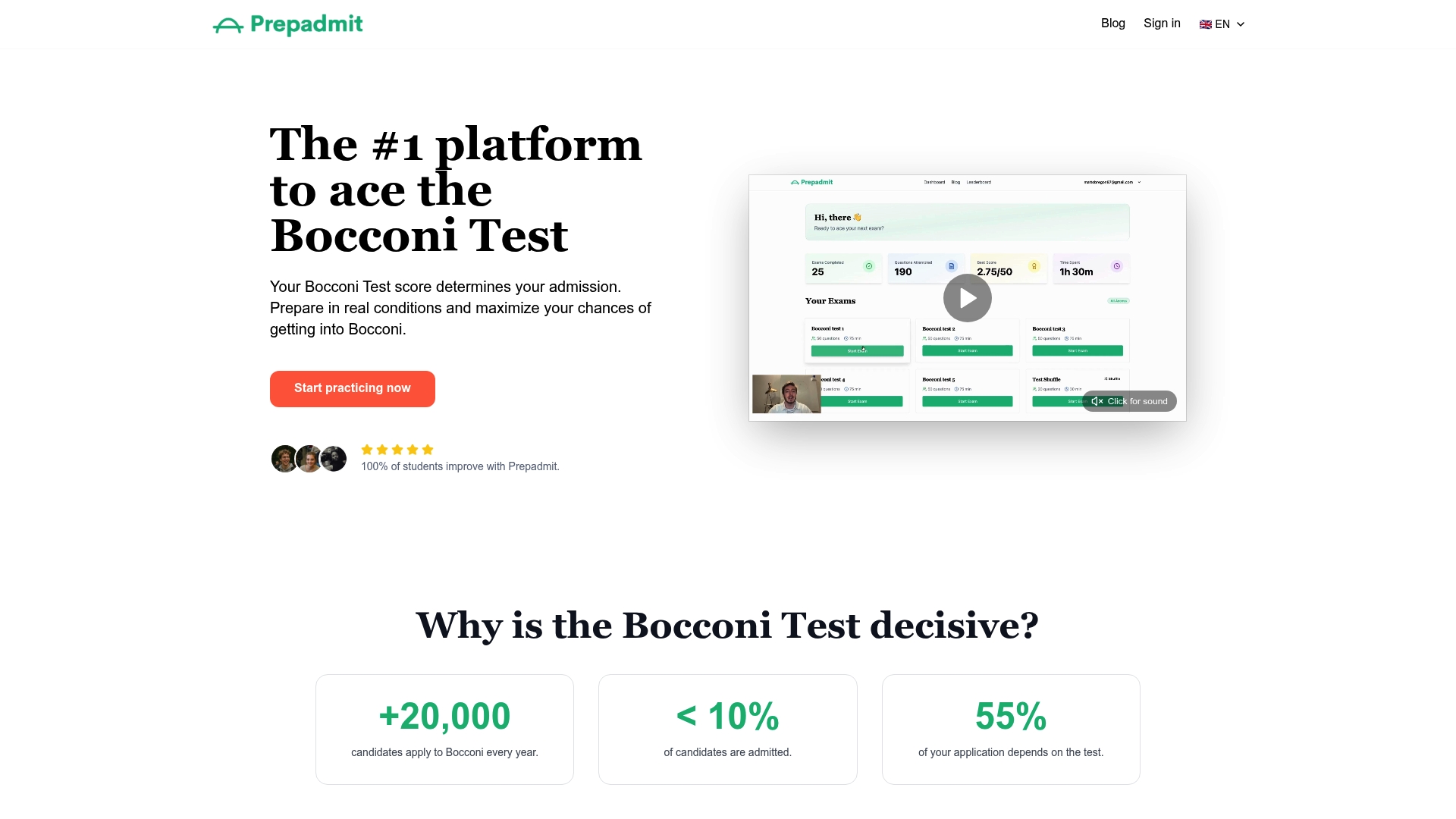
Here’s how to start. First, take a full diagnostic simulation on Prepadmit to get a baseline score and a section-by-section breakdown of where you’re losing points. Second, use the skill-specific drill modes to work your weakest sections with targeted practice built from official past papers. Third, run full timed mocks in the final weeks before your test date and track your score trajectory on the progress dashboard.
Students who follow this workflow report an average score improvement of 34%. The platform costs a fraction of private tutoring, works on both mobile and desktop, and comes with a money-back guarantee. If you’re targeting the Early session, your prep window opens now.
Useful sources and where to verify current dates
Official Bocconi pages update session dates, test windows, and GPA instructions annually. Always verify before booking a test or paying a fee.
| Source | What to check there |
|---|---|
| Bocconi Admissions page | Session dates, accepted tests, fee information, and program-specific procedures |
| Online Bocconi Test page | Test booking windows, attempt limits, webtesting platform access, and test format |
| GPA and High School Curriculum page | Which years count, excluded subjects, grade entry instructions, and conversion rules |
| Apply2B portal | Live application status, grade entry, test score submission, and fee payment |
| Prepadmit international student guide | Financial aid, scholarships, and visa timing for non-EU applicants |
Session dates, test booking windows, and GPA instructions change from one academic year to the next. The table above points you to the right pages, but the specific dates you need are always on Bocconi’s live site. Check them before you plan your test schedule or submit any payment.
Recommended
Related articles
Ready to ace your admission test?
Discover PrepAdmit, the platform that helps you succeed at top university admission tests.
Discover PrepAdmit