Cheap Bocconi Test Prep Alternatives That Actually Work

Cheap Bocconi Test Prep Alternatives That Actually Work
The best cheap alternatives to private Bocconi Test coaching are: official Bocconi past papers (free), a low-cost adaptive platform like Prepadmit, timed full-length simulations, peer study groups, and targeted micro-tutoring sessions for stubborn weak spots. Used together, this approach covers most of what a private tutor provides at a fraction of the cost.
TL;DR: A mixed system of free official past papers, Prepadmit’s on-demand simulations, and structured peer review can replace private coaching for most motivated students. Expect to spend weeks 1–8 in focused prep, with total costs well below what a single hour of private tutoring typically runs.
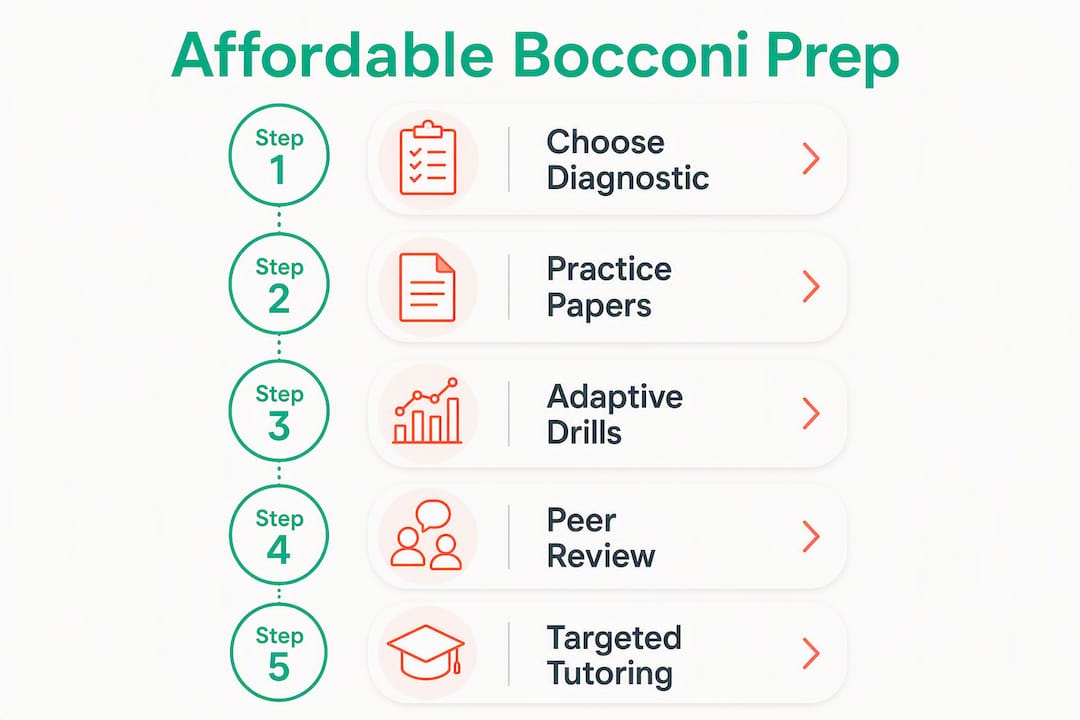
Top affordable alternatives at a glance:
- Official Bocconi past papers — free, directly from Bocconi University; your best diagnostic tool
- Prepadmit — one-time purchase; official past papers, adaptive drills, detailed corrections, progress tracking, and peer ranking built in
- Timed full-length simulated tests — replicates real exam pressure; available through Prepadmit’s on-demand system
- Peer study groups and forums — free; useful for motivation and shared error analysis
- Micro-tutoring sessions — paid but short (2–3 hours); reserved for persistent weak areas only
Table of Contents
- Why cheap alternatives can match private coaching for most students
- Concrete options and how to use each one
- How to pick the right option for your situation
- A 6–8 week study plan using low-cost resources
- Risks and trade-offs of going the low-cost route
- Key Takeaways
- Why this blended approach is the right call
- Prepadmit: the recommended affordable all-in-one option
- Useful sources and where to find official materials
Why cheap alternatives can match private coaching for most students
For motivated students, online adaptive platforms and official past papers replicate the highest-value coaching activities: diagnostic testing, targeted drill, and error analysis.

Free and low-cost tools provide diagnostic tests, baseline tracking, and structured practice that cover foundational learning effectively. Paid tiers add features like adaptive analytics and on-demand feedback. The gap between free and private coaching is narrower than most students assume.
Research from Brookings shows that well-designed online platforms built by high-scoring experts can scale effective lessons and drills at far lower cost than one-on-one human tutoring. Adaptive systems that rebuild your study plan after each question drive faster improvement than bulk question volume alone.
AI-driven platforms also detect high-risk cognitive patterns across many sessions in ways a weekly human tutor often cannot. A tutor sees only the mistakes you make during your session. An adaptive platform logs every error, every time.
Prepadmit reports an average score improvement of 34% among its users, backed by a money-back guarantee. That figure comes from the platform itself, but it aligns with what the research says about expert-designed, adaptive prep systems.
Concrete options and how to use each one
Official Bocconi past papers
Cost: Free. Time: 2–3 hours per full paper.
These are the most important free resource you have. Run your first past paper under timed conditions before you touch any other material. That score is your baseline. Every study decision after that should respond to what the diagnostic reveals.
Pro Tip: Don’t review answers immediately after finishing. Wait 30 minutes, then go through every wrong answer and write one sentence explaining why you missed it. That delay sharpens retention.
Prepadmit: adaptive drills and simulated tests
Cost: One-time purchase. Time: Flexible, on-demand.
Prepadmit is built specifically for the Bocconi Test. It uses official past papers and realistic exam simulations, detailed answer corrections, skill-specific drill modes, progress tracking, and a peer ranking dashboard. The content was developed by experts with HEC and Bocconi backgrounds. For students who want one platform that covers everything, this is the recommended option.
Peer study groups and forums
Cost: Free. Time: 1–2 hours per week.
A well-run peer group keeps you accountable and surfaces question types you might have missed. The risk is bad information. Verify any strategy or answer explanation against official materials before you adopt it.
Micro-tutoring sessions
Cost: Varies; typically charged per hour. Time: 2–3 hours total.
Reserve these for specific, persistent weak spots that self-study hasn’t fixed after two weeks of targeted drill. One focused session with a subject expert is more efficient than ongoing weekly tutoring.
Comparison of method categories
| Method | Cost | Full-length tests | Feedback quality | Expected effectiveness | Guarantee/refund |
|---|---|---|---|---|---|
| Official past papers | Free | Yes (limited supply) | None (self-scored) | High for diagnostics | N/A |
| Prepadmit | One-time purchase | Yes, on-demand | Detailed corrections + tracking | High; 34% avg. improvement reported | Money-back guarantee |
| Peer study groups | Free | No | Peer-level only | Moderate | N/A |
| Micro-tutoring | Per hour | No | High (live, targeted) | High for specific gaps | Varies by tutor |
How to pick the right option for your situation
Choose based on three factors: your diagnostic score, your weekly available hours, and whether you need feedback or practice volume more urgently.
Selection checklist:
- Does the platform use official Bocconi past papers?
- How many full-length timed tests are available?
- Are answer explanations detailed enough to understand why you were wrong?
- Does the system track progress and flag weak subskills?
- What is the refund or guarantee policy?
- Does the schedule fit your available hours per week?
Questions to ask before committing to any platform or group:
- Is progress tracked and exportable so you can review trends over time?
- Are the practice questions drawn from or modeled on official Bocconi materials?
- If results don’t improve, is there a refund path?
Students with 10+ hours per week available can rely primarily on Prepadmit plus official past papers. Students with fewer hours should prioritize timed simulations and focused error review over raw question volume. Peer groups work best as a supplement, not a primary resource.
A 6–8 week study plan using low-cost resources
A focused 6–8 week plan works for most students who start with a clear diagnostic baseline. The structure below assumes 8–10 hours of study per week.
- Week 1: Diagnostic. Complete one full official past paper under timed conditions. Score it. Identify your three weakest skill areas.
- Week 2–3: Skill drills. Use Prepadmit’s skill-specific drill mode to target weak areas. Aim for 5–6 sessions of 45–60 minutes each week.
- Week 4: First full simulation. Run a complete timed test on Prepadmit. Compare your score to Week 1. Review every wrong answer using the detailed corrections.
- Week 5–6: Adaptive review. Let your error patterns guide the next drill cycle. Use spaced repetition to revisit concepts you’ve partially mastered. Add a peer study session once per week.
- Week 7: Second full simulation. Run another timed test. If one skill area is still lagging after two drill cycles, this is the right moment for a 2–3 hour micro-tutoring session.
- Week 8: Test-day prep. One final simulation under real conditions. Light review only. Focus on exam confidence and pacing, not new material.
Pro Tip: Remote students can follow this plan entirely online. Prepadmit’s workflows are built for candidates preparing from outside Italy, with timed practice and mistake review as the core loop. See the overseas prep guide for remote-specific tips.
Risks and trade-offs of going the low-cost route
Cheap alternatives cover most needs. They do not cover everything.
Common risks:
- Motivation loss without external accountability
- Shallow practice: completing questions without understanding the underlying logic
- Over-reliance on peer forums where wrong answers circulate unchecked
- Skipping error analysis because reviewing mistakes feels slower than doing more questions
Red flags that suggest you need private coaching instead:
- Your mock-test scores are inconsistent across three or more full simulations with no clear trend
- You have a severe timing problem that drill alone hasn’t fixed after four weeks
- You are targeting a very high percentile and need personalized strategy adjustments that an adaptive platform cannot provide
For most students, the risks above are manageable with discipline. The 6–8 week plan above builds in the review cycles and simulation frequency that prevent shallow practice from becoming a habit.
Key Takeaways
A mixed system of official past papers, Prepadmit’s adaptive simulations, and structured peer review gives most Bocconi Test candidates everything private coaching provides at a fraction of the cost.
| Point | Details |
|---|---|
| Start with a diagnostic | Run one official past paper timed before anything else to set your baseline. |
| Prioritize feedback over volume | Deep error analysis after each simulation drives faster improvement than bulk questions. |
| Use simulations on a schedule | Run full timed tests in weeks 4, 7, and 8 to track real progress. |
| Add micro-tutoring selectively | Reserve paid sessions for specific weak spots that two drill cycles haven’t fixed. |
| Prepadmit as your all-in-one option | Official past papers, adaptive drills, detailed corrections, and peer ranking in one platform with a money-back guarantee. |
Why this blended approach is the right call
The conventional wisdom says you need a private tutor to get into a competitive program like Bocconi. That’s not wrong exactly, but it overstates what tutors actually provide. Most of a tutor’s value comes from three things: structured practice, error analysis, and accountability. All three are replicable with the right low-cost tools.
What tutors genuinely offer that platforms don’t is live, nuanced feedback on your reasoning in real time. For most students, that gap matters less than they think. Adaptive platforms that log every error and rebuild your study plan accordingly cover the diagnostic and remediation functions well. The emotional coaching piece, which is real, is better handled by a peer group and a clear weekly schedule than by expensive hourly sessions.
The expert-designed content behind Prepadmit addresses the quality concern directly. Materials built by people who know the Bocconi Test from the inside are not the same as generic prep content. That distinction matters when you’re preparing for an exam with a specific structure and scoring logic.
Prepadmit: the recommended affordable all-in-one option
Private Bocconi Test coaching costs more than most students can justify, and the alternatives above cover most of what that coaching provides. Prepadmit closes the remaining gap.
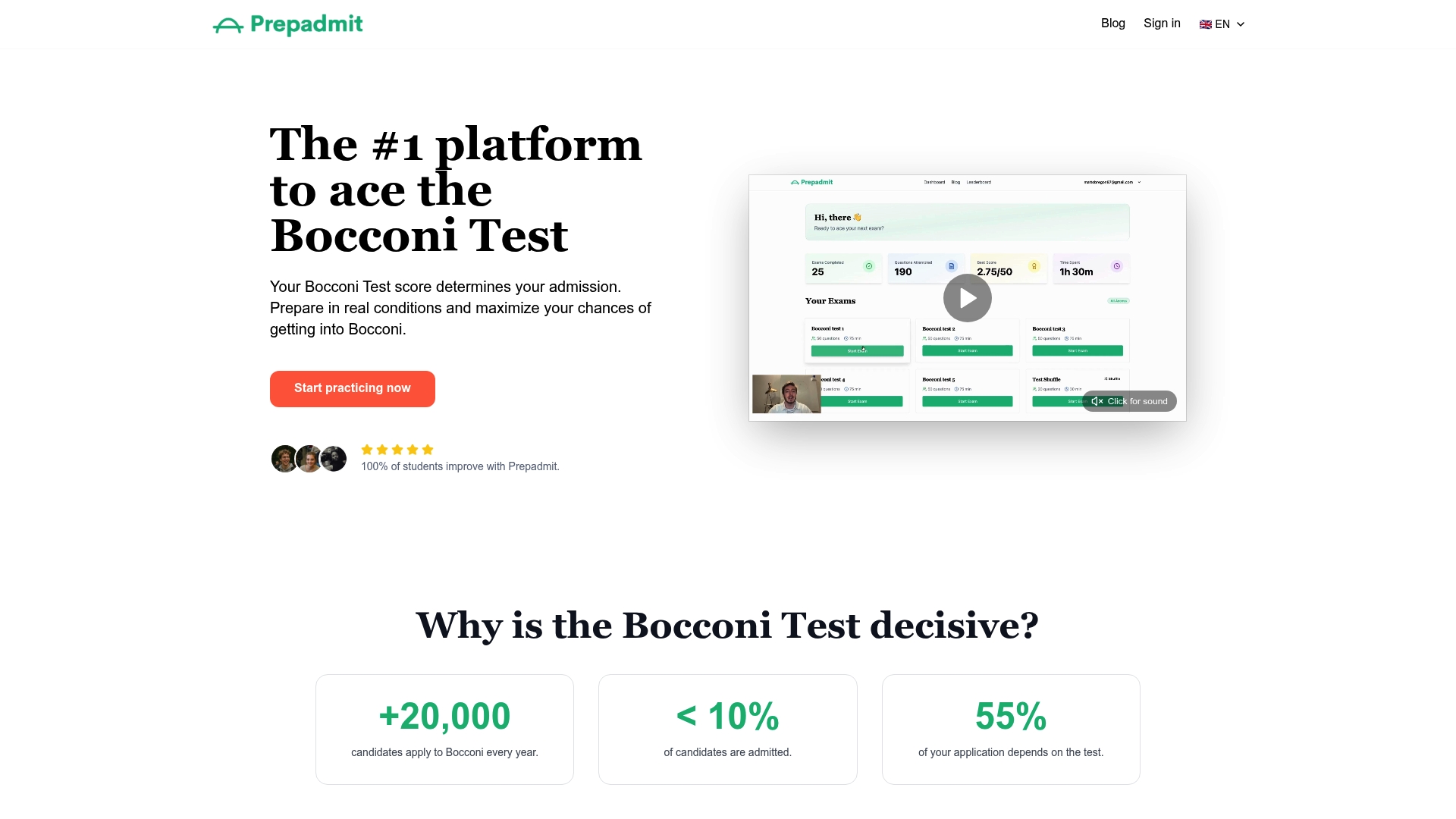
It includes official past papers, on-demand simulated tests that mirror real exam conditions, detailed answer corrections, skill-specific drill modes, progress tracking, and a peer ranking dashboard. The content was built by experts with HEC and Bocconi backgrounds. The platform reports an average score improvement of 34% and backs that with a money-back guarantee.
One-time purchase. No recurring monthly fees. Start with a diagnostic, work through the 6–8 week plan above, and use the leaderboard to see where you stand against other candidates. Start your Bocconi prep today and see your baseline score before the end of the week.
Useful sources and where to find official materials
- Official Bocconi past papers: Available directly from Bocconi University’s admissions pages. Run your first paper timed, without prep, as your diagnostic.
- Prepadmit blog on platform comparisons: Best Bocconi Test Prep Platforms Compared — feature-level breakdown and effectiveness evidence.
- Brookings on AI tutoring research: What the research shows about generative AI in tutoring — evidence base for adaptive platforms.
- PMC on free educational resources: PMC article on educational resources and outcomes — supports claims about what free tools provide.
- AI vs. human tutors comparison: Estha.ai effectiveness comparison — explains adaptive error tracking advantages.
- Prepadmit overseas prep guide: How overseas students access prep materials — practical workflows for remote candidates.
Recommended
Related articles
Ready to ace your admission test?
Discover PrepAdmit, the platform that helps you succeed at top university admission tests.
Discover PrepAdmit