Bocconi Weak Area Targeting Strategies for 2026

Bocconi Weak Area Targeting Strategies for 2026
The most effective Bocconi weak area targeting strategies share one thing: they start with data, not guesswork. Before you open a textbook, run a diagnostic test to see exactly where your score is leaking. Then build every study session around closing those specific gaps. Here is what that looks like in practice:
- Pinpoint sub-topics, not just subjects. A low math score might hide a specific gap in probability or algebra. Use performance analytics to find the exact question types dragging you down.
- Prioritize by scoring impact. Mathematics accounts for a large portion of the questions on the Bocconi test. Fixing a weak spot there pays off more than polishing any other section.
- Run adaptive timed practice. The Bocconi test adjusts question difficulty as you go. Practicing under those same conditions builds both speed and composure.
- Take full-length mock tests regularly. Start your preparation well in advance and increase the frequency of full mock tests as the exam date approaches.
- Build a guessing strategy. The test penalizes wrong answers. If you can eliminate at least one option on a multiple-choice question, guessing may be advantageous. If you cannot eliminate any option, leave it blank.
What does the Bocconi test structure look like?
The Bocconi Graduate Test has 50 questions and a 75-minute time limit. Knowing the section breakdown is the first step toward smart weak area identification.
- Mathematics: 24 questions covering algebra, geometry, probability, and data interpretation
- Verbal Reasoning: reading comprehension, vocabulary, and language logic
- Critical Thinking: data sufficiency and passage-based reasoning, with three-option questions
- General Knowledge: current events and cultural awareness
Mathematics is the single biggest lever on your score. Gains in the math section tend to have a larger impact on overall score compared to gains in other sections. That asymmetry should shape every decision you make about where to spend your study time.
The test is also adaptive. Question difficulty shifts based on your previous answers, so a string of correct responses will trigger harder questions. Practicing with adaptive-format mocks is the only reliable way to prepare for those mid-test difficulty spikes without panicking.
The penalty system adds another layer. Wrong answers on four or five-option questions cost you 0.25 points. On three-option Critical Thinking questions, the penalty is 0.33. Students who skip this detail consistently score below their actual knowledge level, not because they do not know the material, but because they guess randomly when they should leave a question blank.
How do you identify your real weak areas before you study?
Weak area identification is not about feeling uncertain on a topic. It is about measuring where your score actually drops, question type by question type.
Performance analytics dashboards are the fastest way to do this. AI-powered analytics tools can flag the exact sub-topics pulling your score down, rather than pointing to a broad subject like “math” or “verbal.” That level of detail changes how you study.

Pro Tip: Do not rely on your overall score to judge readiness. A 32 out of 50 can hide a 90% accuracy rate in verbal and a 40% rate in critical thinking. Section-by-section and question-type breakdowns tell the real story.
Adaptive mock tests also reveal weaknesses that static practice sets miss. When the test raises difficulty after a correct answer and you start missing questions, that is the boundary of your current skill. Tracking where that boundary sits for each question type gives you a precise target.
Time management is a weak area too, and students often overlook it. If you consistently run out of time in verbal reasoning but finish math early, that is a pacing problem, not a knowledge gap. Both need fixing, but they need different fixes. Pairing analytics data with tutor or peer feedback rounds out the picture, since an outside perspective often catches patterns you cannot see in your own results.
What study strategies actually close weak area gaps?
Closing a gap requires two phases: understanding the concept, then performing under pressure. Skipping the first phase and drilling questions you do not understand is one of the most common preparation mistakes.
Phase 1: Build the foundation. Spend the first two weeks on concept-level work in your weakest subjects. For math, that might mean reviewing probability rules from scratch. For critical thinking, it means learning the two question types (data/statements and passage reasoning) and practicing the logic behind each. Targeting adjacent weak areas that connect to your existing strengths moves faster than rebuilding from zero.
Phase 2: Timed, focused drills. Once the concept is clear, switch to timed question sets built around that specific sub-topic. The goal is accuracy first, then speed. A useful benchmark is to aim for at least 60% of questions answered correctly on a sub-topic under timed conditions before moving on.
- Use adaptive question drills that mirror the test’s difficulty-scaling pattern.
- Apply your guessing strategy during every practice set, not just on test day.
- Rotate between weak sub-topics rather than spending three consecutive days on one.
Pro Tip: Avoid over-investing in your strong areas early in preparation. If you are already scoring well in verbal reasoning, one maintenance session per week is enough. Put the extra hours into math and critical thinking until those scores close the gap.
Students who treat preparation like a market entry problem, matching their study method to the specific demands of the test rather than defaulting to what feels comfortable, tend to improve faster. Sticking to a favored study habit when the test requires a different skill set is a real preparation trap.
How should you build a study schedule around your weak areas?
A structured eight-week plan gives you enough time to build concepts, practice under pressure, and refine your approach before test day. The schedule below maps each phase to a clear objective.
| Week | Focus | Key Tasks |
|---|---|---|
| 1–2 | Concept building | Learn fundamentals in weakest subjects; take a baseline diagnostic test |
| — | Timed topic practice | Attempt subject-specific question sets under time pressure |
| — | Full-length mocks | Run two to three complete 75-minute tests per week |
| — | Review and refine | Analyze errors by section; target remaining weak spots; finalize guessing strategy |

This structure comes from a recommended 8-week preparation framework that moves from concept building through timed practice, full mocks, and deep error analysis. The phases are sequential for a reason: skipping ahead to mocks before your weak areas are stable wastes test attempts and can reinforce bad habits.
A few scheduling principles that hold up across preparation timelines:
- Review your analytics after every mock, not just at the end of the week.
- Adjust your schedule when data shows a sub-topic is no longer a weak area. Redirect that time immediately.
- Keep one session per week on your stronger subjects so they do not erode while you focus elsewhere.
- Do not cram in the final 48 hours. Use that time for light review and rest.
Tracking progress in a simple spreadsheet, logging your score by section after each mock, makes the trend visible. When a weak area is genuinely improving, the data will show it. When it is not, you know to change your approach before test day. For tutors managing multiple students through this kind of structured prep, organized tutoring workflows can make tracking and scheduling significantly easier.
How does Prepadmit help you target weak areas for the Bocconi test?
Prepadmit was built specifically for the Bocconi test, by people who know it from the inside. The platform’s creators come from HEC and Bocconi, which means the content, the question formats, and the scoring logic all reflect how the actual test works.
“Prepadmit users see an average score improvement of 34% through adaptive practice, detailed answer corrections, and skill-specific practice modes. The platform also backs its results with a money-back guarantee.”
The features map directly onto the weak area targeting process described throughout this article. Official past papers and on-demand adaptive tests let you practice in conditions that match the real exam. Detailed answer corrections explain not just what the right answer is, but why, which is where most students actually learn. Skill-specific practice modes let you isolate a single sub-topic and drill it until your accuracy climbs. Progress tracking and peer rankings show you where you stand and whether your weak areas are closing.
The money-back guarantee removes the risk from trying the platform. If you put in the work and the score does not move, you get your money back. That kind of commitment is rare in test prep, and it reflects how confident the team is in the method.
For students who want to see how others have navigated the same preparation challenges, international student success stories on the Prepadmit blog show what targeted preparation actually looks like in practice.
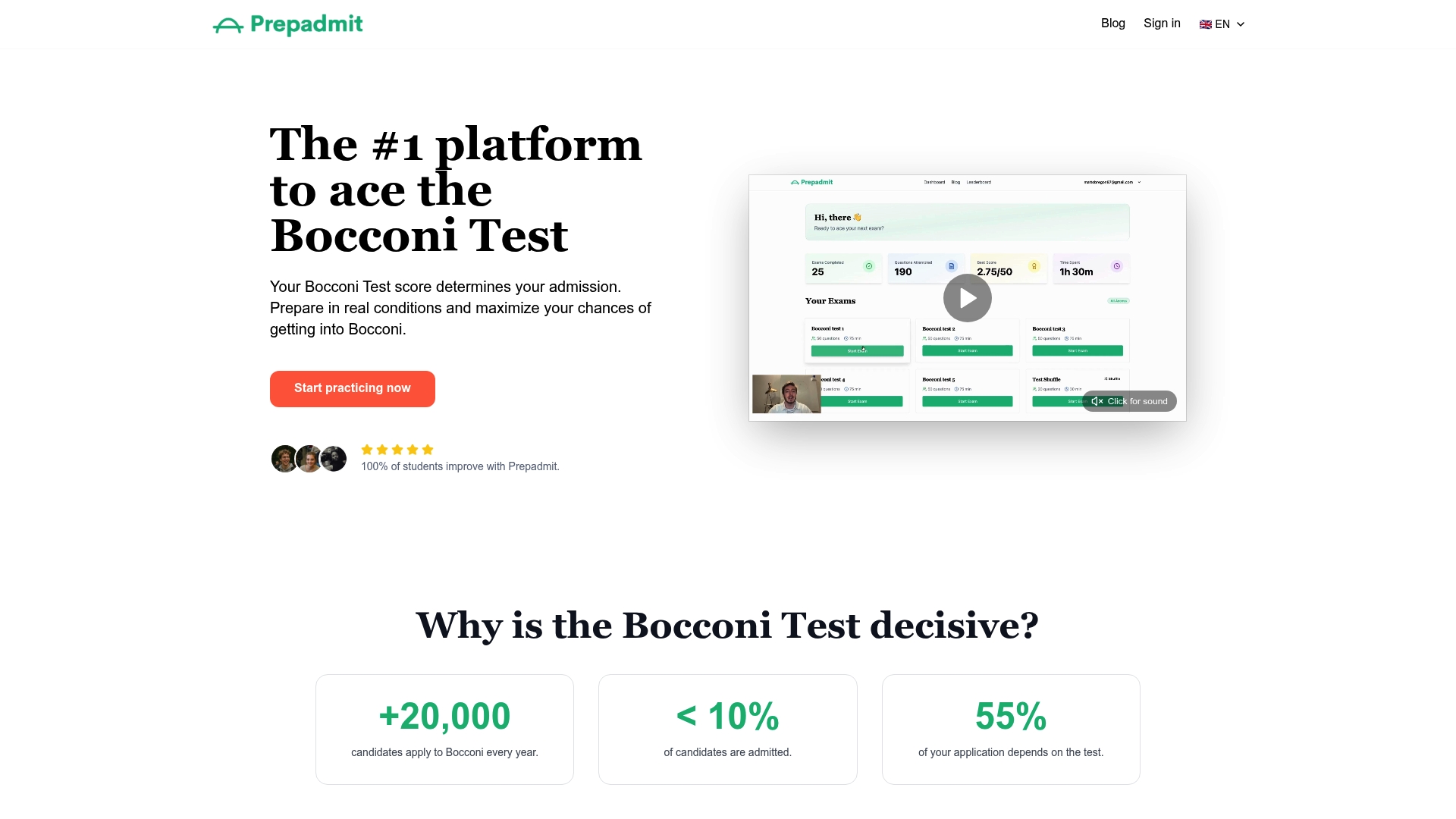
Ready to find your weak areas and close them before test day? Start your Bocconi prep on Prepadmit and see your baseline score within the first session.
Key Takeaways
Targeting weak areas with data and adaptive practice, not broad review, is the fastest path to a higher Bocconi test score.
| Point | Details |
|---|---|
| Math is the top priority | Mathematics covers 24 of 50 questions; a five-point gain there outweighs gains in any other section. |
| Use analytics, not instinct | Performance dashboards identify exact sub-topic gaps faster than self-assessment or general review. |
| Follow the 8-week structure | Move through concept building, timed practice, full mocks, and error analysis in sequence. |
| Master the penalty rules | On four-option questions, guessing is statistically positive if you eliminate at least one option; otherwise, leave it blank. |
| Prepadmit delivers 34% improvement | Adaptive practice, detailed corrections, and skill-specific modes drive an average score gain of 34% for platform users. |
Recommended
- What Is a Good Bocconi Test Score? Benchmarks and Targets for 2026 — PrepAdmit Blog
- International Bocconi Student Success Examples: 2026 Guide — PrepAdmit Blog
- Is the Bocconi Test Hard? An Honest 2026 Difficulty Breakdown — PrepAdmit Blog
- prepadmit.com - La plateforme n°1 pour réussir le Bocconi Test
Related articles
Ready to ace your admission test?
Discover PrepAdmit, the platform that helps you succeed at top university admission tests.
Discover PrepAdmit