Bocconi vs. European Universities: 2026 Guide

Bocconi vs. European Universities: 2026 Guide
Bocconi University is defined as one of Europe’s most selective business-focused universities, consistently placing among the top five in Europe for Business and Management Studies. Understanding how Bocconi compares to other European universities matters because the answer changes depending on whether you are looking at undergraduate admissions, MBA programs, or executive education. Bocconi ranks 4th in Europe and 12th worldwide in Social Sciences and Management according to QS Subject Rankings 2026. That puts it ahead of most continental European rivals and in direct competition with the London School of Economics, HEC Paris, and Copenhagen Business School. This guide breaks down the comparison by rankings, admissions, and real student outcomes so you can make a clear decision.
How does bocconi compare to other european universities?
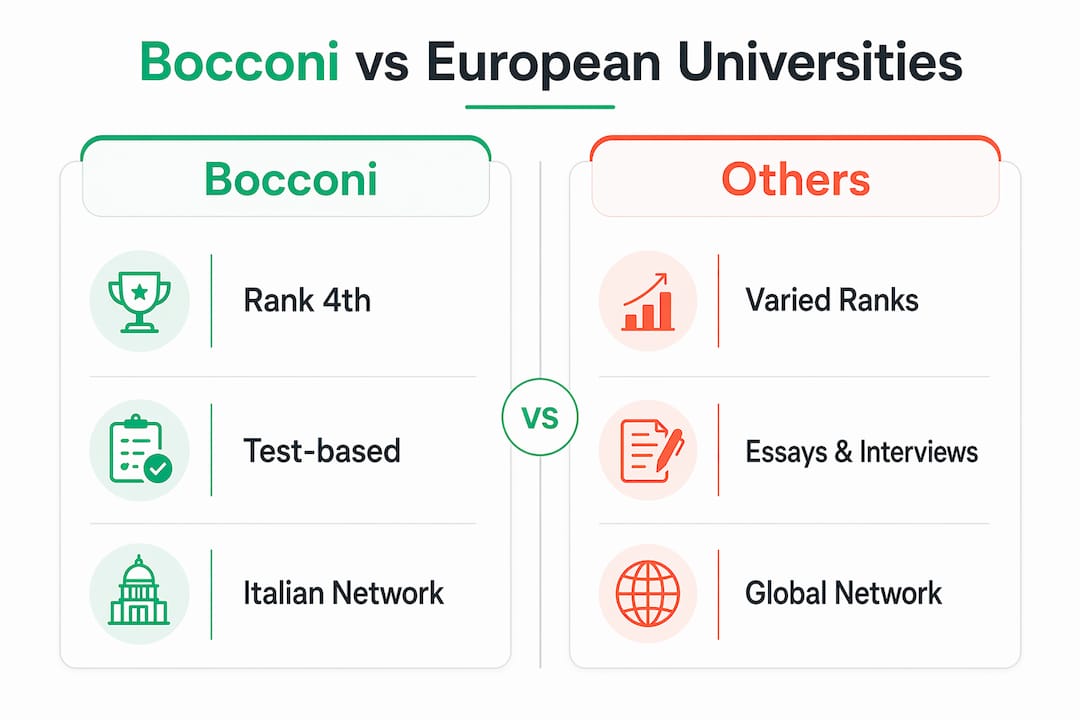
Bocconi’s position in the best European universities comparison depends heavily on which ranking you use. QS subject rankings place it 4th in Europe for Business and Management. That is a subject-specific ranking, which is the most relevant metric for a student choosing a business undergraduate program. General university rankings tell a different story. CWUR ranks Bocconi #590 worldwide, placing it in the top 2.8% globally. That gap between subject rank and general rank is not a weakness. It reflects Bocconi’s deliberate specialization in economics, management, and law rather than broad research output across all disciplines.
SDA Bocconi, the university’s executive education school, ranked #1 worldwide by the Financial Times in 2026 for custom executive education programs. It moved from #6 in 2024 to #3 in 2025 before reaching the top spot. That trajectory signals genuine institutional momentum, not a one-year anomaly.

Here is how Bocconi stacks up against key European peers across the metrics that matter most to undergraduate applicants:
| University | QS Business Rank (Europe) | Annual Tuition (Undergrad) | Admission Style |
|---|---|---|---|
| Bocconi University | 4th | ~€17,000 | Test + GPA only |
| London School of Economics | 1st–2nd | ~£13,000–£20,000 | Grades + personal statement |
| HEC Paris | Top 5 | ~€16,000–€18,000 | Competitive exam (CPGE) |
| Copenhagen Business School | Top 10 | ~€0 (EU) / €10,000+ (non-EU) | Grades + language tests |
| ESADE Business School | Top 15 | ~€15,000–€18,000 | Grades + interview |
Key differences to note:
- LSE and HEC Paris carry stronger global alumni networks, particularly in finance and consulting outside Europe.
- Copenhagen Business School offers near-zero tuition for EU students, making it a cost-effective alternative.
- Bocconi’s admission process is the most transparent and quantifiable of the group, with no subjective components.
- ESADE and Bocconi compete directly for students targeting Southern European and EU career markets.
Bocconi’s Bocconi academic reputation in Europe is strongest in Italy, the EU institutions, and Southern European corporate markets. Its brand recognition in London or New York is real but narrower than LSE or INSEAD.
What makes bocconi’s admission process different?
Bocconi’s undergraduate admission is weighted 55% on the Online Bocconi Test (or SAT/ACT) and 45% on high school GPA from your third-to-last and second-to-last school years. No essays, interviews, or extracurricular records factor into the decision. That is a significant departure from how most top European universities evaluate applicants.
The Online Bocconi Test is 100% online and approximately 75 minutes long. It covers Mathematics, Logic, Numerical Reasoning, Verbal Reasoning, and English Critical Reading across 50 multiple-choice questions scored on a 0–100 scale. Some years include a small penalty for wrong answers, so pacing and accuracy both matter.
Here is what the admission timeline looks like in practice:
- Choose your application round early. Early application rounds at Bocconi typically fill 90–95% of bachelor places. Applying in the Early or Winter round is not just strategic. It is close to necessary.
- Calculate your GPA correctly. Bocconi uses specific school years for GPA calculation. Using the wrong years is one of the most common applicant errors.
- Take the test more than once if needed. Retakes are permitted across rounds without penalty. Your best score counts.
- Submit your application online with the €100 fee. The portal is straightforward and accessible to international students.
- Track your score against the published cutoffs. Bocconi releases score thresholds, so you can assess your competitiveness before the final decision.
This process contrasts sharply with LSE, which requires a personal statement and academic references. HEC Paris requires completion of a two-year preparatory program called Classes Préparatoires aux Grandes Écoles before admission. ESADE includes an interview round. Bocconi’s merit-based quantifiable approach removes subjectivity entirely. For students who test well and have strong grades, that is a structural advantage.
Pro Tip: Focus your preparation time on the Online Bocconi Test first. A strong test score can compensate for a slightly lower GPA, but a weak test score is very hard to overcome regardless of your academic record.
What are bocconi’s real strengths and limitations?
Bocconi’s strengths are specific and worth understanding clearly before you apply.
Where Bocconi genuinely excels:
- Corporate connections in Milan. Milan is Italy’s financial and business capital. Bocconi students have direct access to consulting firms like McKinsey, Bain, and BCG, as well as investment banks and major EU corporations recruiting on campus.
- International student body. Roughly 30% of Bocconi’s 15,000 students are international. That creates a genuinely cosmopolitan classroom experience that many larger European universities do not match at the undergraduate level.
- Scholarship access. About 30% of students receive tuition waivers ranging from 20% to 100%. For a university charging ~€17,000 per year, that scholarship reach is meaningful and competitive.
- EU career positioning. Graduates targeting roles in EU institutions, Southern European markets, or Italian multinationals find Bocconi’s network directly relevant.
Where Bocconi has real limitations:
Bocconi’s global alumni influence is concentrated mainly in Italy and the EU, differing from global giants like LSE or INSEAD. If your career goal is a role in New York, London, or Singapore, that network gap is real and worth factoring into your decision.
The Italian-centric alumni network is the most cited limitation among graduates working outside Europe. LSE alumni chapters exist in over 100 countries. Bocconi’s reach is strong within Europe but thinner beyond it. INSEAD, with campuses in Fontainebleau and Singapore, offers a genuinely global network that Bocconi does not yet match.
The language environment is another factor. Most undergraduate programs at Bocconi are taught in English, but living and networking in Milan requires functional Italian within the first year. Students who arrive without any Italian often find the social integration slower than expected.
How should you compare bocconi to other universities?
The most common mistake applicants make is mixing rankings by program level. SDA Bocconi’s #1 Financial Times ranking applies to executive education, not undergraduate programs. Using that number to justify an undergraduate application choice is a category error.
Here is a practical framework for comparing Bocconi with other European universities:
- Match the ranking to your program level. Use QS subject rankings for bachelor comparisons. Use Financial Times or The Economist rankings for MBA comparisons. Never mix them.
- Build a comparison matrix. List your target universities by program level, ranking source, tuition cost, and admission style. A structured comparison matrix prevents the confusion that comes from comparing a QS subject rank to a general CWUR rank.
- Factor in your career geography. If you want to work in Milan, Rome, or Brussels, Bocconi’s network is a direct asset. If you want to work in London or New York, LSE or a UK Russell Group university may serve you better.
- Assess admission fit honestly. Bocconi rewards test performance and GPA. If your GPA is strong but your standardized test scores are average, prepare for the Online Bocconi Test seriously before applying.
- Account for total cost, not just tuition. Milan’s cost of living is high by Italian standards. Factor in housing, transport, and living expenses alongside the ~€17,000 tuition when comparing Bocconi to Copenhagen Business School or a German public university.
Pro Tip: When comparing universities, always check whether the ranking cited covers the specific subject and degree level you are applying for. A university ranked #1 in executive education and #4 in undergraduate business are two very different claims.
Key takeaways
Bocconi ranks 4th in Europe for Business and Management, admits students purely on test scores and GPA, and offers the strongest career network for students targeting Italy and the EU.
| Point | Details |
|---|---|
| Subject ranking vs. general ranking | Bocconi ranks 4th in Europe for Business but #590 overall; use subject rankings for undergraduate comparisons. |
| Admission is test-heavy | 55% of your admission score comes from the Online Bocconi Test or SAT/ACT, making test prep the highest-leverage activity. |
| Early rounds fill fast | 90–95% of bachelor places fill in Early and Winter rounds; apply early or risk losing your spot. |
| Network is EU-focused | Bocconi’s alumni network is strong in Italy and the EU but thinner globally compared to LSE or INSEAD. |
| Scholarships are real | About 30% of students receive tuition waivers of 20%–100%, making Bocconi more affordable than its sticker price suggests. |
Why bocconi is worth taking seriously — and where it falls short
I have reviewed admissions data and student outcomes across European business schools for years. Bocconi consistently surprises applicants who dismiss it because they have never heard of it the way they have heard of Oxford or LSE.
The test-only admission model is genuinely unusual in Europe. Most top universities use it as a filter, not the primary criterion. Bocconi’s approach means a student from a less-recognized high school in Brazil or Turkey can compete on equal terms with a student from a Swiss private school, as long as both can perform on the test. That is a real equity feature, not just marketing language.
Where I think students go wrong is treating Bocconi as a backup to LSE or a UK university. The programs are not equivalent in structure or outcome. Bocconi is a specialist institution. If your goal is a career in European business, consulting, or EU-level policy work, Bocconi is not a consolation prize. It is often the better choice.
The limitation I take seriously is the alumni network outside Europe. If you have clear ambitions in Asia or North America, that gap matters. But for the majority of applicants reading this, who are targeting European careers, Bocconi’s network is more than sufficient.
Apply early. Prepare for the test with the same seriousness you would give to the SAT. And do not let unfamiliarity with the Bocconi name make you underestimate what it can open for you.
— quentin
Get ready for the bocconi test with Prepadmit
Knowing how Bocconi stacks up against other European universities is the first step. Passing the Online Bocconi Test is the one that gets you in.
Prepadmit is built specifically for this exam. The platform uses official past papers and on-demand tests to simulate real test conditions, so you practice exactly what you will face on test day. Features include detailed answer corrections, skill-specific practice modes, and a ranking system that shows you where you stand against other applicants. Students using Prepadmit improve their scores by an average of 34%. The platform was developed by experts from HEC and Bocconi, and it costs a fraction of private coaching. Start your Bocconi test preparation today and give yourself the best shot at admission.
FAQ
What is bocconi’s ranking among european universities?
Bocconi ranks 4th in Europe for Business and Management Studies according to QS Subject Rankings 2026. Its executive education school, SDA Bocconi, ranks #1 worldwide per the Financial Times 2026.
Does bocconi require essays or interviews for admission?
No. Bocconi’s undergraduate admission relies entirely on the Online Bocconi Test (or SAT/ACT) and high school GPA. No essays, interviews, or extracurricular records are required.
How hard is the online bocconi test?
The test is 75 minutes long and covers Mathematics, Logic, Numerical Reasoning, Verbal Reasoning, and English Critical Reading across 50 questions. Consistent practice under timed conditions is the most effective preparation method.
Is bocconi affordable compared to other european business schools?
Bocconi charges approximately €17,000 per year, which is comparable to HEC Paris and ESADE. About 30% of students receive tuition waivers ranging from 20% to 100%, which can significantly reduce the actual cost.
How does bocconi’s alumni network compare to LSE or INSEAD?
Bocconi’s alumni network is strong across Italy and the EU but narrower globally than LSE or INSEAD. Students targeting careers in Southern Europe, EU institutions, or Italian multinationals will find the network directly useful.
Recommended
Related articles
Ready to ace your admission test?
Discover PrepAdmit, the platform that helps you succeed at top university admission tests.
Discover PrepAdmit