Bocconi Global Ranking Appeal Factors: 2026 Guide

Bocconi Global Ranking Appeal Factors: 2026 Guide
Bocconi University’s global ranking appeal factors are defined by a combination of academic selectivity, career outcomes, international diversity, and deep integration with Milan’s business ecosystem. The university ranks 12th worldwide in Social Sciences & Management (QS 2025) and consistently places in the top 15 globally for Business, Management, Finance, and Accounting. Its 94% graduate employment rate within 12 months signals that Bocconi delivers on its core promise to students. These factors work together, not in isolation, to build a reputation that attracts top students from over 100 countries.
1. Bocconi global ranking appeal factors: academic reputation and subject rankings
Bocconi’s subject rankings are the clearest signal of its academic strength. The university holds a top 15 global position in Business, Management, Finance, and Accounting, and ranks 12th worldwide in Social Sciences & Management according to QS 2025. The Financial Times places its Master in Finance in the top 5 globally and its Master in Management in the top 10. These numbers reflect consistent performance across multiple ranking systems, not a single strong year.
Subject rankings carry more weight than overall university rankings for business school applicants. A school ranked 200th overall but 12th in your field is more relevant to your career than a school ranked 50th overall with a weaker business program. Bocconi’s concentration in economics, finance, and management means its resources, faculty, and networks are all pointed in one direction.

Pro Tip: When comparing business schools, always check subject rankings alongside overall rankings. Bocconi’s subject scores often outperform its overall position, which makes it a stronger choice for finance and management students than headline numbers suggest.
2. Selective admissions and the meritocratic model
Bocconi’s admissions process is one of the most transparent in Europe. Undergraduate admission uses a weighted two-factor model: the Bocconi Test accounts for 55% of the score, and high school GPA from the third-to-last and second-to-last years accounts for 45%. Final-year grades are excluded, which removes grade inflation from the final selection equation.
This model is uncommon in European higher education. Most universities rely heavily on national exam results or subjective application reviews. Bocconi’s formula creates a level playing field for international applicants who come from different grading systems. The Bocconi Test score becomes the single most controllable variable in your application.
For master’s programs, the bar rises further. Programs like International Management enforce hard GMAT minimum scores of 600 before the dossier is even reviewed. That cutoff acts as a strict filter, ensuring the admitted cohort meets a defined academic standard. This selectivity feeds directly into rankings by raising the average academic profile of enrolled students.
- The Bocconi Test covers verbal reasoning, numerical reasoning, and problem-solving
- High school GPA is calculated from specific academic years, not the final year
- GMAT minimums for master’s programs vary by program but act as hard floors
- Selective admissions raise the academic profile of the student body, which boosts reputational survey scores in rankings
3. Career outcomes and employer reputation
Bocconi’s career outcomes are a primary driver of its global appeal. The 94% employment rate within 12 months of graduation is among the highest for any European business school. Beyond placement rate, 33% of graduates work internationally, which signals that Bocconi’s degree carries weight outside Italy.
“Employability and curriculum relevance provide a more stable appeal indicator than reputational surveys, which can fluctuate year to year.”
Employer reputation scores in rankings like QS and FT are built on surveys of hiring managers at major firms. Bocconi’s strong ties to European investment banks, consulting firms, and multinational corporations mean its graduates appear regularly on the hiring lists of top employers. That visibility reinforces the school’s employer reputation score in subsequent ranking cycles.
Milan’s concentration of financial institutions and consulting offices gives Bocconi students direct access to internships and graduate roles that students at more remote campuses cannot easily reach. The city functions as an extended campus for career development.
- Finance: strong placement at European investment banks and asset managers
- Consulting: McKinsey, BCG, and Bain recruit actively from Bocconi’s graduating classes
- Multinational corporations: Milan headquarters of major European and global firms create direct hiring pipelines
- International placement: 33% of graduates work outside Italy within the first year
4. International diversity and cross-border academic partnerships
International outlook is one of the four core criteria in most major ranking systems, and Bocconi scores well on every dimension of it. The university hosts over 100 nationalities on campus, with international students making up 30% of the student body. Most degree programs are taught in English, which removes the language barrier for non-Italian applicants.
Bocconi is a founding member of CIVICA, a European university network that includes the London School of Economics, Sciences Po, and Stockholm School of Economics. Membership in CIVICA enables student exchanges, joint research, and shared academic resources across eight leading European institutions. That network directly boosts Bocconi’s international partnership scores in rankings.
The combination of English instruction, a diverse student body, and formal academic alliances creates an environment that mirrors what students will encounter in global careers. Employers value graduates who have studied alongside peers from different educational and cultural backgrounds. Bocconi’s campus delivers that experience at scale.
- 30% international students from over 100 countries
- English-medium instruction across undergraduate and graduate programs
- CIVICA membership connecting Bocconi to top European universities
- Joint research initiatives and exchange programs with global partner institutions
Pro Tip: If you are applying as a non-EU student, Bocconi’s English-taught programs mean you can compete on equal terms with domestic applicants. Review the non-EU admission guide to understand the specific requirements for your country.
5. Milan’s role as a career accelerator
Milan is Italy’s financial capital and one of Europe’s top five business cities. The city hosts the headquarters of major Italian banks, the Italian Stock Exchange, and the European offices of global consulting and private equity firms. Students at Bocconi can attend industry events, take on part-time roles, and build professional networks while still enrolled.
Milan’s status as a corporate hub gives Bocconi an advantage that no ranking formula fully captures. Location creates access, and access creates outcomes. The 94% employment rate is partly a product of geography as much as curriculum quality.
Bocconi’s deep integration with the Milan ecosystem is a competitive advantage that rarely shows up in published rankings. Faculty consult for firms headquartered nearby. Alumni networks are dense and active within the city. That proximity to industry keeps the curriculum current and the career services team well-connected.
6. Strategic plan 2026–2030 and curriculum innovation
Bocconi’s Strategic Plan 2026–2030 focuses on three areas: increased internationalization, AI-focused curricula, and interdisciplinary skills. The plan reflects a deliberate effort to stay ahead of what employers and ranking systems reward.
New AI and data science courses are being integrated across business and economics programs. This is not a cosmetic update. The plan restructures how quantitative skills are taught across degree levels. Students graduating in 2027 and beyond will have formal training in AI applications within finance and management contexts.
- AI and data science courses integrated into core business programs
- Expanded English instruction to attract more international faculty and students
- Stronger partnerships with CIVICA and other global university networks
- New interdisciplinary programs combining economics with technology and policy
- Increased research output targets to boost academic reputation scores in rankings
Pro Tip: Bocconi’s curriculum updates mean that applicants who demonstrate quantitative aptitude on the Bocconi Test are increasingly well-positioned. Practicing test preparation strategies that cover numerical reasoning will align your skills with what the school values most.
7. Scholarships and accessibility as a ranking factor
Bocconi’s scholarship program affects its ranking appeal in a way that most prospective students overlook. The Bocconi4Access scheme provides tuition waivers ranging from 20% to 100% of fees. Approximately 30% of students receive financial aid, which broadens the socioeconomic and geographic diversity of the student body.
Diversity metrics feed into international outlook scores and reputational surveys. A student body drawn from a wider range of backgrounds produces a richer academic environment, which in turn attracts more diverse faculty and research partnerships. Accessibility is not just a social good at Bocconi. It is a ranking strategy.
For prospective students, the scholarship program also changes the financial calculus of applying. Bocconi’s tuition is competitive with other top European business schools, and a partial waiver can make it more affordable than programs at institutions with lower rankings. The financial aid guide for international students covers eligibility criteria and application timelines in detail.
Key takeaways
Bocconi’s global ranking strength comes from balanced performance across academic quality, career outcomes, international diversity, and strategic location rather than dominance in any single area.
| Point | Details |
|---|---|
| Academic subject rankings | Bocconi ranks top 15 globally in Business and Finance, and 12th in Social Sciences (QS 2025). |
| Selective admissions model | The 55% Bocconi Test and 45% GPA formula creates a transparent, meritocratic selection process. |
| Career outcomes | A 94% employment rate within 12 months and 33% international placement drive employer reputation scores. |
| International outlook | 30% international students, 100+ nationalities, and CIVICA membership boost ranking indicators. |
| Milan location advantage | Direct access to Europe’s financial and consulting firms accelerates graduate career outcomes. |
Why rankings only tell part of the Bocconi story
Bocconi’s ranking position is real, but the numbers understate what the school actually delivers. I have spent years analyzing how European business schools perform across ranking systems, and Bocconi is one of the clearest cases where the headline rank undersells the actual value.
The school’s ranking strength across multiple criteria rather than a single dimension is what makes it durable. Schools that spike in one area, say research output, often drop when that metric is weighted differently. Bocconi holds steady because it performs well across employer reputation, international outlook, and faculty quality simultaneously.
The geographic limitation is real and worth naming. Bocconi’s network is strongest in European finance and consulting. If your goal is a career in New York private equity or Singapore asset management, you will need to work harder to build those connections than a Bocconi graduate heading to Frankfurt or London. That is not a flaw. It is a fact about where the school’s alumni density sits.
My honest advice: if you are drawn to European finance, consulting, or policy, Bocconi is one of the two or three best choices on the continent. If you want a school with equal pull in Asia and North America, the calculus is more complicated. Know what you are optimizing for before you apply.
— quentin
Prepadmit: built for the Bocconi admissions process
The Bocconi Test accounts for 55% of your undergraduate admission score. That single number makes test preparation the highest-return activity you can do before applying.
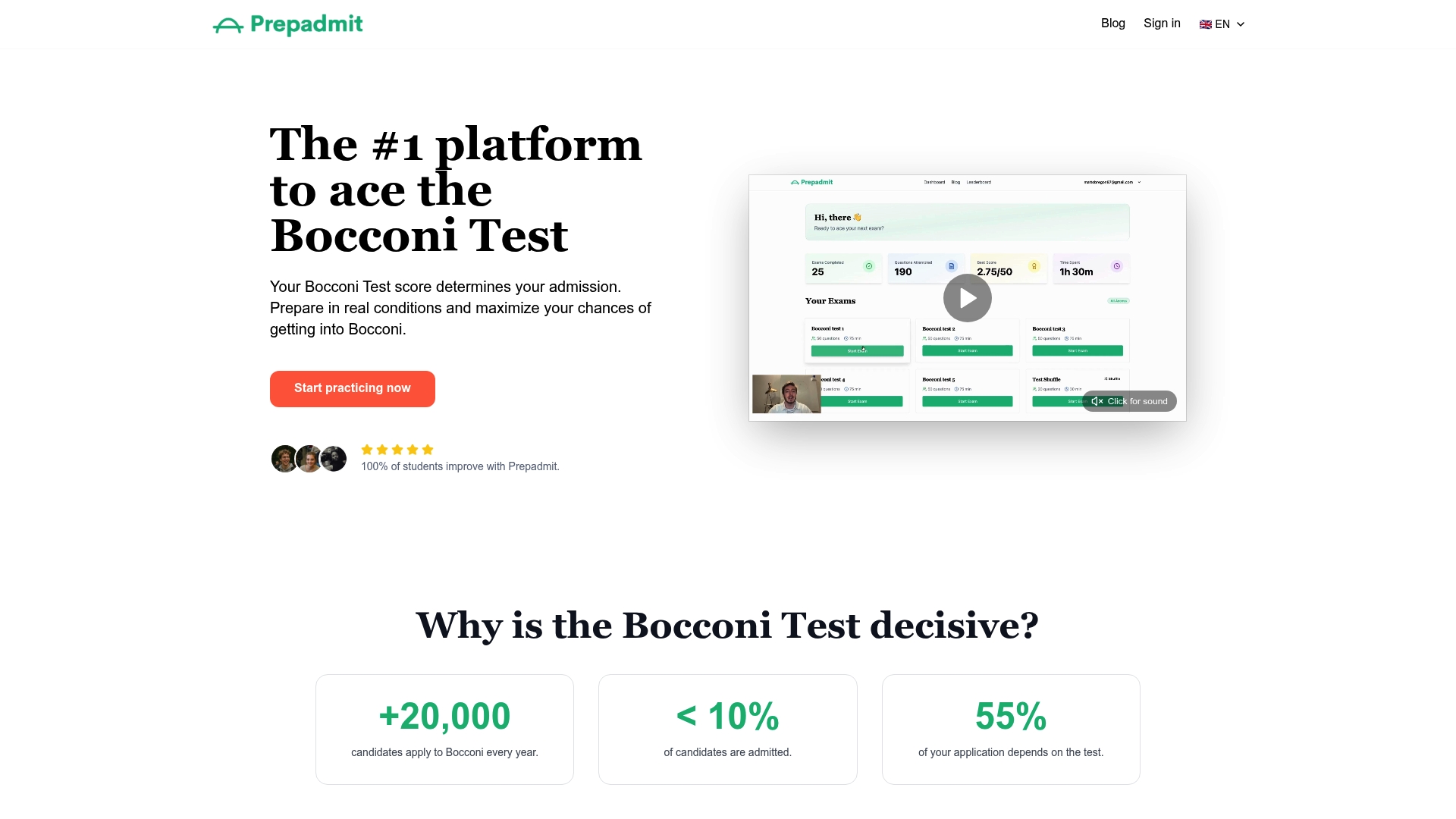
Prepadmit is built specifically for this exam. The platform uses official past papers and on-demand tests to simulate real exam conditions, so you practice exactly what you will face on test day. Detailed answer corrections show you where your reasoning broke down, not just which answer was wrong. A live leaderboard lets you benchmark your score against other applicants in real time. Students on Prepadmit improve their scores by an average of 34%. You can start practicing today and see where you stand before the application window opens.
FAQ
What is Bocconi’s ranking in business and finance?
Bocconi ranks in the top 15 globally for Business, Management, Finance, and Accounting (QS 2025) and 12th worldwide in Social Sciences & Management. Its FT Master in Finance ranks in the top 5 globally.
How does the Bocconi Test affect admission chances?
The Bocconi Test accounts for 55% of the undergraduate admission score, making it the single largest factor in the selection process. A strong test score can offset a weaker GPA, and vice versa.
What is Bocconi’s graduate employment rate?
Bocconi reports a 94% employment rate within 12 months of graduation, with 33% of graduates working internationally in major financial and business hubs.
Does Bocconi offer scholarships for international students?
Yes. The Bocconi4Access program provides tuition waivers from 20% to 100%, and approximately 30% of students receive some form of financial aid. Eligibility is based on academic merit and financial need.
What is CIVICA and why does it matter for Bocconi students?
CIVICA is a European university network that includes the London School of Economics and Sciences Po. Bocconi’s membership gives students access to exchange programs, joint research, and academic resources across eight leading European institutions.
Recommended
- Bocconi Admission Non-EU Student Guide for 2026 — PrepAdmit Blog
- What Is a Good Bocconi Test Score? Benchmarks and Targets for 2026 — PrepAdmit Blog
- Is the Bocconi Test Hard? An Honest 2026 Difficulty Breakdown — PrepAdmit Blog
- Which English Test Is Accepted by Bocconi? Official 2026 Requirements — PrepAdmit Blog
Related articles
Ready to ace your admission test?
Discover PrepAdmit, the platform that helps you succeed at top university admission tests.
Discover PrepAdmit