Bocconi Economics Program: What Applicants Must Know

Bocconi Economics Program: What Applicants Must Know
The Bocconi Economics program is a 3-year undergraduate degree taught entirely in English that blends economic theory, mathematics, statistics, and social sciences to prepare students for careers in finance, policy, research, and data science. Bocconi University, based in Milan, Italy, offers several distinct economics tracks under this umbrella, each with a different focus and career trajectory. If you are a high school student trying to understand what study in Bocconi actually looks like, this guide breaks down the curriculum, admission requirements, and career outcomes so you can make an informed decision before you apply.
What is the bocconi economics program, exactly?
The Bocconi Economics program refers to a group of bachelor’s degrees offered by Bocconi University that share a common foundation in economic theory and quantitative reasoning. The flagship track is the Bachelor in Economic and Social Sciences, known as ESS. It is more mathematically rigorous than a typical business degree and is designed for students who want to pursue research, policy work, or PhD pathways rather than standard corporate management.
Tuition for international students runs approximately $17,021 USD per year. That price point places Bocconi in the mid-range for European universities but well below comparable programs at London School of Economics or Sciences Po. The program’s English instruction makes it accessible to students from any country without requiring Italian language skills.

The educational philosophy at Bocconi prioritizes critical thinking over rote memorization. Students learn to apply interdisciplinary frameworks to real-world problems, not just pass exams. That distinction matters when you are choosing between programs.
How does the bocconi economics curriculum work?
The core curriculum covers economic theory, mathematics, statistics, and behavioral sciences in the first two years. The third year opens up to electives, specializations, and research projects. Every track integrates psychology and social sciences alongside the harder quantitative subjects, which is unusual for a European economics degree.
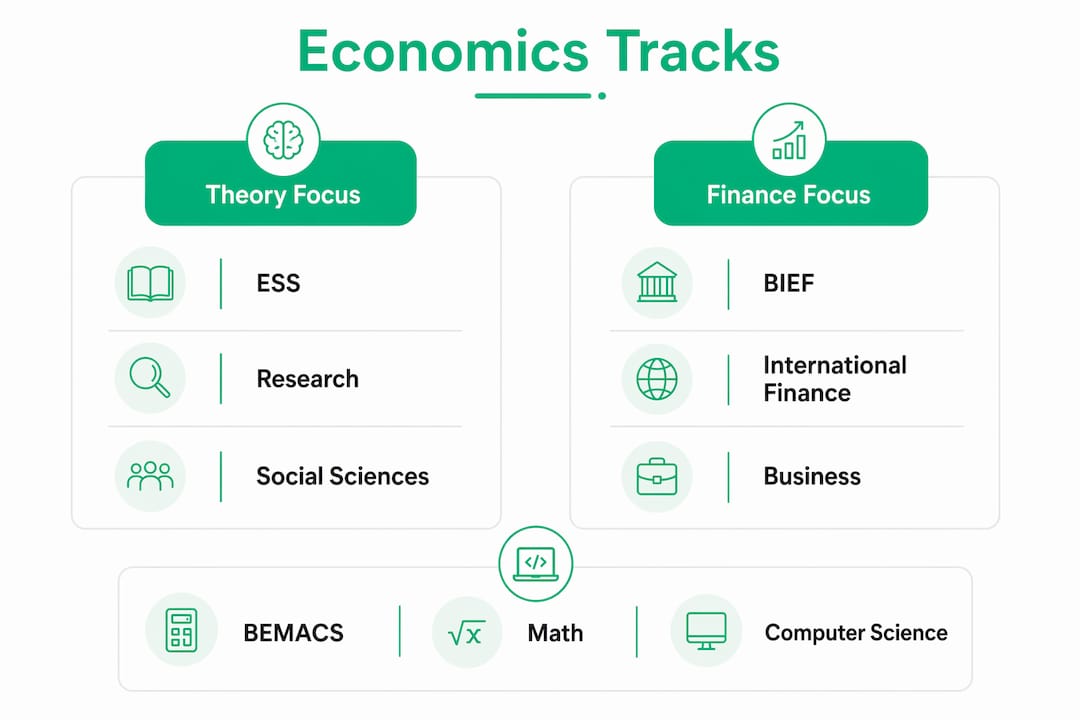
Bocconi offers three main economics-related bachelor’s tracks:
- ESS (Economic and Social Sciences): The most research-oriented track. Heavy on theory, statistics, and interdisciplinary social science. Best for students aiming at graduate school or policy roles.
- BIEF (Bachelor in International Economics and Finance): Focuses on global finance, international trade, and monetary economics. Suited for students targeting investment banking or international organizations.
- BEMACS (Economics, Management and Computer Science): The newest and fastest-growing track. It equips students with machine learning skills, data science tools, and economic reasoning for data-driven decision-making roles.
All three are 3-year interdisciplinary programs taught in English. The key difference is the balance between theory, finance, and computing.
Pro Tip: If you are strong in coding and math but also interested in economics, BEMACS is the track most employers in tech and consulting are currently recruiting from. The combination of machine learning and economic thinking is rare and in high demand.
Case-based learning and workshops led by practitioners appear across all three tracks. Bocconi bridges theory with practical application through research projects and sessions with business leaders and top scholars. You are not just reading textbooks. You are applying models to real scenarios from the first semester.
What are the bocconi economics admission requirements?
Admission to any Bocconi economics track is holistic. The university evaluates your Bocconi Test score, your high school GPA, your CV, and your extracurricular profile together. No single element automatically disqualifies you, but no single element guarantees admission either.
Here is how the process works:
- Bocconi Test: A standardized entrance exam covering verbal reasoning, numerical reasoning, and problem-solving. Your score is the most heavily weighted factor. Preparing specifically for this test is not optional if you want a competitive result.
- High school GPA: Bocconi reviews your academic transcript. Strong grades in mathematics and sciences signal readiness for the quantitative demands of the program.
- CV and extracurriculars: These act as tiebreakers in admissions when test scores and GPAs are similar. Leadership roles, research experience, and academic competitions all strengthen your file.
- Application form: You submit personal statements and background information through the Bocconi online portal during the application window.
The most common mistake applicants make is underestimating the mathematical rigor of the ESS program. Understanding the higher quantitative expectations before you apply prevents mismatched expectations and burnout in the first semester.
Pro Tip: Do not treat your CV as an afterthought. Students who document concrete achievements, such as math olympiad participation or economics research, stand out when scores are close. Build that record before your senior year.
The Bocconi On Demand Test is an alternative testing format that Bocconi introduced to give applicants more scheduling flexibility. Understanding how it differs from the standard test format is worth researching early in your preparation.
What careers do bocconi economics graduates pursue?
Bocconi economics graduates enter a wide range of fields. The program’s interdisciplinary design means you are not locked into one career path after graduation. Here are the most common directions:
- Investment banking and financial services: BIEF graduates in particular move into roles at firms like Goldman Sachs, JPMorgan, and European Central Bank affiliates.
- Policy advising and international organizations: ESS graduates frequently join the European Commission, World Bank, and national finance ministries.
- Data science and analytics: BEMACS graduates are recruited by tech companies and consulting firms for roles that combine economic modeling with data engineering.
- Management consulting: All three tracks produce graduates who enter firms like McKinsey, BCG, and Bain, often through internship pipelines built during the degree.
- Academic research and PhD programs: ESS is the most direct path to graduate school in economics at institutions like LSE, Bocconi’s own master’s programs, or American universities.
“Employers increasingly seek candidates with a 360-degree understanding of data combining economic, mathematical, and legal skills.” — Bocconi University
Bocconi’s student body includes approximately 4,000 international students out of a total of around 15,200. That international mix creates a network that spans continents and industries. The connections you build in class often matter as much as your GPA when you start applying for internships.
Faculty at Bocconi maintain strong ties to industry regulators, consulting firms, and central banks. Those relationships translate into internship referrals and job placements that students at less connected universities simply do not have access to. Early classroom engagement and research participation are the fastest ways to tap into that network.
How do the three bocconi economics tracks compare?
Choosing between ESS, BIEF, and BEMACS is the most important decision you make before applying. The table below lays out the key differences.
| Feature | ESS | BIEF | BEMACS |
|---|---|---|---|
| Primary Focus | Economic theory and social sciences | International finance and trade | Data science, computing, and economics |
| Math Intensity | Very high | High | Very high |
| Coding Required | No | No | Yes (Python, machine learning) |
| Best Career Path | Research, policy, PhD | Banking, international finance | Tech, consulting, data roles |
| Language | English | English | English |
| Program Length | 3 years | 3 years | 3 years |
| Elective Flexibility | Moderate | Moderate | Moderate |
All three programs share the same admission process through the Bocconi Test and GPA review. There are no separate entrance exams for individual tracks. You select your preferred program during the application, and Bocconi considers your profile against that track’s typical student profile.
ESS is the right choice if you want the most academically rigorous path and are open to graduate school. BIEF suits students who already know they want to work in global finance. BEMACS is the best fit if you want to combine economics with programming and data skills. A solid entrance exam revision plan applies equally well to all three tracks since the Bocconi Test is the same regardless of which program you choose.
Key takeaways
The Bocconi Economics program is a rigorous, English-taught, 3-year degree with three distinct tracks, each designed for a different career path, and admission depends on your Bocconi Test score, GPA, and extracurricular profile together.
| Point | Details |
|---|---|
| Three distinct tracks | ESS, BIEF, and BEMACS each target different careers: research, finance, or data science. |
| Holistic admissions | Bocconi weighs test scores, GPA, and CV together, so no single factor decides your outcome. |
| Mathematical rigor | ESS and BEMACS demand strong quantitative skills; underestimating this is the most common applicant mistake. |
| Career breadth | Graduates enter banking, policy, consulting, tech, and academia through strong faculty-industry ties. |
| International environment | Around 4,000 international students create a global network that supports career placement across industries. |
What i have learned watching students choose bocconi economics
Most students I talk to focus almost entirely on getting in. They spend months on test prep and almost no time thinking about which track actually fits their goals. That is a mistake that shows up fast once classes start.
ESS is not a business degree with extra math. It is closer to a rigorous social science degree with serious quantitative demands. Students who arrive expecting something like a finance program often struggle in the first semester. The ones who thrive are the ones who genuinely enjoy theory and are comfortable sitting with abstract problems before they get practical answers.
The research engagement opportunities at Bocconi are real, but you have to pursue them actively. Professors do not hand out research assistant roles. You ask for them. You show up to office hours. You engage with the material beyond the exam. The students who do this consistently are the ones who graduate with strong references and internship offers from places most people only read about.
My honest advice: pick the track that matches how you actually think, not the one that sounds most impressive at a dinner table. BEMACS is exciting right now because data science is everywhere. But if you do not enjoy coding, you will be miserable by year two. ESS is harder to explain to relatives, but it opens more doors at the graduate level than most applicants realize.
Bocconi rewards students who are genuinely curious and willing to work hard across disciplines. If that describes you, the program will deliver.
— quentin
Start your bocconi test preparation the right way
Knowing what the Bocconi Economics program offers is the first step. Getting in is the next one, and the Bocconi Test is where most applicants win or lose their spot.
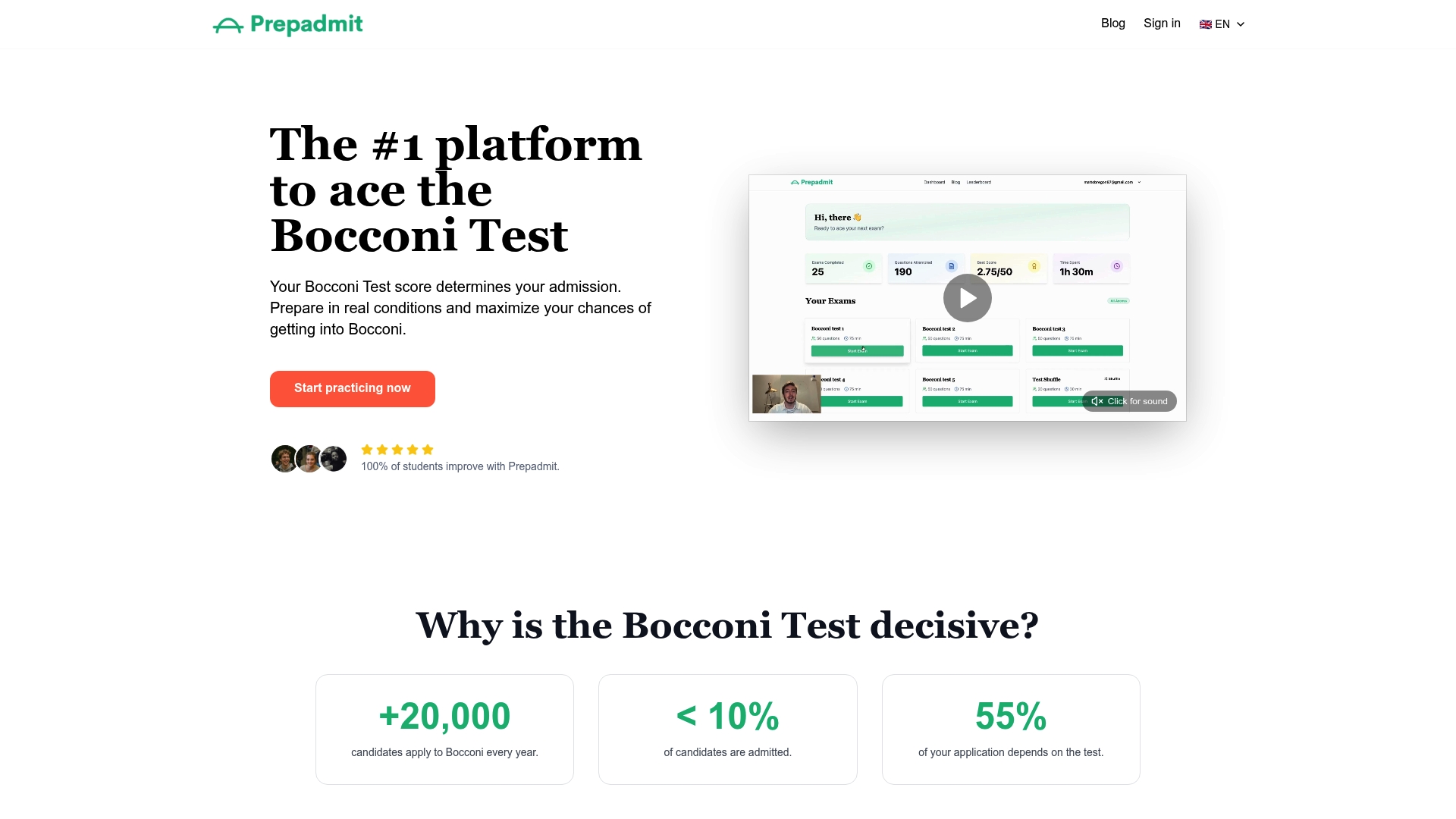
Prepadmit is built specifically for students preparing for the Bocconi Test. The platform uses official past papers and on-demand mock exams to simulate real test conditions. Detailed answer corrections show you exactly where your reasoning breaks down, not just which answers were wrong. Students using Prepadmit report an average score improvement of 34%. If you want structured, affordable preparation that actually moves your score, start preparing on Prepadmit today and give yourself the best shot at the program you want.
FAQ
What is the bocconi economics program in simple terms?
The Bocconi Economics program is a 3-year English-taught undergraduate degree at Bocconi University in Milan that combines economic theory, mathematics, and social sciences. It includes three tracks: ESS, BIEF, and BEMACS, each targeting different career paths.
How hard is it to get into bocconi economics?
Admission is competitive and holistic, weighing your Bocconi Test score, high school GPA, and extracurricular profile together. Strong math skills and a well-prepared test score are the most important factors.
Do i need to speak italian to study economics at bocconi?
No. All three economics bachelor’s tracks at Bocconi are taught entirely in English, so Italian language skills are not required for admission or coursework.
What is the difference between ESS, BIEF, and BEMACS at bocconi?
ESS focuses on economic theory and social sciences for research and policy careers. BIEF targets international finance and banking. BEMACS combines economics with computer science and machine learning for data-driven roles in tech and consulting.
How should i prepare for the bocconi test?
Use mock exams that replicate real test conditions, review your errors carefully, and practice consistently across verbal and numerical reasoning sections. Structured platforms designed specifically for the Bocconi Test give you the most targeted preparation available.
Recommended
Related articles
Ready to ace your admission test?
Discover PrepAdmit, the platform that helps you succeed at top university admission tests.
Discover PrepAdmit