Bocconi Data Interpretation Question Examples: 2026 Guide

Bocconi Data Interpretation Question Examples: 2026 Guide
Bocconi data interpretation questions are the numerical reasoning tasks that test your ability to extract, calculate, and compare data from tables, charts, and graphs under strict time pressure. The Bocconi Online Test includes 50 multiple-choice questions in approximately 75 minutes, with a scoring system of +1 for correct answers and a penalty of -0.20 to -0.25 for wrong ones. Competitive candidates score above 35 out of 50. Practicing bocconi data interpretation question examples before test day is the single most reliable way to close that gap.
What types of data interpretation questions appear on the Bocconi Test?
The Bocconi Test covers four core data question formats. Knowing each one before you sit down to practice saves you from wasting time figuring out the rules mid-drill.
- Percentage change questions. You read a table showing revenue or population across two years and calculate the percentage increase or decrease. The numbers are rarely round, so mental math speed matters.
- Ratio and proportion questions. A chart shows market share across five companies. You calculate which company holds exactly twice the share of another, or what fraction of total sales one segment represents.
- Average and weighted average questions. You receive a dataset of scores, salaries, or production figures and calculate a mean, sometimes weighted by a second variable like headcount.
- Compound growth questions. A graph shows a value growing at a fixed annual rate. You calculate the value after three or four periods using the compound growth formula.
- Multi-step interpretation questions. These combine two of the above. For example, you read a bar chart, calculate a ratio, then compare it to a percentage threshold stated in the question stem.
Data interpretation questions require quick calculation of percentages, ratios, and averages within 1.2 to 2 minutes per question. That window is tight when a question involves two calculation steps. The test also uses an adaptive structure with no backtracking, meaning you cannot return to a question once you move past it. That rule alone changes how you should approach uncertain answers.
Pro Tip: When you encounter a multi-step question, write the intermediate result in your head or on scratch paper before moving to the next step. Skipping ahead and trying to hold two numbers in memory at once is where most calculation errors happen.

How to effectively prepare for Bocconi data interpretation questions
Preparation for Bocconi exam data questions follows a clear sequence. Skipping steps in this sequence is the most common reason candidates plateau.
-
Build mental arithmetic speed first. Drills that automate percentage and ratio calculations reduce time loss during the actual exam. Spend 10 minutes each morning calculating percentages of three-digit numbers without a calculator. After two weeks, the calculations become reflexive.
-
Practice under timed conditions from day one. Simulating real exam conditions treats each practice session as a diagnostic. Set a 90-second timer per question and stop when it rings, even mid-calculation. This trains you to make a decision under pressure rather than freeze.
-
Complete at least 300 questions across six weeks. Top-scoring students practice at least 300 questions across all sections over six weeks. That volume builds both speed and pattern recognition. Spread the load across data interpretation, logical reasoning, and verbal sections.
-
Review every answer twice. Check your answers immediately after each session. Then review the same set again one week later. Repeated review prevents lucky guessing and forces you to understand the logic behind each solution.
-
Learn the penalty scoring system and build a guessing strategy. Wrong answers incur a negative penalty; omitted questions score zero. If you can eliminate two of five options, guessing is mathematically favorable. If you cannot eliminate any, skip and move on.
-
Practice on a digital interface without annotations. The online format with no option to annotate requires different habits than paper tests. Practice reading charts directly on screen and holding key numbers in working memory rather than circling them on paper.
A solid exam revision plan structures these six steps into weekly targets so you never lose momentum.
Pro Tip: If you finish a timed session with more than five minutes to spare, your timer is too generous. Shorten it by 15 seconds per question until you feel real pressure. Comfort during practice means you are not preparing for actual exam conditions.
Sample Bocconi data interpretation questions with explanations
These examples reflect the format and difficulty of actual Bocconi analytical questions. Work through each one before reading the explanation.
Question 1: Percentage increase
A company’s revenue was €240,000 in 2023 and €300,000 in 2024. What is the percentage increase?
Solution: Subtract the original from the new value: 300,000 minus 240,000 equals 60,000. Divide by the original: 60,000 divided by 240,000 equals 0.25. Multiply by 100 to get 25%. The shortcut is to recognize that 60,000 is exactly one quarter of 240,000, which you can spot without long division.
Question 2: Ratio comparison
A market has five companies. Company A holds 36% market share and Company B holds 12%. How many times larger is Company A’s share than Company B’s?
Solution: Divide 36 by 12 to get 3. Company A is exactly three times larger. On the actual test, the numbers are rarely this clean. Practice spotting common multiples quickly: 36/12, 45/15, 48/16 all equal 3.
Question 3: Weighted average
Three product lines generate revenues of €100,000, €200,000, and €300,000. Their profit margins are 10%, 20%, and 30% respectively. What is the weighted average profit margin across all three lines?
Solution: Calculate profit for each line: €10,000, €40,000, and €90,000. Total profit equals €140,000. Total revenue equals €600,000. Weighted margin equals 140,000 divided by 600,000, which equals approximately 23.3%. The common mistake is averaging the three percentages (which gives 20%) rather than weighting by revenue.
Question 4: Compound annual growth
A population of 10,000 grows at 5% per year. What is the population after two years?
Solution: Year 1: 10,000 multiplied by 1.05 equals 10,500. Year 2: 10,500 multiplied by 1.05 equals 11,025. The mental shortcut is to remember that two periods of 5% growth yields approximately 10.25% total growth, not 10%. That 0.25% difference is the compounding effect.
Question 5: Multi-step table interpretation
| Region | Sales (units) | Price per unit (€) |
|---|---|---|
| North | 4,000 | 50 |
| South | 2,500 | 80 |
| East | 1,500 | 60 |
Which region generates the highest total revenue, and what percentage of total revenue does it represent?
Solution: North: 4,000 × 50 = €200,000. South: 2,500 × 80 = €200,000. East: 1,500 × 60 = €90,000. Total revenue = €490,000. North and South are tied at €200,000 each. Each represents 200,000 divided by 490,000, which equals approximately 40.8%. This question tests whether you read the question carefully. “Highest” has two correct answers, and a rushed reader picks only one.
How does the Bocconi Test compare to similar admission tests?
Placing the Bocconi test in context helps you understand what makes its data analysis sample questions distinctive.
| Feature | Bocconi Test | GMAT (Data Insights) | SAT (Math) |
|---|---|---|---|
| Questions | 50 total, mixed sections | 20 data-focused questions | 44 math questions |
| Time per question | ~1.5 minutes | ~2.5 minutes | ~1.7 minutes |
| Penalty for wrong answers | Yes (−0.20 to −0.25) | No | No |
| Backtracking allowed | No | Yes | Yes |
| Annotation tools | None (online only) | On-screen tools | Paper scratch work |
| Question format | Multiple choice only | Multiple choice and multi-select | Multiple choice and grid-in |
The Bocconi test is uniquely demanding because it combines a penalty scoring system with no backtracking and no annotation tools. The GMAT gives you more time per question and lets you flag and return to items. The SAT allows scratch work on paper. Bocconi candidates must hold calculations in working memory and commit to answers without a safety net. That combination makes mock exam practice under realistic conditions more valuable here than for almost any other admission test.
Key Takeaways
Mastering Bocconi data interpretation questions requires timed practice, a clear guessing strategy, and at least 300 questions completed across six weeks of structured preparation.
| Point | Details |
|---|---|
| Know the scoring rules | Wrong answers cost −0.20 to −0.25 points; skipping costs nothing, so skip when you cannot eliminate options. |
| Practice 300+ questions | Top scorers complete at least 300 questions over six weeks to build speed and pattern recognition. |
| Automate mental arithmetic | Daily percentage and ratio drills make calculations reflexive, saving critical seconds per question. |
| No backtracking allowed | Commit to each answer before moving on; you cannot return to previous questions during the test. |
| Use digital practice tools | The online format with no annotation requires screen-based practice, not paper-based study habits. |
What I have learned from watching students prepare for this test
Most students who struggle with Bocconi data questions are not bad at math. They are slow at math under pressure. That distinction matters because the fix is different. Bad math requires learning new concepts. Slow math under pressure requires repetition until the process becomes automatic.
The second pattern I see constantly is students who review their wrong answers once and move on. One review is not enough. You need to revisit the same question a week later and solve it again from scratch. If you get it right the second time without remembering your first attempt, you have actually learned it. If you get it right because you remember the answer, you have memorized a number, not a method.
The third pattern is over-reliance on elimination. Elimination is a useful tool, but it is not a substitute for calculation. Students who eliminate down to two options and then guess are essentially flipping a coin on 20% of the test. That is too much variance. Build the calculation skills so you do not need to guess on questions you should be able to solve.
Finally, do not underestimate the no-annotation constraint. Practicing on paper and then switching to a screen for the real test is a genuine disadvantage. Train the way you will compete.
— quentin
Prepadmit: targeted practice for Bocconi data questions
Prepadmit is built specifically for students preparing for the Bocconi Test. The platform offers curated data interpretation practice questions, timed mock exams that replicate the actual test interface, and detailed answer explanations that show the fastest path to each correct answer.
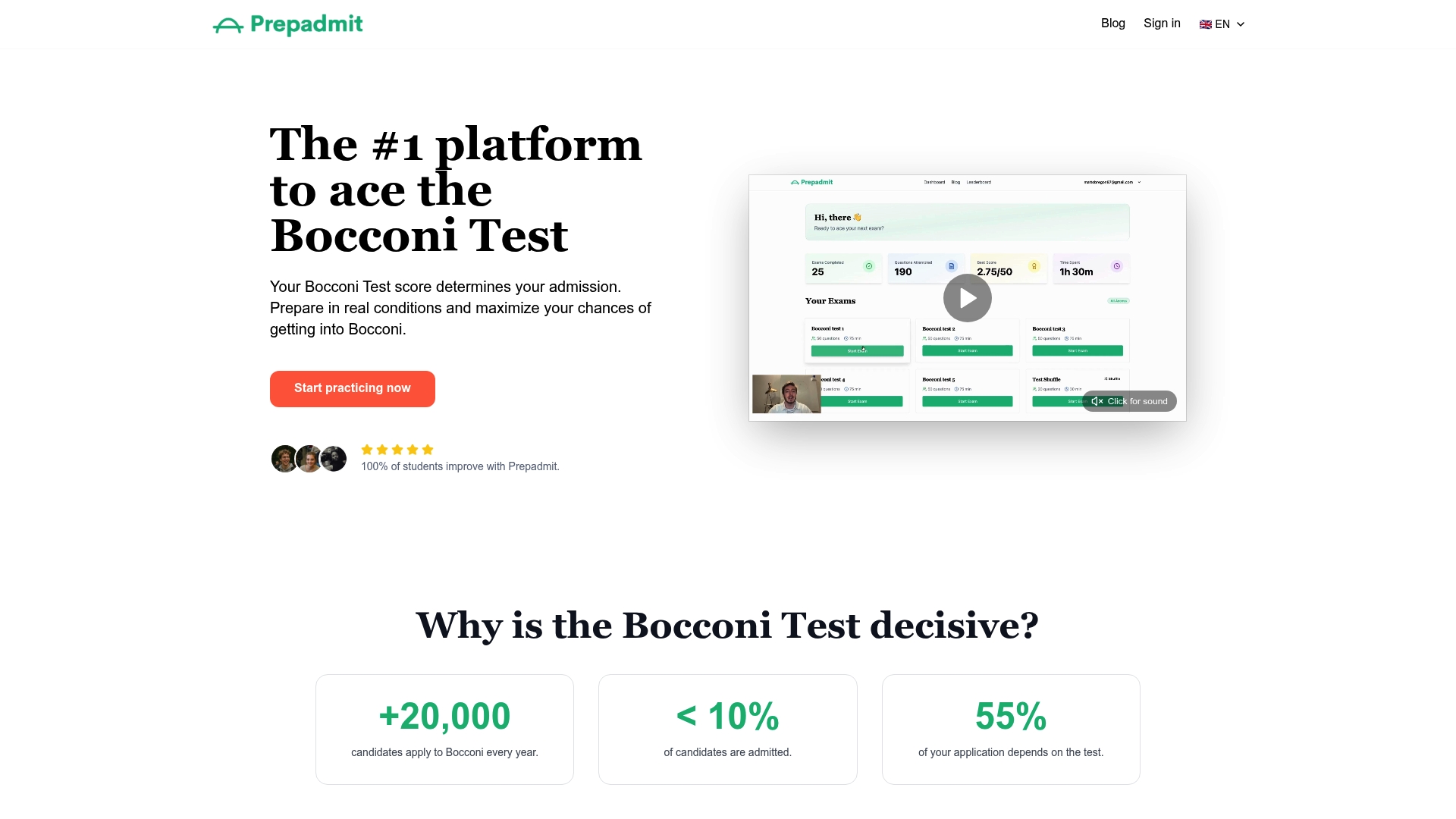
Prepadmit reports an average score improvement of 34% among its users. The platform was developed by experts with backgrounds from HEC and Bocconi University, so the question difficulty and format match what you will face on test day. If you want structured, realistic Bocconi test preparation without paying for private coaching, Prepadmit is the direct alternative. You can also read more about on-demand test advantages to understand how flexible practice sessions fit into a six-week study plan.
FAQ
How many data interpretation questions are on the Bocconi Test?
The Bocconi Online Test contains 50 multiple-choice questions in approximately 75 minutes, with data interpretation questions spread across the numerical reasoning section alongside other question types.
What is the penalty for wrong answers on the Bocconi Test?
Wrong answers receive a penalty of −0.20 to −0.25 points. Omitted questions score zero, so skipping is the safer choice when you cannot eliminate any answer options.
How long should I spend on each data interpretation question?
Each question allows roughly 1.2 to 2 minutes. Multi-step questions with tables or charts sit at the longer end of that range, so practice committing to an answer within 90 seconds.
Can I use scratch paper during the Bocconi Test?
No. The test is fully online with no annotation tools available. Practice reading and calculating directly from the screen to build the working memory habits the test demands.
What score do I need to be competitive on the Bocconi Test?
Competitive candidates typically score above 35 out of 50. The minimum entry threshold sits near 18 out of 50, but scoring at that level does not guarantee admission to selective programs.
Recommended
Related articles
Ready to ace your admission test?
Discover PrepAdmit, the platform that helps you succeed at top university admission tests.
Discover PrepAdmit