Bocconi Applicant Profile Examples: 2026 Guide

Bocconi Applicant Profile Examples: 2026 Guide
A strong Bocconi applicant profile is defined by two numbers: your Bocconi Test score and your high school GPA from your 3rd-last and 2nd-last years. Bocconi University’s undergraduate admission is strictly merit-based, weighting test scores at 55% and GPA at 45%. No motivation letter, CV, or interview enters the equation. This makes Bocconi unlike almost every other top European university, and it means your preparation strategy must be laser-focused on exactly two measurable outputs. The bocconi applicant profile examples below show you what competitive looks like in 2026, with real score ranges and GPA benchmarks for each major program type.
1. What Bocconi applicant profile examples look like for top programs
The most competitive Bocconi undergraduate profiles share a clear pattern. Bocconi Test scores of 43 to 47+ are the standard for English-taught programs like BIEF (Bachelor in International Economics and Finance) and BIEM (Bachelor in International Economics and Management). A score of 40 to 44 covers highly competitive Italian-taught programs. Anything below 40 makes admission unlikely regardless of GPA.
Here are four concrete profile models that illustrate what successful applicants look like:
- Profile A (BIEF/BIEM target): Bocconi Test score of 46, GPA of 8.7/10 from 3rd-last and 2nd-last years (excluding physical education, behavior, and religion). This profile sits comfortably in the admit range for the most competitive English-taught programs.
- Profile B (Italian-taught Economics target): Bocconi Test score of 42, GPA of 8.4/10. Competitive for programs like CLEF and CLEAM, with a realistic shot at merit scholarship consideration if applied in the Winter session.
- Profile C (Multiple attempts, improving trajectory): First attempt score of 38, second attempt score of 44 after structured preparation. Bocconi uses your highest score across all submissions, so this applicant’s final profile reflects the 44, not the 38.
- Profile D (SAT equivalent): SAT score of 1450 combined with a GPA of 8.6/10. Bocconi accepts SAT and ACT scores as substitutes for the Bocconi Test, and this profile is competitive for mid-tier English-taught programs.
Pro Tip: If you are applying with an SAT or ACT score, submit your Bocconi Test score too if you have one. Bocconi takes the highest across all three, so multiple submissions only help you.
2. How Bocconi’s evaluation system differs from holistic admissions

Bocconi’s undergraduate admissions model is a direct contrast to the holistic approach used by schools like UCL, Bocconi’s peer in European business education, or American universities like NYU Stern. The table below makes the difference concrete.
| Criterion | Bocconi (Undergraduate) | Typical Holistic University |
|---|---|---|
| Standardized test score | 55% of total score | One factor among many |
| High school GPA | 45% of total score | One factor among many |
| Motivation letter | Not considered | Often required |
| CV / extracurriculars | Not considered | Frequently weighted |
| Interview | Not required | Common for top programs |
| Personal statement | Not required | Standard requirement |
Graduate admissions at Bocconi follow a different model entirely. The SDA Bocconi MBA, for example, requires motivation letters, CVs, and interviews, with GMAT scores of 690+ expected. The undergraduate process strips all of that away. This means the energy you might spend crafting a personal narrative is better spent on timed practice tests and GPA verification.
The practical implication is significant. You cannot compensate for a weak test score with a compelling story. A score of 38 with a perfect personal statement loses to a score of 44 with no personal statement at all.
3. Score thresholds by program type
Not every Bocconi program demands the same score. Knowing the threshold for your target program prevents you from over-preparing for a score you do not need or under-preparing for one you do.
English-taught programs (BIEF, BIEM, BESS): These are the most competitive. Target a Bocconi Test score of 43 or above. A score of 47 or higher puts you in a strong position for both admission and merit scholarship consideration.
Italian-taught economics and management programs (CLEF, CLEAM, CLES): A score in the 40 to 44 range is competitive here. These programs draw a large applicant pool from Italian high schools, so GPA quality matters more at the margin.
Law and social sciences programs: Score requirements sit slightly lower, typically in the 38 to 42 range, but GPA from core academic subjects remains a meaningful differentiator.
The minimum score Bocconi will consider for any program is 17. That number is not a target. It is the floor below which your application is automatically excluded. Treat 40 as your personal minimum and 44 as your realistic goal for any competitive program.
4. Effective strategies to build a competitive profile
Building a strong profile requires a plan that starts months before your application deadline, not weeks.
- Start test preparation 8 to 12 weeks out. Structured preparation over 6 to 8 weeks can improve scores by 10 or more points. Starting earlier gives you buffer time to identify weak areas and repeat targeted practice.
- Use your first test attempt as a dry run. Test-taking experts recommend treating the first sitting as a calibration exercise. The real-exam pressure reveals timing issues and question-type weaknesses that mock tests alone cannot fully replicate.
- Submit all available scores. Bocconi records your highest score across Bocconi Test, SAT, and ACT submissions. There is no penalty for submitting a lower score alongside a higher one.
- Verify your GPA calculation before entering it. Physical education, behavior, and religion grades are excluded from the Bocconi GPA calculation. Enter only core academic subjects. An inflated GPA from included non-academic grades does not help you; it creates a discrepancy that can hurt your application during verification.
- Apply in the Winter session. Approximately 90 to 95% of undergraduate spots fill by the Winter session. Early applicants face less competition and have access to the full range of merit scholarships. Late-session applicants compete for what remains.
- Practice with official mock exams. The Bocconi Test has a specific format, timing, and question style. Generic SAT prep does not replicate it. Use past papers and on-demand tests that mirror the real exam structure.
- Track your score by section, not just total. The Bocconi Test covers logical reasoning, mathematics, and reading comprehension. Knowing which section costs you the most points lets you allocate practice time where it matters.
Pro Tip: Apply in the earliest available session even if your score is not yet where you want it. You can retake the test and update your application. An early application with a later score update beats a late application with a perfect score.
5. Common mistakes that weaken Bocconi applicant profiles
Most applicants who fall short do not fail because they lacked ability. They fail because of avoidable errors in how they built and submitted their profile.
- Including excluded subjects in GPA. Incorrect GPA calculation is one of the most common errors. Physical education, behavior, and religion grades must be excluded. Students who include them either inflate their GPA artificially or create a mismatch with official transcripts during verification.
- Preparing for the SAT instead of the Bocconi Test. The Bocconi Test is not an SAT. Its logical reasoning section, timing constraints, and question formats are distinct. Applicants who rely only on SAT preparation consistently underperform on the actual Bocconi Test.
- Applying in the Spring or Summer session. By the time late sessions open, most spots are already filled. Scholarship pools are also significantly reduced. Late applicants are not just competing for fewer places; they are competing against a pool that includes applicants who were rejected in earlier sessions.
- Submitting only one test score. Since Bocconi takes your highest score across all submissions, not submitting all available scores leaves points on the table for no reason.
- Overestimating the value of extracurriculars. Extracurriculars and personal statements are excluded from undergraduate admission. Time spent polishing a CV or writing a personal narrative is time not spent on test preparation. This is the single most common misallocation of effort among international applicants.
Key takeaways
A competitive Bocconi undergraduate profile requires a Bocconi Test score above 40, a verified GPA from core academic subjects only, and an application submitted in the Winter session.
| Point | Details |
|---|---|
| Score is the primary lever | Target 43 or above for English-taught programs; 40 to 44 for Italian-taught programs. |
| GPA must exclude non-academic subjects | Remove physical education, behavior, and religion before entering your GPA. |
| Submit all standardized scores | Bocconi uses your highest score across Bocconi Test, SAT, and ACT submissions. |
| Apply early for scholarships | 90 to 95% of spots fill by Winter session; early applicants access the full scholarship pool. |
| Extracurriculars do not count | Undergraduate admission is purely score and GPA based; personal narratives have zero weight. |
What I have learned from watching applicants succeed and fail at Bocconi
After working with hundreds of students preparing for Bocconi, the pattern is consistent. The applicants who succeed are not always the most academically gifted. They are the ones who accepted the rules of the game early and played accordingly.
The biggest mindset shift I see students resist is letting go of the holistic application instinct. If you have been preparing for American or British universities, you are trained to think that your story matters. At Bocconi’s undergraduate level, it does not. That is not a criticism of the system. It is a feature. It means the process is predictable and controllable in a way that holistic admissions never are.
The students who struggle are usually the ones who spend October writing a personal statement that no one will read, then panic in January when their test score is not where it needs to be. The students who get in are the ones who spent October doing timed practice tests and verifying their GPA calculation.
One more thing: do not treat your first test attempt as your only attempt. The on-demand test format at Bocconi gives you flexibility. Use it. A student who scores 38 on their first attempt and 45 on their second is admitted. A student who scores 38 once and never retakes is not.
— quentin
How Prepadmit helps you build the profile Bocconi wants
Prepadmit is built specifically for students preparing for the Bocconi Test. The platform offers official past papers, on-demand mock exams, and section-by-section performance tracking so you know exactly where your score is leaking.
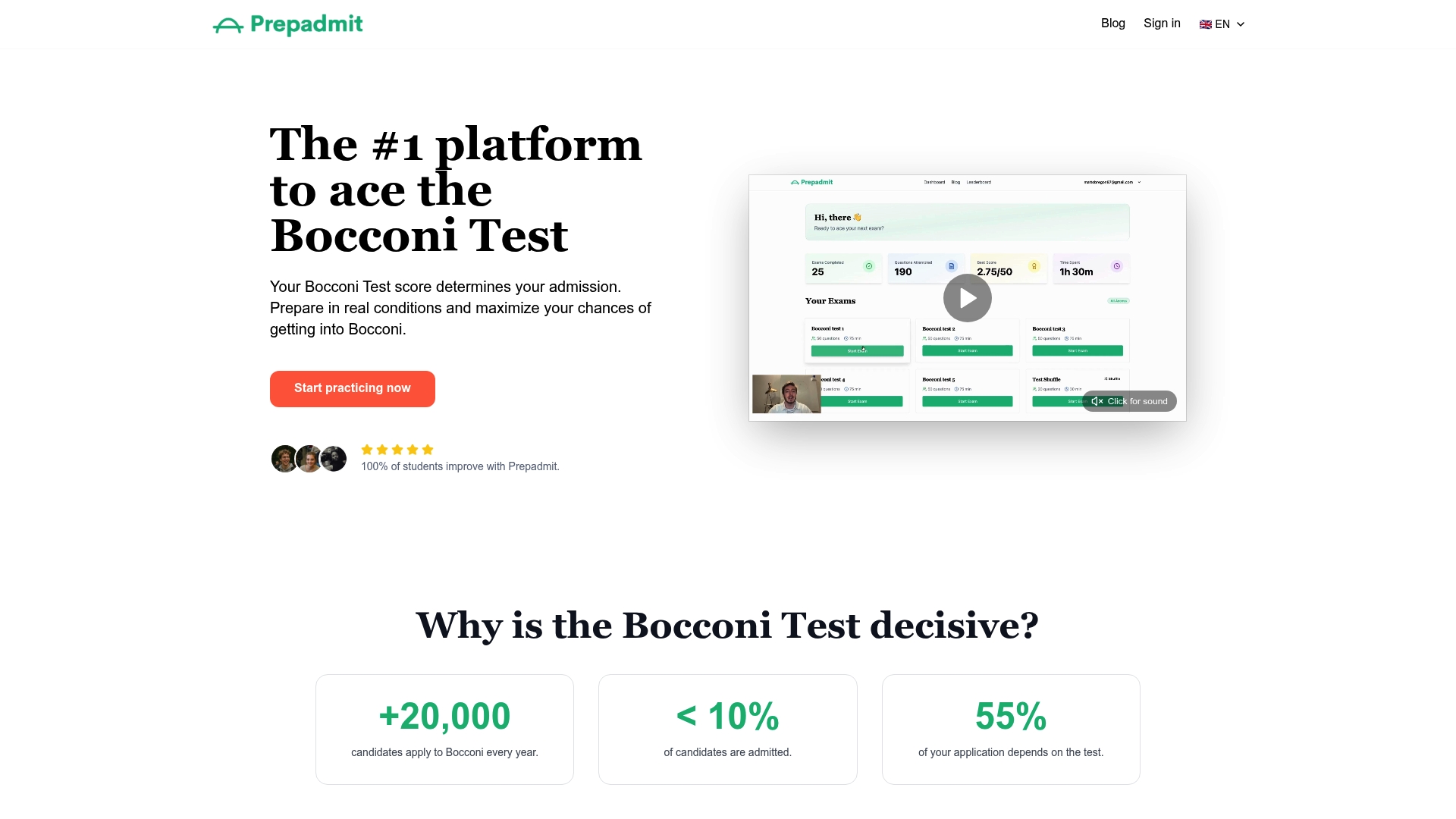
Students using Prepadmit improve their scores by an average of 34%. The platform was developed by experts from HEC and Bocconi, so the content reflects the actual test format, not a generic approximation of it. If you are serious about hitting the score threshold your target program requires, start your preparation on Prepadmit today. It costs a fraction of private coaching and comes with a money-back guarantee.
FAQ
What Bocconi Test score do I need for BIEF or BIEM?
A score of 43 to 47 or above is the competitive range for English-taught programs like BIEF and BIEM. Scores below 40 make admission to these programs unlikely.
Does Bocconi consider extracurriculars for undergraduate admission?
No. Undergraduate admission at Bocconi is based entirely on test scores and GPA. Extracurriculars, personal statements, and CVs are not considered.
Which GPA years does Bocconi use for undergraduate admission?
Bocconi uses grades from your 3rd-last and 2nd-last years of high school, excluding physical education, behavior, and religion grades from the calculation.
Can I submit both a Bocconi Test score and an SAT score?
Yes, and you should. Bocconi records your highest score across all standardized test submissions, so submitting multiple scores only works in your favor.
When should I apply to Bocconi for the best admission chances?
Apply in the Winter session. Around 90 to 95% of undergraduate spots fill by that session, and the full merit scholarship pool is available only to early applicants.
Recommended
Related articles
Ready to ace your admission test?
Discover PrepAdmit, the platform that helps you succeed at top university admission tests.
Discover PrepAdmit