Adaptive Test Preparation: A Complete Student Guide

Adaptive Test Preparation: A Complete Student Guide
Adaptive test preparation is a personalized study method that continuously adjusts your practice based on real-time performance data, targeting your specific knowledge gaps instead of covering every topic equally. Unlike a fixed study plan that treats every student the same, adaptive prep uses algorithms to build a unique learning path for you. Platforms like PrepScholar pioneered this approach for SAT and ACT prep, and AI-driven tools have since expanded it to GRE, university entrance exams, and beyond. The result is a study experience that gets smarter the more you use it, spending your time where it counts most.
What is adaptive test preparation and how does it differ from adaptive testing?
Adaptive test preparation is defined as a dynamic, data-driven study method that personalizes your practice in real time based on your performance. The term is sometimes confused with adaptive testing, which refers to the format of the actual exam itself. These are two separate concepts worth understanding clearly.
Adaptive testing in an exam context means the test software selects each question based on how you answered the previous one. The SAT, GRE, and many professional certification exams use this format. Adaptive test preparation, by contrast, is what happens before exam day. It is the study process that uses the same logic to decide what you should practice next, how difficult that practice should be, and which skills need the most attention.
Adaptive systems provide reliable ability estimates with fewer questions compared to static study plans. That efficiency matters when you have limited weeks before a university entrance exam. Personalized test preparation of this kind focuses your energy precisely, rather than asking you to review material you already know.
How does adaptive test preparation work behind the scenes?
The technology driving adaptive prep is more sophisticated than most students realize. At its core, the system runs a diagnostic assessment when you first sign up. That assessment maps your baseline skill level across every topic the exam covers.
From that point forward, the platform tracks three data streams with every question you answer:
- Accuracy: Did you get it right or wrong?
- Response time: How long did it take you to answer?
- Error patterns: Which specific sub-skills are causing mistakes?
Modern adaptive systems use AI including reinforcement learning to analyze this behavioral data and adjust content complexity dynamically. Deep Q-Networks, a type of AI model, optimize your learning path to reduce the risk of disengagement and improve outcomes through personalized resource suggestions. That is a significant step beyond simply making questions harder or easier.
The most effective platforms build what researchers call a granular knowledge map, targeting specific sub-skills rather than broad subject areas. For example, instead of flagging “reading comprehension” as a weak area, the system identifies that you struggle specifically with inference questions in science passages. That level of precision is what separates adaptive prep from a traditional study guide.

Pro Tip: Answer every diagnostic question honestly and at your own pace. Guessing randomly or rushing through the initial assessment gives the algorithm inaccurate data, which sends your entire study path in the wrong direction.
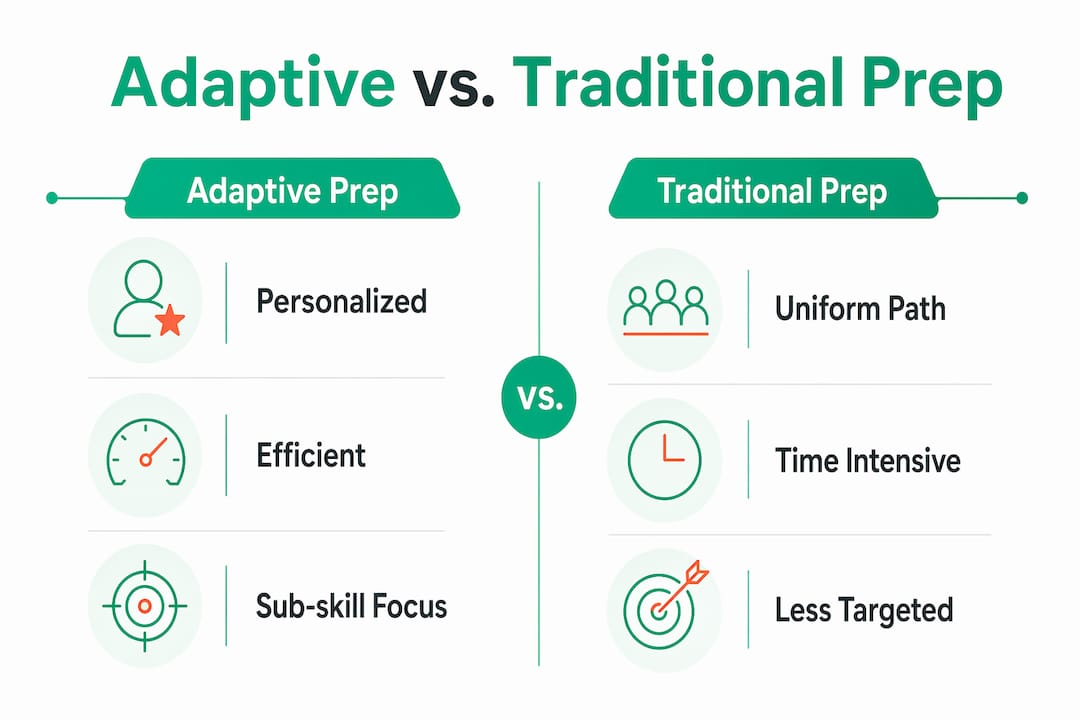
A static study plan cannot do any of this. It assigns the same chapters in the same order to every student, regardless of whether you already mastered those topics two years ago.
What are the benefits and limitations of adaptive prep vs. traditional methods?
Adaptive test preparation offers clear advantages over traditional methods, but it also has real constraints. Understanding both helps you use it correctly.
Key benefits
- Efficiency: Adaptive testing technology can reduce test lengths by 50%–90% while maintaining or improving accuracy. A 30-question adaptive session can outperform a 60-question fixed session by focusing precisely on your proficiency level.
- Precision: The system identifies knowledge gaps with fewer questions than a traditional test would require. You spend less time confirming what you already know.
- Engagement: Matching difficulty to your level avoids both frustration and boredom, which keeps motivation higher over a long study period.
- Exam readiness: Practicing in an adaptive format prepares you for the actual structure of exams like the SAT and GRE, which use adaptive question delivery.
Honest limitations
Not every claim about adaptive prep holds up in every situation. Adaptive tests are not always shorter by default. When a curriculum requires full content coverage, such as a national exam with mandatory topic lists, adaptive prep may take just as long as a fixed-form approach. Time savings depend heavily on the platform’s design and the exam’s requirements.
The quality of the question bank also matters enormously. Poor question pools lead to repetitive or inaccurate assessments, which breaks the entire personalization engine. A platform with 200 questions cannot adapt meaningfully. Effective adaptive systems require a professionally calibrated item bank typically three times the size of the test length, piloted on large student samples to confirm psychometric validity.
| Feature | Adaptive prep | Traditional prep |
|---|---|---|
| Study path | Personalized to your gaps | Same for every student |
| Question difficulty | Adjusts in real time | Fixed by chapter or level |
| Time efficiency | High when content coverage is flexible | Consistent but often inefficient |
| Exam format alignment | Matches adaptive exam formats | May not reflect actual exam structure |
| Transparency | Less visible logic | Clear, predictable structure |
Choosing between adaptive and fixed-form approaches depends on your goals. Efficiency and precision favor adaptive models. Simplicity and full content coverage favor fixed-form plans. Most students benefit from using both.
How does adaptive prep enhance performance and test confidence?
The cognitive benefits of adaptive test preparation go beyond just covering the right material. The method builds genuine mastery by targeting fine-grained sub-skills and reinforcing them incrementally.
Adaptive assessments provide precise data on a student’s current learning status, which is especially powerful for students at lower achievement levels. Knowing exactly where you stand removes the guesswork from studying. You stop wondering whether you are ready and start seeing measurable progress.
Test anxiety is a real obstacle for many students preparing for university entrance exams. Adaptive prep addresses this directly. When questions match your current ability level, you are neither overwhelmed by content that is too hard nor bored by content that is too easy. That balance keeps your confidence intact across a long preparation period.
The sub-skill focus also builds self-awareness. When the platform tells you that your weakest area is data interpretation in quantitative reasoning, you know exactly what to work on next. That clarity replaces the vague anxiety of “I need to study math” with a specific, manageable task.
Pro Tip: Combine adaptive prep sessions with full-length practice tests under timed conditions. Adaptive sessions sharpen your weak areas, but full mock exams build the stamina and pacing skills the actual test demands.
Students who use adaptive learning techniques alongside realistic practice conditions consistently report stronger performance on exam day. The combination of targeted skill work and full-exam simulation covers both precision and endurance.
What should you look for in an adaptive test prep platform?
Not all platforms that call themselves adaptive actually deliver meaningful personalization. Here is what to evaluate before committing to one.
Question bank quality is the single most important factor. A small or poorly designed question pool breaks the algorithm’s ability to adapt accurately. Look for platforms built by subject-matter experts, with questions that closely mirror the actual exam format and difficulty range.
AI engine sophistication separates surface-level tools from genuinely effective ones. Ask whether the platform tracks sub-skills or just broad topics. A platform that only knows you got a math question wrong is far less useful than one that identifies the specific concept behind the error.
Alignment with your target exam is non-negotiable. A platform designed for the SAT will not prepare you well for the Bocconi Test or the GRE. Confirm that the content, question types, and difficulty calibration match the specific exam you are taking.
Additional features worth checking:
- Progress tracking with clear visual reports
- Peer ranking or benchmarking to gauge your standing
- Skill-specific practice modes for focused sessions
- Detailed answer explanations, not just correct/incorrect feedback
Managing expectations matters too. Adaptive prep is a tool, not a guarantee. It works best when you show up consistently, engage honestly with every question, and use the data it gives you. A well-structured revision plan that incorporates adaptive sessions alongside timed practice will outperform either method used alone.
Key takeaways
Adaptive test preparation works because it replaces generic study plans with a personalized, data-driven path that targets your exact weaknesses and adjusts in real time.
| Point | Details |
|---|---|
| Core definition | Adaptive prep personalizes your study path using real-time performance data, not a fixed curriculum. |
| Technology behind it | AI and reinforcement learning analyze accuracy, speed, and error patterns to adjust question difficulty dynamically. |
| Efficiency gains | Adaptive systems can reduce required practice volume significantly, but only when content coverage is flexible. |
| Confidence and anxiety | Matching question difficulty to your level reduces test anxiety and builds measurable, incremental mastery. |
| Platform selection | Prioritize expert-curated question banks and sub-skill tracking over platforms that only adjust broad difficulty. |
Why I think most students are using adaptive prep wrong
I have watched hundreds of students go through adaptive prep platforms and make the same mistake. They treat the diagnostic like a speed round, clicking through quickly to get to the “real” studying. Then they wonder why the platform keeps sending them easy questions or misses their actual weak spots.
The algorithm is only as good as the data you feed it. Honest, deliberate engagement with every question is not optional. It is the foundation the entire system builds on.
The other pattern I see is students using adaptive prep as their only study method. Adaptive sessions are excellent for identifying and closing skill gaps. They are not a substitute for sitting through a full-length, timed practice exam. The Bocconi Test, like most high-stakes university entrance exams, rewards both precision and endurance. You need both.
My honest view is that adaptive prep is the most efficient study tool available for targeted skill work. But technology does not replace effort. The students who improve the most are the ones who show up consistently, take the feedback seriously, and combine adaptive sessions with realistic full-exam practice. The tool is powerful. What you do with it is what determines your result.
— quentin
How Prepadmit brings adaptive preparation to the Bocconi Test
Prepadmit is built specifically for students preparing for the Bocconi Test, one of Italy’s most competitive university entrance exams. The platform combines skill-specific practice modes, detailed answer corrections, and progress tracking to give you a genuinely personalized preparation experience.
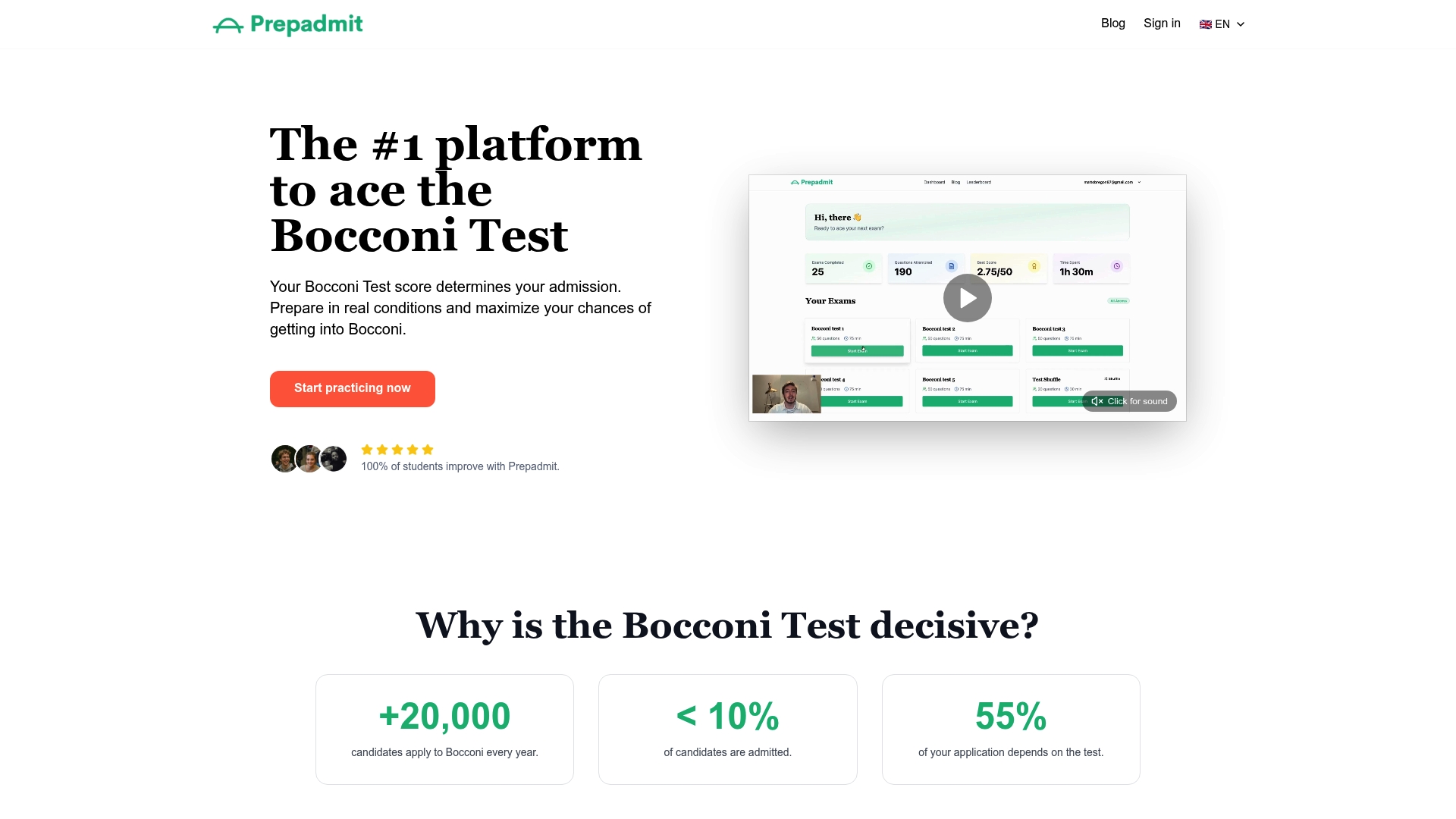
Every feature on Prepadmit is designed around the actual Bocconi Test format, so your practice time maps directly to what the exam demands. Students using Prepadmit see an average score improvement of 34%, and the platform costs a fraction of private coaching. If you are serious about Bocconi admission, explore the on-demand test advantages Prepadmit offers and start building a study plan that actually adapts to you.
FAQ
What is adaptive test preparation in simple terms?
Adaptive test preparation is a study method that uses algorithms to personalize your practice in real time, focusing on your specific weak areas instead of covering all topics equally. The system adjusts question difficulty and topic selection based on your performance data.
How is adaptive prep different from a regular study plan?
A regular study plan assigns the same content to every student in a fixed order. Adaptive prep builds a unique path for each student based on diagnostic data, continuously updating that path as your skills improve.
Does adaptive test prep actually reduce study time?
Adaptive systems can reduce required practice volume significantly by eliminating time spent on topics you already know. However, when an exam requires full curriculum coverage, total study time may be similar to traditional methods.
What makes a good adaptive test prep platform?
The most important factors are a large, expert-curated question bank and an AI engine that tracks specific sub-skills rather than just broad topics. Alignment with your target exam format is equally critical.
Can adaptive prep help with test anxiety?
Matching question difficulty to your current ability level reduces both frustration and boredom, which directly lowers test anxiety. Students who practice at the right challenge level consistently report higher confidence on exam day.
Recommended
Related articles
Ready to ace your admission test?
Discover PrepAdmit, the platform that helps you succeed at top university admission tests.
Discover PrepAdmit