What Is a Full-Length Practice Test for Bocconi?

What Is a Full-Length Practice Test for Bocconi?
Most students preparing for the Bocconi Test spend weeks doing topic quizzes, reviewing flashcards, and working through random question sets. It feels productive. But when test day arrives, many are blindsided — not by the content, but by the sheer mental exhaustion of sitting through a full exam. That gap is exactly what a full-length practice test is designed to close. Understanding what is a full-length practice test, and how to use one correctly, can be the difference between a good score and a great one. This guide covers everything you need to know.
Table of Contents
- Key takeaways
- What a full-length practice test actually is
- Full-length test benefits you cannot get any other way
- How to build full-length tests into your study plan
- Common mistakes when using full-length practice tests
- My take on what actually moves the needle
- Start practicing with Prepadmit today
- FAQ
Key takeaways
| Point | Details |
|---|---|
| Full-length tests simulate reality | They replicate the exact duration, format, and pressure of the real Bocconi Test. |
| Pacing is a trainable skill | Repeated full-length practice builds both macro and micro timing skills you cannot develop with short quizzes. |
| Review matters as much as the test | Spending equal time on error analysis after each test drives the most score improvement. |
| Start early, space tests out | A diagnostic test early in prep, followed by spaced practice tests, outperforms last-minute cramming. |
| Third-party scores are not final predictions | Only official test providers give reliable score estimates; use other tests for learning, not forecasting. |
What a full-length practice test actually is
A full-length practice test is a complete, timed simulation of the actual exam you are preparing for. It covers every section, mirrors the real question types and difficulty levels, and runs for the same total duration as the official test. Nothing is skipped. Nothing is shortened.
This is very different from a topic quiz or a partial mock. Those have their place in building knowledge. But they do not train the skills that matter most on test day: pacing, concentration over long stretches, and the ability to recover quickly when a question stumps you.
For Bocconi Test candidates, a full-length practice exam means sitting through all sections back to back, under timed conditions, with no extra breaks. The experience should feel uncomfortable the first time. That discomfort is the point.
Here is what a well-designed full-length practice test includes:
- Complete section coverage: Every subject area tested on the real exam, in the same order and proportion.
- Strict timing: Each section timed exactly as it will be on test day, with no pausing or rewinding.
- Realistic environment: No phone notifications, no background music, no interruptions. Treat it like the real thing.
- Scheduled breaks only: If the actual Bocconi Test includes a break, take it. If it does not, skip it.
- No outside help: No notes, no dictionaries, no looking things up mid-test.
Research shows that replicating test-day conditions builds mental and physical endurance in ways that partial practice simply cannot. The brain needs to learn what two-plus hours of focused work feels like before it has to do it for real.
Pro Tip: Take your first full-length practice test in the morning, at the same time your actual Bocconi Test is scheduled. Your brain performs differently at different times of day, and training at the right hour matters.
Full-length test benefits you cannot get any other way
The advantages of full-length practice testing go well beyond content review. They are cognitive, strategic, and psychological. Here are the five most significant benefits:
-
Macro and micro pacing. Full-length tests train you to manage time at two levels. Macro pacing means knowing how to distribute your total time across sections. Micro pacing means knowing when to move on from a single question. Both pacing skills require repeated practice to internalize, and short quizzes simply do not provide enough repetition at scale.
-
Mental stamina. Concentration degrades over time. A student who can focus sharply for 30 minutes may struggle badly in the final third of a two-hour exam. Full-length tests build the endurance needed to stay sharp from the first question to the last.
-
Stress inoculation. Sitting through a timed, high-stakes simulation exposes you to controlled pressure. Over time, students develop calming rituals and automatic reset habits that kick in when anxiety spikes during the real test.
-
Behavioral pattern recognition. Mock tests reveal how you behave under pressure, not just what you know. They expose tendencies like overthinking easy questions, rushing through hard ones, or second-guessing correct answers. Recognizing these patterns lets you correct them before they cost you points on the real exam.
-
Long-term retention through active recall. A 2017 meta-analysis of 118 studies confirmed that active recall through practice testing significantly outperforms passive study methods like re-reading or note-taking for long-term retention. Every full-length test you complete is also a memory consolidation session.
“Students who develop automatic reset routines report better focus under pressure.” This is not a soft skill. It is a trained response, and full-length practice is how you build it.
The importance of full-length tests becomes clear when you realize that the Bocconi Test is not just a knowledge exam. It is a performance exam. You need to execute under time pressure, after an hour of prior effort, while managing nerves. That is a skill set. And like any skill set, it requires specific practice.
How to build full-length tests into your study plan

Knowing what a full-length practice exam is matters less than knowing how to use one strategically. Here is a framework that works.
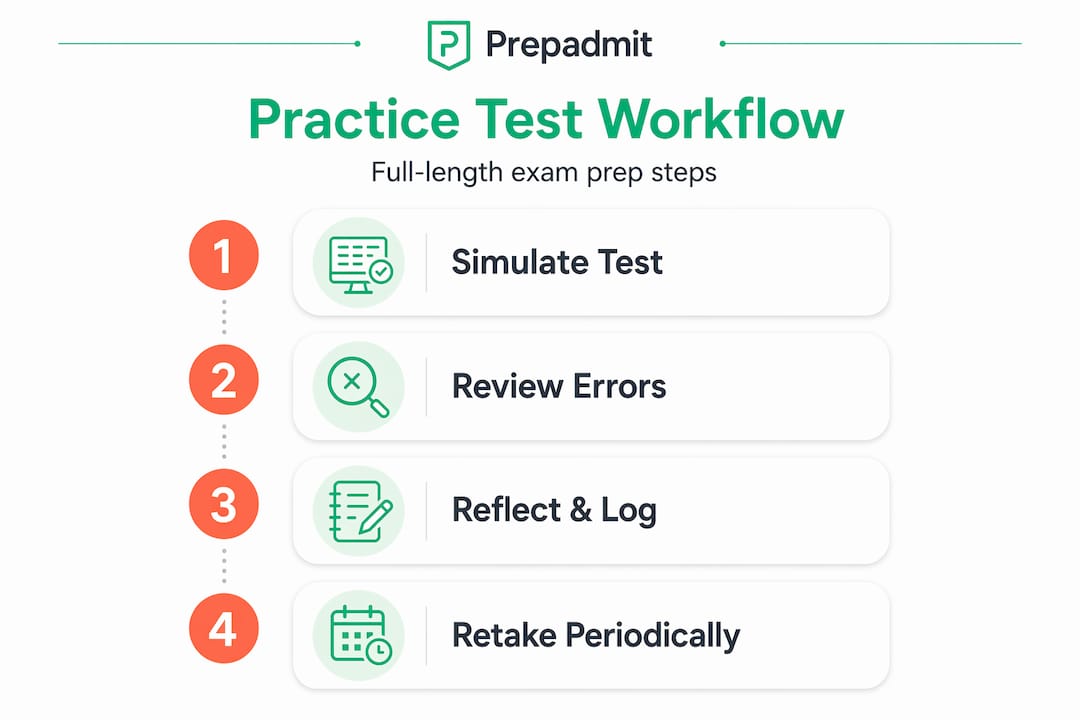
| Study phase | Recommended action | Purpose |
|---|---|---|
| Week 1 of prep | Take a diagnostic full-length test | Establish your baseline score and identify weak areas |
| Mid-prep (weeks 4 to 8) | Take one full-length test every 10 to 14 days | Track progress and adjust study focus |
| Final 2 weeks | Take one or two tests under exact exam conditions | Build confidence and lock in pacing habits |
| After every test | Spend equal time on error review | Identify patterns in mistakes and close knowledge gaps |
Research consistently shows that cramming tests in the final two weeks rarely improves scores. A preparation window of two to three months, with tests spaced throughout, produces far better results. Most students find that five to seven full-length tests across their prep period is the right number. That is enough to build stamina and track progress without burning out.
The review step is where most students underinvest. After each test, log every wrong answer. Categorize the error: was it a content gap, a pacing mistake, or a misread question? Categorizing your errors after each test is what turns practice into genuine improvement. Without that step, you are just repeating the same mistakes in a slightly different order.
Pro Tip: Set a timer for the same amount of time as the test itself and use that entire block for review. If the test took two hours, spend two hours going through every question you got wrong or guessed on.
Avoid the temptation to schedule multiple tests in the same week during the final stretch. Fatigue accumulates, and a tired brain does not learn. Space your tests. Rest between them. The goal is to arrive at the real exam sharp, not exhausted.
Common mistakes when using full-length practice tests
Even students who commit to full-length practice often undercut their own progress with a few predictable habits. Watch out for these.
- Testing under non-exam conditions. Doing a “full-length test” with your phone nearby, pausing to check something, or spreading it across two sessions is not a full-length test. It is a long quiz. The simulation only works if the conditions are real.
- Trusting third-party scores as final predictions. Third-party practice tests often deflate scores by five to fifteen points intentionally, to motivate more study. They are useful for learning and stamina building. They are not reliable for predicting your actual Bocconi Test score. Only official materials should be used for score forecasting.
- Skipping the review. This is the single most common and most damaging mistake. Without thorough review, performance gains from practice testing are minimal. The test reveals the problem. The review is where you fix it.
- Ignoring pacing issues. Many students focus entirely on content after a test and never examine their timing. If you ran out of time on a section, that is a pacing problem, not a knowledge problem. Macro and micro pacing must be practiced and corrected repeatedly.
- Neglecting psychological preparation. Stress management is a real part of exam performance. If you finish a practice test and feel wrecked, that is data. Build a pre-test routine. Practice breathing or focus techniques. Repeated full-length testing under exam conditions converts anxiety into routine over time.
The best full-length practice tests are only as useful as the habits you build around them. The test itself is the tool. How you use it determines the result.
My take on what actually moves the needle
I have seen students take ten full-length tests and barely improve. I have also seen students take five and jump significantly in score. The difference is never the number of tests. It is always the quality of what happens after each one.
In my experience, pacing and stamina are the most underestimated factors in Bocconi Test prep. Students spend months on content and almost no time training their ability to sustain focus for a full exam. Then they wonder why they fell apart in the last 40 minutes.
What I have found actually works is treating each full-length test as a two-part event. The test is part one. The review is part two. Neither is optional. Students who skip the review are essentially practicing their mistakes.
The other thing I believe strongly: you cannot fake test-day conditions in a comfortable environment. Sit at a desk. Use a timer. Remove every distraction. Do it at the same time of day as your real exam. The discomfort of that setup is exactly what builds the psychological resilience you need when the real stakes are on the line.
Balancing quantity with quality review is the core principle. Five well-reviewed tests beat ten carelessly completed ones every time.
— quentin
Start practicing with Prepadmit today
If you are preparing for the Bocconi Test and want to practice with full-length exams that actually mirror real conditions, Prepadmit is built for exactly that.
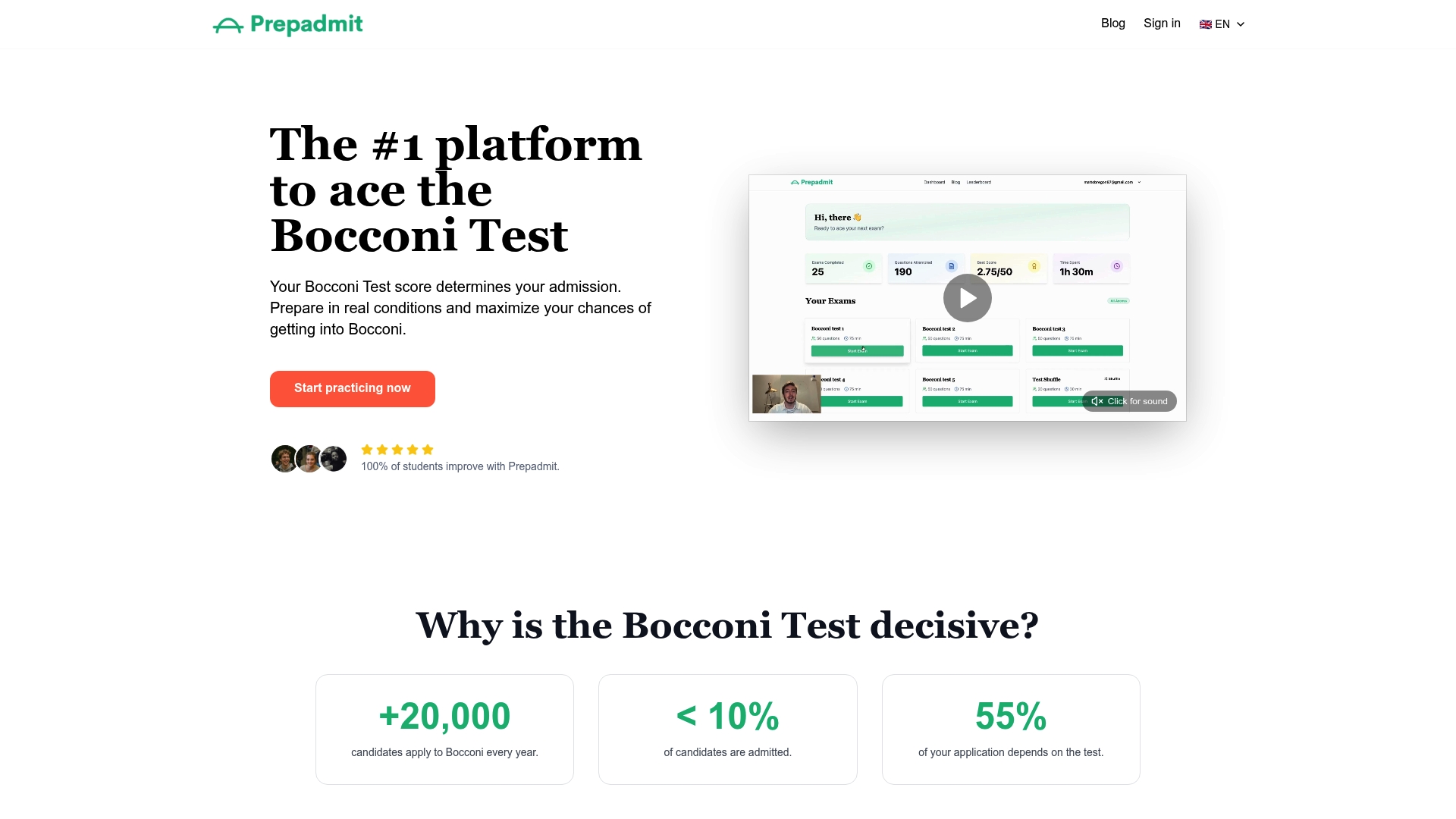
Prepadmit offers full-length Bocconi Test simulations using official past papers, complete with detailed answer corrections and error tracking. You get progress analytics, skill-specific practice modes, and the ability to rank yourself against other candidates. The platform was developed by experts from HEC and Bocconi, so the content is accurate, relevant, and properly calibrated. Students using Prepadmit see an average score improvement of 34%. It costs a fraction of private coaching and comes with a money-back guarantee. If you want to prepare the right way, this is where to start.
FAQ
What is a full-length practice test?
A full-length practice test is a complete, timed simulation of the real exam, covering all sections at the same difficulty and duration as the actual test. It builds pacing, stamina, and test-day confidence in ways that shorter quizzes cannot.
How many full-length practice tests should I take for the Bocconi Test?
Most students benefit from five to seven full-length tests spaced across two to three months of preparation. Cramming multiple tests into the final two weeks rarely produces score gains.
Do full-length practice test scores predict my real Bocconi Test score?
Only official practice materials give reliable score predictions. Third-party tests often deflate scores intentionally and should be used for learning and stamina building, not final score forecasting.
What should I do after a full-length practice test?
Spend as much time reviewing the test as you spent taking it. Log every wrong answer, categorize the error type, and identify whether the issue was content, pacing, or misreading. This review step drives the most improvement.
Can I pause a full-length practice test during prep?
No. Pausing breaks the simulation and defeats the purpose. The value of a full-length practice exam comes from experiencing the full duration under continuous, realistic pressure. Treat every practice test as if it is the real thing.
Recommended
Related articles
Ready to ace your admission test?
Discover PrepAdmit, the platform that helps you succeed at top university admission tests.
Discover PrepAdmit