Study the Bocconi Test Across Different Time Zones

Study the Bocconi Test Across Different Time Zones
Studying for the Bocconi Test in a different time zone is a scheduling and performance challenge that every international applicant must solve before exam day. The Bocconi Online Test allows candidates to select any hour between 00:00 and 23:59 CET/CEST on their booked date. That flexibility is a real advantage, but only if you use it deliberately. Students who pick a test time that clashes with their natural sleep cycle, or who skip the required technical checks, pay for it in lost points. This guide covers the scheduling rules, study timing strategies, and technical steps that international students need to get right.
How to study the Bocconi Test in a different timezone
The Bocconi Online Test runs on a 24-hour window. You can book any hour within that window on your selected exam date, which means a student in Tokyo, São Paulo, or New York can each find a slot that falls during their local daytime hours. That said, the window does not mean you can be casual about booking. Slots near application deadlines fill quickly, sometimes weeks in advance. Book early to secure the time that actually works for your body clock.
The scheduling rules carry one firm constraint: your test must be completed at least two days before your application deadline. That rule exists so scores reach Bocconi in time for processing. For international students, this means you need to account for both your local date and the CET/CEST date when calculating your last possible test day. A student in UTC+9 who books a test at 23:00 local time on what feels like “two days before” may actually be crossing into the wrong CET date.
Key scheduling rules at a glance
- 24-hour window: Book any hour from 00:00 to 23:59 CET/CEST on your chosen date.
- Two-day buffer: Complete the test at least two days before your application deadline.
- Technical check: Complete the proctoring system check exactly 48 hours before your session.
- Early booking: Preferred time slots near deadlines fill fast. Book as soon as your target date opens.
- Identity document: Have a government-issued ID ready for the identity verification step.
| Timezone | CET Offset | Example: 10:00 AM local = CET |
|---|---|---|
| UTC+0 (London, winter) | +1 hour | 11:00 CET |
| UTC+5:30 (India) | +4.5 hours | 05:30 CET |
| UTC+9 (Japan/Korea) | +8 hours | 02:00 CET |
| UTC-5 (Eastern US) | +6 hours | 16:00 CET |
| UTC-3 (Brazil) | +4 hours | 14:00 CET |
Pro Tip: Use a time zone converter like World Time Buddy to lock in your CET test time before you book. Screenshot the conversion and save it. Daylight saving time shifts in Europe (CET becomes CEST in late march) can move your local equivalent time by one hour.
How to align your study schedule with your exam time slot
Training at the same time of day as your planned exam slot is the single most effective timing adjustment you can make. The brain adapts to routine. If you run timed practice tests every morning at 9:00 AM for four weeks, your reasoning speed and focus at 9:00 AM on exam day will be measurably sharper than if you had practiced at random hours. This is not a theory. It is how circadian conditioning works in practice.

Most cognitive performance follows circadian patterns. Exams scheduled outside your natural peak hours increase the risk of simple errors, especially on verbal reasoning and critical thinking sections. The Bocconi Test is not forgiving of careless mistakes. Picking a test time that falls during your natural morning or afternoon alertness window is one of the easiest performance gains available to you.
Here is a practical approach to aligning your preparation:
- Identify your peak hours. Track your alertness for one week. Note when you feel sharpest, typically 1–3 hours after waking. That window is your target exam time.
- Book your test slot first. Decide on your exam time before you build your study schedule, not after.
- Run timed practice tests at that exact hour. Use this routine for the final four weeks of your Bocconi test preparation. Do not skip it on weekends.
- Protect your sleep schedule. Go to bed and wake up at the same time every day during the final two weeks. Sleep disruption caused by forced time zone shifts on test day reduces cognitive accuracy, especially in reasoning sections.
- Avoid extreme time slots. Taking an exam at 3:00 AM local time significantly hurts verbal reasoning accuracy. No amount of caffeine fully compensates for circadian fatigue.
Pro Tip: If your natural peak falls at an awkward CET hour, shift your sleep schedule gradually over two weeks before the exam. Move bedtime 30 minutes earlier every two days. This is far safer than trying to force a sudden adjustment the night before.
What technical setup do international Bocconi Test takers need?
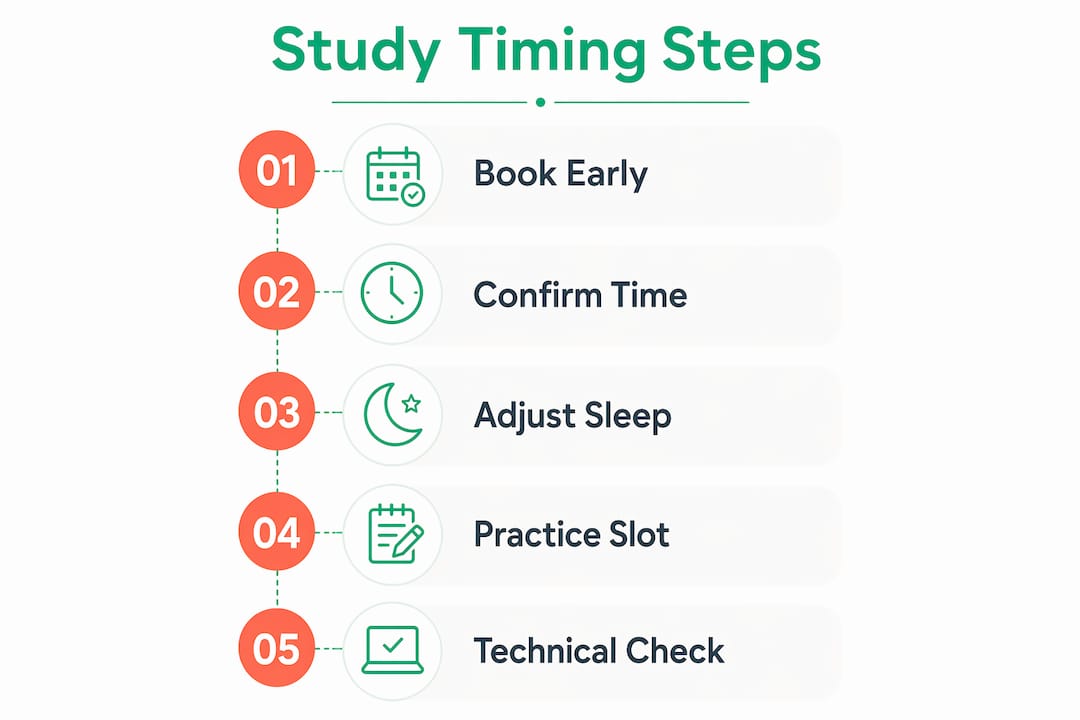
Technical failure on exam day is one of the most avoidable problems international students face. The proctoring system requires a working webcam, a functioning microphone, and a stable internet connection capable of real-time video streaming. None of these should be tested for the first time on exam day.
The required technical check must be completed at least 48 hours before your test session. This check verifies that your hardware and software meet the proctoring platform’s minimum requirements. Completing it early gives you time to fix problems before they become emergencies.
Internet speed is the variable most students underestimate. Connection quality varies by region and by time of day. Your bandwidth at 2:00 PM may be very different from your bandwidth at 8:00 AM when your neighborhood is less active. Test your internet connection at the exact hour you plan to take the exam, not just once at a convenient time.
- Webcam and microphone: Test both during the official 48-hour check. Confirm the proctoring software recognizes them.
- Internet stability: Run a speed test at your planned exam time on at least two separate days before the exam.
- Quiet environment: Choose a room where you will not be interrupted. Proctoring rules prohibit background noise and visible distractions.
- Clear desk: Remove phones, notebooks, and second screens from your field of view before the session starts.
- Government-issued ID: Keep your passport or national ID within reach for the identity verification step.
Pro Tip: If your home internet is unreliable, identify a backup location with a strong connection, such as a library or a coworking space. Test that location at your planned exam time too. Having a backup plan removes one major source of pre-exam anxiety.
How to avoid common pitfalls when taking the Bocconi Test across time zones
Time zone confusion causes more last-minute panic than almost any other issue for international students. The fix is simple but requires attention to detail.
- Confirm your CET/CEST conversion twice. Calculate your local exam time, then verify it again 48 hours before the test. Remember that Europe switches from CET to CEST in late march, shifting the offset by one hour.
- Avoid extreme local hours. A slot that looks convenient on a calendar but falls at 4:00 AM or midnight local time is a performance risk. Choose a time you would normally be awake and alert.
- Use your retake options strategically. Students may attempt up to four tries per test type each year. If your first attempt falls on a bad day technically or physically, a retake is not a failure. It is a planned contingency.
- Build a test day checklist. Write down every step: wake time, meal, technical check confirmation, ID location, and login time. Run through it the night before.
- Have a backup internet plan. Know your mobile hotspot option or nearest reliable connection before you need it.
Scheduling the exam during your natural alertness window and completing the technical check at the same hour you plan to test are the two decisions that most directly protect your score. Everything else is preparation. These two steps are execution.
For a full breakdown of what scores you need to aim for, the Bocconi score benchmarks guide gives you concrete targets by program.
Key Takeaways
International Bocconi Test candidates who book early, align their study schedule with their exam time slot, and complete technical checks at the planned exam hour give themselves the clearest path to a strong score.
| Point | Details |
|---|---|
| 24-hour test window | Book any CET/CEST hour on your exam date, but confirm the local time conversion carefully. |
| Two-day deadline rule | Complete the test at least two days before your application deadline to avoid missed submissions. |
| Circadian alignment | Run timed practice tests at your planned exam hour for the final four weeks of preparation. |
| Technical check timing | Complete the 48-hour proctoring check and test your internet at the exact planned exam hour. |
| Retake flexibility | Up to four attempts per test type per year allow you to recover from scheduling or technical setbacks. |
Why timing is the most underrated part of Bocconi Test prep
Most students I talk to spend months on content and almost no time on timing. They practice whenever they have a free hour, book whatever test slot is still open, and then wonder why their exam performance does not match their practice scores. The answer is almost always circadian mismatch or a technical surprise they did not anticipate.
The advice to align your final four weeks of practice with your actual exam time is not a minor tip. It is the difference between a brain that is warmed up and ready at 10:00 AM and one that is still in first gear. I have seen students drop a full performance tier simply because they practiced at night and tested in the morning.
The retake policy is also more valuable than most students realize. Knowing you have up to four attempts per year should change how you approach your first booking. Do not treat the first attempt as your only shot. Treat it as a calibration. Book it at a good time, prepare well, and if something goes wrong technically or physically, you have room to recover. That mindset reduces pressure and, counterintuitively, tends to produce better first-attempt results.
For non-EU students who want a full picture of the application process alongside test timing, the non-EU student guide covers both in one place.
— quentin
Prepadmit: preparation built for international Bocconi candidates
International students preparing for the Bocconi Test face a different set of challenges than local applicants. Prepadmit was built specifically for this exam, by people who know it from the inside.
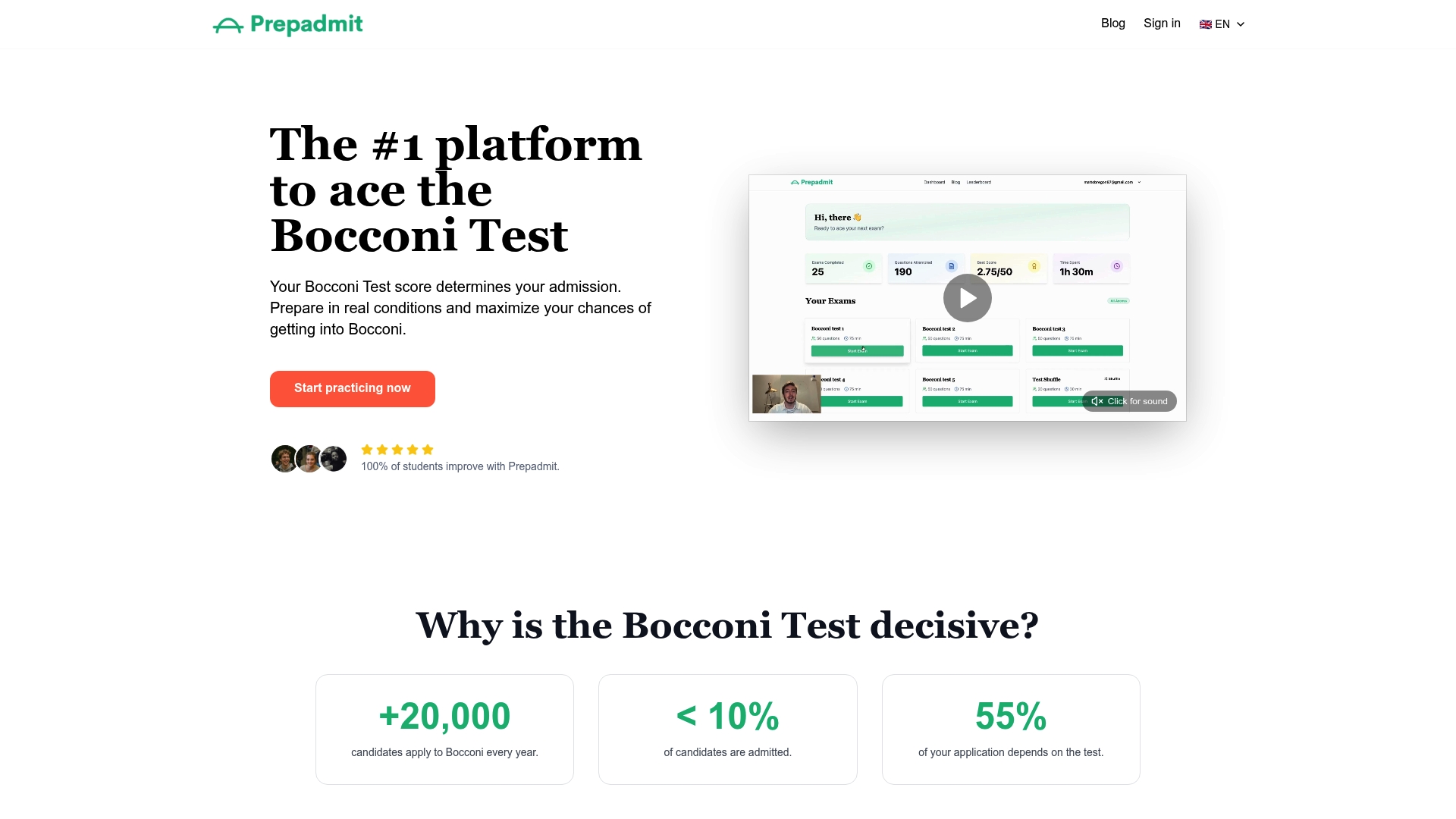
The platform gives you access to official past papers, on-demand timed practice tests, and detailed answer corrections. You can run practice sessions at the exact hour you plan to test, which is the most direct way to condition your performance. Prepadmit users see an average score improvement of 34%, and the platform costs a fraction of private coaching. If you are preparing from outside Italy, start your preparation with a system designed around the actual exam, not a generic test prep approach.
FAQ
What hours can I take the Bocconi Test if I live outside Europe?
The Bocconi Online Test is available at any hour between 00:00 and 23:59 CET/CEST on your booked date. Choose a slot that falls during your natural daytime hours in your local time zone.
How early should I book my Bocconi Test slot?
Book as early as possible. Test slots near application deadlines fill weeks in advance, and you need to complete the test at least two days before your deadline.
What is the 48-hour technical check and why does it matter?
The technical check must be completed at least 48 hours before your test session. It confirms your webcam, microphone, and internet connection meet the remote proctoring requirements, giving you time to fix any issues before exam day.
Can I retake the Bocconi Test if my first attempt goes badly?
Students may attempt up to four tries per test type each year. Retakes are a built-in safety net for timing problems, technical failures, or simply wanting to improve your score.
How do I avoid time zone confusion on Bocconi Test day?
Convert your CET/CEST test time to your local time zone at least 48 hours before the exam, and verify the conversion again on the day before. Account for Europe’s daylight saving time shift in late march, which moves CET to CEST and changes the offset by one hour.
Recommended
- How to Prepare for the Bocconi Test: A Step-by-Step 2026 Guide — PrepAdmit Blog
- Is the Bocconi Test Hard? An Honest 2026 Difficulty Breakdown — PrepAdmit Blog
- prepadmit.com - La plateforme n°1 pour réussir le Bocconi Test
- What Is a Good Bocconi Test Score? Benchmarks and Targets for 2026 — PrepAdmit Blog
Related articles
Ready to ace your admission test?
Discover PrepAdmit, the platform that helps you succeed at top university admission tests.
Discover PrepAdmit