Reduce Bocconi Coaching Dependency: Steps for Students

Reduce Bocconi Coaching Dependency: Steps for Students
You can replace private Bocconi coaching with a focused self-study system. The steps to reduce your coaching dependency are: take a full timed diagnostic mock, run targeted drills on weak areas, complete weekly full-length simulations, keep a disciplined error log, and use a platform like Prepadmit for feedback and accountability. Prepadmit reports an average score improvement of 34% among users who follow the platform’s preparation system, and the platform was built by HEC and Bocconi alumni. The Bocconi University online test page confirms the format, timing, and the importance of practicing on your actual test-day hardware.
TL;DR steps:
- Take a timed diagnostic mock and record your baseline score by section
- Drill your weakest topic daily for the first four weeks
- Add one full-length timed simulation every week from week five onward
- Log every error with the exact reason it happened
- Use a platform with dashboards and peer ranking to stay accountable
Table of Contents
- How do you replace private Bocconi coaching step by step?
- What practice habits actually replace a coach’s feedback?
- Which platform features replace what a coach actually does?
- How long does self-study take, and what does it cost?
- What mistakes kill self-study plans before they start?
- What should you do in the next 48 hours?
- Key Takeaways
- Why this method works, and what students underestimate
- Prepadmit gives you the coaching functions without the coaching cost
- Useful sources
How do you replace private Bocconi coaching step by step?
The sequence matters. Skipping straight to mock tests before you know your weak areas wastes time. Skipping drills and going straight to content review wastes even more.
Start with a diagnostic mock. Before anything else, sit a full 50-question, 75-minute timed test under real conditions. Record your score by section: Reading Comprehension, English Language, Logic and Critical Thinking, and Numerical Reasoning. That breakdown is your study map.
Phase 1: Weeks 1–4, concept building
Focus on your two weakest sections. Keep daily sessions to 30–45 minutes of active drills, not passive reading. Work through topic-specific question blocks: algebra and probability for math, syllogisms and logical deduction for logic, and timed passage sets for reading. The goal is accuracy first, speed second.
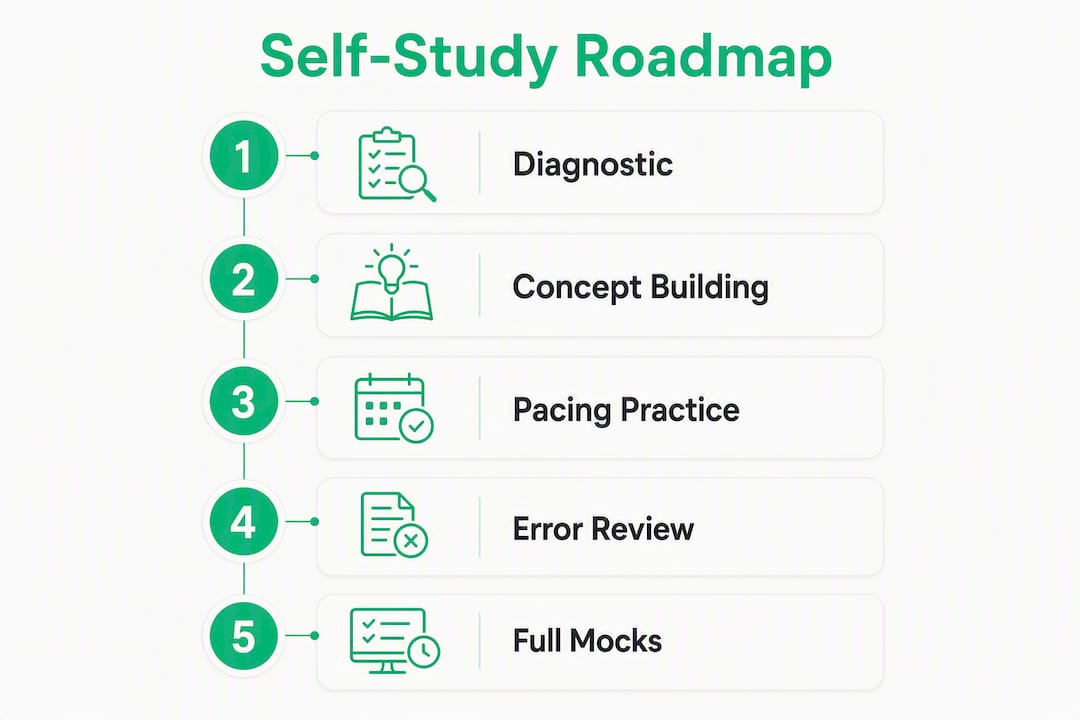
Phase 2: Weeks 5–8, pacing and stamina
Introduce one full-length timed simulation every week, ideally on the same day and time each week. Mixed-section practice replaces single-topic drills as your primary mode. Track your pacing per section after every mock.

Phase 3: Weeks 9 onward, error reduction and consolidation
Shift focus to your error log. Run simulated exam weeks: two full mocks in seven days, then a rest day, then error review. Adjust the length of this phase based on how far your baseline is from your target.
Baseline-to-timeline table:
| Baseline score | Target | Recommended weeks | Weekly hours |
|---|---|---|---|
| — | 40+ | 12+ weeks | 10–15 hrs |
| — | 40+ | 8–10 weeks | 8–12 hrs |
| — | — | 8–12 weeks | 10+ hrs |
| — | 40 | 4 weeks | 4 hrs |
Sample weekly schedule (Phase 2):
- Monday: 40-min drill block on weakest topic
- Tuesday: 30-min mixed logic and math questions
- Wednesday: 30-min reading timed passages
- Thursday: 40-min drill block on second weakest topic
- Friday: 30-min error log review and spaced repetition
- Saturday: Full-length timed mock (75 minutes)
- Sunday: Mock review and error log update
A step-by-step Bocconi prep guide from Prepadmit covers sample schedules in more detail.
What practice habits actually replace a coach’s feedback?
The biggest shift is moving from passive review to active recall. Reading notes feels productive. Timed drills reveal what you actually know.
Active recall in practice:
- Replace re-reading with timed question blocks on the same material
- Use spaced repetition for formulas and logic patterns: review them at 1-day, 3-day, and 7-day intervals
- Interleave topics in a single session rather than blocking one subject per day
Error log template: For every missed question, record four things: the question ID, the error type (conceptual gap, formula gap, calculation slip, misread, or time/strategy failure), the exact reason you got it wrong, and one specific fix. A log that just marks “wrong” teaches you nothing.
| Error type | Example | Fix |
|---|---|---|
| Conceptual gap | Misunderstood probability rule | Re-drill that concept with 10 focused questions |
| Calculation slip | Arithmetic error under time pressure | Practice mental math daily for two weeks |
| Time/strategy failure | Spent 4 minutes on one question | Practice disciplined skipping |
| Misread | Missed a “not” in the question stem | Read question stems twice before answering |
Bocconi’s penalty rule matters here. The test deducts 0.25 points for each wrong answer. Disciplined skipping, deciding when to walk away from a low-probability question, often separates average scores from competitive ones. Train this skill explicitly: during every mock, flag any question where you have no clear path to elimination within 90 seconds, and move on.
Weekly metacognitive review: After each mock, spend 15 minutes asking: Where did I rush? Which question types triggered guessing? Did I skip the right questions? This review replaces the debrief a coach would give you.
Pro Tip: Build a spaced-review card set for the 10–15 formulas and logic patterns you miss most often. Review the set every three days. Within two weeks, those gaps close faster than any single drill session will close them.
Which platform features replace what a coach actually does?
A coach gives you a baseline, tells you what to work on, holds you accountable, and gives you feedback after every session. A platform can do all four if it has the right features.
Feature checklist:
- Official-simulation mocks that mirror the real test format and timing
- Targeted drill modes organized by skill area (math, logic, reading, English)
- Detailed answer corrections that explain why each answer is right or wrong
- A progress dashboard that tracks accuracy and pacing over time
- Peer leaderboards that show where you rank against other candidates
- Device-friendly access so you can practice on your actual test hardware
Prepadmit provides all of these. Its diagnostic test sets your baseline. Drill modes let you target math, logic, or reading in isolation. Detailed corrections replace the coach’s post-session debrief. The progress dashboard shows your trajectory week over week. The peer leaderboard adds social accountability that keeps you honest about whether you are actually improving.
Prepadmit reports an average score improvement of 34% among users who follow the platform’s preparation system.
Pro Tip: Set a calendar reminder every Sunday evening to check your dashboard metrics before the week starts. Treat your accuracy trend and leaderboard rank as your weekly performance review. That five-minute check replaces the accountability a weekly coaching session would provide.
How long does self-study take, and what does it cost?
The timeline depends on your baseline. The cost difference is significant.
Milestones by phase:
- First 4-week target: close your biggest conceptual gap and gain 3–4 points on your weakest section
- Week 5–8 target: consistent pacing across all sections in full mocks
- Week 9+ target: score within 2–3 points of your goal in two consecutive mocks
Cost comparison:
| Preparation route | Estimated monthly cost | Estimated total (8–12 weeks) |
|---|---|---|
| Private coaching (1-on-1, typical rate) | $200–$400/month | $400–$1,200 |
| Prepadmit platform access | One-time purchase | Fraction of coaching cost |
Private coaching also locks you into fixed session times. Self-study with a platform lets you practice at 11 PM before a school deadline or on a Saturday morning. That flexibility has real value, especially for students managing school schedules alongside test prep.
Practicing on your actual test-day hardware also reduces anxiety on exam day. The official Bocconi proctoring instructions specify Safe Exam Browser and camera requirements. Running mocks under those exact conditions means no surprises on test day.
What mistakes kill self-study plans before they start?
Most self-study failures come from the same short list of errors.
- Passive studying: Reading prep materials without drilling questions. Fix: replace at least 70% of your study time with timed question practice.
- Skipping timed mocks: Drilling topics but never practicing under full test conditions. Fix: schedule one fixed mock every Saturday and treat it as non-negotiable.
- Shallow error review: Marking wrong answers without logging why. Fix: spend as much time on error review as on the mock itself.
- Ignoring test-day tech: Not rehearsing with Safe Exam Browser and your webcam. Fix: run at least two full mocks in the exact proctored setup before your real test date.
- No baseline diagnostic: Starting drills without knowing your weak areas. Fix: take a full timed mock before any other prep activity.
- Inconsistent schedule: Studying when you feel like it rather than on a fixed routine. Fix: block study time in your calendar like a class you cannot skip.
What should you do in the next 48 hours?
Hour 1: Take a full timed Bocconi mock on your test-day laptop or desktop. Record your score and section breakdown. That number is your baseline.
Hour 2: Open a spreadsheet or notebook and create your error log with four columns: question ID, error type, reason, and fix. Log every missed question from the diagnostic.
Day 2: Build your weekly schedule. Block one 30–45-minute drill session per day and one full mock on a fixed day each week. Sign up for Prepadmit’s platform or start a trial to access official simulations and drill modes.
Tech check (do this before your first platform mock):
- Install Safe Exam Browser per the official Bocconi proctoring instructions
- Test your webcam and microphone
- Confirm a stable internet connection
- Run one full mock in the exact proctored setup
Key Takeaways
Replacing private Bocconi coaching works when you reproduce its core functions: a diagnostic baseline, targeted drills, weekly timed simulations, disciplined error analysis, and a platform that tracks your progress.
| Point | Details |
|---|---|
| Start with a diagnostic | Take a full timed mock before any other prep to set your baseline by section. |
| Error log is non-negotiable | Record the exact reason for every missed question; vague review does not improve scores. |
| Weekly mocks build pacing | One full-length timed simulation per week converts knowledge into test performance. |
| Cost savings are real | Self-study with a platform costs a fraction of private coaching at $200–$400 per month. |
| Prepadmit reproduces coaching | Diagnostics, drill modes, corrections, dashboards, and leaderboards replace coach functions. |
Why this method works, and what students underestimate
The conventional advice is to “study more.” The students who actually improve study differently. They spend most of their time on timed drills and error review, not on re-reading content they already half-know.
What most students underestimate is the metacognitive layer. Knowing the right formula is not the same as knowing when to skip a question that is eating your time. That decision-making skill is what a good coach trains, and it is exactly what weekly mock reviews build when you ask the right questions after every simulation.
The other underestimated factor is consistency over intensity. Two focused 40-minute sessions per day, every day, outperform a six-hour Saturday cram every time. The students who replace coaching successfully are not the ones who study the hardest in a single week. They are the ones who show up to their error log on a Tuesday night when they would rather do anything else.
Prepadmit’s leaderboard and dashboard make that consistency visible. When you can see your rank move, the Tuesday night session has a reason attached to it.
Prepadmit gives you the coaching functions without the coaching cost
Private coaching for the Bocconi Test runs $200–$400 per month. Prepadmit delivers the same core functions at a fraction of that cost: a diagnostic that sets your baseline, drill modes that target math, logic, reading, and English in isolation, detailed answer corrections that explain every wrong answer, a progress dashboard that tracks your accuracy and pacing week over week, and a peer leaderboard that keeps you accountable.
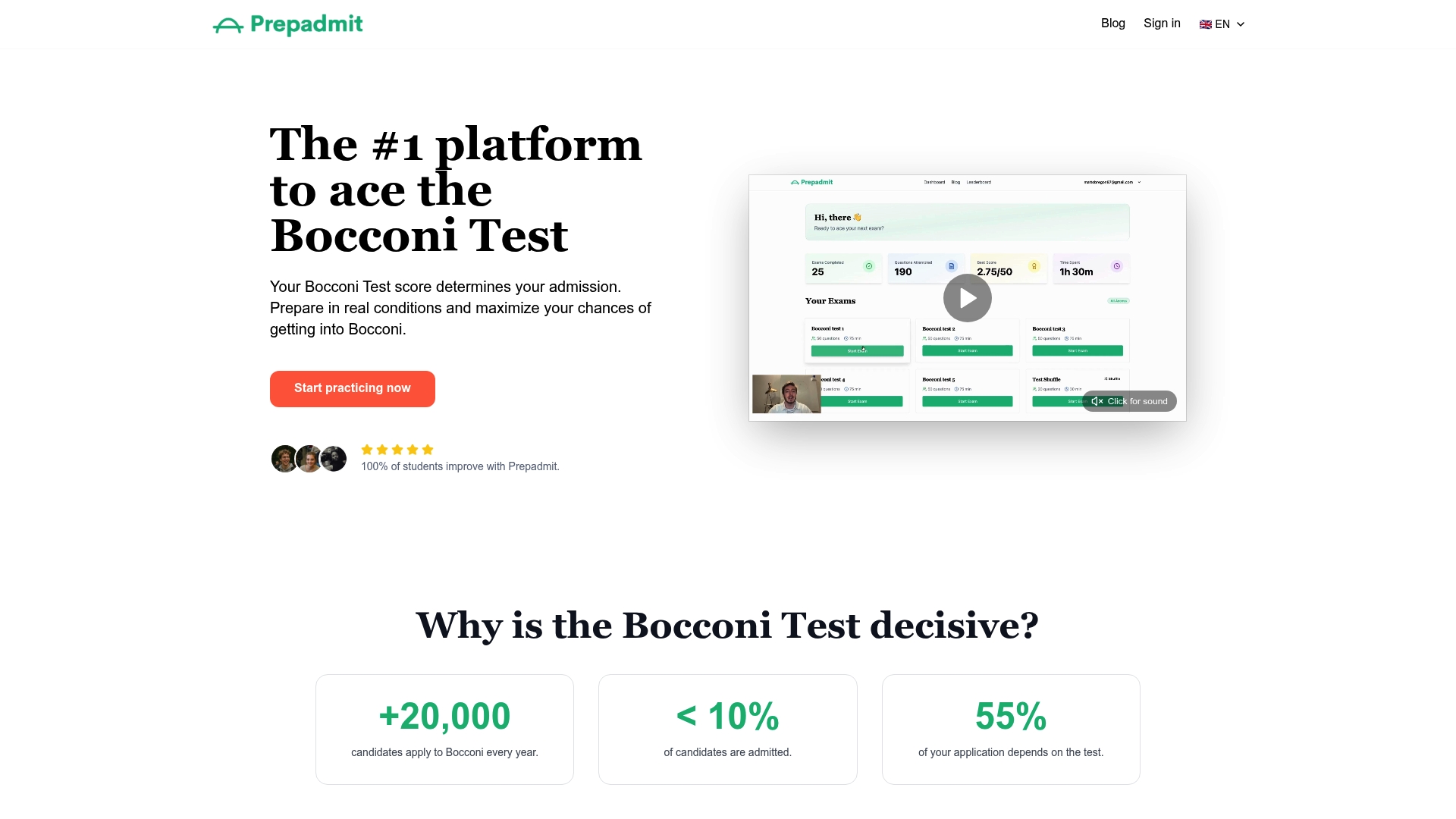
The platform was built by HEC and Bocconi alumni. It uses official past papers and on-demand simulations that mirror the real test format. Users report an average score improvement of 34%. A money-back guarantee backs the platform’s claims.
The next step is simple: take the diagnostic, see your baseline, and follow the 8–12 week roadmap inside the platform. Start your Bocconi prep on Prepadmit today and skip the $1,200 coaching bill.
Useful sources
- How to Prepare for the Bocconi Test: A Step-by-Step 2026 Guide — Prepadmit Blog: Sample weekly schedules and topic-by-topic prep guidance tailored to the Bocconi Test.
- On-Demand Test Advantages — Prepadmit Blog: Explains how platform-based adaptive practice reproduces the feedback loop a coach provides.
- Prepadmit Platform — Bocconi Test Prep: The main platform page. Start here to access the diagnostic, drill modes, and progress dashboard.
Recommended
Related articles
Ready to ace your admission test?
Discover PrepAdmit, the platform that helps you succeed at top university admission tests.
Discover PrepAdmit