Bocconi Test Section Drilling Technique: 2026 Guide

Bocconi Test Section Drilling Technique: 2026 Guide
The Bocconi test section drilling technique is the most direct method to build the speed and accuracy you need to score competitively on this university admission exam. The 2026 Bocconi Test gives you 75 minutes to answer 50 questions across four sections, each with its own scoring rules and time demands. Generic study habits will not cut it here. You need a section-specific drilling method that matches the test’s structure, penalties, and timing pressure from day one.
What are the Bocconi test sections and how do their scoring rules impact drilling?
The Bocconi Test in 2026 is built around four sections: Mathematics, Reading Comprehension, Numerical Reasoning, and Critical Thinking. Each section carries a different question count and a different penalty for wrong answers. Understanding this structure is the foundation of any effective drilling method.
Mathematics dominates the test with 24 questions, which is 48% of the total. Reading Comprehension follows with 11 questions, Critical Thinking with 9, and Numerical Reasoning with 6. A competitive score sits at 40 or more correct answers. That means Mathematics alone can make or break your result.
The penalty system is where most students go wrong. Here is how it breaks down:
- Mathematics and Numerical Reasoning: Wrong answers cost you 0.2 points each.
- Reading Comprehension and Critical Thinking: Wrong answers cost you 0.33 points each.
- Correct answers: +1 point for every section.
- Skipped questions: 0 points, no penalty.
The higher penalty in verbal sections changes your drilling strategy completely. In Mathematics, a calculated guess after eliminating one or two options can still be worth the risk. In Reading Comprehension and Critical Thinking, skipping unqualified guesses is mathematically better than guessing blind. Your drills must train both your accuracy and your skipping instincts, not just your ability to find the right answer.
What tools and prerequisites do you need before starting section drills?
Effective drilling starts before you answer a single practice question. You need the right setup to make every session count.
- Diagnostic test: Take one full timed test before anything else. This tells you your real baseline across all four sections, not the one you imagine.
- Quality question banks: Use official sample tests and past papers. Low-quality questions train bad habits.
- Timing tool: A simple stopwatch or phone timer works. The goal is to simulate real test pressure on every drill session.
- Error log: Create a notebook or digital file to record every mistake. Label each error as either a conceptual gap (you did not understand the topic) or an execution error (you understood but rushed or misread).
- Online platform: A structured platform with sectional drills, progress tracking, and timed simulations saves you from building all of this from scratch.
Pro Tip: Label your error log with two columns: “Conceptual” and “Silly Mistake.” Separating these two types of errors tells you exactly where to spend your next drill session. Wasting time re-drilling topics you already understand is one of the biggest time losses in test prep.
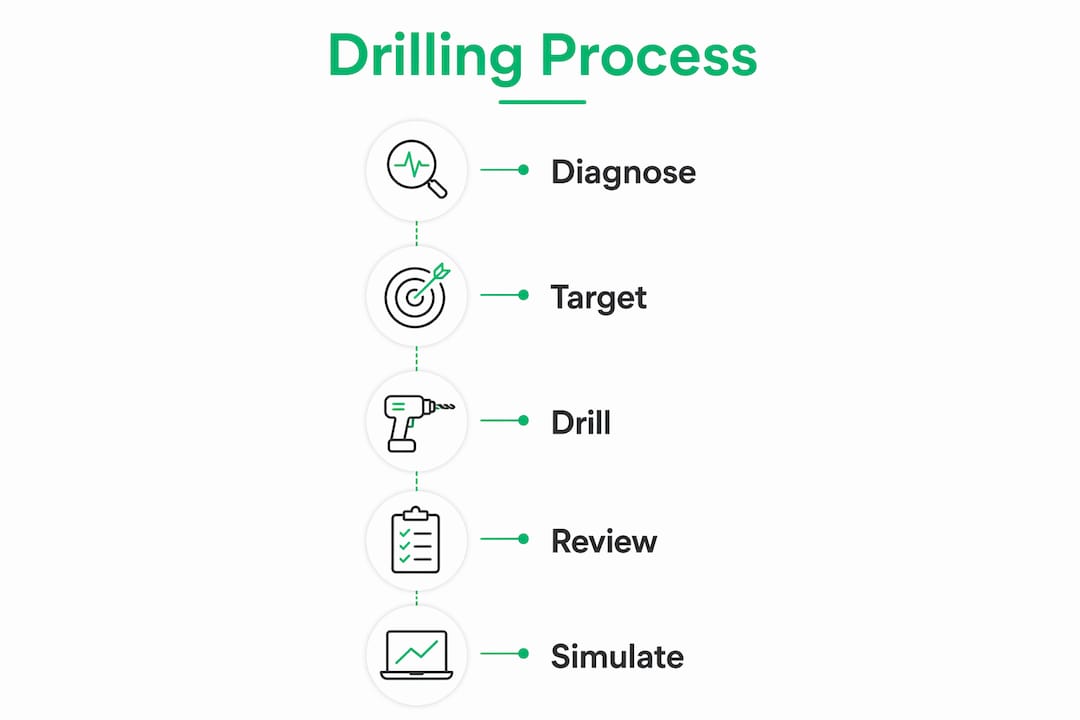
Your step-by-step preparation guide should always start with this diagnostic phase. Skipping it means drilling blind.
How to execute targeted drilling for the Mathematics section
Mathematics is the highest-leverage section on the test. With 24 questions and a 0.2 penalty, it rewards fast, accurate calculation more than any other section.
-
Build arithmetic fluency first. Drilling percentages, fractions, and basic algebra until they feel automatic is non-negotiable. Pausing to calculate 15% of 80 costs you seconds across 24 questions. Those seconds add up to minutes you do not have.
-
Identify your high-frequency question types. After your diagnostic test, you will see patterns. Algebra word problems, ratio questions, and percentage calculations appear repeatedly. Drill these types in isolation before mixing them.
-
Practice rapid question triage. On every timed drill, mark questions as “solve now” or “skip and return.” A question that takes more than 90 seconds is a blocker. Flag it and move on. Return only if time allows.
-
Run daily timed sets. During your peak preparation phase, work through 30–40 Mathematics questions per session under timed conditions. Do not pause the clock to check notes. Simulate the real test every time.
-
Review mistakes twice. Review errors immediately after each drill, then review the same errors again one week later. The second review forces you to recall the corrected method from memory, which builds lasting speed.
Pro Tip: After each timed set, sort your wrong answers by error type before reviewing. Fix conceptual errors with focused study. Fix execution errors by slowing down your reading of the question, not by re-studying the math.
The Mathematics section is where consistent daily drilling pays off the most. Students who treat it as a skill to train, not a subject to memorize, score significantly higher.

What are effective drilling techniques for Reading Comprehension and Critical Thinking?
These two sections carry the steepest penalties, so your drilling approach must be different from Mathematics. Accuracy matters more than speed here, and skipping is a legitimate tactic.
- Read the question before the passage. Students who read the question first scan only the relevant part of the passage. Re-reading entire passages wastes time and rarely improves accuracy.
- Identify unstated assumptions before looking at answer choices. In Critical Thinking, spotting the assumption that connects the premise to the conclusion eliminates most wrong answers before you even read the options.
- Train your “Not deducible” instinct. Critical Thinking questions often include “Not deducible” as a valid answer. Most students underuse it. Drill yourself to treat it as a real option with equal weight, not a fallback.
- Practice skipping under time pressure. Set a rule during drills: if you cannot eliminate at least two answer choices within 60 seconds, skip the question. This habit protects your score in the real test.
- Drill your weakest question type in isolation. If data-based statements trip you up more than passage reasoning, spend two full drill sessions per week on that type alone before mixing question types.
Skipping is not giving up. In a section where a wrong answer costs 0.33 points, a disciplined skip is the highest-value move you can make. Train yourself to skip without guilt during every drill session, and it will feel natural on test day.
Understanding how difficult these sections are helps you calibrate your expectations and drill with the right intensity from the start.
How to structure a multi-week Bocconi test drilling schedule
A structured 8–12 week schedule is the most reliable path to consistent improvement. Here is how to build it:
- Week 1: Baseline. Take one full timed diagnostic test. Score it by section. Identify your two weakest sections.
- Weeks 2–4: Focused section drills. Drill your weakest section daily with 20–30 questions per session. Do not mix sections yet. Fix the foundation first.
- Weeks 5–7: Mixed drills. Combine two or three sections per session. Practice switching mental modes between Mathematics and Critical Thinking.
- Weeks 8–10: Full timed tests. Run complete timed mock exams at least twice per week. Treat each one as the real test.
- Weeks 11–12: Light review and rest. Reduce volume. Focus only on your error log. Do not introduce new question types this late.
| Phase | Focus | Daily Questions |
|---|---|---|
| Weeks 1–2 | Diagnostic and weak-section identification | 20–30 per weak section |
| Weeks 3–5 | Targeted section drills | 30–40 per session |
| Weeks 6–8 | Mixed section practice | Full mixed sets |
| Weeks 9–11 | Full timed simulations | 50 questions per test |
| Week 12 | Error log review and rest | Light review only |
A phased drilling schedule that starts with diagnosis and ends with full simulations consistently outperforms random practice. The structure matters as much as the volume.
Pro Tip: In your final week, run a full technical rehearsal if you are taking the online version of the test. Technical failures like unsupported webcams have disqualified candidates before. Check your setup at least three days before the exam.
What I have learned from watching students drill for the Bocconi test
The biggest mistake I see is students treating drilling as passive review. They read through past papers, nod at the solutions, and move on. That is not drilling. Drilling means answering under time pressure, logging every error, and returning to those errors a week later with fresh eyes.
The second mistake is treating all errors the same. A student who misunderstands a concept needs to study. A student who understood the concept but rushed the calculation needs to slow down their reading, not re-study algebra. Separating these error types in your log is the single fastest way to stop wasting drill sessions.
The Bocconi test is shorter and tighter than the SAT, which means intuition matters. Students who drill enough develop a feel for which questions to skip instantly. That instinct does not come from reading about skipping strategies. It comes from hundreds of timed practice questions where you force yourself to make the skip decision in real time.
Staying motivated across 8–12 weeks is genuinely hard. The students who make it through are the ones who track progress visibly. Use a leaderboard, a score chart, or a simple spreadsheet. Seeing your Mathematics accuracy climb from 60% to 80% over six weeks is the most motivating thing in test prep.
— quentin
Prepadmit’s tools for your Bocconi test drilling plan
Prepadmit is built specifically for students preparing for the Bocconi Test, and its features map directly onto the drilling method described here.

The platform offers sectional drills aligned with the 2026 test format, timed simulations that replicate real exam pressure, and an error tracking system that logs your mistakes by section and question type. Prepadmit was developed by experts from HEC and Bocconi, and the platform reports an average score improvement of 34% for students who complete the full preparation program. You can start drilling on Prepadmit today and see exactly where you stand against other applicants through the built-in ranking system. It is a direct, affordable alternative to private coaching, with the structure and feedback that self-study alone cannot provide.
FAQ
What is the Bocconi test section drilling technique?
The Bocconi test section drilling technique is a structured practice method where you repeatedly work through questions from one specific test section under timed conditions. The goal is to build speed, accuracy, and smart skipping habits for each section’s unique scoring rules.
How many questions are in each Bocconi test section?
The 2026 Bocconi Test has 24 Mathematics questions, 11 Reading Comprehension, 9 Critical Thinking, and 6 Numerical Reasoning questions, totaling 50 questions in 75 minutes.
Should I guess or skip in the Reading Comprehension section?
Skip if you cannot eliminate at least two answer choices. The Reading Comprehension and Critical Thinking sections carry a 0.33 penalty per wrong answer, which makes blind guessing mathematically harmful to your score.
How long should I drill each day for the Bocconi test?
During your peak preparation phase, 30–40 questions per daily session is the recommended target. Quality and timed conditions matter more than raw volume.
When should I start full timed practice tests?
Start full timed mock tests around weeks 8–10 of a 12-week schedule, after you have completed focused sectional drills. Running full tests too early, before fixing section-specific weaknesses, reinforces bad habits rather than correcting them.
Key takeaways
The most effective Bocconi test drilling method combines section-specific timed practice, a two-stage error review cycle, and disciplined skipping strategies tailored to each section’s penalty rules.
| Point | Details |
|---|---|
| Mathematics is the priority section | With 24 questions and 48% of the test, daily timed drills on arithmetic fluency deliver the highest score gains. |
| Penalty rules change your strategy | Reading Comprehension and Critical Thinking carry a 0.33 penalty, making skipping better than guessing blind. |
| Review mistakes twice | Check errors immediately after each drill, then review the same errors one week later to lock in faster methods. |
| Use a phased 8–12 week schedule | Start with a diagnostic test, move to focused section drills, then mix sections, and finish with full timed simulations. |
| Separate error types in your log | Label each mistake as conceptual or execution to avoid wasting drill time on topics you already understand. |
Recommended
Related articles
Ready to ace your admission test?
Discover PrepAdmit, the platform that helps you succeed at top university admission tests.
Discover PrepAdmit