Bocconi Degree Recognition Countries: U.S. Guide

Bocconi Degree Recognition Countries: U.S. Guide
Yes — a Bocconi University degree is recognized internationally, including by U.S. universities and employers. Bocconi degrees are state-accredited Italian qualifications issued under Italian Ministry of University and Research (MUR) standards and mapped to European Qualifications Framework (EQF) levels 6, 7, and 8. That mapping makes them directly comparable to U.S. bachelor’s, master’s, and doctoral degrees. One caveat: receiving institutions and licensing boards apply their own verification steps, so you will need the right documents ready.
TL;DR for your application: “I hold a Bocconi University degree, a state-accredited Italian qualification mapped to EQF Level [6/7/8] under the Bologna Process, and I am providing official transcripts, a bilingual Diploma Supplement, and a credential evaluation report from a NACES member agency.”
Table of Contents
- What does Bocconi degree recognition actually mean?
- How do U.S. universities and employers treat Bocconi degrees?
- How to get your Bocconi degree recognized step by step
- How long does the process take and what does it cost?
- When a Bocconi degree alone is not enough
- What Bocconi’s partner network means for credit recognition
- Your copyable checklist for U.S. applications
- Where to get your documents and who to contact
- Key Takeaways
- The part most applicants get wrong
- Prepadmit gets you through the Bocconi entrance exam first
- Useful sources
What does Bocconi degree recognition actually mean?
“Recognition” is not a binary stamp of approval. It is a verification that your degree’s level and curriculum meet the receiving institution’s requirements. Here is the legal and practical basis that makes Bocconi degrees internationally understandable:
- State accreditation by MUR: Every Bocconi degree is issued in compliance with Italian law and MUR standards. That accreditation is the baseline legitimacy that foreign evaluators check first.
- EQF mapping: Laurea = EQF 6 (bachelor’s equivalent), Laurea Magistrale = EQF 7 (master’s equivalent), PhD = EQF 8 (doctoral equivalent).
- Bologna Process / EHEA: The Bologna Process standardizes degree cycles and ECTS credits across European Higher Education Area members, making European qualifications far easier for U.S. evaluators to translate into U.S. degree levels.
- Diploma Supplement: A standardized bilingual document that describes your curriculum, ECTS credits, graduation level, and the status of your studies. Foreign employers and universities prefer it because it removes ambiguity.
- Rankings as informal trust signals: Financial Times and QS rankings are cited by admissions professionals as proxies for program rigor when evaluating unfamiliar degrees. They do not replace documentary checks, but they do reduce skepticism.
The key distinction: State accreditation gives your degree automatic legitimacy. Receiving-institutional evaluation checks whether your specific curriculum and credit load meet their program requirements. Both matter, and they are separate steps.
How do U.S. universities and employers treat Bocconi degrees?
U.S. graduate programs and employers generally accept Bocconi degrees without hesitation, but they almost always ask for a standard verification packet. Here is what that typically looks like:
- Official transcripts sent directly from Bocconi’s Academic Services to the receiving institution.
- Bilingual Diploma Supplement attached to your application to clarify ECTS credits and degree level.
- Certified English translation of any document not already in English.
- Credential evaluation report from World Education Services (WES), Educational Credential Evaluators (ECE), or another NACES member agency.
- Declaration of Value (DoV) if a U.S. licensing board or graduate program specifically requests it. The DoV is issued by the Italian Consulate or Embassy and confirms the legal status of the awarding institution.
A U.S. graduate admissions office typically wants items 1–4 in a single application packet. Employers in finance, consulting, and tech rarely ask for more than transcripts plus a credential evaluation. Regulated professions are a different story — more on that below.
How to get your Bocconi degree recognized step by step
Follow this sequence before your application deadline:
- Log in to your yoU@B Student Diary and request official transcripts through cert@B.
- Request the bilingual Diploma Supplement from Bocconi Academic Services at the same time.
- Obtain certified English translations of your degree certificate and transcripts if not already bilingual.
- Choose a credential evaluator: WES or ECE for most U.S. purposes; any NACES member agency is acceptable.
- Submit your evaluation report alongside official transcripts and the Diploma Supplement.
Documents and what each one does
| Document | Why it matters | Who typically requests it |
|---|---|---|
| Official transcript | Lists courses, grades, and ECTS credits | U.S. universities, employers, licensing boards |
| Bilingual Diploma Supplement | Explains curriculum, level, and ECTS in English | U.S. graduate programs, foreign employers |
| Degree certificate | Confirms award of the degree | All recipients |
| Certified English translation | Makes Italian documents readable | Any U.S. recipient |
| Credential evaluation report | Converts your degree to a U.S. equivalent | Graduate admissions, HR departments |
| Declaration of Value (DoV) | Official attestation of the awarding institution’s legal status | Regulated professions, some graduate programs |

Pro Tip: Request the bilingual Diploma Supplement and official transcripts at the same time. Bocconi issues most digital certificates within four working days, but physical copies and the DoV take longer. Order everything together.
How long does the process take and what does it cost?
Plan for these timelines and costs before your application deadlines:
- Official transcripts and Diploma Supplement: Most digital certificates are available within four working days of finalizing your request through cert@B. Physical copies take longer.
- Certified translations: Typically 3–7 business days for standard turnaround; rush services are available at higher cost. Budget roughly $50–$150 per document depending on length and the translation agency.
- Credential evaluation (WES or ECE): Document-by-document reports take approximately 7 business days; course-by-course reports take 20 business days. Rush processing is available. Fees typically range from $100–$250 depending on the report type and agency.
- Declaration of Value: Processing times vary by Italian Consulate. Allow 4–8 weeks if one is required.
Pro Tip: Start document requests 8–12 weeks before your earliest application deadline. Credential evaluation agencies have peak seasons around fall admissions cycles, and rush fees add up fast.
When a Bocconi degree alone is not enough
For most U.S. jobs and graduate programs, your Bocconi degree plus the standard document packet is sufficient. Regulated professions are the exception:
- Medicine: U.S. medical licensing requires passing the USMLE and completing a residency match. A foreign medical degree does not automatically qualify you to practice.
- Law: U.S. bar admission typically requires a J.D. from an ABA-accredited school or, in some states, an LL.M. plus additional steps. A Bocconi law degree alone does not satisfy bar requirements in most states.
- Teaching: State teaching licenses require state-specific coursework and certification exams. Check your target state’s board of education requirements directly.
- Engineering: Some state PE licenses require ABET-accredited degrees. Verify with your state’s engineering licensing board.
For academic eligibility (applying to a U.S. Ph.D. or master’s program), a Bocconi Laurea Magistrale is generally accepted as equivalent to a U.S. master’s degree. The credential evaluation report makes that equivalence explicit.
What Bocconi’s partner network means for credit recognition
Bocconi has 293 partner institutions in 56 countries. That network matters in two specific ways:
- Exchange credit transfer: Credits earned at a partner university during a Bocconi-approved exchange are recognized automatically under dedicated agreements, per Bocconi’s academic regulations. Up to five courses from an exchange semester can be recognized.
- Double and joint degrees: Some partner agreements include automatic recognition clauses for joint or double degree programs, which simplifies the equivalence question entirely.
- U.S. application advantage: If you completed an exchange at a U.S. partner institution, note it explicitly on your application. A transcript from a recognized U.S. university alongside your Bocconi transcript removes almost all evaluator uncertainty.
For non-EU applicants navigating U.S. applications, leveraging any U.S. partner institution experience in your packet is one of the most practical ways to reduce friction.
Your copyable checklist for U.S. applications
Use this list for university portals, employer HR systems, and licensing board submissions:
- Official transcript (sent directly from Bocconi Academic Services)
- Bilingual Diploma Supplement
- Degree certificate (original language)
- Certified English translation of all Italian-language documents
- Credential evaluation report (WES, ECE, or NACES member)
- Declaration of Value (only if specifically requested)
- Contact information for Bocconi Academic Services (for verification requests)
Course-by-course vs. document-by-document: Choose course-by-course evaluation for graduate admissions and credit transfer. Choose document-by-document for employer background checks and general degree equivalence.
Where to get your documents and who to contact
- Bocconi Academic Services (cert@B): Request transcripts and Diploma Supplement through your yoU@B Student Diary. Digital certificates are typically ready within four working days.
- Bocconi International Mobility Office: Contact for exchange credit documentation and partner agreement letters.
- Certified translations: Use a certified translation agency or an ATA-certified translator for U.S. submissions.
- Credential evaluators: WES (wes.org), ECE (ece.org), and other NACES member agencies. NACES maintains a full member directory at naces.org.
- State licensing boards: Search your target state’s official government website for the relevant board (medicine, law, engineering, education).
Pro Tip: Request digital copies of all documents first and keep scanned originals. Many U.S. portals accept digital uploads initially, and you can send physical copies later. This saves time and avoids delays if a document gets lost in transit.
Key Takeaways
Bocconi degrees are state-accredited, EQF-mapped Italian qualifications that U.S. universities and employers broadly accept, provided you submit the right verification documents.
| Point | Details |
|---|---|
| State accreditation is the foundation | MUR accreditation gives Bocconi degrees automatic legitimacy; receiving institutions then verify level and curriculum. |
| Three core documents | Official transcript, bilingual Diploma Supplement, and a credential evaluation report from WES, ECE, or a NACES member cover most U.S. requirements. |
| Regulated professions need extra steps | Medicine, law, teaching, and some engineering licenses require state-specific exams or bridging programs beyond your degree. |
| Start 8–12 weeks early | Credential evaluations and DoV requests take weeks; rush fees are avoidable with early planning. |
| Prepadmit for exam prep | Prepadmit helps you pass the Bocconi entrance exam first — the prerequisite before any recognition question applies. |
The part most applicants get wrong
The conventional wisdom is that a top-ranked university degree “speaks for itself.” It does not, at least not administratively. Admissions officers at U.S. graduate programs genuinely respect Bocconi’s Financial Times and QS rankings, and that reputation does reduce skepticism. But it does not replace the document packet.
The applicants who run into trouble are the ones who submit a transcript without a Diploma Supplement, assume their ECTS grades translate automatically, or request translations two weeks before a deadline. The Diploma Supplement exists precisely because European grading scales and credit systems look unfamiliar to U.S. evaluators. A 28/30 from Bocconi is an excellent grade, but without context, a U.S. reviewer may not know that.
The other common mistake: conflating academic recognition with professional licensure. Your Bocconi degree gets you into a U.S. graduate program. It does not get you a medical license or a bar card. Those are separate processes governed by state boards, and they require separate research well before you apply.
If you are currently preparing for the Bocconi entrance exam, the recognition question is worth understanding now. Knowing what documents you will need later helps you keep records organized from day one.
Prepadmit gets you through the Bocconi entrance exam first
Before recognition matters, admission does. Prepadmit gives you access to official past papers, on-demand exam simulations, and detailed answer corrections built by experts from HEC and Bocconi. Students using the platform improve their scores by an average of 34%. The platform costs a fraction of private coaching, comes with a money-back guarantee, and lets you track your progress against other applicants on a live leaderboard.
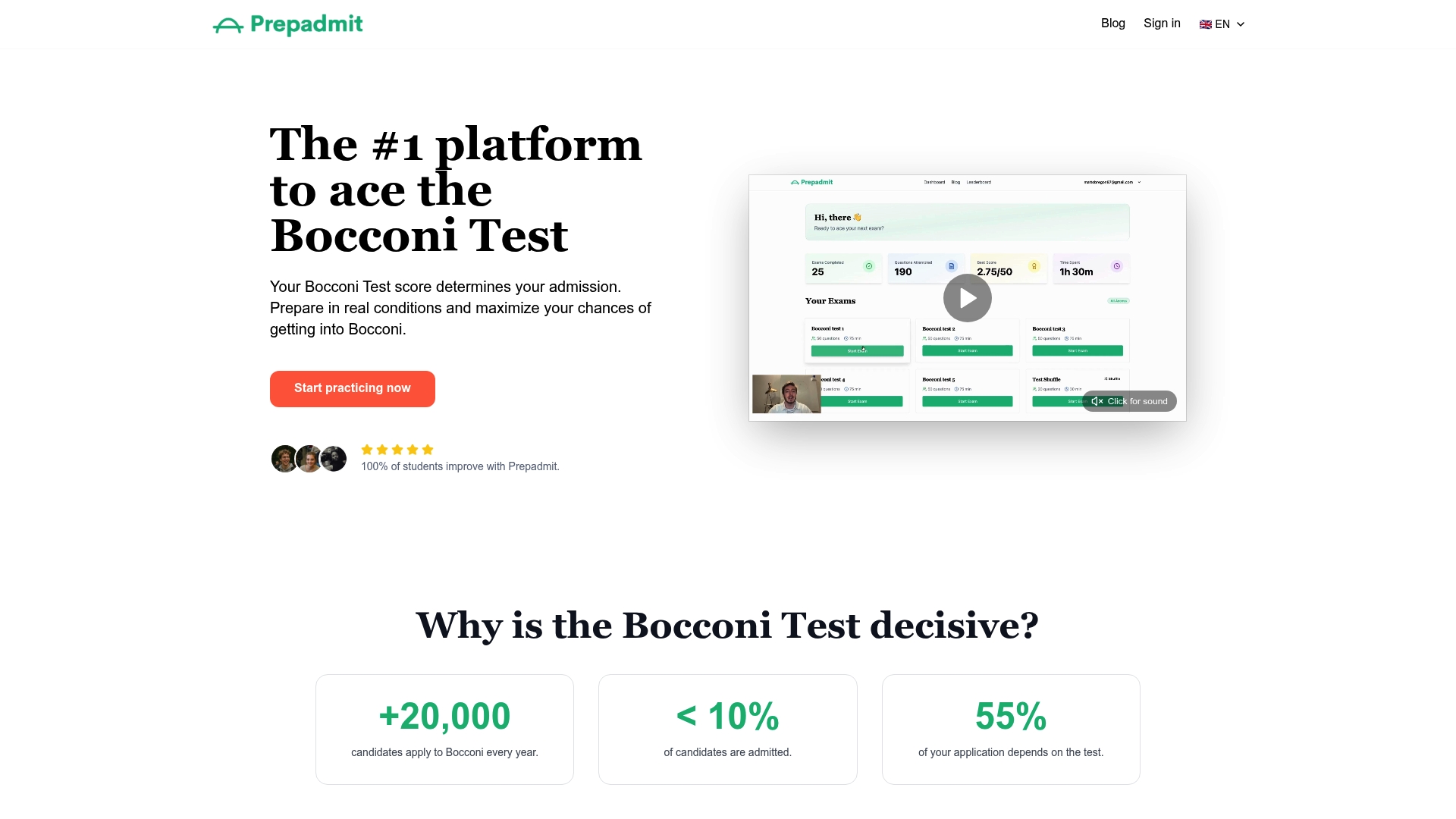
Credential recognition is handled through official documents and evaluators as described above. Prepadmit’s job is to get you past the entrance exam so that question becomes relevant. Start your preparation today and see where you stand.
Useful sources
- Bocconi Academic Regulations: Legally definitive source for EQF mapping, credit recognition rules, and degree program accreditation.
- Bocconi Certificates and Degree Verifications: Official page for requesting transcripts, Diploma Supplements, and understanding self-declaration rules.
- Bocconi Diploma Supplement guide: Explains what the Diploma Supplement contains and how to request it.
- MUR academic recognition guidance: Italian Ministry of University and Research page on how foreign qualifications are processed. Authoritative on the legal framework.
- Bocconi partner schools: Full list of 293 partner institutions across 56 countries.
- Bocconi immigration documentation: Explains the Declaration of Value and when it is required.
- NACES (naces.org): Directory of U.S. credential evaluation agencies, including WES and ECE. Advisory, not legally definitive, but the standard reference for U.S. evaluator selection.
Recommended
Related articles
Ready to ace your admission test?
Discover PrepAdmit, the platform that helps you succeed at top university admission tests.
Discover PrepAdmit