Top Diagnostic Test Tools for Bocconi Exam Readiness

Top Diagnostic Test Tools for Bocconi Exam Readiness
For Bocconi Test readiness, the most effective approach combines official full-length simulations, adaptive diagnostics, and progress tracking. Prepadmit delivers all three in one place, built specifically for the Online Bocconi Test’s 50-question, 75-minute format.
Here is why this matters for your prep:
- Realistic simulation: Official past-paper questions under strict 75-minute timing, with no-backtracking navigation that mirrors the real test.
- Bocconi-specific analytics: Per-question diagnostics tied to math, verbal, and reasoning sections, including time-per-question heatmaps.
- Penalty-aware practice: The −0.25 penalty for wrong answers makes guessing strategy a scorable skill, not an afterthought. This penalty system means you should be strategic about which questions you answer.
- Documented results: Prepadmit users see an average score improvement of 34%, based on internal platform data.
Table of Contents
- What does a top Bocconi diagnostic test tool need to include?
- How Bocconi Test format and scoring change which diagnostics matter
- How to use diagnostic tests effectively to raise your Bocconi score
- Why Prepadmit is the recommended diagnostic solution for Bocconi readiness
- A diagnostic-driven 4–6 week prep schedule you can follow
- Benchmarks and calculations: how to judge improvement and set realistic targets
- Key Takeaways
- What most students get wrong about diagnostic prep
- Prepadmit gives you an immediate diagnostic advantage
- Sources and where this advice comes from
What does a top Bocconi diagnostic test tool need to include?
Not every test readiness assessment is built for the Bocconi Test. Most generic platforms miss the features that actually move your score. Here is the checklist to apply before committing to any tool.
Simulation realism
- Full 50-question, 75-minute format with no-backtracking navigation
- Sequential question delivery that prevents reviewing earlier answers mid-test
- Webcam and microphone compatibility for proctoring simulation
- Safe Exam Browser guidance or lockdown-browser compatibility
Analytics depth
- Per-question error taxonomy (wrong answer type, not just wrong/right)
- Time-per-question heatmaps showing where you slow down
- Skill-tagged diagnostics: algebra, functions, critical reasoning, verbal comprehension
- Section-level accuracy broken down by question type
Practice options
- Full-length simulations and on-demand adaptive drills
- Targeted timed mini-tests for weak question categories
- Spaced repetition for question types you consistently miss
Progress tracking
- Score trajectory charts across multiple simulations
- Percentile and peer-ranking dashboards
- Exportable diagnostic reports for tutors or parents
Pro Tip: The single most overlooked evaluator is how accurately a tool simulates the skip/flag constraint. On the real Bocconi Test, you cannot return to a question once you move past it. If a practice platform lets you freely navigate back, you are training the wrong habit. Test this before you buy.
How Bocconi Test format and scoring change which diagnostics matter
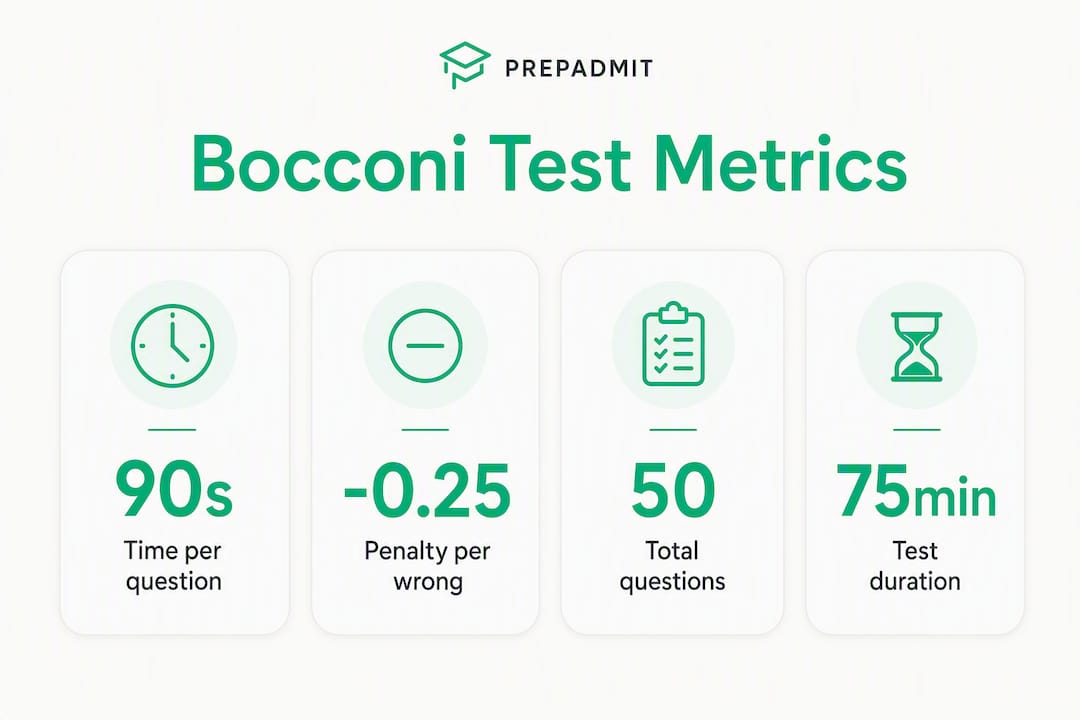
The Online Bocconi Test is 50 multiple-choice questions in 75 minutes. That works out to roughly 90 seconds per question on average, with no time buffer for second-guessing. The typical section split includes verbal reasoning, data insight, and quantitative reasoning components, with math items demanding fast mental calculation.
The −0.25 penalty per wrong answer changes how you should read a diagnostic report. A raw accuracy score is not enough. You need to know your accuracy by question type, your skip rate, and your time distribution, because a student who answers 40 questions with 85% accuracy often outscores one who attempts all 50 at 70%.
| Diagnostic metric | Why it matters for Bocconi |
|---|---|
| Time-per-question by section | Identifies where you lose pacing; math items need the most attention |
| Skip rate and unanswered count | Reveals whether your guessing threshold is calibrated to the penalty |
| Accuracy by question type | Shows which section drills will yield the largest score gain |
| Score under no-backtracking | Separates real mastery from review-dependent performance |
| Rolling three-sim average | Smooths out single-session variance for reliable trend data |
Proctoring readiness is also a diagnostic variable. The real test requires a stable internet connection, webcam, and microphone. Practicing without those conditions means your first experience with them is on test day, which costs time and focus.
How to use diagnostic tests effectively to raise your Bocconi score
Diagnostic tests are most useful when they tell you where to study, not just how much. Here is a step-by-step method that turns a diagnostic report into a focused plan.
- Take a full baseline simulation first. Set up your webcam, use a quiet room, and run a complete 50-question, 75-minute test without pausing. This is your honest starting point.
- Read your section scores, not just your total. Identify which question types have the largest gap between your accuracy and the competitive threshold of 35/50.
- Rank your weak areas by score impact. A 10-point accuracy gain on a 16-question section moves your score more than the same gain on a 10-question section. Prioritize accordingly.
- Set short-term metrics. Pick one time target (e.g., under 80 seconds per math question) and one accuracy target (e.g., 80% on verbal reasoning) for the next two weeks.
- Schedule targeted drills daily, full sims weekly. Daily 30-minute drills on weak question types build speed. Weekly full simulations track whether those gains transfer to test conditions.
- Calibrate your guessing policy. With a −0.25 penalty, you need at least a 1-in-4 chance of being right before guessing. Practice skipping questions where you have no strong instinct, and revisit only if time allows.
Pro Tip: Use a rolling three-simulation average as your real progress metric. A single mock score swings based on question mix and how you slept. Three sims averaged together give you a number you can actually trust and plan around.
Why Prepadmit is the recommended diagnostic solution for Bocconi readiness
Prepadmit was built by contributors with HEC and Bocconi backgrounds, which means the platform reflects how the test actually works, not how a generic prep company assumes it works.

Feature alignment with Bocconi requirements
The platform delivers official past-paper simulations in the exact 50-question, 75-minute format, with no-backtracking navigation active by default. Safe Exam Browser guidance is included, and the interface works on both mobile and desktop. Sectional timing presets let you practice math-first pacing or verbal-first pacing depending on your diagnostic output.
Reporting that goes beyond a score
After each simulation, you get per-question corrections with full explanations, an error taxonomy that categorizes each mistake by type, skill-tagged diagnostics, time heatmaps, and a percentile ranking against other Prepadmit users. Reports are downloadable, so a tutor or parent can review them alongside you. The platform’s feature set is designed specifically for this test, not adapted from a generic SAT or GRE tool.
Documented improvement and trust signals
Prepadmit users achieve a substantial score improvement, based on internal platform data. The platform is backed by a money-back guarantee and was developed by HEC and Bocconi contributors who understand both the test mechanics and the admissions stakes.
On-demand drills fit into a student’s schedule without requiring long sessions. Community support and customer service are available for questions about technical setup, study plans, and score interpretation.
A diagnostic-driven 4–6 week prep schedule you can follow
A condensed 4–6 week plan works well for students who start with a diagnostic and use it to focus every session. Here is how to structure it.
| Week | Focus | Daily session (60–90 min) |
|---|---|---|
| 1 | Baseline and gap identification | Full sim on Day 1; targeted drills by question type Days 2–6 |
| 2 | Skill building on weakest areas | 30 min drills + 30 min formula/method review; mini timed sets |
| 3 | Mixed timed practice | Alternating full sims and section-specific timed sets |
| 4 | Pacing and penalty calibration | Full sims with strict skip strategy; error-analysis sessions |
| 5–6 (optional) | Refinement and final simulations | Two full sims per week; light drills on persistent weak spots |
Weekly priorities:
- Run a full mock exam every 5–7 days once you pass your baseline threshold.
- Schedule one error-analysis session per week, not per session. Reviewing every mistake immediately after every drill creates noise; weekly reviews reveal patterns.
- Build in one rest day per week. Fatigue degrades pacing more than any content gap.
- If your baseline math accuracy is below 60%, allocate 30 minutes of every session to calculation drills before moving to mixed practice.
Benchmarks and calculations: how to judge improvement and set realistic targets
A competitive Bocconi Test score is generally above 35 out of 50, though program-specific thresholds vary. Percentile placement matters as much as raw score, since Bocconi uses test results comparatively across applicants.
Here is a simple way to frame your progress. If your baseline simulation gives you 30/50 and you move to 36/50 over four weeks, that six-point gain typically shifts you from the middle of the applicant pool into the upper competitive range. The gain is not linear in percentile terms: moving from 30 to 33 may add a few percentile points, while moving from 33 to 36 often adds significantly more because the applicant density is lower at higher scores.
Short-term weekly targets keep you honest. Aim for one measurable improvement per week: one fewer skipped question, two seconds faster per math item, or 5% better accuracy on verbal reasoning. Small, specific targets compound.
If your rolling three-sim average is not improving after two weeks of drills, the issue is usually drill type, not volume. Switch from passive review to timed active practice, and check whether your error taxonomy shows a pattern you have not addressed.
Key Takeaways
Prepadmit’s official-simulation plus adaptive-diagnostic approach is the most direct path to a competitive Bocconi Test score, with users typically seeing significant score improvements.
| Point | Details |
|---|---|
| Start with a full baseline sim | Run a complete 50-question, 75-minute test before any targeted study to get accurate gap data. |
| No-backtracking is non-negotiable | Any tool that lets you navigate freely is training the wrong habit for the real test. |
| Target 35/50 as your benchmark | Scores above 35 are generally competitive; use percentile framing to set program-specific goals. |
| Use a rolling three-sim average | Single mock scores vary too much; three-sim averages give reliable trend data to plan around. |
| Prepadmit as your diagnostic system | Official past-paper sims, per-question analytics, peer ranking, and a money-back guarantee in one platform. |
What most students get wrong about diagnostic prep
Students tend to treat a diagnostic as a score to beat rather than a map to follow. The score is almost irrelevant on the first attempt. What matters is the error taxonomy: which question types you miss, how long you spend on them, and whether your mistakes cluster in one section or spread across all three.
The other common mistake is drilling known strengths because it feels productive. If you are already at 85% accuracy on verbal reasoning, another hour of verbal drills returns almost nothing. That same hour on quantitative reasoning at 55% accuracy could add two or three points to your final score.
Penalty-aware skipping is the skill most students never practice deliberately. They know the rule intellectually but have not internalized it under timed conditions. Practice skipping out loud during drills: say “skip” when you hit a question you cannot answer in 20 seconds, and move on without hesitation. Do this until it is automatic.
Prepadmit gives you an immediate diagnostic advantage
Spending weeks on generic prep before you know your actual weak spots is the slowest route to a competitive score. Prepadmit gives you an official-mode simulation and a full diagnostic report from your very first session, so your study plan is built on real data, not guesswork.
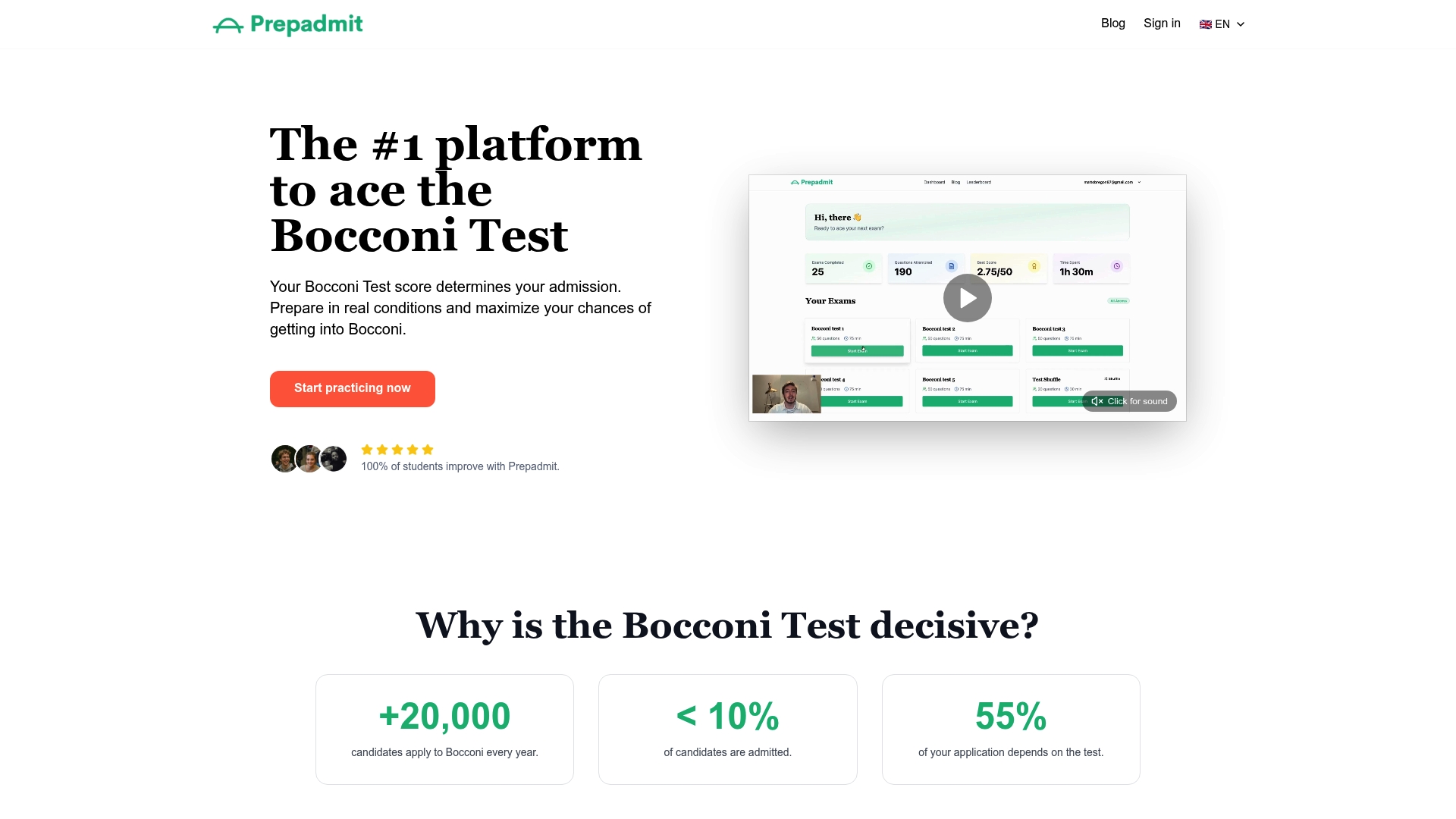
Getting started takes three steps. Create your account on Prepadmit, take your baseline simulation under real test conditions (webcam on, 75 minutes, no pausing), then open your diagnostic report and follow the 4–6 week plan outlined above. The platform’s money-back guarantee means there is no risk in starting today. If you want a deeper look at how the platform compares on specific features, the Bocconi prep platform comparison covers it in detail.
Sources and where this advice comes from
The factual claims in this article draw from official Bocconi University documentation and established diagnostic prep research.
- Online Bocconi Test — Bocconi University — Primary source for test format (50 questions, 75 minutes), the −0.25 penalty rule, proctoring requirements, and the no-backtracking navigation rule. All format and scoring claims trace back here.
- Online Admission Test AY 2026–2027 — Bocconi Official PDF — Official instructions covering technical requirements, sequential navigation rules, and test-day procedures.
- The SAT, ACT, and the Value of Diagnostic Tests — A-List Education — Research-backed case for using diagnostic tests to identify skill gaps and build targeted study plans rather than relying on passive review.
- Prepadmit platform: Source for the 34% average score improvement figure, money-back guarantee, and platform feature descriptions.
Recommended
Related articles
Ready to ace your admission test?
Discover PrepAdmit, the platform that helps you succeed at top university admission tests.
Discover PrepAdmit